- Practical strategies to design SaaS systems that stay reliable and adaptable under changing conditions.
- Key architectural approaches that help teams build scalable and resilient cloud-based products.
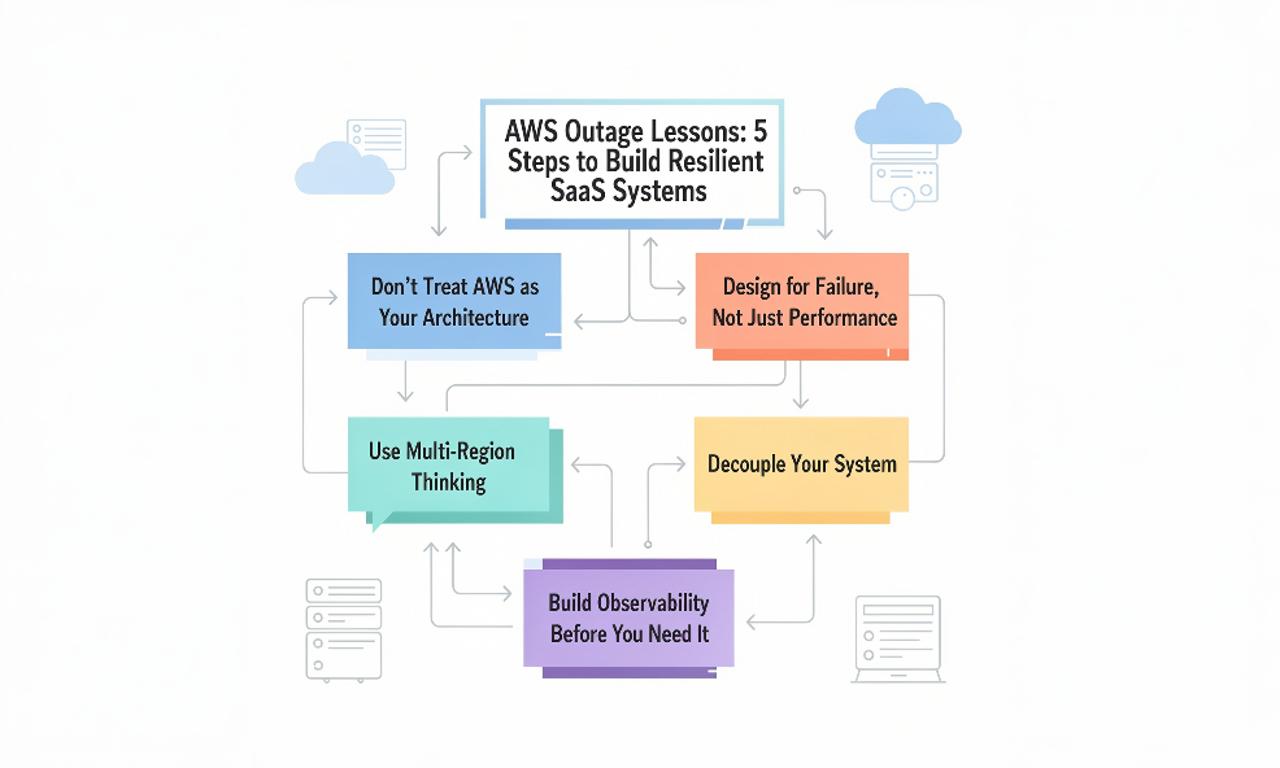
AWS Outage Lessons: 5 Steps to Build Resilient SaaS Systems
1 min read
Most SaaS teams don’t think about failure until it happens.
Everything looks stable. AWS is running. Systems are deployed. Traffic is scaling. And slowly, without realizing it, you start treating uptime like a guarantee.
Then one outage hits.
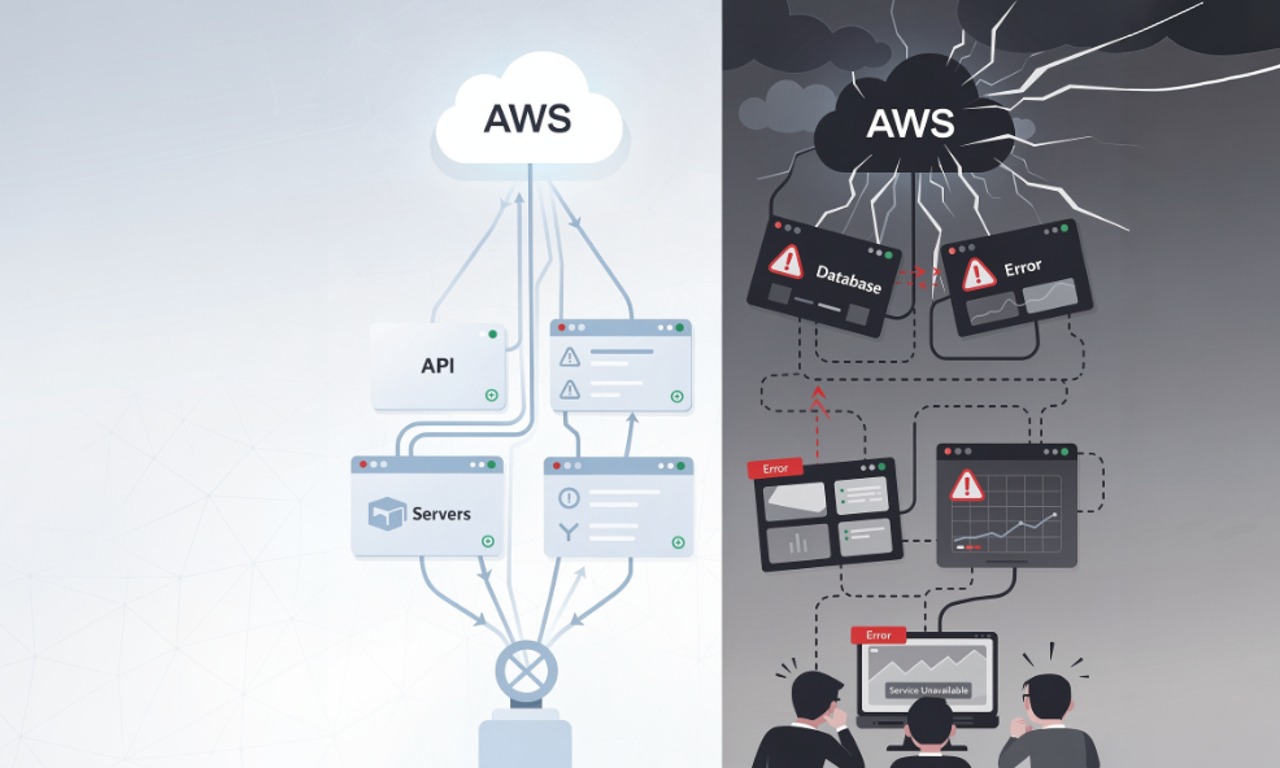
Dashboards go silent. APIs stop responding. Customers don’t care whose fault it is, they just see your product not working.
That’s where most teams get it wrong.
AWS didn’t fail you. Your system was never designed to survive failure in the first place.
And the cost of that assumption is real. Gartner estimates cloud downtime can cost between $100,000 to $540,000 per hour. But the bigger loss isn’t money, it’s trust.
The teams that survive outages aren’t the ones with the best infrastructure.
They’re the ones who designed for the moment things break.
1. Don’t Treat AWS as Your Architecture
AWS gives you infrastructure, not resilience. There’s a subtle but critical difference here.
Too many systems are built in a way where:
- One region goes down → the entire product goes down
- One service fails → everything cascades
That’s not an AWS issue. That’s an architecture decision. At Mediusware, when we worked on scalable platforms like CRM Runner and Nexivent, AWS was just one layer, not the safety net.
The real focus was:
- Isolation
- Redundancy
- Failure boundaries
If your system assumes AWS will always be available, you’ve already introduced risk.
2. Design for Failure, Not Just Performance
Most teams optimize for speed. Very few design for failure.
Amazon’s own engineering culture actually emphasizes this. As Werner Vogels, CTO of Amazon, said:
Everything fails, all the time.
That mindset changes everything.
Instead of asking: How do we make this fast?
You start asking: What happens when this breaks?
That’s where patterns like:
- Circuit breakers
- Retry mechanisms
- Fallback responses
start becoming essential, not optional.
3. Use Multi-Region Thinking
You don’t need to go fully multi-region from day one. But you do need to think like it. Recent AWS incidents have shown how region-level disruptions can affect thousands of services at once. Even AWS itself advises customers to design for fault isolation across regions.
A practical approach:
- Keep backups in a separate region
- Separate critical services from single-region dependency
- Design your database strategy carefully
Even partial distribution can dramatically reduce downtime impact.
4. Decouple Your System Wherever Possible
Tightly coupled systems break together. Decoupled systems degrade gracefully. This is one of the biggest differences I see between early-stage SaaS products and scalable ones.
Instead of: Frontend → API → Database → Third-party → Everything fails together
You move toward:
- Queues
- Event-driven architecture
- Async processing
So when one part slows down, the entire system doesn’t collapse. This is especially important in high-traffic platforms like e-commerce or real-time applications. If you're curious how this plays out in real products, you can check our software development services and how we approach scalable system design at Mediusware.
5. Build Observability Before You Need It
Most teams invest in monitoring after something breaks. That’s already too late.
You need visibility into:
- System health
- Latency spikes
- Service dependencies
- Error rates
According to a Google SRE report, high-performing teams detect incidents up to 2.5x faster when proper observability is in place.
That speed of detection is what turns:
- hours of downtime → minutes of recovery
And honestly, this is where a lot of teams struggle, not because tools aren’t available, but because observability wasn’t part of the system design from the beginning.
So What Should You Take Away From AWS Outages?
AWS outages aren’t the problem. They’re the reminder.
A reminder that:
- Cloud ≠ resilience
- Scaling ≠ stability
- Uptime ≠ guaranteed
The teams that handle these moments well aren’t the ones with the biggest infrastructure. They’re the ones who designed for uncertainty from the start.
If You’re Starting to Think About This Now
If you’re building or scaling a SaaS product and starting to think more seriously about resilience, you’re already on the right track.
This is usually the stage where teams begin exploring:
- Better system design patterns
- External engineering support
- Long-term technical partnerships
If you want to understand where your system might be vulnerable or what improving resilience could realistically look like, that’s something we work through regularly with growing teams at Mediusware. No pressure, just a conversation. Let's Talk.
Frequently Asked Questions
An AWS outage happens when one or more AWS services become unavailable or experience disruptions, affecting applications and platforms that rely on them.

I work with founders and leadership teams when growth moves faster than their systems, teams, or decisions. I’ve led 850+ projects for 750+ clients across 20+ countries, working across 100+ technologies and counting. I care about ownership, clarity, and building things that last beyond the launch.
Featureblogs
Relatedblogs
01
Introduction to System Design | System Design Course Pro | Part 102
The Art of Simplicity - How Minimalism Improved UI/UX Design03
The Software Development Life Cycle (SDLC): A Complete Guide04
Which Approach Is Best for Your Software Development Team: Scrum vs. Kanban05
How to adapt the Agile process to modern software developmentAuthorblogs
01
SaaS MVP Development: A Founder’s Guide for 202702
Zero Clicks, Falling Traffic: How to Win Back Revenue03
Ranking on Google in 2026: What Matters in the Age of AI Search04
How to Choose an API Development Company for Your SaaS Product05
Why Software Companies Are Turning to Strategic Partnerships for Faster Growth