- Step-by-step AI automation roadmap for SaaS founders to reduce manual work.
- Covers workflow bottlenecks, data readiness, adoption mistakes, and scalable automation planning.
AI Automation Roadmap for SaaS Founders (Step-by-Step)
1 min read
SaaS teams don’t scale slowly because they lack people.
They scale slowly because too much work still depends on people doing repetitive tasks manually.
Support, onboarding, reporting, CRM updates, follow-ups, internal approvals — these small delays compound fast.
The timing matters: the Stanford AI Index Report 2025 shows AI adoption and investment are rising fast across businesses, making automation a practical scaling move, not just a future trend.
At Mediusware, we’ve seen the best results when SaaS founders start with real workflow bottlenecks first, then apply AI where it saves time, improves speed, or reduces operational chaos.
This roadmap shows exactly how to do that.
Why SaaS Founders Are Prioritizing AI Automation
The biggest operational challenge for growing SaaS companies is not always product development.
It is operational inefficiency.
As SaaS companies grow, teams often become dependent on:
- Manual processes
- Repetitive customer support tasks
- Spreadsheet-based reporting
- Fragmented communication
- Slow internal approvals
- Human-heavy coordination
These issues quietly reduce scalability.
A recent Deloitte State of AI in the Enterprise 2026 report shows that organizations are moving from AI ambition to activation, with growing focus on adoption, impact, and business outcomes.
For SaaS founders, that means AI automation is no longer just experimentation.
It is becoming operational infrastructure.
If your company is already facing workflow bottlenecks, investing in proper AI automation services early can reduce long-term operational complexity.
The AI Automation Roadmap for SaaS Founders
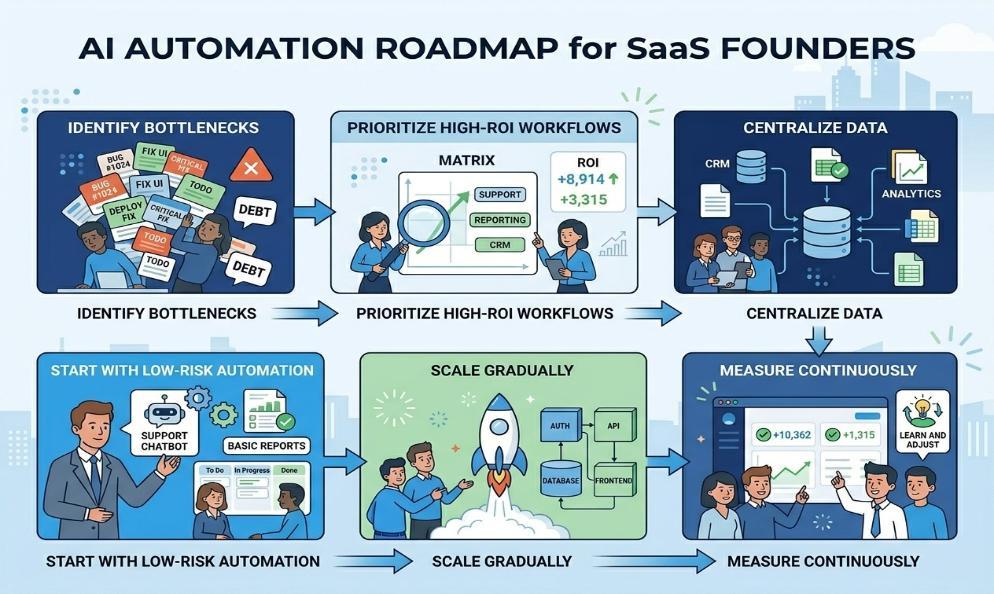
Step 1: Identify Repetitive Operational Bottlenecks
Before buying AI tools, founders should identify where their teams lose time every day.
This is where many automation projects go wrong.
Companies start purchasing tools before understanding the operational problem.
Start by asking:
- Which tasks happen every day?
- Which workflows need constant manual updates?
- Where do delays happen most often?
- Which processes depend too heavily on human coordination?
- Which tasks create little strategic value?
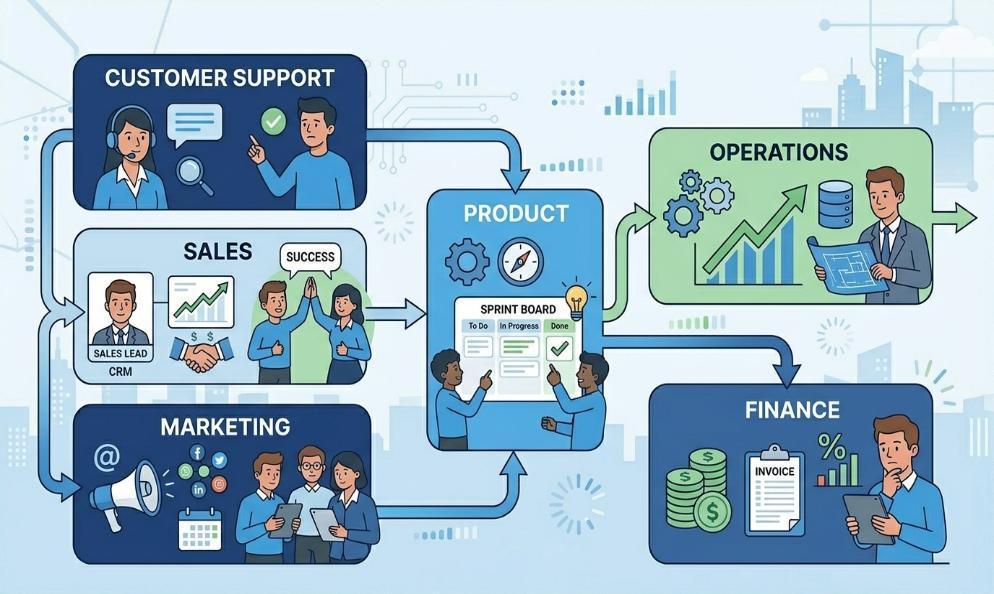
Common SaaS Automation Opportunities
| Department | Automation Opportunity |
| Customer Support | AI chatbots, ticket routing, FAQ responses |
| Sales | Lead qualification, CRM updates, follow-ups |
| Marketing | Reporting, content workflows, campaign summaries |
| Product | User onboarding, usage alerts, feedback grouping |
| Operations | Workflow approvals, notifications, task routing |
| Finance | Invoice processing, payment reminders, forecasting |
The goal is not to automate everything.
The goal is to remove repetitive work that slows growth.
Step 2: Prioritize High-ROI Automation First
Not all automation creates meaningful business impact.
Some workflows save a few minutes.
Others improve scalability, retention, or revenue speed.
The best SaaS teams prioritize automation based on three factors:
-
Frequency
How often does the task happen?
-
Time Consumption
How much manual work does it require?
-
Business Impact
Does improving this process affect revenue, retention, support quality, or team speed?
High-ROI SaaS Automation Areas
| Automation Area | ROI Potential | Complexity |
| AI Customer Support | High | Medium |
| AI Sales Assistance | High | Medium |
| Internal Reporting | Medium | Low |
| Workflow Notifications | Medium | Low |
| Predictive Analytics | High | High |
This prevents teams from overengineering low-impact workflows.
Growing SaaS companies often combine workflow automation with scalable dedicated development team services to implement faster without slowing down product delivery.
Step 3: Centralize Your Data Before Scaling AI
AI systems are only as effective as the data behind them.
One of the biggest automation mistakes SaaS companies make is running AI across disconnected systems.
That usually means:
- Multiple CRMs
- Isolated analytics dashboards
- Scattered spreadsheets
This creates unreliable automation outputs.
IBM’s research on generative AI highlights how leadership, data readiness, and execution quality shape AI outcomes.
Step 4: Start with Low-Risk Automation
Many founders try to automate mission-critical operations too early.
That creates risk.
A smarter approach is to start with low-risk workflows first.
Good Starting Points
- Automated onboarding emails
- AI-generated meeting summaries
- CRM updates
- Customer support routing
These workflows create quick operational wins while helping teams adapt gradually.
This matters because successful automation is not only about technology.
It is also about adoption.
Step 5: Introduce AI Decision Support Systems
Once foundational automation is stable, SaaS companies can move toward intelligent automation.
This is where AI becomes more than workflow execution.
It starts helping teams make faster and smarter decisions.
Examples Include
- Predictive churn analysis
- Revenue forecasting
- AI-powered customer insights
For SaaS teams, this matters because sales and customer success are often where manual work hides.
AI can help teams see patterns faster, respond sooner, and make better decisions before problems become expensive.
Step 6: Build Human + AI Collaboration Workflows
The best SaaS companies are not replacing teams with AI.
They are augmenting teams with AI.
That difference matters.
AI works best when:
- Humans handle strategy
- AI handles repetitive execution
- Teams review critical outputs
Over-automation creates poor experiences.
At Mediusware, we’ve worked on AI-powered SaaS systems, dashboards, and workflow automation solutions that help businesses improve operational efficiency across industries.
Common AI Automation Mistakes SaaS Founders Make
1. Automating Broken Processes
Bad workflows become worse when automated.
Fix the process first.
Then automate.
2. Buying Too Many AI Tools
Tool overload creates operational complexity.
Simple systems usually scale better.
3. Ignoring Team Adoption
Even the best automation system fails if teams don’t trust it.
Training, documentation, and gradual rollout matter.
4. Expecting Instant ROI
AI automation is infrastructure.
Like product development, returns compound over time.
Where SaaS Companies Are Using AI Automation Most
AI automation is already showing up across major SaaS functions.
Common areas include:
- Customer support
- Marketing operations
- Sales workflows
- User onboarding
The biggest benefit is not only cost reduction.
It is operational speed.
The Future of SaaS Automation Is Agentic AI
The next evolution of SaaS automation is already happening.
Companies are moving from simple workflow automation toward:
- AI copilots
- Autonomous AI agents
- Predictive operational systems
Instead of only following fixed rules, these systems can increasingly:
- Make recommendations
- Take actions
- Adapt workflows
That shift is changing how SaaS companies scale.
But the principle stays the same:
Start with the business problem first.
Then apply AI.
Final Thoughts
AI automation is no longer optional for scaling SaaS companies.
But successful automation isn’t just about replacing humans or buying every new AI tool. It's about building smarter operational systems, step by step, that drive growth.
That’s how SaaS companies scale without operational chaos. And if you're ready to take that next step, our AI Automation Services can help turn these strategies into actionable, scalable solutions.
Frequently Asked Questions
AI automation in SaaS means using artificial intelligence to automate repetitive operational tasks such as customer support, reporting, onboarding, lead management, workflow routing, and customer success processes.

I work with founders and leadership teams when growth moves faster than their systems, teams, or decisions. I’ve led 850+ projects for 750+ clients across 20+ countries, working across 100+ technologies and counting. I care about ownership, clarity, and building things that last beyond the launch.
Featureblogs
Relatedblogs
Authorblogs
01
SaaS MVP Development: A Founder’s Guide for 202702
Zero Clicks, Falling Traffic: How to Win Back Revenue03
Ranking on Google in 2026: What Matters in the Age of AI Search04
How to Choose an API Development Company for Your SaaS Product05
Why Software Companies Are Turning to Strategic Partnerships for Faster Growth