- Explains why Java frameworks still shape modern, scalable software systems.
- Breaks down the strengths, limits, and best use cases of 10 leading Java frameworks.
- Helps teams avoid long-term maintenance and scalability traps.
- Guides developers and decision-makers toward smarter framework choices.
The Top 10 Most Popular Java Frameworks
1 min read
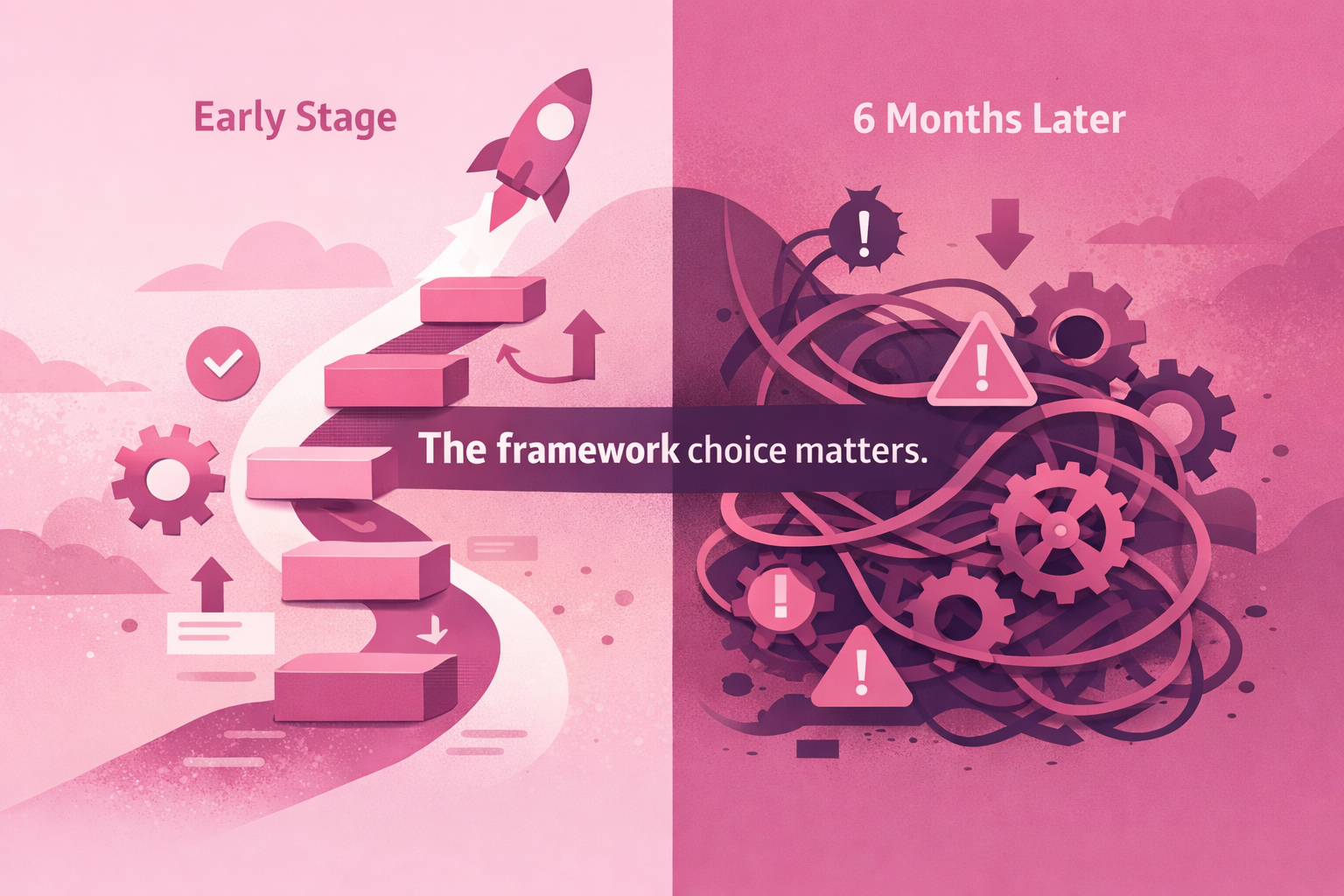
You’ve probably seen this happen. A Java project starts strong. The codebase looks clean. The roadmap feels realistic. Then six months later, development slows down, bugs creep in, and scaling becomes painful. Not because Java failed you, but because the framework choice didn’t age well.
That’s the quiet truth most teams eventually run into. Java keeps showing up in places where failure is not an option. Banking systems. Enterprise platforms. High-traffic retail. Android applications. Decades in, it’s still trusted to run software that needs to be fast, stable, and built to last. When things go wrong, it’s rarely the language that’s at fault. It’s the decisions made around it.
So here’s the real question.
Are you choosing Java frameworks that still make sense for where your product is headed, not just where it started?
The frameworks you build on decide whether your team moves forward with confidence or spends sprint after sprint fighting complexity that didn’t need to exist. Some choices create flexibility as your system grows. Others quietly lock you into patterns that are hard to escape.
This guide breaks down the 10 most popular Java frameworks, what they’re actually good at, where they struggle, and how modern teams choose between them to stay reliable today and adaptable tomorrow.
Why Java Frameworks Still Matter More Than Ever
Java on its own is powerful, but modern software rarely lives in isolation anymore. Today, you’re building systems that need to talk to multiple services, scale across cloud environments, stay secure by default, and ship updates without breaking production. That level of complexity didn’t exist when many legacy Java applications were first written.
This is where frameworks stop being optional and start becoming critical. Think about what your team is actually dealing with day to day. Microservices that need clear boundaries. APIs that must stay stable as features evolve. Security requirements that grow stricter every year. CI/CD pipelines that expect predictable structure. When these pieces aren’t aligned, development slows down, not because the team lacks skill, but because the foundation isn’t helping them move.
The right Java framework absorbs much of that complexity. It gives developers patterns that are already tested in real-world systems, so they don’t waste time solving the same architectural problems again and again. Over time, that translates into faster delivery, cleaner codebases, and fewer late-stage surprises. On the other hand, a poor framework choice tends to show its impact gradually. Early progress looks fine. Then features become harder to add. Testing takes longer. Small changes ripple through unrelated parts of the system. Scaling feels risky instead of routine. By the time these issues are visible, replacing the framework is often far more expensive than choosing correctly from the start.
What makes this even more important today is longevity. Java applications are rarely short-term projects. Many are expected to run, evolve, and generate value for years. Frameworks that support modular design, strong testing practices, and long-term maintenance give teams the freedom to adapt as business needs change, instead of locking them into rigid structures. That’s why Java frameworks still matter more than ever. They’re not just productivity tools. They’re strategic choices that shape how your software grows, how your team works, and how confidently you can respond to what comes next.
Spring Framework
If there’s one Java framework most teams eventually cross paths with, it’s Spring. Not because it’s trendy, but because it keeps showing up when applications need to grow without falling apart. In simple terms, Spring helps you build Java applications where components stay loosely connected instead of tightly glued together. In practice, that means you can change one part of the system without breaking five others.
A real-world example
Imagine you’re building a payment service for an e-commerce platform. At launch, you integrate one payment gateway. A year later, the business expands into new regions and needs two more providers. With Spring’s dependency injection, you don’t rewrite your core payment logic. You swap implementations, test them in isolation, and move forward without disrupting the rest of the system.
That ability to evolve without rewrites is where Spring earns its reputation.
Why Spring is so widely adopted
Spring is not a single tool. It’s an ecosystem that teams assemble based on their needs. Common pieces include:
- Spring Boot for fast setup and opinionated defaults
- Spring MVC for building web applications and APIs
- Spring Security for authentication and authorization
This modular design allows teams to start simple and add complexity only when it’s justified.
Where Spring can feel heavy
Spring’s flexibility comes with responsibility. Without clear architectural boundaries, applications can become over-configured and difficult to reason about.
Here’s how Spring compares to lighter frameworks:
|
Aspect |
Spring |
Lightweight Frameworks |
|
Initial setup |
Moderate |
Very fast |
|
Flexibility |
Very high |
Limited |
|
Long-term scalability |
Strong |
Context-dependent |
|
Learning curve |
Medium |
Low |
For short-lived or very small projects, Spring can feel like more than you need. For systems expected to grow and change, that structure often prevents problems later.
Security and enterprise readiness
Spring Security is one of the strongest reasons large organizations trust Spring. It supports role-based access control, OAuth, JWT-based authentication, and secure API design. Instead of adding security as an afterthought, teams usually design with it from the start.
According to a Senior Java Architect, enterprise SaaS systems
Spring works best when architecture is treated as a first-class concern, not something patched in later.
For teams building regulated or high-risk systems, that mindset matters.
When Spring is the right choice
Spring is a strong fit when:
- Your application is expected to evolve over years
- You’re building APIs or microservices
- Security and testing are non-negotiable
- Maintainability matters as much as speed
Spring may not be the fastest framework to learn, but it’s one of the safest choices when the cost of rework is high.
Apache Struts
Apache Struts played a major role in shaping how Java web applications were built for years. If you’ve worked on older enterprise systems, there’s a good chance you’ve encountered it. Struts helped standardize the Model View Controller pattern in Java long before modern alternatives became popular.
Today, Struts is less about innovation and more about stability.
A practical example
Consider an internal enterprise portal built a decade ago for employee management or reporting. It may not need frequent feature changes, but it must remain stable and predictable. Many of these systems still run on Struts because rewriting them would introduce unnecessary risk and cost.
In those cases, Struts continues to do its job quietly.
Where Struts still fits
Struts was designed for traditional server-side rendered web applications. It offers:
- A clear MVC structure
- Centralized configuration through XML
- Predictable request handling
For teams maintaining existing systems, this structure can still feel familiar and reliable.
Where Struts falls short today
The biggest challenge with Struts is that modern application needs have moved faster than the framework itself.
Compared to newer frameworks like Spring, Struts:
- Is less modular
- Requires more boilerplate configuration
- Has a smaller and less active ecosystem
Here’s a simple comparison:
|
Aspect |
Struts |
Spring |
|
Modern development support |
Limited |
Strong |
|
Configuration style |
XML-heavy |
Convention-driven |
|
Ecosystem growth |
Slowed |
Very active |
|
New project suitability |
Low |
High |
For greenfield projects, these differences matter.
Security considerations
Struts has faced notable security issues in the past, which led many organizations to reassess their long-term reliance on it. While patched versions address known vulnerabilities, the framework requires careful maintenance and disciplined upgrade practices to remain safe.
Because of this history, many teams prefer frameworks with more proactive security ecosystems.
According to a Java modernization consultant, enterprise systems
Struts is not a bad framework. It’s a framework from a different era.
That distinction is important.
When Struts still makes sense
Struts can still be a reasonable choice if:
- You’re maintaining a stable legacy application
- The system has limited change requirements
- Rewriting carries higher risk than maintaining
For new applications or systems expected to grow, most teams now look elsewhere. Struts remains part of Java’s history, but it’s no longer shaping its future.
Google Web Toolkit (GWT)
Google Web Toolkit was created with a very specific promise in mind: let Java developers build rich web interfaces without living deep inside JavaScript ecosystems. Instead of writing frontend logic in JavaScript, GWT allows developers to write client-side code in Java and compile it into optimized JavaScript that runs in the browser.
A practical example
Imagine a large internal admin dashboard used by thousands of employees. The frontend logic is complex, but the team is deeply experienced in Java, not JavaScript frameworks. With GWT, that team can stay productive without context-switching technologies.
Where GWT still delivers value
GWT shines when:
- Applications are UI-heavy and logic-driven
- Teams prefer Java across the stack
- Browser compatibility needs to be abstracted
It also handles browser quirks well, which was a major advantage when it was first introduced.
Where GWT struggles today
The rise of modern JavaScript frameworks changed the landscape. Compared to React or Vue-based stacks, GWT:
- Has a smaller ecosystem
- Feels less flexible for modern frontend workflows
- Is less attractive for new frontend-focused teams
GWT still works, but it’s no longer the default choice it once was.
Grails
Grails was built to make Java web development feel faster and less verbose. It embraces convention over configuration and is powered by Groovy, a JVM language designed to be concise and expressive.
A practical example
A startup building a proof of concept or MVP can use Grails to move quickly without managing extensive configuration. Many common tasks are handled automatically, allowing developers to focus on features rather than setup.
Why teams choose Grails
Grails offers:
- Rapid development speed
- Minimal configuration
- Strong integration with existing Java libraries
For teams that value productivity and speed, this can be a strong advantage.
Trade-offs to consider
Grails introduces Groovy into the stack, which:
- Reduces verbosity
- But limits the available talent pool
For long-term enterprise systems, this trade-off needs careful consideration.
Play Framework
Play is built for modern, reactive applications. It favors non-blocking I/O and is designed to handle high concurrency with efficiency.
A practical example
Consider a real-time analytics platform where thousands of users are active simultaneously. Play’s asynchronous model allows the system to scale under heavy load without slowing down.
Why Play stands out
Play offers:
- Excellent performance
- Hot reload during development
- Strong support for reactive architectures
It’s especially appealing when responsiveness and throughput matter.
Where Play may not fit
Play’s roots in Scala can slow onboarding for teams that are purely Java-focused. While Java support is strong, the ecosystem still feels different from Spring-based stacks.
Hibernate
Hibernate is one of the most widely used persistence frameworks in the Java ecosystem. It bridges the gap between object-oriented code and relational databases.
A practical example
An enterprise HR system with complex data relationships can use Hibernate to map business objects directly to database tables, reducing boilerplate and keeping code cleaner.
Why Hibernate remains dominant
Hibernate provides:
- Database abstraction
- Caching support
- Reduced JDBC boilerplate
It simplifies data-heavy applications significantly.
What to watch out for
Hibernate can hide inefficient queries if not used carefully. Teams need to understand what’s happening under the hood to avoid performance issues.
Dropwizard
Dropwizard is designed for building RESTful services quickly and cleanly. It comes with sensible defaults and production-ready tooling out of the box.
A practical example
A backend service that exposes APIs to mobile and web clients can be built and deployed rapidly using Dropwizard, without complex setup.
Why teams like Dropwizard
Dropwizard includes:
- Built-in metrics
- Logging and monitoring
- Simple deployment as a standalone JAR
It’s well-suited for microservices and backend APIs.
Limitations
Dropwizard is opinionated and less flexible than Spring. That’s a strength for some teams and a limitation for others.
Vaadin
Vaadin allows developers to build web interfaces entirely in Java while still delivering modern, browser-based applications.
A practical example
An internal enterprise dashboard requiring strict security and rich UI components can be built efficiently with Vaadin.
Why Vaadin is attractive
Vaadin offers:
- A large set of UI components
- Strong security defaults
- Java-only development
It reduces frontend complexity for Java-centric teams.
Trade-offs
Vaadin is less flexible than JavaScript-based frontend frameworks and may not suit highly customized UI needs.
Blade
Blade focuses on simplicity and modularity. It’s lightweight and easy to understand, making it appealing for smaller applications.
A practical example
A small team building a straightforward full-stack application can use Blade to stay productive without enterprise-level overhead.
Where Blade fits best
Blade is useful when:
- Simplicity matters more than scale
- Teams want minimal configuration
- Projects are small to medium in scope
It’s not designed for complex enterprise systems.
Apache Wicket
Apache Wicket takes a component-based approach to building web applications. It emphasizes strong typing and clean separation between logic and presentation.
A practical example
A compliance-focused application with strict UI behavior requirements can benefit from Wicket’s structured design.
Why teams choose Wicket
Wicket provides:
- Strong security controls
- Clear component models
- Long-term maintainability
It’s well-suited for stable, long-running systems.
Limitations
Wicket has a smaller community and less momentum than newer frameworks, which can impact adoption.
Framework Comparison Overview
|
Framework |
Best Use Case |
Complexity |
Ideal For |
|
Spring |
Enterprise systems |
High |
Long-term platforms |
|
Struts |
Legacy apps |
Medium |
Maintenance |
|
GWT |
Java-based UI |
Medium |
Complex dashboards |
|
Grails |
Rapid development |
Low |
MVPs |
|
Play |
High-performance apps |
Medium |
Real-time systems |
|
Hibernate |
Data-heavy apps |
Medium |
ORM |
|
Dropwizard |
APIs |
Low |
Microservices |
|
Vaadin |
Enterprise UI |
Medium |
Secure dashboards |
|
Blade |
Simple apps |
Low |
Small teams |
|
Wicket |
Secure systems |
Medium |
Long-term apps |
Final Thoughts
Java frameworks are not interchangeable tools. They influence how your software evolves, how your team collaborates, and how expensive future changes become. The right framework supports growth without friction. The wrong one quietly compounds technical debt.
What matters most is alignment. Your framework choice should match your application’s lifespan, architectural complexity, and long-term business goals. When that alignment is right, teams move faster with fewer surprises. When it isn’t, even small changes can become costly. Making the right decision early often saves years of rework later.
Choose the Right Java Framework?
If you’re planning a new Java project or modernizing an existing one, having the right expertise makes the difference. Our Software development services help teams design, build, and scale applications using frameworks that fit both current needs and future growth. Explore our Java services to see how we help teams build reliable, future-ready Java systems.
Frequently Asked Questions
Yes. Independent benchmarks like TechEmpower’s Web Framework Benchmarks compare performance across many Java frameworks.

I work at the point where product decisions, system architecture, and engineering execution meet. At Mediusware, I’m accountable for how technology choices affect reliability, scale, and long-term delivery for our clients.
Featureblogs
Relatedblogs
01
How to Create a Stunning WordPress Website in 2024: Step-by-Step Tutorial02
How Mediusware Empowered Protesters, Strengthened the Economy & Showcased Employee Resilience in the 2024 Movement03
Mastering Error Handling in Rust with Essential Techniques04
Best Practices for Writing Clean Code05
Let's Deep Dive Into Threads with RustAuthorblogs
01
How Digital Agencies Can Deliver Custom Software Without Hiring Developers02
AI in FinTech: Build, Buy, or Integrate? A Founder's Decision Framework03
How to Choose a SaaS MVP Development Company04
How Seed-Stage SaaS Teams Add Engineering Capacity Without Hiring Chaos05
Why Seed-Stage SaaS Startups Struggle to Ship Fast