- Identify how weak dev execution silently slows SaaS growth.
- Learn when your SaaS needs better team structure, not just more developers.
Why Your SaaS Growth Is Stuck: It Might Be Your Dev Team
1 min read
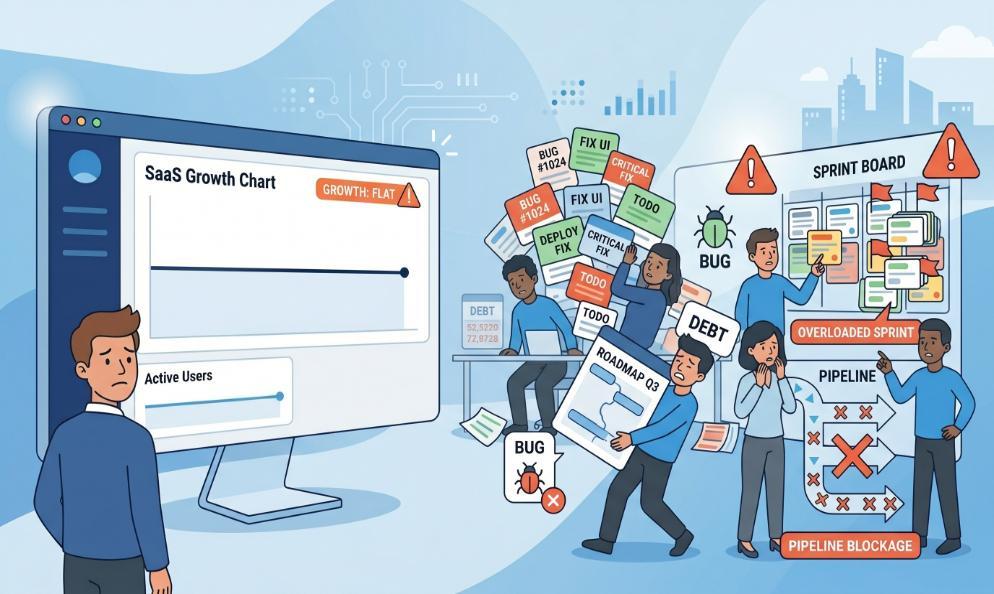
Most SaaS founders don’t realize their growth problem is actually a development problem.
They look at marketing, sales, pricing, onboarding, or churn first.
But very often, the real bottleneck is the team building the product.
A SaaS company can only grow as fast as its product can improve.
If your dev team is slow, overloaded, unclear, or constantly fixing old problems, your growth will eventually hit a wall.
Not because your idea is weak.
Not because your market is bad.
But because your product delivery system cannot keep up with the speed your business needs.
That is where many SaaS companies quietly get stuck.
Quick Reality Check: Is Your Dev Team Slowing Growth?
| Warning Sign | What It Usually Means | Business Impact |
| Features take longer than expected | Team is overloaded or poorly structured | Slower growth experiments |
| Bugs keep coming back | Weak QA or poor architecture | Lower user trust |
| Developers are always “busy” | No clear prioritization | Founder loses visibility |
| Releases feel risky | No strong deployment process | Product team becomes cautious |
| Roadmap keeps slipping | Team capacity does not match business goals | Missed market opportunities |
| One developer knows everything | Knowledge is centralized | High operational risk |
If two or more of these feel familiar, your SaaS may not have a growth problem.
It may have a delivery problem.
Growth slows when execution can’t keep up
SaaS growth depends on how quickly your team can turn business needs into stable product improvements.
When execution slows down, everything else feels stuck: sales waits for features, marketing waits for updates, support waits for bug fixes, and customers wait for a better experience.
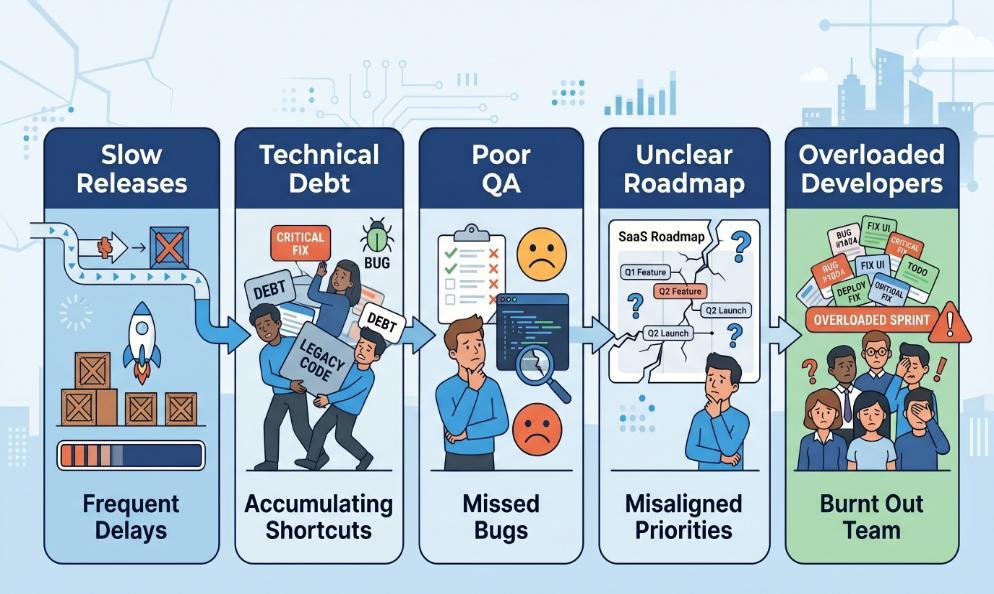
Most of the time, this happens for five reasons.
1. Your Developers Are Maintaining More Than Building
Your team may be busy every day, but growth work is not moving.
Common signs:
- Bugs keep coming back
- Small changes take too long
- Roadmap features keep moving
- Support tickets interrupt planned work
Business impact: The product survives, but growth slows.
2. Your Architecture Was Built for Launch, Not Scale
Early-stage SaaS products are often built fast to validate the idea.
But the same setup may not support more users, data, integrations, and workflows.
Common signs:
- Pages load slowly
- New features break old ones
- Integrations become difficult
- Developers avoid parts of the codebase
Business impact: Every new feature feels risky.
3. Your Roadmap Is Bigger Than Your Team Capacity
A roadmap only works when the team has enough capacity to execute it.
If everything is urgent, nothing gets proper focus.
Common signs:
- Priorities change every week
- Important features keep getting delayed
- Developers work on too many things at once
- No one knows what should be built first
Business impact: Execution becomes scattered.
4. QA Is Treated as the Final Step
If testing only happens before release, bugs will keep slowing the team down.
Strong SaaS teams build quality into the process from the beginning.
Common signs:
- Releases create new bugs
- Users report issues first
- Fixes break other features
- Deployments feel risky
Business impact: The team becomes afraid to ship fast.
5. You Have Developers, But No Delivery System
Having developers is not the same as having a scalable SaaS delivery team.
Growth needs ownership, QA, technical leadership, planning, and communication.
Common signs:
- The founder manages every detail
- No clear technical owner exists
- Tasks move without proper planning
- Communication breaks between product, design, and engineering
Business impact: Growth depends on individual effort instead of a repeatable system.
What a Strong SaaS Dev Team Looks Like
A strong dev team does more than write code.
It helps the business move faster with less risk through clear ownership, better planning, strong QA, and predictable delivery.
| Weak Dev Setup | Strong Dev Setup |
| Reactive fixes | Clear priorities |
| Risky releases | Tested releases |
| Repeated bugs | Strong QA |
| Founder manages everything | Team owns delivery |
| Roadmap keeps slipping | Progress is predictable |
| Code becomes harder to change | Architecture supports growth |
When this structure is in place, the product can improve without slowing the whole business down.
This is also why many SaaS companies eventually need to scale SaaS development without increasing overhead.
Growth needs delivery capacity.
But it also needs delivery discipline.
Before You Hire More Developers, Check This First
More developers can help only when capacity is the real problem.
But if the issue is poor process, unclear priorities, weak QA, or technical debt, hiring more people may create more confusion.
Before expanding your team, ask:
- Is the team overloaded or disorganized?
- Is the roadmap clear?
- Is technical debt slowing delivery?
- Is QA catching issues early?
- Is there a clear technical owner?
The goal is not just to increase headcount.
The goal is to build a development system that can support SaaS growth.
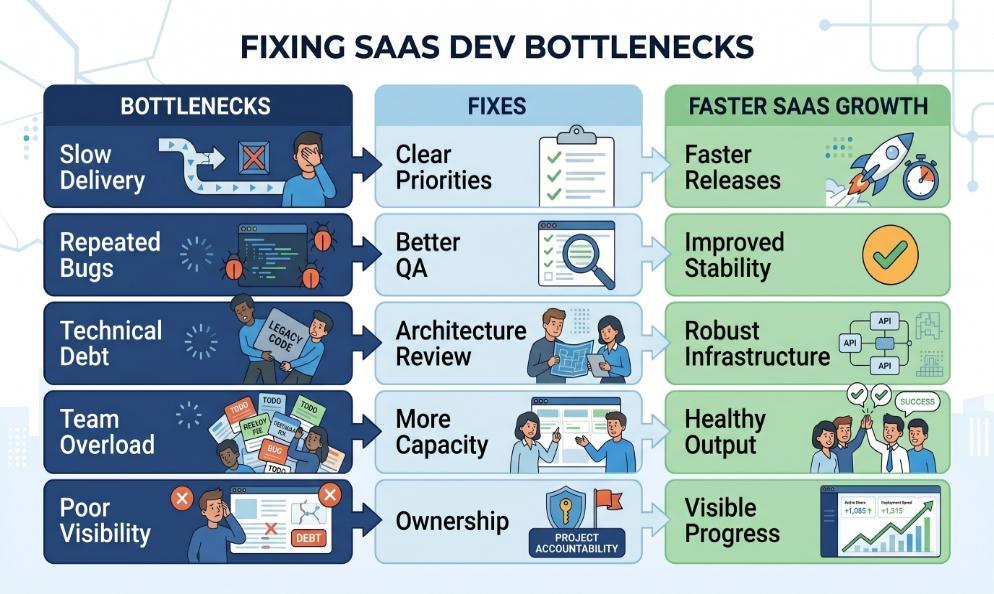
How to Fix Dev Team Bottlenecks
Start with the biggest constraint first.
| Bottleneck | What to Improve |
| Slow delivery | Sprint planning and priorities |
| Repeated bugs | QA and release process |
| Technical debt | Architecture review |
| Team overload | More development capacity |
| Poor visibility | Ownership and reporting |
Once the real bottleneck is clear, the solution becomes easier.
You may need a dedicated dev team, better QA, architecture improvement, DevOps support, or stronger technical leadership.
Where Mediusware Fits In
Mediusware helps SaaS companies fix delivery bottlenecks through a dedicated development team.
You get the development capacity, QA support, technical ownership, and delivery structure needed to ship faster with less risk.
The goal is simple:
Turn your dev team from a bottleneck into a growth enabler.
Final Thoughts
If your SaaS growth feels stuck, do not only look at marketing, sales, or pricing.
Look at how quickly your product team can turn business needs into stable product improvements.
Mediusware helps SaaS companies move faster with SaaS MVP Development, AI automation, UI/UX design, QA, DevOps, and scalable product engineering services.
Frequently Asked Questions
A dev team can slow SaaS growth when it delays feature releases, creates unstable deployments, or spends too much time fixing old issues instead of building new improvements.
This affects sales, marketing, customer success, and retention because every part of a SaaS business depends on the product improving consistently.

I work with founders and leadership teams when growth moves faster than their systems, teams, or decisions. I’ve led 850+ projects for 750+ clients across 20+ countries, working across 100+ technologies and counting. I care about ownership, clarity, and building things that last beyond the launch.
Featureblogs
Relatedblogs
01
Introduction to System Design | System Design Course Pro | Part 102
The Art of Simplicity - How Minimalism Improved UI/UX Design03
The Software Development Life Cycle (SDLC): A Complete Guide04
Which Approach Is Best for Your Software Development Team: Scrum vs. Kanban05
How to adapt the Agile process to modern software developmentAuthorblogs
01
SaaS MVP Development: A Founder’s Guide for 202702
Zero Clicks, Falling Traffic: How to Win Back Revenue03
Ranking on Google in 2026: What Matters in the Age of AI Search04
How to Choose an API Development Company for Your SaaS Product05
Why Software Companies Are Turning to Strategic Partnerships for Faster Growth