1. Define the Scope and Goals
Review Your Business Objectives: During the definition phase of the UX audit, the primary objective is to assess your business objectives and fully understand the aspirations of your organization. Involving team members from various departments, including stakeholders such as marketers, salespeople, product managers, developers, and others, provides a comprehensive perspective.
Determine what you want to achieve with the audit (e.g., improve conversion rates, reduce bounce rates) and specify the scope, such as which parts of the website or application to focus on.
2. Gather Data
Conduct a UX Maturity Survey: Early in the UX audit, a survey is conducted to assess the level of UX maturity within the organization. This survey involves questioning team members about their perceptions of the existing UX processes, how the organization utilizes UX methodologies, and the perceived importance of UX practices.
The score from the survey is translated into a level of ‘UX maturity’ based on the model developed by the Nielsen Norman Group, which identifies six positions of UX maturity:
- Absent: UX is disregarded or non-existent.
- Limited: UX work is uncommon, carelessly conducted, and of little significance.
- Emergent: UX work is valuable and promising but inefficient.
- Structured: The organization has a widely used scientific UX methodology with varying degrees of efficiency.
- Integrated: UX work is extensive, successful, and widespread.
- User-driven: Insights and outstanding user-centered design outputs result from a commitment to UX at all levels.
Understanding your UX maturity position helps ensure that user-driven design decisions minimize user-related risks during development and optimize resource utilization.
3. Analyze User Flows
Map out user journeys to understand how users interact with the product. Identify common paths and potential drop-off points.
4. Evaluate the Current Design
Assess usability through heuristic evaluation (e.g., Nielsen’s heuristics). Check for consistency in design elements (colors, typography, buttons) to ensure a cohesive user experience.
5. Conduct Competitor Analysis
Compare your product with competitors to identify best practices and areas for improvement. Highlight what works well for others and how you can adapt those strategies to your own product.
6. Carry Out a Stakeholder Workshop
The workshop stage serves as the foundation for the UX audit by establishing a connection between the organization’s business goals and its target users, their journeys, and the challenges they may encounter.
A one-and-a-half-hour workshop is conducted with key stakeholders to establish the following:
- Target users and their journeys
- Target users’ current challenges
- Standards such as accessibility and device support
- Competitors
- KPIs and metrics
These areas, particularly those concerning target users, are paramount in creating proto-personas, which are outputs of the UX audit.
7. Create an Actionable Report
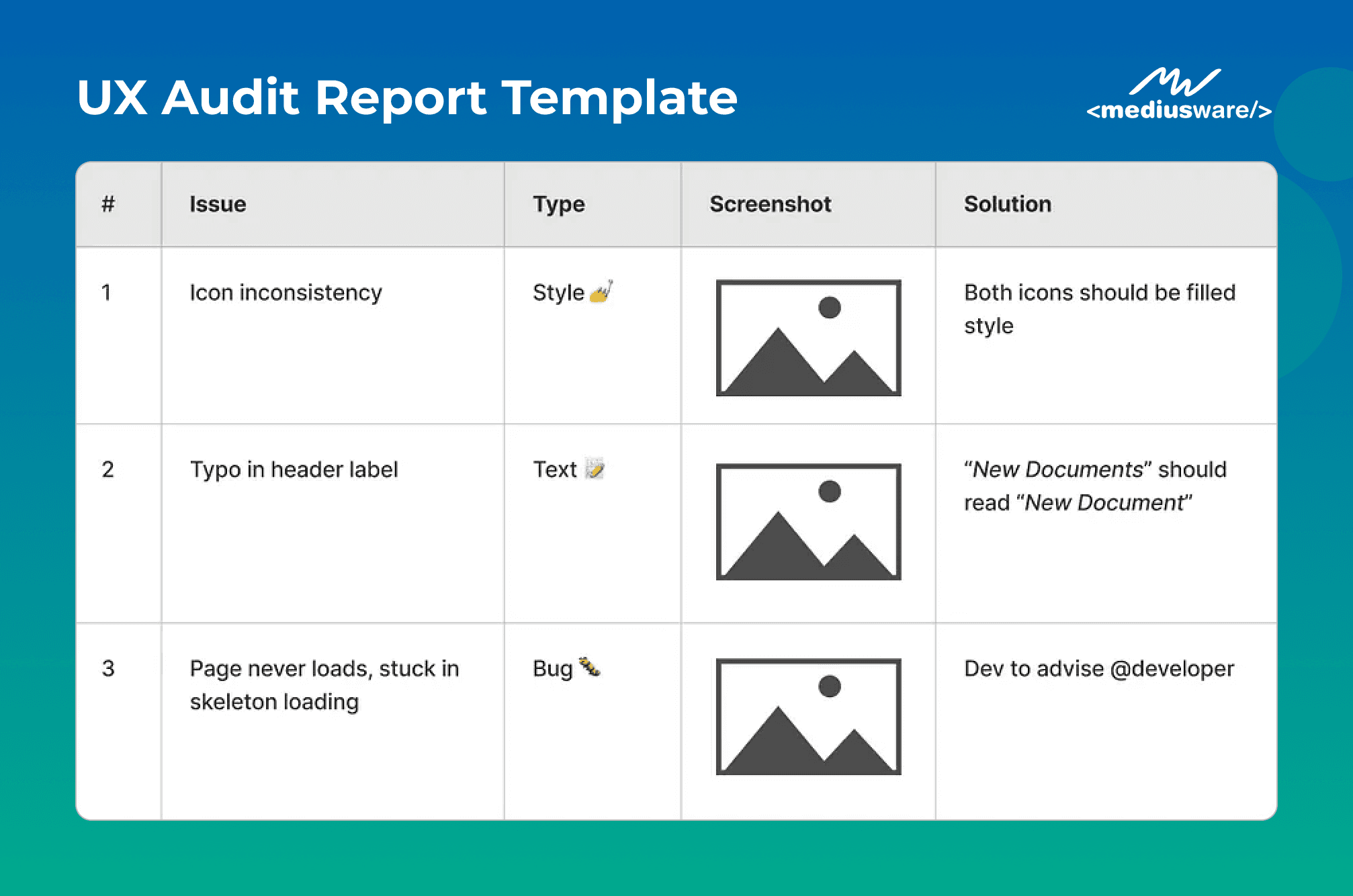
Summarize findings, highlighting key issues and areas for improvement. Prioritize issues based on their impact and ease of implementation. The final output of the UX audit is a report that includes insights from across activities and recommendations to improve the user experience of your product.