- AI automation simplifies insurance paperwork by processing documents and claims faster.
- Intelligent systems improve insurance operations with automated workflows and smarter decisions.
The End of Paperwork: How AI is Quietly Fixing the Most Broken Part of Insurance
1 min read
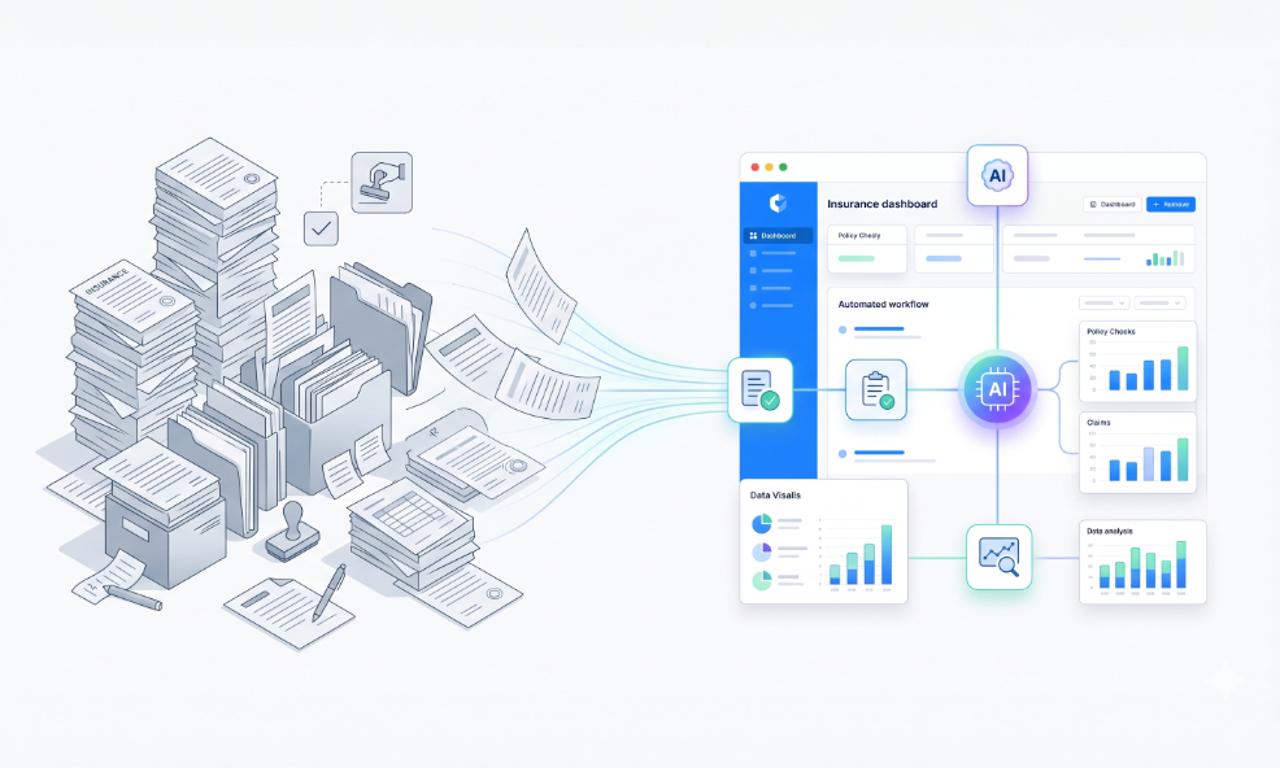
Walk into any insurance office today, and you’ll still see it.
Stacks of documents.
Endless forms.
Teams manually reviewing files one by one.
Now imagine a customer waiting days, sometimes weeks, just to hear back about a claim.
That’s not a technology problem.
That’s a workflow problem.
And for decades, paperwork has been the slowest, most expensive part of insurance operations.
What’s changing now isn’t the industry itself.
It’s how the work gets done.
Why Paperwork Has Always Been the Bottleneck
Insurance runs on documentation.
Every policy, claim, and compliance step depends on it.
But here’s the issue most teams ignore:
The system was never designed for speed.
A single claim can involve:
- Accident reports
- Medical records
- Invoices
- Customer forms
Someone has to read all of it.
Extract data.
Verify accuracy.
Move it to the next system.
That’s where things break.
Not because people are inefficient.
But because the process is.
The result?
- Delayed claims
- High operational cost
- Human errors
- Frustrated customers
And the bigger the company gets, the worse it becomes.
What AI Actually Fixes And What It Doesn’t
There’s a misconception that AI replaces people.
It doesn’t.
It removes the parts of the job that slow people down.
The repetitive, document-heavy, rule-based work.
That’s where AI creates leverage.
Here's how:
1. Intelligent Document Processing (IDP)
Instead of humans reading every file, AI systems process documents automatically.
They can:
- Extract policy numbers
- Identify claim details
- Pull customer data
- Recognize supporting evidence
Even from:
- PDFs
- Scanned files
- Images
- Handwritten forms
This alone removes hours of manual work from every claim.
2. Faster Claims Processing
Claims are where insurance feels slow to customers.
AI changes that.
Instead of waiting for manual review, systems can:
- Analyze documents instantly
- Validate information against historical data
- Trigger approvals automatically for simple cases
What used to take days can now take minutes.
And that shift isn’t just operational.
It’s experiential.
3. Smarter Fraud Detection
Fraud doesn’t look obvious.
It hides in patterns.
AI models analyze thousands of claims at once and detect anomalies that humans would miss.
Not just faster.
But more accurately.
That means:
- Lower financial loss
- Better risk control
- More confidence in decisions
4. Automated Underwriting
Underwriting has always been document-heavy.
AI compresses that process.
Instead of manually reviewing files, systems can:
- Analyze customer history
- Evaluate risk signals
- Pull external data sources
All in seconds.
This doesn’t remove underwriters.
It gives them better inputs, faster.
Why AI Works Where Traditional Automation Fails
Traditional automation follows rules.
If something changes, it breaks.
AI adapts.
It understands:
- Context
- Variations in document formats
- Unstructured data
That’s why it works in insurance.
Because insurance data is messy.
Where This Is Already Working
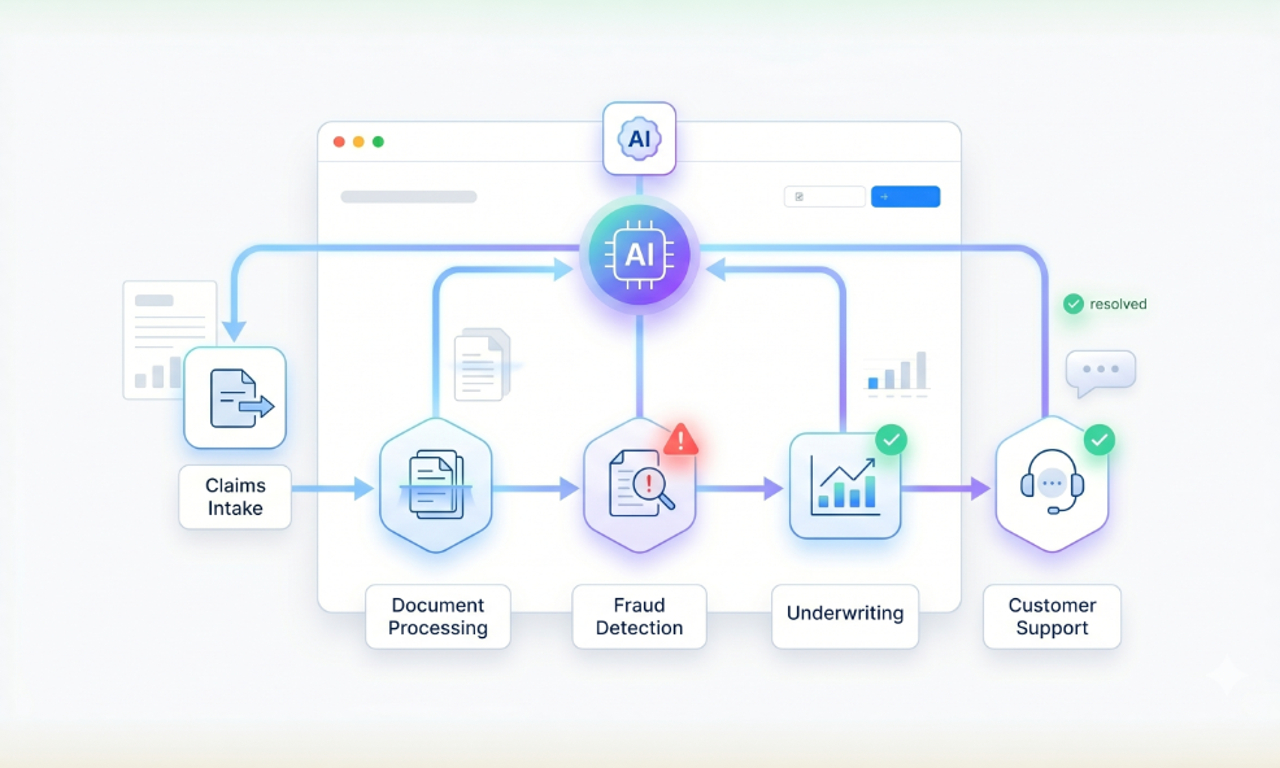
This isn’t future talk.
It’s already happening across real workflows.
1. Claims Intake
Customers upload documents → AI extracts data → claim starts instantly
2. Policy Management
Documents get classified and stored automatically
3. Customer Support
AI assistants guide users through claims and policy updates
4. Compliance
Reports are generated automatically with audit-ready data
The Real Shift Most Teams Miss
Most companies think AI is a tool.
It’s not.
It’s a system layer.
If you plug AI into broken workflows, you get faster chaos.
If you redesign workflows around AI, you get leverage.
That’s the difference.
And it’s where most insurance teams get stuck.
What This Looks Like in Practice
At Mediusware, we’ve seen the same pattern across industries:
Manual workflows → fragmented systems → slow decisions.
And the solution is never just “add AI.”
It’s:
- Structuring data flows
- Connecting systems
- Automating decision points
- Reducing human bottlenecks
That’s how platforms like CRM Runner eliminate operational friction by centralizing workflows and automating processes across systems.
Insurance is simply the next major industry going through that shift.
The Future of Insurance Operations
The direction is clear.
We’re moving toward:
- Real-time claim processing
- Predictive risk assessment
- AI-driven policy recommendations
- Fully automated underwriting layers
Not because it’s trendy.
Because the old system doesn’t scale anymore.
Final Thoughts
Paperwork was never just an inconvenience.
It was the hidden system slowing everything down.
AI isn’t “replacing insurance.”
It’s removing the friction that made insurance slow in the first place.
And the companies that understand this early will move faster than the rest.
Frequently Asked Questions
No. Mid-sized insurers often benefit faster because they have fewer legacy systems. The real requirement isn’t size, it’s having document-heavy workflows that can be automated.

I work with founders and leadership teams when growth moves faster than their systems, teams, or decisions. I’ve led 850+ projects for 750+ clients across 20+ countries, working across 100+ technologies and counting. I care about ownership, clarity, and building things that last beyond the launch.
Featureblogs
Relatedblogs
Authorblogs
01
SaaS MVP Development: A Founder’s Guide for 202702
Zero Clicks, Falling Traffic: How to Win Back Revenue03
Ranking on Google in 2026: What Matters in the Age of AI Search04
How to Choose an API Development Company for Your SaaS Product05
Why Software Companies Are Turning to Strategic Partnerships for Faster Growth