- Discover the top 12 LLMs, showcasing the most powerful models revolutionizing industries.
- Learn about the capabilities, performance benchmarks, and practical applications of leading LLMs.
The 12 Most Powerful LLMs: Powering Tomorrow’s Tech Landscape
8 min read
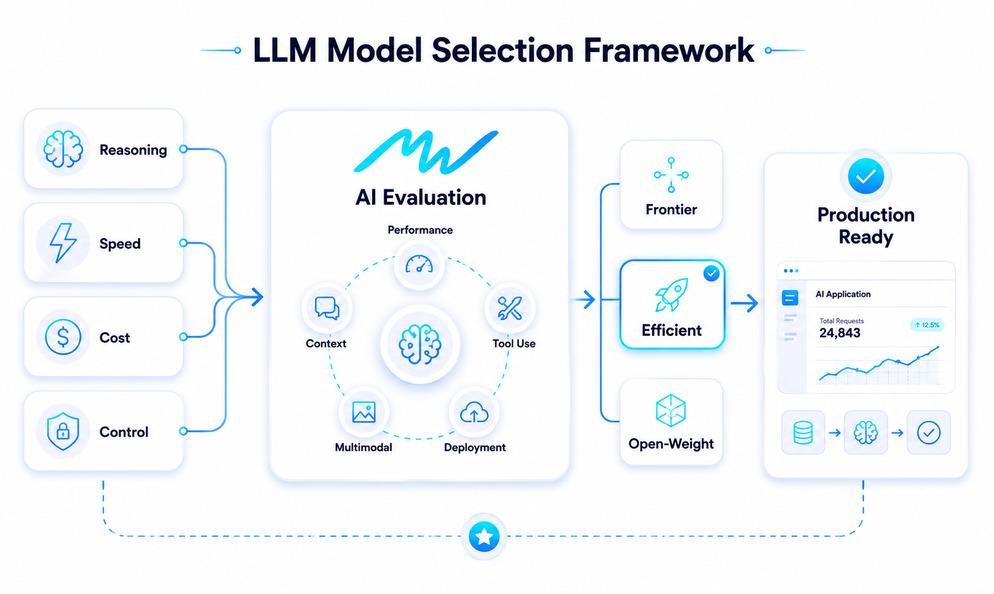
Choosing an LLM used to feel simple. Pick the biggest name, test a few prompts, and ship.
That does not work anymore.
In 2026, the gap between a good demo and a production-ready AI system is wide. Some models are better at deep reasoning. Some are stronger at coding. Some handle multimodal inputs better. Others win on cost, speed, or deployability.
That is why the real question is no longer which LLM is the smartest.
According to Artificial Analysis, it is which LLM is smartest for your workflow, your latency target, your cost ceiling, and your risk profile.
Stanford University report,
AI's capabilities are advancing quickly; less so, our ability to measure and manage them.
That is exactly what business leaders are facing right now.
The strongest teams are not chasing model hype. They are matching the right model to the right job.
Why powerful LLM more than a benchmark win
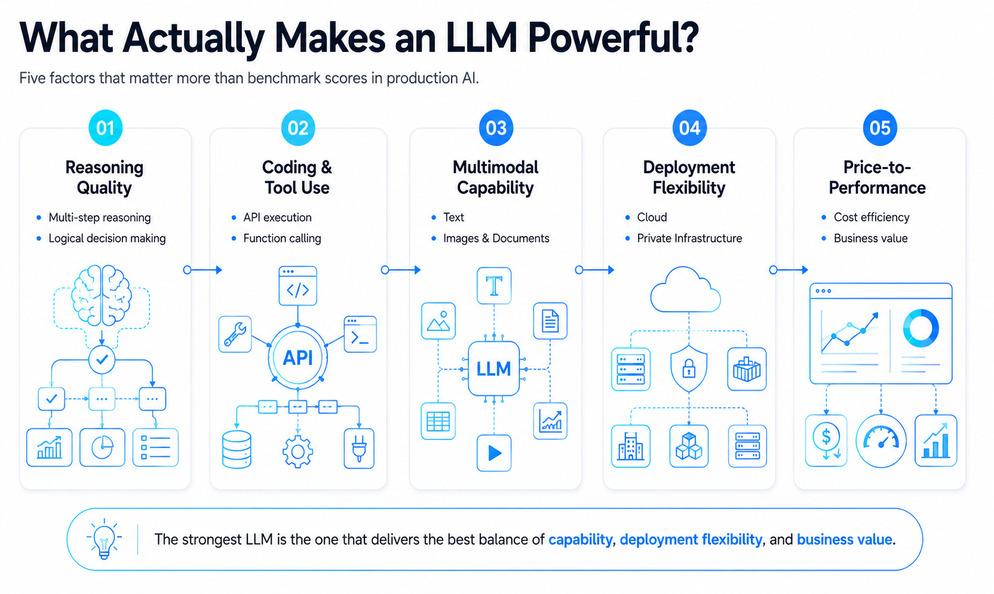
A powerful LLM in 2026 is not just the one with the highest benchmark score.
It is the one that can reliably handle long context, use tools well, reason through multi-step tasks, work across text and images when needed, and stay cost-effective in real production workloads.
Artificial Analysis now evaluates models across reasoning, coding, knowledge, and agentic tasks for exactly this reason.
So this list looks at power through five lenses:
- reasoning quality
- agent and tool-use strength
- multimodal capability
- deployment flexibility
- price-to-performance tradeoff
Quick comparison table
Below is a practical snapshot of several leading models.
These benchmark values are public snapshots and will change as providers update their models.
| Model | Public signal | Why it stands out |
| GPT-5.4 | AA Intelligence Index: 57 | Frontier reasoning, coding, tool use, 1M context |
| Claude Opus 4.7 | AA Intelligence Index: 57 | Elite long-run reasoning and advanced software work |
| Qwen3.6 Plus | AA Intelligence Index: 50 | Strong reasoning with aggressive price-performance |
| Gemini 2.5 Pro | AA Intelligence Index: 35 | Strong long-context multimodal analysis |
| Claude 4 Sonnet | AA Intelligence Index: 33 | Balanced production model for coding and agents |
| DeepSeek V3.1 | AA Intelligence Index: 28 | Efficient hybrid thinking and agent workflows |
| Grok 3 | AA Intelligence Index: 25 | Fast reasoning with web-aware positioning |
The 12 most powerful LLMs right now
1. GPT-5.4
OpenAI positions GPT-5.4 as its most capable frontier model for professional work, with state-of-the-art coding, computer use, tool search, and a 1M-token context window.
On GDPval, OpenAI reports it matches or exceeds industry professionals in 83.0% of comparisons.
Best for: difficult coding tasks, long-running reasoning, premium knowledge work.
2. Claude Opus 4.7
Anthropic describes Opus 4.7 as a notable improvement over Opus 4.6, especially on difficult software engineering work.
Public benchmark tracking from Artificial Analysis puts it among the current leaders overall.
Best for: difficult coding tasks, long-running reasoning, premium knowledge work.
3. GPT-5.2
GPT-5.2 is still one of the strongest all-around production models for everyday professional work.
OpenAI highlights improvements in reasoning, long-context understanding, coding, vision, tool calling, and context management.
Best for: teams that need a dependable, broadly capable flagship without always paying for the absolute top tier.
4. Qwen3.6 Plus
Qwen says Qwen3.6-Plus was built for “real world agents,” with major gains in agentic coding.
Artificial Analysis ranks it near the top tier while also showing unusually strong price-to-performance.
Best for: cost-conscious teams building AI agents, developer tools, and repository-level coding workflows.
5. OpenAI o3
OpenAI describes o3 as a powerful reasoning model for multi-step work across text, code, and images, though it has now been succeeded by GPT-5 reasoning models.
It still matters because many teams benchmark against it when evaluating structured reasoning quality.
Best for: complex analysis, math, science, visual reasoning, and evaluation baselines.
6. Gemini 2.5 Pro
Google positions Gemini 2.5 Pro as its most advanced reasoning model, built for complex problems in code, math, STEM, and large-scale analysis across text, audio, images, video, and code repositories.
Best for: multimodal enterprise use cases, massive-document analysis, and codebase-level reasoning.
7. Claude Sonnet 4.5
Anthropic calls Sonnet 4.5 its best coding model and strongest model for building complex agents and computer-use workflows.
This makes it one of the most practical “do real work every day” models on the market.
Best for: coding assistants, operator-style agents, and mid-to-high complexity business automation.
8. Mistral Large 3
Mistral Large 3 is Mistral’s most capable model to date, with 41B active and 675B total parameters, released under Apache 2.0.
It is one of the strongest open-weight options for teams that want serious capability without fully locking into closed providers.
Best for: enterprises that want open-weight flexibility, multimodal capability, and strong general performance.
9. Mistral Medium 3
Mistral positions Medium 3 as a frontier-class multimodal model, and its docs show competitive pricing with strong enterprise features.
It matters because not every team needs the absolute largest model if the mid-tier tradeoff is better.
Best for: enterprise assistants, document workflows, and teams optimizing for value over bragging rights.
10. Llama 4 Maverick
Meta’s Llama 4 Maverick is part of the Llama 4 series built on a mixture-of-experts architecture.
Meta’s published model materials position it as a strong multimodal open model for developers who need customization and self-hosting flexibility.
Best for: open-weight customization, controlled deployments, and fine-tuned domain systems.
11. DeepSeek V3.1
DeepSeek presents V3.1 as a step toward the agent era, with hybrid thinking and non-thinking modes, stronger tool use, and better multi-step agent tasks.
That makes it especially interesting for teams optimizing efficiency without abandoning reasoning quality.
Best for: efficient agent pipelines, tool-use workflows, and budget-sensitive deployments.
12. Grok 3
xAI describes Grok 3 as its most advanced model, trained with significantly more compute and built to improve reasoning, coding, and world knowledge.
Public evaluations show it above average, though not in the very top tier of current general intelligence rankings.
Best for: fast-answer systems, consumer-facing assistants, and teams that value X/web-connected positioning.
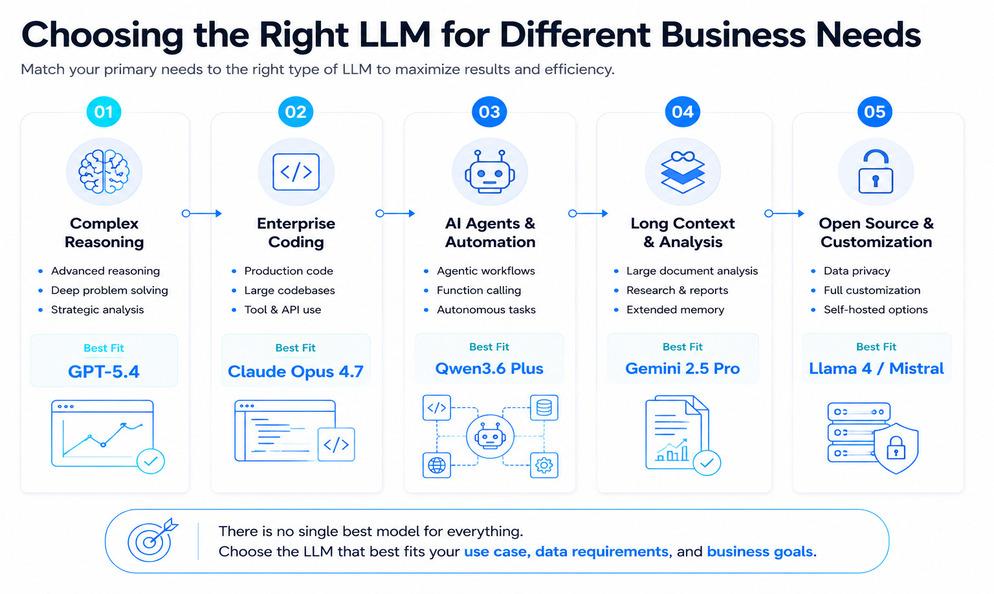
What business leaders usually get wrong
Most teams do not fail because they picked a bad model.
They fail because they picked a model before defining the job.
A retrieval-heavy internal knowledge assistant does not need the same model as a coding agent. A compliance workflow needs different strengths than a creative content assistant.
A multimodal claims review system has different requirements than an internal summarizer.
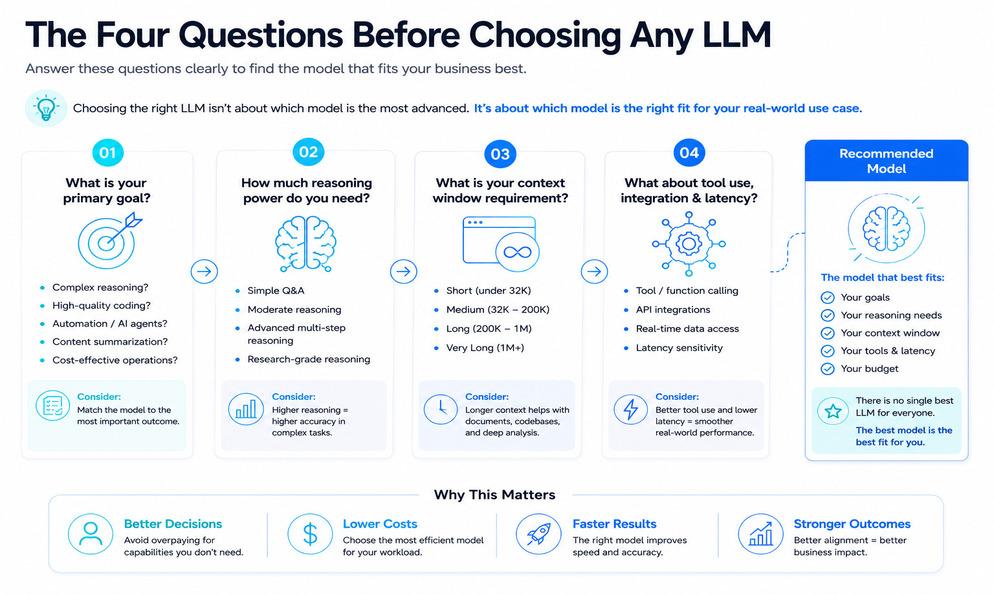
That is why a good LLM strategy usually starts with four questions:
- What kind of reasoning is actually required?
- How much context does the workflow need?
- What tools must the model call reliably?
- What latency and cost can production tolerate?
If those answers are fuzzy, the model choice will be fuzzy too.
A better way to think about model selection
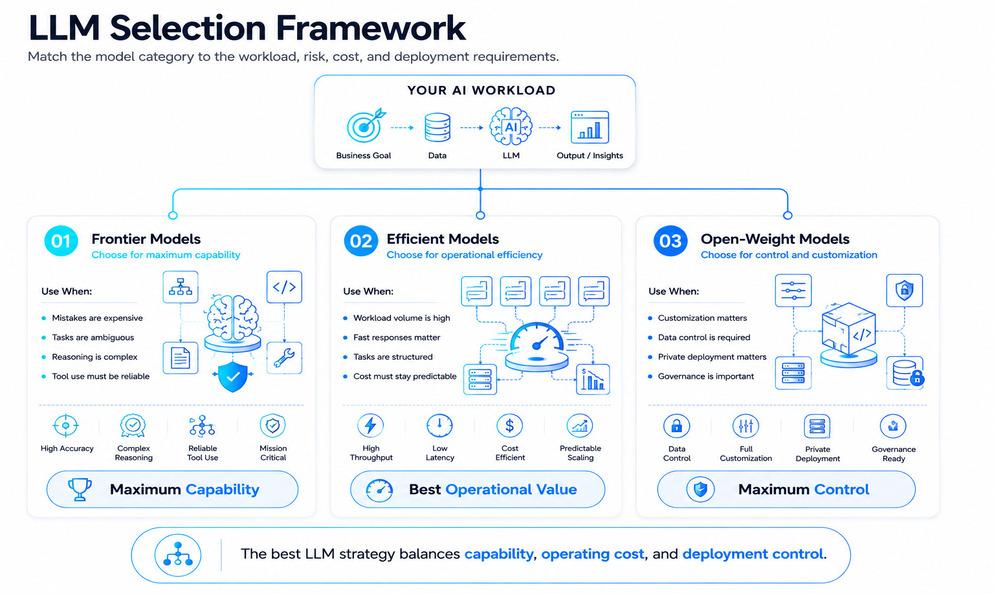
Use this simple framework:
1. Use frontier models when:
- mistakes are expensive
- tasks are multi-step and ambiguous
- tool use must be reliable
- outputs affect revenue, compliance, or operations
2. Use efficient high-value models when:
- volume is high
- latency matters
- prompts are narrower
- the workflow is structured and repeatable
3. Use open-weight models when:
- control matters
- domain tuning matters
- deployment constraints matter
- governance or data residency matters
The Mediusware perspective
At Mediusware, we do not look at LLMs as a popularity contest.
We look at them as system components.
That difference matters in production.
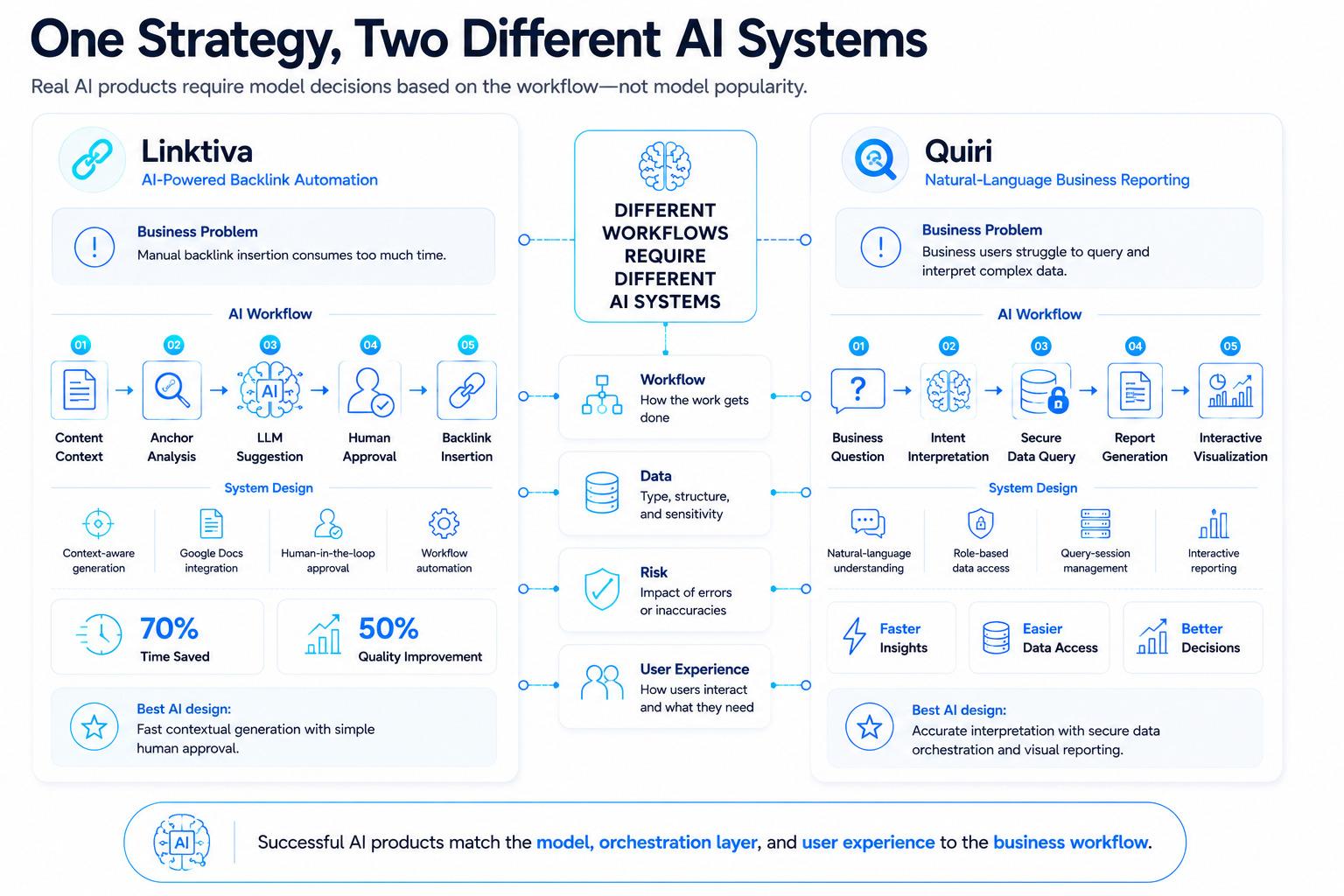
In Linktiva, Mediusware used ChatGPT integration to generate context-aware backlink suggestions, helping users save 70% of the time spent on manual insertion while lifting suggestion quality by 50%.
In Quiri, Mediusware built a natural-language query experience that turns user questions into interactive visual reporting for business teams. Those are two very different AI jobs, and they benefit from different model decisions, orchestration layers, and UX patterns.
That is also why this topic matters beyond ranking tables.
The best LLM is rarely the model with the loudest launch.
It is the model that helps your workflow become faster, safer, and more useful.
Final thoughts
The LLM market in 2026 is no longer dominated by one obvious winner.
OpenAI, Anthropic, Google, Qwen, Mistral, Meta, DeepSeek, and xAI all matter now, but they matter for different reasons.
The real advantage comes from choosing models by workflow fit, not headline hype.
Frequently Asked Questions
An LLM is a language model trained on massive datasets to understand and generate text, code, and sometimes images, audio, or video.

I work at the point where product decisions, system architecture, and engineering execution meet. At Mediusware, I’m accountable for how technology choices affect reliability, scale, and long-term delivery for our clients.
Featureblogs
Relatedblogs
01
How to Create a Stunning WordPress Website in 2024: Step-by-Step Tutorial02
How Mediusware Empowered Protesters, Strengthened the Economy & Showcased Employee Resilience in the 2024 Movement03
Mastering Error Handling in Rust with Essential Techniques04
Best Practices for Writing Clean Code05
Let's Deep Dive Into Threads with RustAuthorblogs
01
How Digital Agencies Can Deliver Custom Software Without Hiring Developers02
AI in FinTech: Build, Buy, or Integrate? A Founder's Decision Framework03
How to Choose a SaaS MVP Development Company04
How Seed-Stage SaaS Teams Add Engineering Capacity Without Hiring Chaos05
Why Seed-Stage SaaS Startups Struggle to Ship Fast