Highlights
- Enrollment: Connect purchases to trainees.
- Roles: Clarify each user’s responsibilities.
- Cohorts: Reuse and prepare course content.
- Reliability: Plan around live training.
Highlights
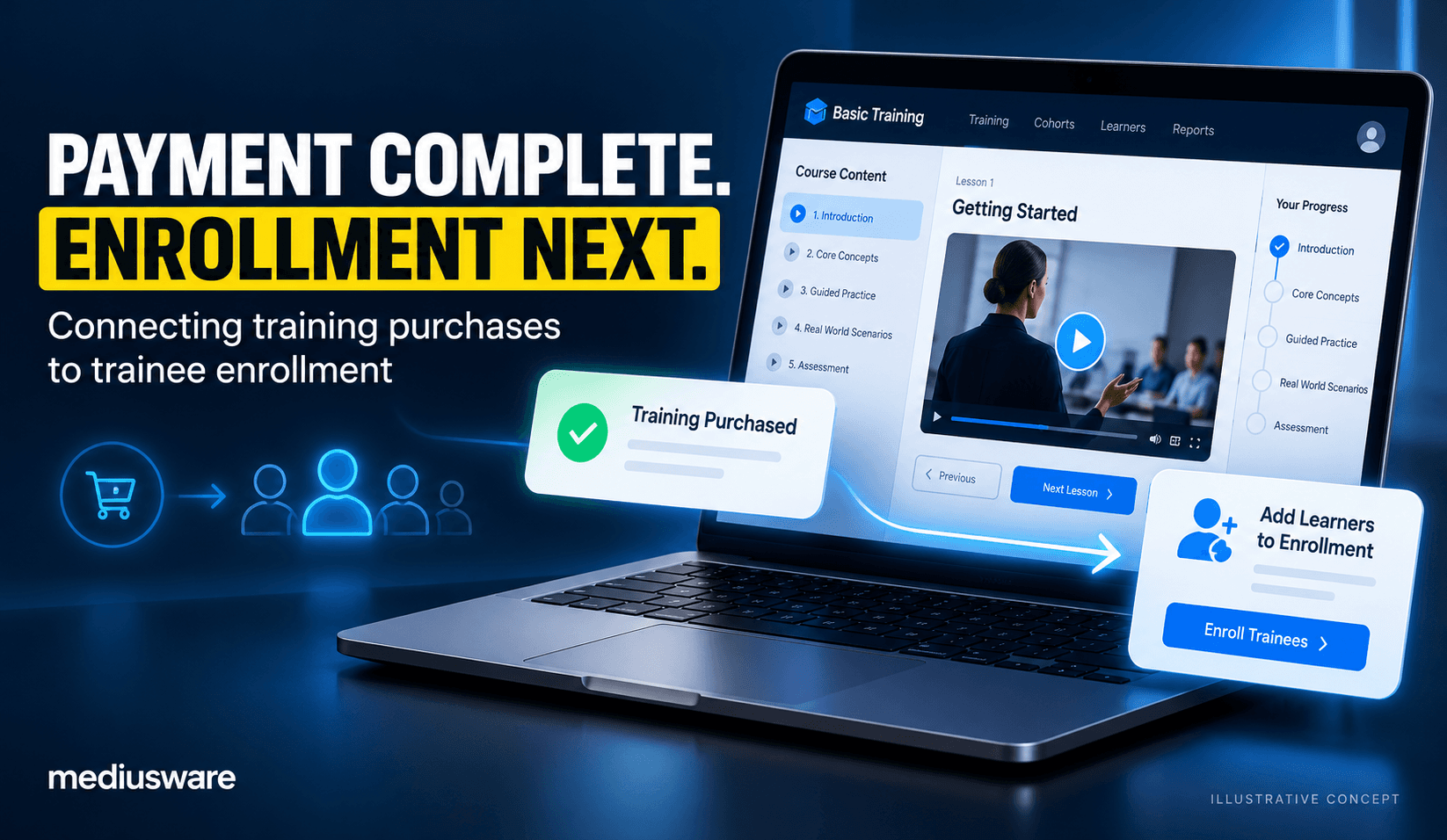
An organization purchases several training places. The payment succeeds. But only one employee is added or none.
For the training provider, the purchase is recorded while learner setup remains unfinished. For the purchaser, the process may appear complete.
That was the enrollment problem described in this project’s client discussions.
Mediusware demonstrated a revised enrollment experience intended to clarify the steps and make adding trainees a more prominent action after payment. The work formed part of a wider engagement involving scheduled training, course administration, support and production troubleshooting.
The product lesson was specific: a successful checkout did not establish that employees were enrolled and ready for their cohort.
The platform supported a paid professional-training programme purchased by organizations for their employees.
The supplied project account describes instructor-led sessions, recordings, learning materials and assessments. Organizations selected scheduled training and bought places or credits. They then needed to add the employees who would use them.
Client feedback showed that some purchasers stopped between those activities. They paid for multiple places but did not finish adding trainees, apparently believing payment had completed enrollment.
That distinction mattered because an organization’s purchase and an employee’s participation required different information and actions.
| Stage | What it establishes |
| Purchase | The organization has paid for training capacity. |
| Trainee setup | The intended employees have been added. |
| Assignment | Those employees are associated with the relevant session. |
| Access | Trainees can reach the training they need. |
This is a conceptual explanation of the operating model, rather than a verified sequence of the latest production screens.
The enrollment work needed to help purchasers understand what remained—and who was responsible for doing it.
The supplied account describes Mediusware’s involvement in platform development, enrollment interfaces, course and session administration, support tools, testing, deployment and production troubleshooting.
The clearest improvement example is a development demonstration of a revised enrollment path.
| Work area | Reported involvement |
| Enrollment | Demonstrating changes covering enrollment information, session and quantity selection, payment, organization details and trainee creation |
| Course operations | Work involving session configuration, learning content and reuse of earlier courses |
| Support | FAQ, help-material and chatbot-related work |
| Production support | Investigation of access and assessment problems, alongside reported capacity changes |
| Administration | Continuing discussions about making coach-facing workflows easier to use |
The materials describe an operating product and ongoing work. They do not provide a complete original-build history or confirm the acceptance and release status of every improvement.
The reported enrollment problem suggested a direct product response: make trainee setup visible as part of the journey.
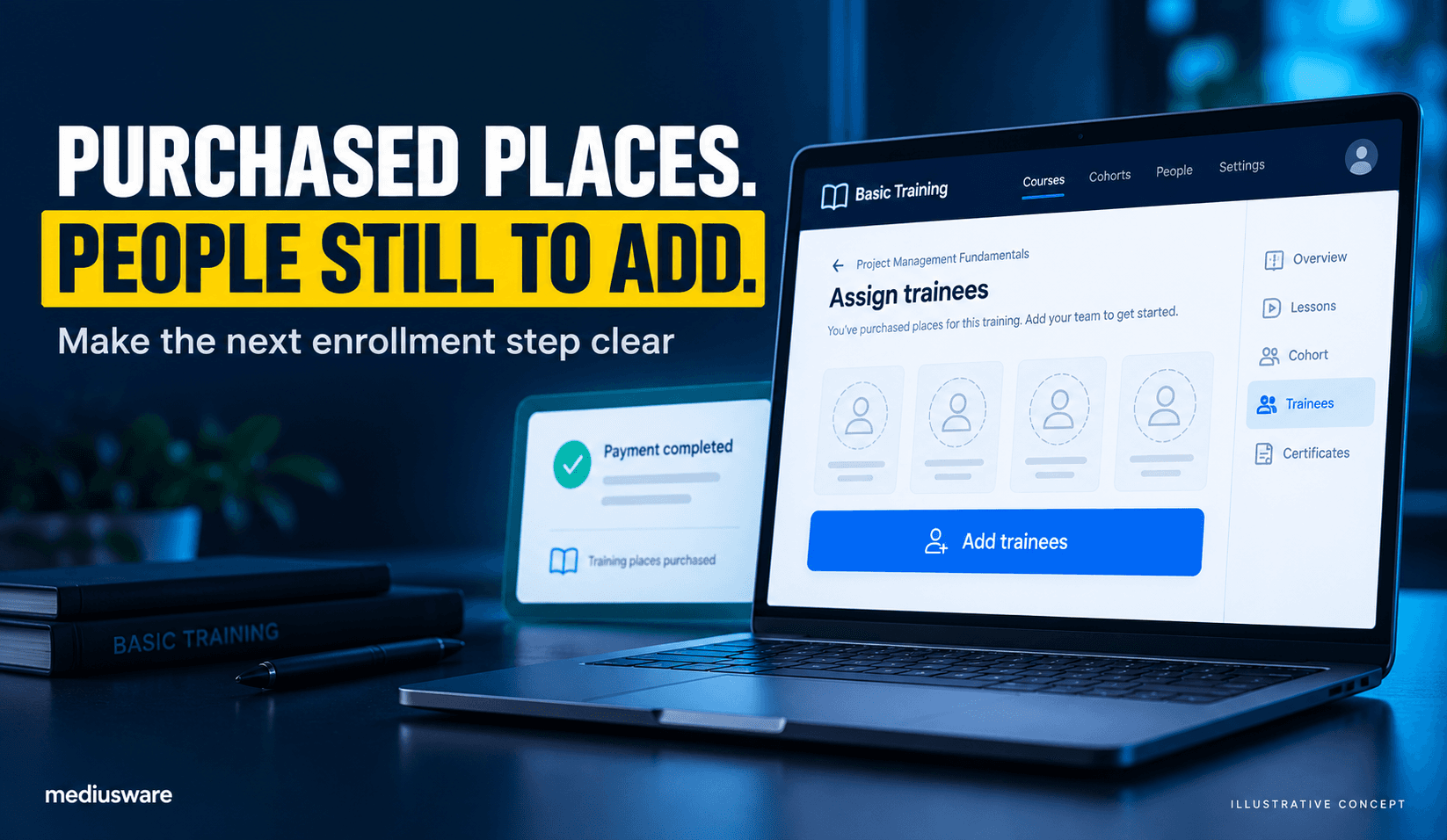
In a development review described in the intake, Mediusware demonstrated a revised path covering information and acknowledgements, training-session selection, quantity, payment, organization details and trainee creation.
The important change was not simply another form. It was the connection between the purchaser’s understanding and the work still required.
A purchaser who sees payment confirmation needs to know whether enrollment is finished. If employees must still be added, that action needs to be recognizable and its purpose understandable.
The supplied account says the proposed experience made “add your trainees” a prominent next step. The exact released sequence and its effect on completion have not been verified.
A useful way to evaluate such a change would be to compare purchased places with trainees actually assigned to the intended cohort. That is a recommended measurement not a result established by this engagement.
The organization and the learner interact with the same training service, but their jobs differ.
The organization selects training, pays for capacity, and adds employees. A trainee needs access to the assigned content, sessions, and assessments.
| Organization tasks | Trainee tasks |
| Select scheduled training. | Open assigned training |
| Purchase places or credits | Review learning materials. |
| Add and assign employees. | Attend relevant sessions. |
| Maintain organizational information. | Complete required assessments |
These differences affect account setup, instructions, and support.
An organization administrator needs to understand how to use purchased capacity. A trainee needs to understand how to enter the learning experience. Sending both users through unclear or interchangeable steps can leave the wrong person registered or the intended learner without access.
The project account identifies this role confusion as part of the operational problem. It supports describing different responsibilities but does not establish that every permission or account path was tested exhaustively.
Scheduled training introduces recurring setup work.
The supplied account describes the ability to copy a previous session’s course into a new cohort. It also describes session-specific configuration, including links for live instruction.
That gives administrators a starting point for the next training run. It does not establish that every detail should carry forward unchanged.
Dates, links, and materials may need to reflect the new session. The distinction between reusable course content and session-specific information is therefore important.
The records support describing course copying. They do not establish automatic synchronization back to a master course or across all cohorts, and they provide no measured administrative time saving.

The platform also had a commercial relationship with a separate membership offering.
Client discussions covered a training discount for existing members and a proposed process for checking membership claims. A membership attestation and manual comparison against the client list were discussed; automatic verification was not established.
This added another responsibility to enrollment. A purchaser could need both the correct commercial treatment and the correct trainee setup.
Those are different checks:
The separate membership product should not be merged with the training platform. A proposed later membership credit should also not be described as a training refund or a proven conversion program.
The supplied records do not confirm the final verification implementation or its effectiveness.
Enrollment was not the only issue raised during the engagement.
The intake records serious quiz and course access problems during an active training period. The client described substantial support pressure and concern about customer confidence.
Mediusware reported immediate capacity increases and discussed further database or scaling work between sessions, because some changes could require downtime.
That introduced a practical delivery tradeoff: respond to the immediate problem while accounting for the training already underway.
The available account does not establish the incident’s technical root cause or prove permanent resolution. It supports describing a reported response and the consideration of release timing.
Later feedback also identified continuing coach-admin usability problems. The presence of administrative features therefore should not be presented as proof that the workflow had become simple or fully satisfactory.

| Area | Supported account | Remaining question |
| Operating product | The supplied meetings describe live training and enrollment activity. | What does the complete release history show? |
| Enrollment problem | The client reported paid places without corresponding trainee setup. | How frequently did this happen? |
| Proposed improvement | Mediusware demonstrated a revised enrollment path in development. | Which changes shipped, and when? |
| Cohort administration | Course copying and session-specific setup were described. | What was accepted and validated in production? |
| Reliability work | Capacity changes and further planned work were reported. | What do incident, deployment and monitoring records establish? |
| Business impact | No verified before-and-after result was supplied. | Did completion, support demand or class reliability improve? |
Reported signup and trainee counts are not used here as redesign results. They describe activity at particular moments, without establishing an improvement attributable to Mediusware’s changes.
Private client praise is also not treated as a publication-approved testimonial.
The most useful question extends beyond checkout:
What must happen before the person receiving the service is ready to use it?
For organization-purchased training, that can include adding employees, assigning the right cohort and providing appropriate access instructions.
A practical review could examine:
These are recommended checks for similar products, rather than documented acceptance criteria from this project.
They help teams define completion in operational terms. A payment record shows a purchase; the wider journey determines whether the learner can begin.
An organization can purchase training places before adding the employees who will use them. Successful payment alone does not make trainees ready to begin.