Quick Summary
- Community: Connect belonging with participation.
- Rewards: Define discovery and allocation rules.
- Roles: Clarify status and management rights.
- Delivery: Set an explicit purpose for each phase.
Quick Summary

A member joins a community, watches a video, and discovers a limited reward opportunity.
The experience may feel spontaneous. Behind it, the product needs explicit rules.
Who creates the opportunity?
Who can participate?
How are rewards allocated?
What happens after someone places a bid?
For one community-platform founder, answering questions like these became central to turning a longstanding vision into a working product.
Mediusware’s reported contribution connected discovery, product design, web and mobile development, administration workflows, and testing. The engagement progressed from historical concept materials to working demonstrations and private test distribution.
This case study examines that development journey. The client is anonymized, and demonstrated features are distinguished from confirmed production delivery. Public launch, final acceptance and measurable business outcomes remain unverified.
The founder’s concept combined interest-based communities with familiar social activity and a participation-rewards model.
Members would create profiles, discover communities, publish content, interact, answer surveys and earn rewards. Longer-term ambitions included advertising, sponsored activity and a broader marketplace.
That vision introduced several connected product questions.
A social feed needed recognizable interactions. Community membership needed entry and management rules. Rewards needed eligibility and allocation logic. Administrative tools needed to support the people operating those systems.
The founder had historical presentations and concept documents. Detailed journeys, governance, reward rules and phase boundaries still required definition.
| Product area | Question requiring definition |
| Access | How does a person request or receive entry? |
| Communities | How do members discover, join and participate? |
| Rewards | Which actions qualify, and how are opportunities controlled? |
| Leadership | What does status mean, and which permissions accompany it? |
| Administration | Who reviews requests and configures activity? |
| Delivery | What must work before a phase is considered ready? |
The challenge was to turn those intentions into flows that could be designed, demonstrated and evaluated.

The supplied project account describes a new-product engagement based on the founder’s concept and existing materials.
Mediusware’s work spanned product definition, interface design, development, testing and release preparation.
| Work area | Reported contribution |
| Discovery and analysis | Research, requirements, information architecture, journeys and phased planning |
| UX/UI | Onboarding, profiles, communities, social feeds, rewards-related interfaces and web/mobile designs |
| Development | Web application, mobile builds, shared backend and administration workflows |
| Quality assurance | Internal testing, defect reporting and retesting |
| Release preparation | Android testing distribution and iOS TestFlight access |
Project reviews demonstrated social posts, reactions, comments, replies, sharing, reels and real-time messaging.
Community creation and membership workflows were also demonstrated, alongside survey participation and administration features.
These reviews establish working product demonstrations. They do not constitute a complete production acceptance checklist.
The distinction matters because the engagement continued through revisions, unresolved commercial dependencies and release preparation.
The product needed an identity that expressed the founder’s community vision.
Early designs felt too close to conventional social platforms. The founder preferred a more historical, community-themed and game-like direction.
That preference affected the visual language, but the underlying actions still needed to remain understandable.
Members needed to recognize how to join, publish, respond and navigate. A distinctive setting could provide character while familiar interaction patterns helped organize participation.
The supplied designs reflect that ambition through themed environments, emblems and progression-oriented language.
The product question was how to introduce unfamiliar concepts without making every interaction unfamiliar.
For comparable platforms, a useful review asks whether users can distinguish:
These are recommended review questions, rather than documented usability test results from this engagement.
The available account supports the change in visual direction. It does not establish that the revised identity improved comprehension or engagement.

The clearest product decision concerned a feature described as “hunting.”
An initial demonstration included a visible auction or listing experience, with user-created listings.
The founder’s intended experience was different.
He wanted limited opportunities created by administrators and encountered unexpectedly while members browsed the feed or reels. Opportunities a member encountered or bid on would remain accessible through an active-hunts view.
| Initial experience | Preferred direction |
| Browsable auction or listing area | Opportunities encountered during browsing |
| User-created listings | Administrator-created opportunities |
| Conventional inventory discovery | Surprise as part of the experience |
| Listing-based access | Continued access to encountered or active opportunities |
This was a difference in product behavior, not simply presentation.
A marketplace invites users to browse available inventory. The preferred hunting model made discovery part of participation.
The recorded rationale also connected administrator control with the quantity and real-world cost of rewards.
Those requirements influence several parts of the product: creation rights, visibility, participation, bidding, and the way an opportunity remains available afterward.
The revised direction was discussed during project reviews. Its final implementation requires confirmation.
The supported lesson is the importance of defining the intended experience before treating a familiar feature label as an agreed specification.
A participation-rewards model connects ordinary actions with additional consequences.
Posting, reacting, watching content, or answering a survey can become part of a progression system. That introduces questions beyond whether the social interaction itself works.
Which actions qualify?
Are there limits?
When is a reward recorded?
What should a member see afterward?
The project materials describe missions, reward points, and progression concepts. They also identify unfinished business rules around pricing, allocation, and differences between creators and other members.
That means the article can explain the product model without presenting the entire economy as operational.
For a similar platform, useful specifications would connect each qualifying action with its conditions and visible outcome.
| Rule area | Example question |
| Eligibility | Who can participate? |
| Completion | What establishes that the action is finished? |
| Allocation | What reward, if any, follows? |
| Limits | How often can the action qualify? |
| Visibility | How does the member understand the result? |
| Exceptions | Who reviews an incorrect or disputed outcome? |
These are recommended specification questions. They are not a claim that every rule was finalized in this project.
A visible balance or reward screen can communicate the model. Complete behavior still requires agreed rules and validation.

The community structure introduced a related question: how should status relate to management authority?
The intake identifies a need to clarify the distinction between community creator or moderator rights and chief status.
Those concepts can overlap, but they answer different questions.
A title can communicate reputation or standing. A permission determines what someone can do, such as reviewing membership requests or managing community information.
The final relationship between those responsibilities was not established in the supplied evidence.
For founders, the useful product question is direct:
Does earning a status also grant permission to manage other members?
The answer needs to be explicit because it affects administration, member expectations and future governance.
The engagement supports describing this as an area requiring definition. It does not support inventing a final leadership model or claiming that all governance workflows were complete.
The project also exposed the importance of defining what a delivery milestone is ready for.
The records describe different expectations around the first phase. One interpretation centered on friends-and-family testing; another expected a public-ready product.
Further work followed through an additional phase.
The public-facing lesson is about acceptance criteria: a milestone needs an intended audience and a clear standard.
| Milestone purpose | Questions to resolve |
| Internal demonstration | Can the team show the intended flow and collect feedback? |
| Invited testing | Can selected users complete the agreed journeys, with support available? |
|
Public release |
Have the agreed release requirements been validated? |
This is a conceptual distinction, not the project’s verified acceptance framework.
It helps explain why “working” and “ready for public access” should not be treated as interchangeable descriptions.
A demonstration can reveal whether an interaction matches the founder’s intent. Testing can uncover defects and inconsistencies. Public release requires its own agreed scope and evidence.
For this engagement, private testing and release preparation were reported. Final public readiness and client acceptance remain unconfirmed.
Purchasing reward points introduced another dependency.
The team discussed native mobile purchasing, web-only purchasing and an in-app route directing users to a web purchase.
The founder raised concerns about the friction of leaving the mobile experience. The team raised integration and store-distribution considerations.
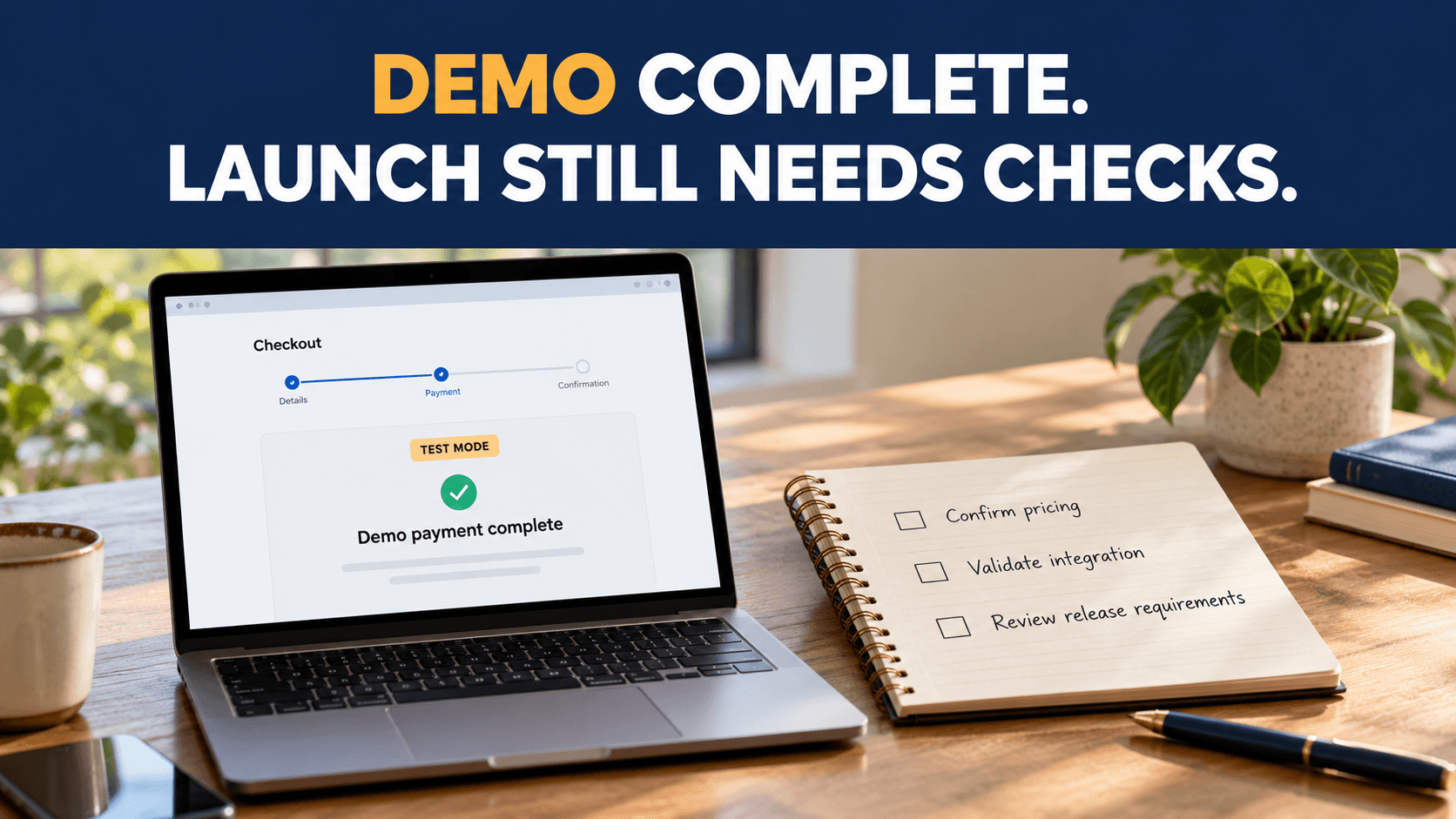
A purchase flow was demonstrated using placeholder pricing. Later records still described payments as unresolved and placed them in a subsequent phase.
The available evidence therefore supports a payment demonstration and an ongoing scope decision. It does not establish complete commercial purchasing.
This distinction matters because a visible purchase screen represents only part of the journey. Final pricing, payment behavior, access and transaction handling need confirmation against the agreed implementation.
The meeting discussions also should not be treated as authoritative guidance on current app-store rules.
For this case study, the relevant point is how purchasing affected scope and sequencing.
The team also made a specific platform decision: administration would remain on the web.
A mobile admin panel was excluded from the discussed scope because the mobile application was intended for members. Adding administration there would require additional work.
That created a clear division between member participation and platform operation.
Other capabilities remained outside confirmed delivery. Automated AI video moderation was not implemented in the reviewed July discussion, while a complete marketplace and real-world reward spending remained future ambitions.
These boundaries help explain the product’s development stage.
The community foundation could be demonstrated while broader commercial and operational systems continued to require work.
The records do not establish that every deferred capability was permanently rejected. They establish that the wider vision exceeded the verified scope of the demonstrated product.
The strongest supported outcome is progression from concept materials into working web and mobile demonstrations and private test distribution.
| Area | Supported account |
| Product definition | Journeys, requirements, designs and phase planning were developed |
| Social workflows | Feed interactions, reels and messaging were demonstrated |
| Communities | Creation, membership and management flows were demonstrated |
| Surveys | Participation and created/participated history were demonstrated |
| Administration | Access-review and advertising-related workflows were described |
| Release preparation | Android testing and iOS TestFlight access were reported |
| Remaining uncertainty | Public launch, final acceptance, handover and complete commercial behavior |
| Business impact | Adoption, retention, engagement and revenue improvements were not measured in the supplied evidence |
Some demonstrations also exposed unresolved issues, including an advertisement that did not display during a review. Its cause and resolution were not confirmed.
The latest substantive project evidence in the intake is from October 1, 2026. The later website capture provides a positioning reference but does not independently resolve the outstanding release questions.
A stronger results assessment would require accepted scope, release records, QA sign-off and production usage data.
For founders planning a social product with participation rewards, this engagement highlights 5 questions:
For this platform, the most useful decisions emerged when broad concepts became specific behavior.
Reward discovery needed a different flow from a conventional marketplace. Community leadership needed clearer boundaries. Delivery phases needed a shared meaning.
Mediusware’s reported work helped turn those questions into product discussions, designs and working demonstrations.
Verifying the final behavior and measuring real-world use remain the next steps in assessing the product’s impact.
Building a community platform with social features and participation rewards? Let's Discuss your user journeys, reward rules, administrative roles and release priorities with Mediusware to define a focused development scope.
It combines social interactions, such as joining communities and sharing content, with participation mechanics such as rewards, challenges and status.