- Learn how to evaluate API development companies before investing in your SaaS product.
- Discover practical criteria for selecting a scalable, secure, and reliable API development partner.
How to Choose an API Development Company for Your SaaS Product
6 min read
Most SaaS founders do not regret choosing the wrong API development company during the first sprint. They regret it months later, when every new integration takes longer, enterprise clients ask for security controls the API cannot support, documentation is missing, and switching teams becomes expensive.
That is why choosing an API development partner is not just a technical decision. It affects your roadmap speed, customer experience, product scalability, vendor dependency, and long-term engineering cost.
The right API development company should understand your product, users, workflows, data, security expectations, and commercial goals before recommending REST, GraphQL, microservices, or any specific technical approach.
By the end of this guide, you should know what to check, what proof to ask for, which warning signs to watch, and how to compare API development companies before investing in your SaaS product.
Start With Your Product Requirements Before Comparing Companies
Before comparing API development companies, define what your SaaS product actually needs.
You do not need a complete technical specification, but you should be clear about the business problem, intended users, required integrations, security expectations, and likely growth.
This early clarity also improves the wider custom software development process because every vendor receives the same starting information. Their questions, assumptions, estimates, and recommendations become easier to compare.
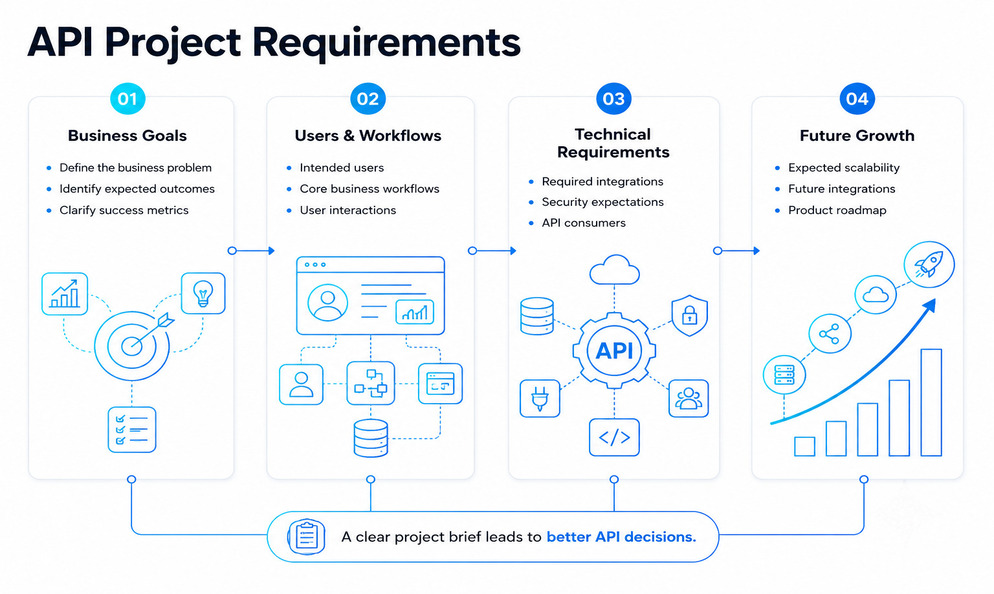
1. Define the Business Problem
Start with the outcome, not the technology.
A weak requirement sounds like this:
We need an API for our SaaS product.
A stronger requirement would be:
We need enterprise customers to sync billing and account data with their internal systems without using manual exports.
The second version explains the user, the workflow, and the expected result. A reliable API development company should understand the business problem before recommending REST, GraphQL, or any specific architecture.
2. List the Required Integrations
Identify the systems the API must connect, such as:
- payment gateways
- CRM or ERP platforms
- authentication providers
- internal databases
- web or mobile applications
- customer or partner systems
This helps vendors identify technical dependencies, access requirements, rate limits, and possible risks early. A strong partner should explain where uncertainty exists instead of treating every integration as equally simple.
3. Clarify Who Will Use the API
An internal API has different requirements from a public or partner-facing API.
Clarify whether the API will be used by:
- your internal team
- your web or mobile product
- enterprise customers
- partners
- third-party developers
This affects documentation, access control, versioning, monitoring, and support. It also helps you judge whether the company has experience with the type of API your product needs.
4. Plan for Future Growth
Your API should support future growth without becoming unnecessarily complex.
Think about:
- expected usage
- future integrations
- enterprise requirements
- new product features
- changes to data or workflows
Ask each vendor:
What should we build now, what can wait, and what may require architectural changes later?
A strong answer should explain the trade-offs rather than promise unlimited scalability.
5. Prepare a Simple Project Brief
Before requesting proposals, document:
- the business objective
- intended users
- required integrations
- main workflows
- security needs
- expected growth
- current technology
- preferred timeline
This brief gives every company the same context, so you can compare the quality of their thinking instead of only comparing price.
Evaluate Relevant API Experience, Not Just General Development Skills
Many software companies can build applications. That does not mean they can build the right API for your SaaS product.
API development is more than writing code. It involves designing secure integrations, handling data between systems, supporting future growth, and making sure the API remains reliable as your product evolves.
That is why you should look for relevant API experience, not just general software development experience.
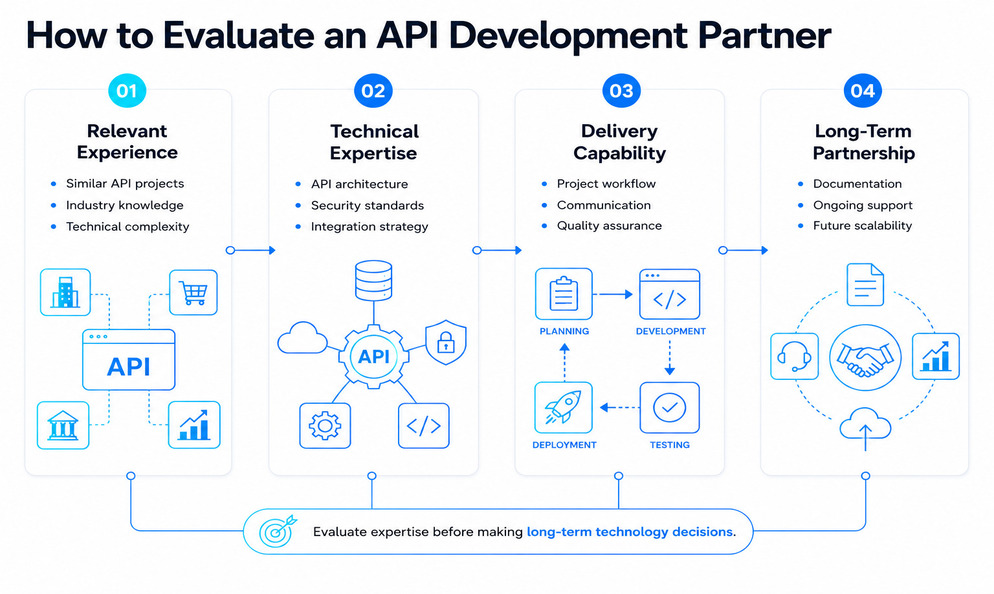
1. Look for Similar API Projects
A company does not need experience in your exact industry, but it should have solved problems similar to yours.
For example, ask if they have built APIs that:
- connect with third-party platforms
- support web and mobile applications
- handle secure authentication and user permissions
- process large amounts of data or traffic
- integrate with enterprise systems
Similar technical experience is often more valuable than industry experience alone.
2. Ask for Proof, Not Promises
Ask to see comparable work, measurable outcomes, and the engineering decisions behind it. A useful starting point is the company’s case study portfolio, but do not stop at screenshots or client logos.
Useful questions include:
- Can you show a similar API or SaaS integration project?
- What technical challenges did you face?
- How did you solve them?
- What changed for the client after delivery?
- What would you do differently if you rebuilt it today?
The goal is not to see a long client list. It is to understand how the team solves real engineering and product problems.
Third-party review platforms can also help you validate a company before adding it to your shortlist.
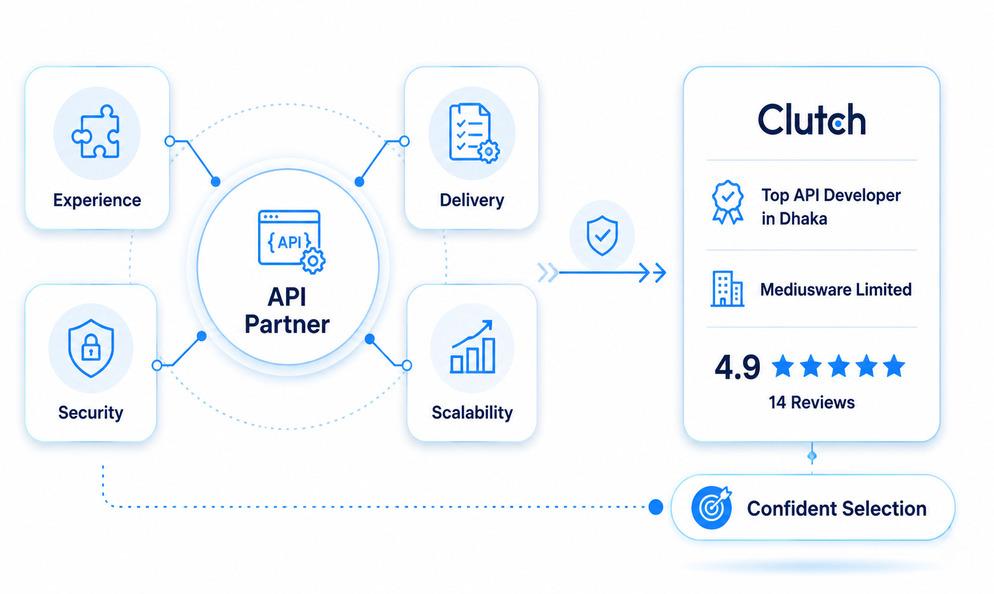
For example, Mediusware is listed on Clutch among API development companies in Dhaka, with a 4.9 rating from 14 client reviews as of July 2026. Review platforms such as Clutch can help SaaS founders look beyond sales claims and evaluate signals such as client satisfaction, project delivery, communication, cost effectiveness, and relevant service experience.
Still, reviews should not replace technical due diligence. Use them to create your shortlist, then validate each company through case studies, architecture discussions, documentation standards, security practices, and ownership terms.
One way to evaluate technical expertise is to look at measurable business outcomes.
For example, Mediusware partnered with Bulk.ly, an AI-powered social media automation platform, to help scale its product and engineering capabilities.
The project delivered measurable results, including:
- A 90% reduction in manual scheduling
- A 35% increase in user engagement with AI-powered content optimization
- A 35% increase in user engagement with AI-powered content optimization
3. Know Who Will Build Your API
The person selling the project is not always the person building it.
Before making a decision, ask:
- Who will lead the project?
- Who will design the API?
- Will senior engineers review the work?
- Who will be my main technical contact?
Knowing who is responsible helps you judge the experience of the actual delivery team, not just the confidence of the sales conversation.
4. Watch for Generic Answers
Be careful if every answer sounds the same.
Statements like:
- We build scalable APIs.
- We follow best practices.
- We have years of experience.
sound impressive, but they tell you very little. A strong company should explain why they made certain decisions, how they solved difficult problems, and what the results were.
The more specific their answers, the more confidence you can have in their experience.
A good API development company does not ask you to trust its claims. It earns your trust by showing relevant experience and explaining how it solves problems like yours.
Use an API Development Company Evaluation Framework
Once you have a shortlist, compare each company using the same criteria. This reduces emotional decision-making and helps you avoid choosing based on price, brand polish, or a confident sales presentation alone.
| Evaluation Area | Strong Signal | Red Flag |
| Relevant API experience | Shows similar SaaS/API projects and explains technical decisions. | Only says 'we build scalable APIs.' |
| Product understanding | Asks about users, workflows, business goals, and growth plans. | Jumps straight to technology choices. |
| Security approach | Explains authentication, authorization, access control, and monitoring. | Gives vague answers about best practices. |
| Documentation | Includes API documentation, handover notes, endpoint details, and ownership terms. | Treats documentation as optional. |
| Delivery process | Shows sample updates, milestones, risks, and responsibilities. | Only promises regular communication. |
| Ownership | Clearly states source code, documentation, and infrastructure access rights. | Avoids ownership discussion. |
| Post-launch support | Explains maintenance, monitoring, change requests, and support windows. | Ends responsibility after launch. |
Find Out How the Company Will Deliver Your API
Before signing, do not ask whether the company communicates well. Test how it reports progress, assigns responsibility, and handles problems.
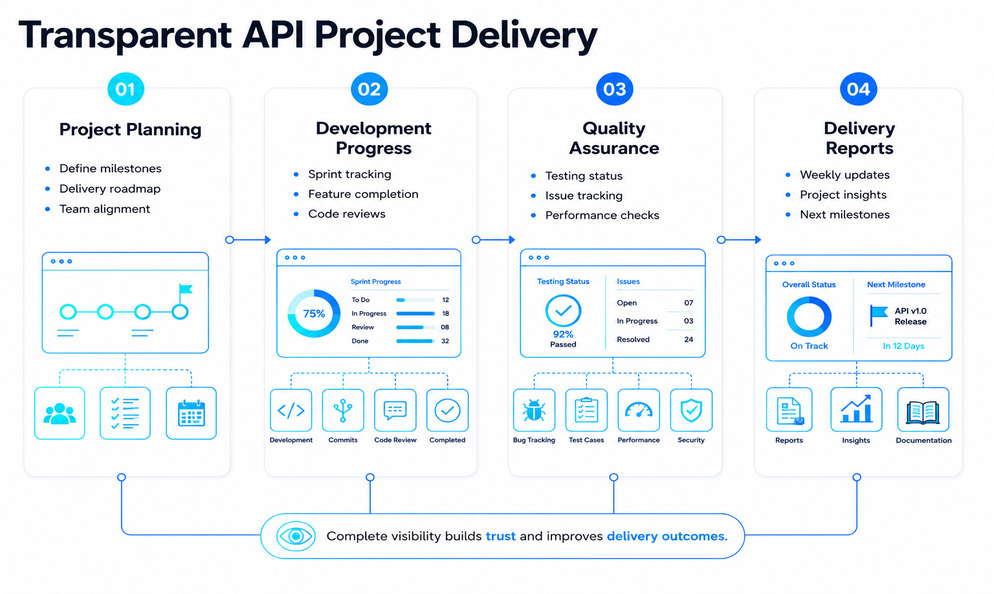
1. Ask to See a Real Project Update
Most companies promise regular updates. Ask to see a sample report, dashboard, or weekly summary.
A useful update should show:
- Completed work
- Work in progress
- Upcoming milestones
- Current risks
- Decisions needed from you
This shows whether the company communicates clearly or simply sends vague status messages.
2. Confirm Who Owns Each Decision
The person leading the sales call may not stay involved after the contract is signed.
Ask:
- Who will be my main contact?
- Will I have access to the technical lead?
- Who approves technical decisions?
- Who is responsible if the timeline changes?
You should know who manages communication, who manages delivery, and who can make decisions without creating unnecessary delays.
3. Ask About a Project That Went Wrong
Do not ask whether projects ever face problems.
Ask for a real example:
Tell me about a recent project that did not go as planned. What happened, and how did you handle it?
A strong answer should explain:
- What caused the problem?
- When the client was informed?
- What action the team took?
- What changed afterward?
Be cautious if the answer is only "We solved it quickly." That gives you no proof of honesty, accountability, or learning.
4. Clarify How Changes Affect Cost and Time
Feedback and new requirements can change the scope of the project.
Before hiring the company, ask:
- When will you review the work?
- How are change requests approved?
- How will extra work affect the budget?
- How many revision rounds are included?
These answers help you avoid surprise charges, unclear responsibilities, and disputes later.
The way a company communicates during the sales process is often the best preview of how it will communicate after the project begins. Ask for evidence, not reassurance.
Understand Who Owns the Code and Documentation
A successful API project should leave you with more than a working product. It should leave you with control over the system.
Before signing a contract, understand what you will own when the project is complete. This helps you avoid vendor lock-in and makes future updates easier.
1. Confirm Who Owns the Source Code
Ask who will own the source code after the project is delivered. The agreement should clearly state that you own the code unless both sides agree otherwise. This prevents confusion if you decide to work with another development team in the future.
2. Make Sure Documentation Is Included
Documentation is just as important as the code itself. Standards such as the OpenAPI Specification can help teams describe endpoints, authentication methods, request and response formats, error handling, and versioning.
Well-documented APIs make future maintenance, onboarding, third-party integrations, and internal handovers significantly easier.
3. Check Access to Infrastructure and Accounts
Before signing, understand who controls hosting, repositories, CI/CD pipelines, API keys, cloud accounts, monitoring tools, and documentation spaces.
If the vendor controls too much without a clear handover process, future changes can become slow and expensive.
Red Flags to Watch Before Hiring an API Development Company
Be careful if a company:
- Cannot explain similar API projects
- Gives vague answers about security
- Does not include documentation in the scope
- Cannot show how project progress is reported
- Avoids questions about source code ownership
- Promises unlimited scalability without trade-offs
- Does not explain how change requests affect cost and timeline
- Cannot identify risks in your API requirements
Security should also be evaluated early. The OWASP API Security Top 10 is a useful reference for understanding common API risks such as broken authorization, poor inventory management, unsafe authentication patterns, and unrestricted access to sensitive business flows.
A reliable partner should be comfortable discussing constraints, trade-offs, and risks before development begins.
Compare Proposals Based on Value, Not Just Price
The lowest price does not always offer the best value. Likewise, the most expensive proposal is not automatically the best choice.
Instead of comparing numbers, compare what each company will actually deliver.
1. Compare the Scope of Work
Review each proposal carefully.
Check whether it includes:
- API design
- Development
- Testing
- Documentation
- Deployment
- Post-launch support
A lower price may simply mean that important services are missing.
2. Understand What Is Included
Ask what happens if the project changes.
Find out:
- How revisions are handled?
- What counts as additional work?
- Whether support is included after launch?
These details often have a bigger impact than the initial project cost.
3. Look Beyond the Initial Budget
A cheap build can become expensive when releases slow down, defects multiply, or the architecture must be rewritten. The hidden cost of slow SaaS development often appears as delayed revenue, missed integrations, growing technical debt, and reduced customer trust.
Choose the company that offers the strongest long-term value, not simply the lowest quote.
Compare Your Final Shortlist Before Making a Decision
Once you have narrowed your options, compare every company using the same criteria.
This makes the decision more objective and helps you avoid choosing based on price or a polished sales presentation alone.
1. Compare Each Company Side by Side
Review each company based on:
- Relevant API experience
- Delivery process
- Communication
- Security approach
- Ownership terms
- Support after launch
- Overall value
Using the same checklist for every company makes differences much easier to identify.
2. Ask for Client References
If possible, speak with one or two previous clients.
Ask questions such as:
- Was the project delivered on time?
- How did the team handle unexpected challenges?
- Would you work with them again?
Real client feedback often reveals details that proposals cannot.
3. Trust Evidence Over Promises
A good sales presentation is helpful, but it should never be your only reason for choosing a company.
Look for real examples, clear processes, and honest answers throughout your evaluation.
The best decision is based on evidence, not confidence. Choose the company that consistently proves its capabilities, not the one that makes the biggest promises.
Final Verdict
Before hiring an API development company, make sure you can answer "Yes" to these questions:
- Have I clearly defined my API requirements?
- Does the company have experience with similar API or SaaS integration projects?
- Can the company explain its delivery process clearly?
- Does the proposal include documentation, testing, support, and handover?
- Have I checked reviews, references, or case studies instead of relying only on sales claims?
- Are source code ownership and infrastructure access clearly defined?
- Will I know who owns technical decisions and communication?
Choosing the right API development company is not only about finding skilled engineers. It is about finding a partner that understands your business, challenges assumptions, follows a reliable process, communicates openly, and leaves you in control of the product.
If you are planning an API build for a SaaS product, Mediusware can help you evaluate requirements, integration risks, architecture options, delivery scope, and long-term maintainability before development begins.
Frequently Asked Questions
Choose a company with relevant API experience, strong documentation practices, clear ownership terms, secure development standards, transparent delivery processes, and SaaS product experience. Do not compare vendors only by price.

I work with founders and leadership teams when growth moves faster than their systems, teams, or decisions. I’ve led 850+ projects for 750+ clients across 20+ countries, working across 100+ technologies and counting. I care about ownership, clarity, and building things that last beyond the launch.
Featureblogs
Relatedblogs
01
Introduction to System Design | System Design Course Pro | Part 102
The Art of Simplicity - How Minimalism Improved UI/UX Design03
The Software Development Life Cycle (SDLC): A Complete Guide04
Which Approach Is Best for Your Software Development Team: Scrum vs. Kanban05
How to adapt the Agile process to modern software developmentAuthorblogs
01
SaaS MVP Development: A Founder’s Guide for 202702
Zero Clicks, Falling Traffic: How to Win Back Revenue03
Ranking on Google in 2026: What Matters in the Age of AI Search04
Why Software Companies Are Turning to Strategic Partnerships for Faster Growth05
Your SaaS Isn’t Slow Because of Developers It’s a Scaling Problem