- NetSuite implementation brings clarity, but poor planning leads to costly mistakes and rework later.
- Success depends on alignment, simple configuration, clean data, and structured execution across phases.
NetSuite Implementation: What Makes It succeed
1 min read
You don’t decide to implement NetSuite because things are going perfectly.
It usually starts with friction.
Numbers don’t match. Reports need double
checking. Teams argue over “truth.”
Growth is happening. But control is slipping.
That’s where NetSuite comes in.
It promises clarity at scale. But here’s the part
most teams underestimate:
A bad implementation doesn’t fail loudly. It quietly slows everything down.
So the real question is simple:
How do you get control without creating long-term chaos?
Why NetSuite Implementation Feels Like Both Progress and Risk
NetSuite aligns your business.
One system. One data source. One workflow.
That sounds simple.
But alignment exposes reality:
- Processes were never fully agreed on
- Metrics mean different things across teams
- Manual fixes were hiding deeper problems
NetSuite doesn’t create issues.
It reveals them.
That’s why some companies scale faster after implementation…
While others lose confidence in the system they just paid for.
What NetSuite Implementation Actually Means
NetSuite implementation is not software setup.
It’s translating how your business should run into a system that enforces it.
Let’s make it real.
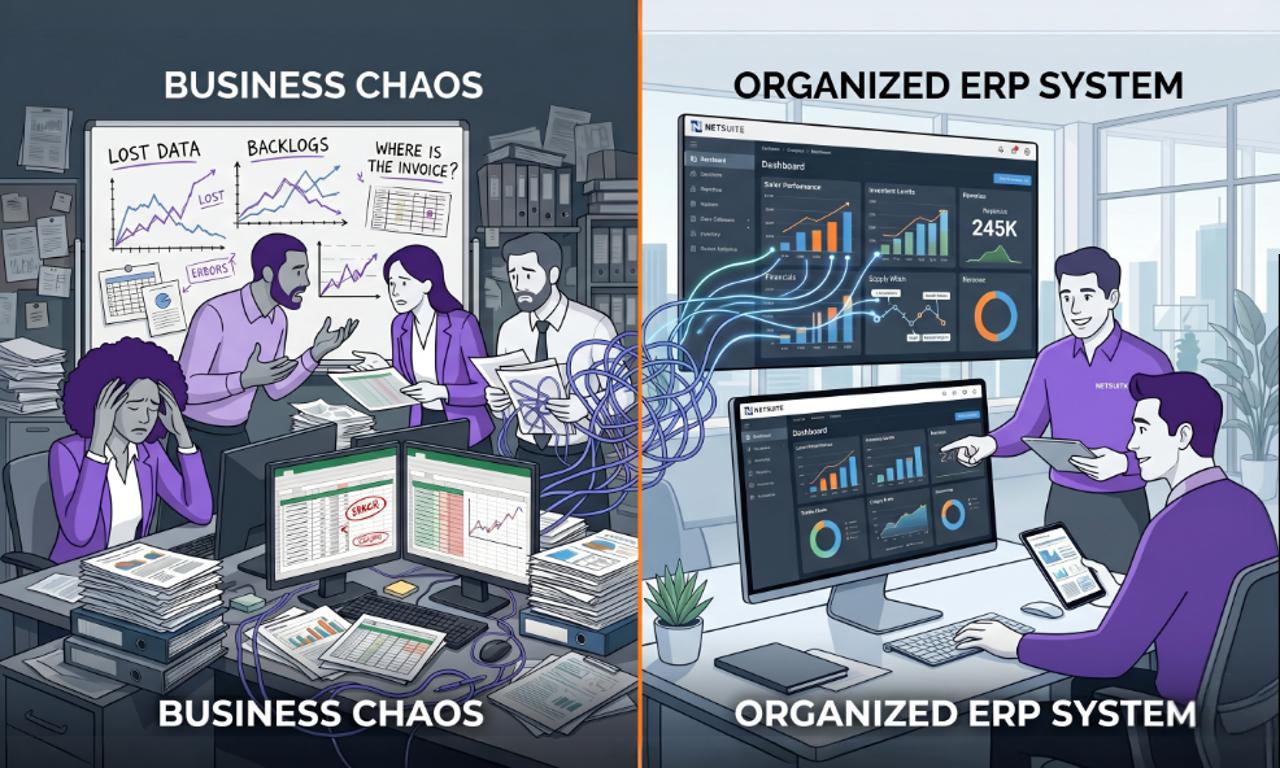
1. Before NetSuite:
- Inventory tracked in spreadsheets
- Finance always catching up
- Leadership double-checking reports
2. After NetSuite:
- Real-time inventory visibility
- Structured order workflows
- Consistent revenue tracking
The difference?
Discipline.
And that’s where long-term value compounds.
NetSuite Implementation Phases
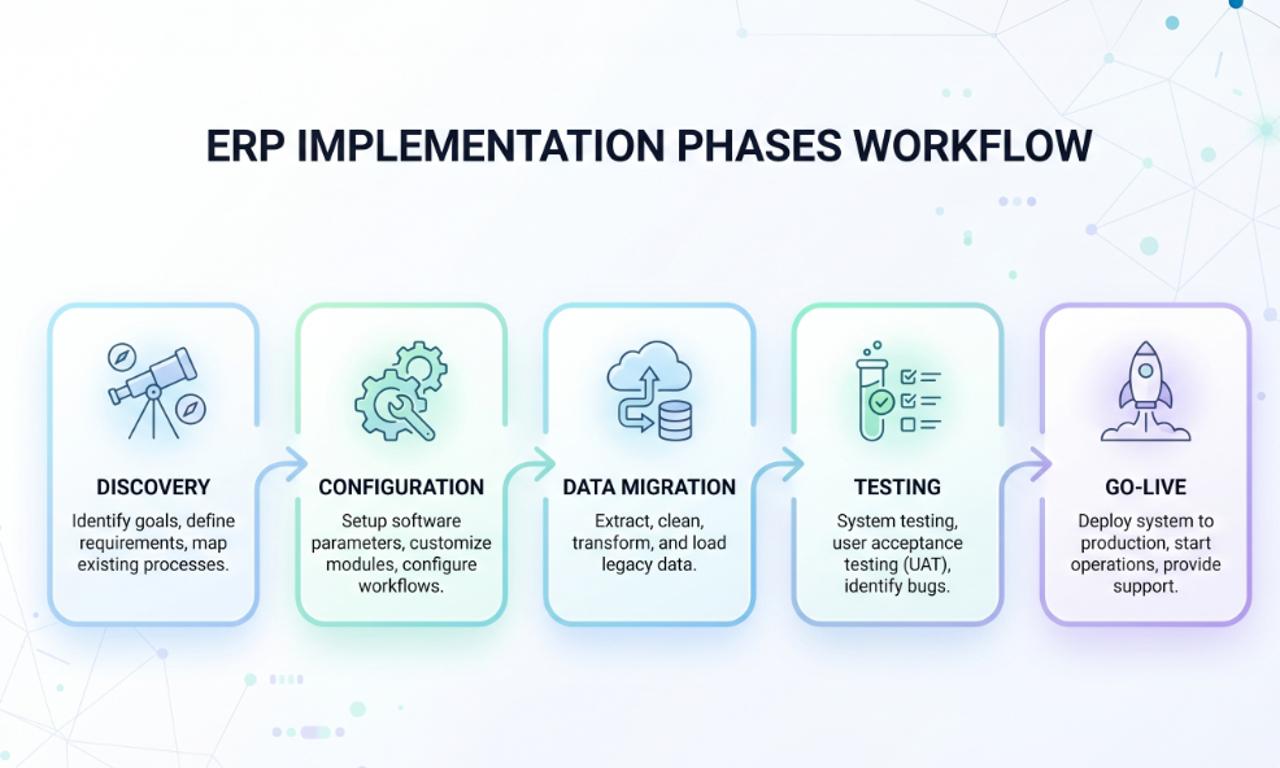
To reduce complexity, think in phases.
Each phase has one job.
Phase 1: Discovery and Alignment
Goal: Clarity
Strong teams:
- Map real workflows
- Agree on metrics early
- Challenge unnecessary complexity
Weak teams:
- Assume alignment exists
- Skip edge cases
- Delay decisions
Phase 2: Configuration vs Customization
Goal: Simplicity
| Approach | Short-Term Effect | Long-Term Effect |
| Configuration-first | Faster rollout | Easier upgrades |
| Heavy customization | Feels tailored | Higher maintenance |
| Balanced hybrid | Flexible | Sustainable |
Most teams fail here.
They try to rebuild old workflows instead of improving them.
Phase 3: Data Migration
Goal: Trust
Data defines confidence.
Best practices:
- Clean before migration
- Validate samples, not assumptions
- Migrate only what matters
According to Oracle NetSuite documentation, irrelevant legacy data should be archived, not migrated.
Phase 4: Testing and User Readiness
Goal: Confidence
Testing is not clicking buttons.
It answers real questions:
- Can finance close the month smoothly?
- Can ops handle exceptions?
- Can leadership trust dashboards immediately?
Adoption starts before go-live, not after.
Phase 5: Go-Live and Stabilization
Goal: Control
This is the most fragile stage.
Strong teams plan for:
- Rapid issue resolution
- Controlled changes
- Clear ownership
Silence after go-live usually means hidden problems.
Common NetSuite Implementation Mistakes
Across projects, patterns repeat:
- Treating ERP as an IT project
- Over-customizing to avoid change
- Ignoring internal decision fatigue
- Choosing partners based on cost
The result?
More rework. More confusion. More cost.
In-House vs Partner-Led NetSuite Implementation
| Model | Works Best When | risk |
| In-house | Strong ERP experience exists | Slow learning |
| Partner-led | Speed and structure matter | Context gaps |
| Hybrid | Clear Shared ownership | Role confusion |
Most mid-market companies succeed with a hybrid model.
Because ERP is not just technical. It’s operational.
What Actually Drives Implementation Cost
Costs increase due to:
- Deep customization
- Complex data structures
- Multiple entities
- Post-launch changes
Ironically, rushed implementations cost more later.
How to Know If You’re Ready
You’re ready if:
- Leadership agrees on metrics
- Processes are documented
- Ownership is clear
- You’re open to change
If not, NetSuite will force those conversations anyway.
What We’ve Learned from Real Systems
At Mediusware, we’ve built platforms where system clarity directly impacts growth.
For example, platforms like CRM Runner show how centralized data and workflows:
- Improve decision-making
- Reduce operational friction
- Enable scalable growth
That same principle applies to ERP systems.
Structure drives scale. Not tools alone.
Frequently Asked Questions
Usually 3 to 9 months.
Complex setups take longer due to data and customization.

I work at the point where product decisions, system architecture, and engineering execution meet. At Mediusware, I’m accountable for how technology choices affect reliability, scale, and long-term delivery for our clients.
Featureblogs
01
Why Software Companies Are Turning to Strategic Partnerships for Faster Growth02
The 12 Most Powerful LLMs: Powering Tomorrow’s Tech Landscape03
C# vs. Java: Key Differences, Advantages, and Future Prospects04
Is Golang Still the Right Choice in 2025?05
Haptic Feedback: Why Touch is Becoming the Most Powerful Experience in Tech01
Why Software Companies Are Turning to Strategic Partnerships for Faster Growth02
The 12 Most Powerful LLMs: Powering Tomorrow’s Tech Landscape03
C# vs. Java: Key Differences, Advantages, and Future Prospects04
Is Golang Still the Right Choice in 2025?05
Haptic Feedback: Why Touch is Becoming the Most Powerful Experience in TechRelatedblogs
01
How to Create a Stunning WordPress Website in 2024: Step-by-Step Tutorial02
How Mediusware Empowered Protesters, Strengthened the Economy & Showcased Employee Resilience in the 2024 Movement03
Mastering Error Handling in Rust with Essential Techniques04
Best Practices for Writing Clean Code05
Let's Deep Dive Into Threads with RustAuthorblogs
01
How Digital Agencies Can Deliver Custom Software Without Hiring Developers02
AI in FinTech: Build, Buy, or Integrate? A Founder's Decision Framework03
How to Choose a SaaS MVP Development Company04
How Seed-Stage SaaS Teams Add Engineering Capacity Without Hiring Chaos05
Why Seed-Stage SaaS Startups Struggle to Ship Fast