- SaaS teams waste time on reporting, support, onboarding, CRM, and meetings.
- AI fixes repeated workflows so teams move faster and focus better.
Where SaaS Companies Waste Time And How AI Fixes It
1 min read
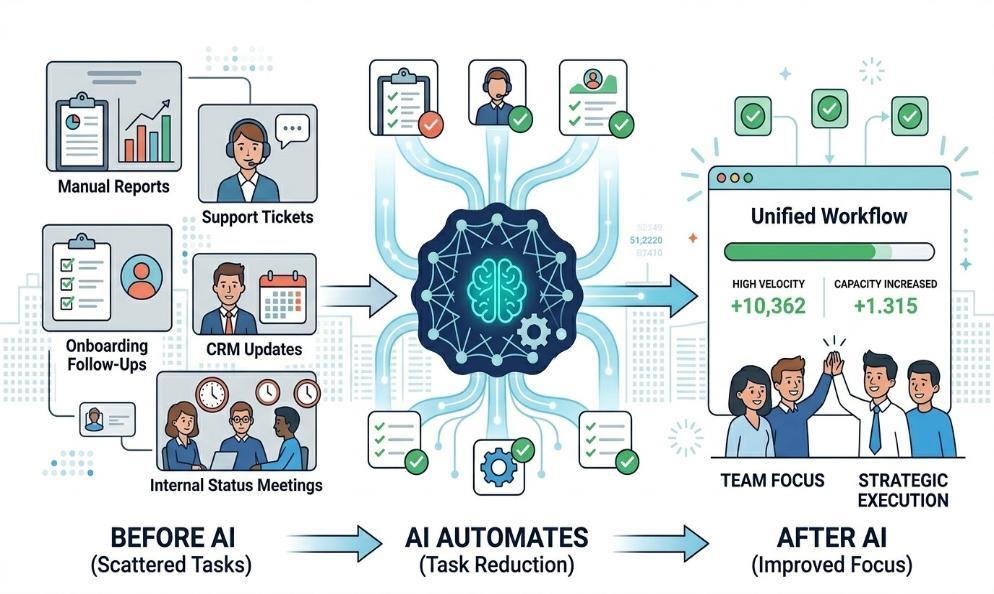
After years of working with SaaS teams, one pattern becomes clear fast: the team is not always slow because they lack talent.
They are slow because their best people spend too much time on repeated work.
Reports are prepared manually.
Support teams answer the same questions.
Customer success follows up one account at a time.
Sales reps update CRM instead of talking to prospects.
These tasks look small alone.
But together, they drain speed, focus, and growth.
Growth does not always slow down because the product is weak or the team lacks talent. It happens when inefficient processes bog down teams.
That’s where AI becomes valuable, not as hype, but as a way to remove repeated work and help SaaS teams move faster.
Quick Summary: Where SaaS Teams Waste Time
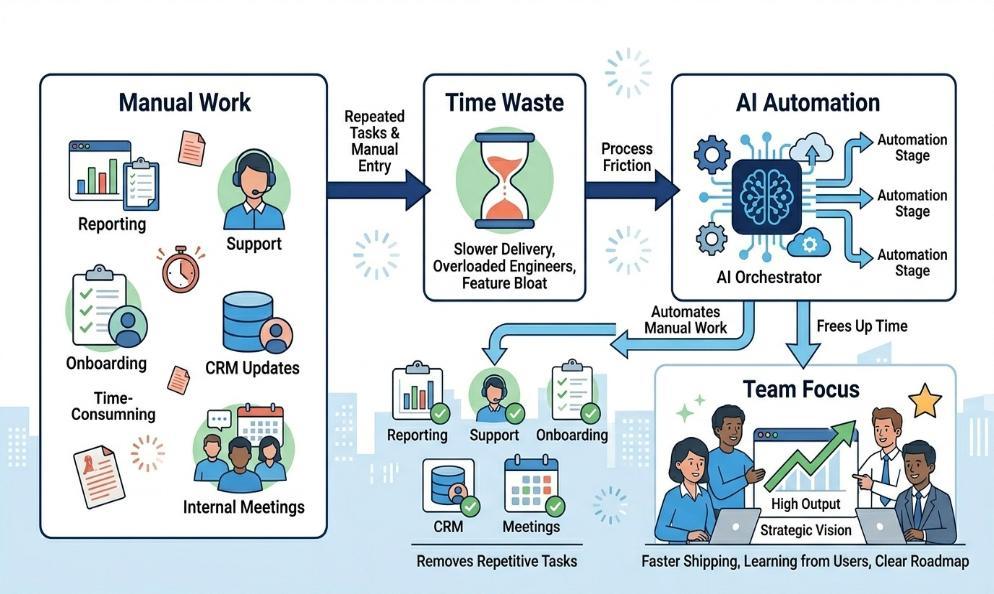
Most SaaS companies lose valuable time in five key areas:
- Reporting: Time-consuming manual data collection and analysis.
- Support: Answering the same questions over and over.
- Onboarding: Manual follow-ups with users who haven’t reached key milestones.
- Sales Admin: Reps spending more time updating CRM records than selling.
- Internal Updates: Teams holding meetings to piece together scattered context.
AI helps by removing repetitive tasks, allowing your team to focus on more strategic work.
Now, let's dive into the top five areas where AI can make the biggest difference in saving time and boosting efficiency:
1. Manual Reporting Slows Down Decisions
In most SaaS companies, reporting is a major time sink.
Someone pulls data from product usage, CRM systems, support tickets, and spreadsheets.
They clean the data.
They create summaries.
By the time the report is ready, the information could already be outdated.
The problem is not just the time spent preparing reports. The real issue is slower decision-making.
AI can solve this problem by automatically pulling data from multiple sources, analyzing it, and summarizing the key insights. For example:
- Which customers are showing signs of churn?
- Which feature is being used most?
- Which onboarding step is causing users to drop off?
In a study by the Federal Reserve Bank of St. Louis, workers using generative AI saved 5.4% of their weekly work hours, about 2.2 hours per week for a 40-hour worker.
For SaaS teams, this means faster insights and better decision-making with minimal manual work.
For teams needing better reporting systems, Mediusware’s Custom Software Development can help build integrated dashboards and automation solutions that connect your data streams.
2. Support Teams Repeat the Same Answers
Support is one of the biggest drains on SaaS teams’ time.
Support teams spend a lot of time answering repeated questions such as:
- How do I reset my password?
- Why is my billing not updated?
- How do I connect this integration?
- Where can I find this feature?
These questions are critical, but they don’t always require human intervention from the start.
How AI Fixes It
AI can serve as the first line of support, offering instant responses to commonly asked questions.
It can:
- Automatically read help docs
- Suggest answers to customers
- Summarize tickets for the support team
- Route issues to the right team
- Detect recurring issues for proactive action
This does not replace the support team; it empowers them by giving them more time to focus on complex problems.
AI agents that can automate tasks across workflows are a great solution. Mediusware’s AI Agent Development offers solutions that optimize support workflows and save time.
3. Onboarding Depends Too Much on Manual Follow-Up
SaaS onboarding is where customers decide if your product is worth keeping. If users do not reach value quickly, they leave.
The issue is that many onboarding processes are still generic. Every user gets the same sequence of emails. Customer success teams manually track progress, often missing critical signs that high-value users are at risk.
How AI Fixes It
AI can make onboarding smarter and behavior-driven. Instead of sending the same email to everyone, AI can respond to user actions.
For example:
- If a user skips setup, AI sends them a personalized guide.
- If a user does not activate a key feature, AI alerts customer success.
- If a high-value user shows low activity, the team gets an alert to take action.
This ensures that users are supported proactively, and customer success teams can focus their time where it matters most.
For SaaS companies with complex onboarding processes or integrations, Mediusware’s SaaS Development Services can help streamline your onboarding workflow while integrating AI-powered solutions for scaling efficiently.
4. Sales Teams Spend Too Much Time Before Selling
Sales teams often spend hours doing administrative work rather than talking to prospects.
They:
- Research leads manually
- Update CRM records
- Write follow-up emails
- Summarize previous calls
How AI Fixes It
AI can support sales teams by automating repetitive tasks such as:
- Summarizing calls
- Updating CRM
- Scoring leads
- Researching accounts
- Drafting emails
The goal is to get salespeople back to what they do best: selling.
For example, AI can analyze a lead’s data and tell the sales rep:
This prospect mentioned budget approval next month. No follow-up has been sent in 10 days. Suggested email prepared.
AI helps teams stay organized without slowing down, which is crucial for fast-moving SaaS sales cycles.
5. Tool Sprawl Quietly Wastes Budget and Focus
SaaS companies often buy tools to improve efficiency, but those tools quickly become another thing to manage.
- One team uses one project management tool.
- Another team uses a different one.
- Marketing uses one stack.
- Sales uses another.
Soon, nobody has a complete view.
How AI Fixes It
AI can help reduce tool sprawl by identifying unused licenses, duplicate tools, and inefficiencies.
It can:
- Automatically track tool usage
- Flag unused licenses before renewal
- Suggest consolidations
This gives leadership better insight into the tools that are truly valuable and those that are just adding complexity.
The result: better decision-making and a cleaner tech stack.
6. Meetings Happen Because Context Is Scattered
Many SaaS meetings happen because context is missing.
Teams meet to ask:
- What’s the status?
- Who owns this?
- What changed?
- Why is this delayed?
- What did the customer say?
AI can reduce unnecessary meetings by summarizing discussions, generating action items, and providing weekly updates.
Instead of repeating status checks, AI can provide a detailed summary of everything that has happened since the last meeting.
For example:
Three features shipped. Two bugs remain open. One enterprise customer is waiting on integration support. Billing update is blocked by API review.
This type of summary saves time and prevents context from getting lost in a meeting.
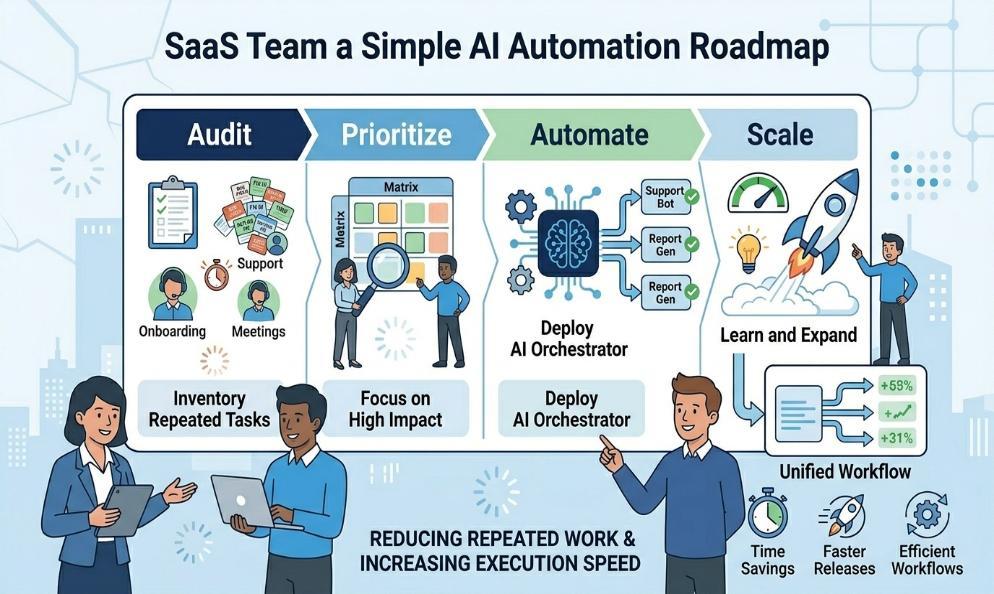
What SaaS Companies Should Automate First
AI can make a huge impact, but not every process should be automated right away.
Start with workflows that are repeated frequently and have a measurable business impact.
For example:
- Support automation can be a great first step.
- Reporting automation saves time across teams.
- CRM updates can be automated to ensure better lead management.
- Onboarding workflows can be made smarter with AI-powered alerts.
AI is most effective when it removes manual work without adding complexity.
Stop Letting Repeated Work Slow Your SaaS Growth
If your SaaS team is still spending hours on manual reports, repeated support questions, slow onboarding checks, CRM updates, and status meetings, you are not just losing time.
In SaaS, speed affects product delivery, customer experience, sales follow-up, retention, and team focus. AI automation is no longer just a nice-to-have, it’s a game-changer for scaling efficiently.
At Mediusware, we help SaaS Dev teams identify wasted time, design practical AI workflows, and build automation systems to reduce manual work without adding complexity.
Frequently Asked Questions
SaaS companies waste time on manual reporting, repeated support tickets, onboarding follow-ups, CRM updates, and tool management.

I work at the point where product decisions, system architecture, and engineering execution meet. At Mediusware, I’m accountable for how technology choices affect reliability, scale, and long-term delivery for our clients.
Featureblogs
Relatedblogs
Authorblogs
01
How Digital Agencies Can Deliver Custom Software Without Hiring Developers02
AI in FinTech: Build, Buy, or Integrate? A Founder's Decision Framework03
How to Choose a SaaS MVP Development Company04
How Seed-Stage SaaS Teams Add Engineering Capacity Without Hiring Chaos05
Why Seed-Stage SaaS Startups Struggle to Ship Fast