- Seed-stage SaaS teams can expand engineering capacity without chaos.
- Structured augmentation accelerates delivery while maintaining product quality.
How Seed-Stage SaaS Teams Add Engineering Capacity Without Hiring Chaos
1 min read
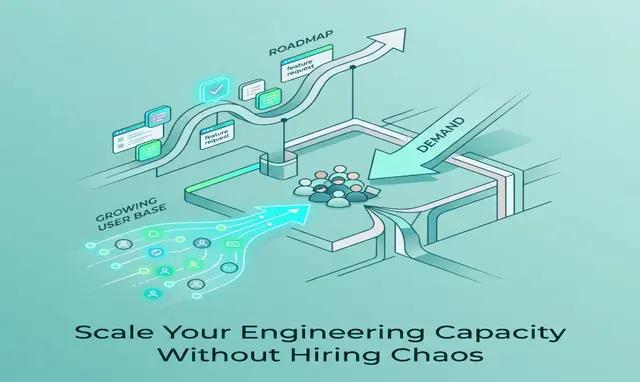
Most seed-stage SaaS teams reach a point where the roadmap grows faster than the engineering team can handle.
The obvious answer seems to be hiring more developers. But hiring takes time, adds management load, and often creates more coordination problems before it creates speed.
What founders actually need is not just more people. They need reliable engineering capacity, clear ownership, and a delivery system that can move without constant founder involvement.
This article breaks down how seed-stage SaaS teams can add engineering capacity without turning hiring, onboarding, and delivery into chaos.
Why Adding Engineering Capacity Becomes Chaotic
Seed-stage SaaS teams usually add engineers when the product is already under pressure.
Features are delayed. The founder is chasing updates. Existing developers are handling too many priorities at once.
But adding people without a clear delivery structure can slow the team down before it speeds anything up.
Every new developer adds onboarding, coordination, code review, communication, and management overhead.
The problem is not always a lack of developers.
The real problem is adding capacity without a system.
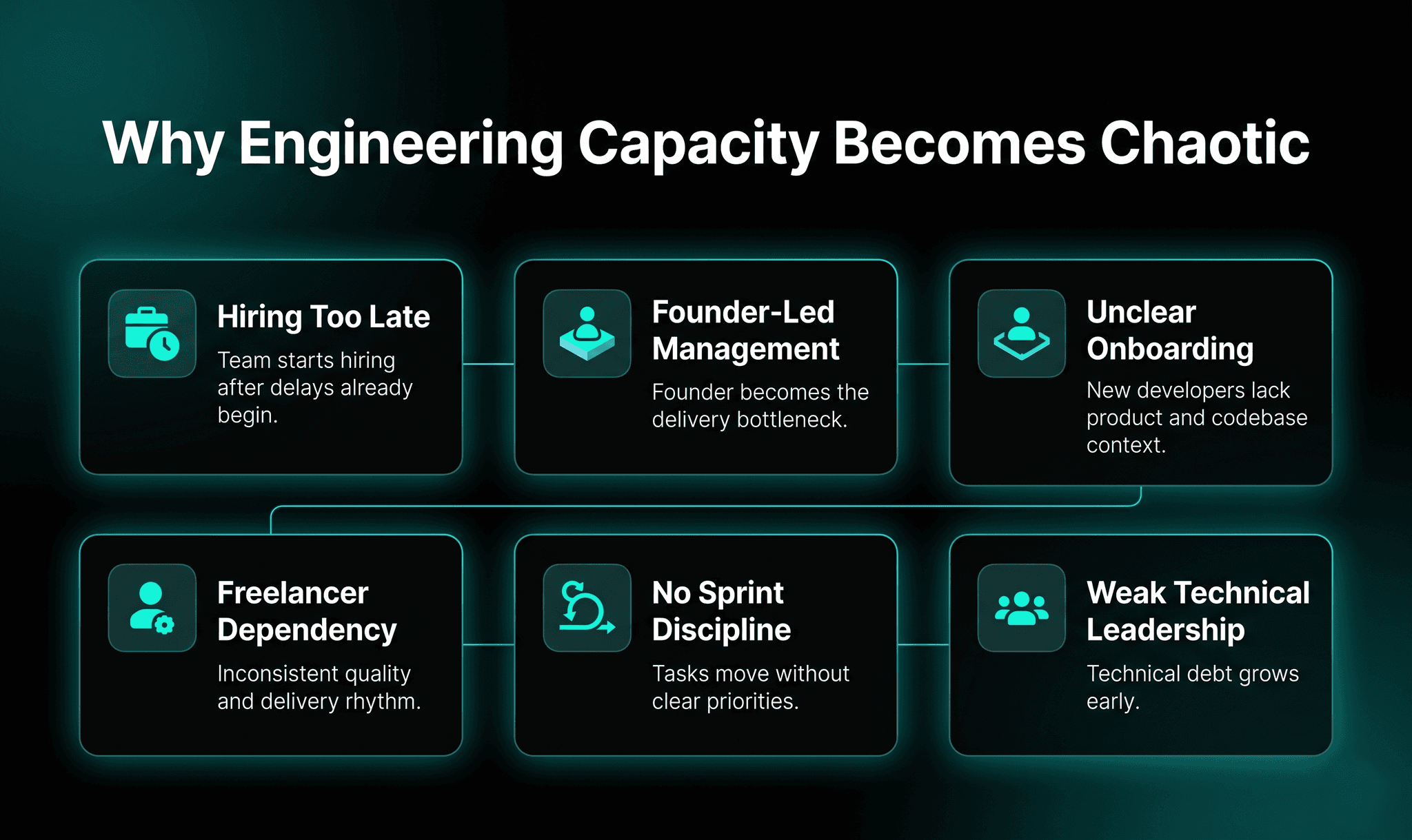
| Capacity Problem | What It Looks Like | Business Cost | Better Approach |
| Hiring too late | Team starts hiring after the roadmap is already delayed | Product momentum slows further | Plan capacity before the team reaches overload |
| Founder-led management | Founder assigns tasks, checks progress, and handles blockers | Founder becomes the delivery bottleneck | Create clear ownership and delivery roles |
| Unclear onboarding | New developers do not understand the product, codebase, or priorities | First few weeks produce little output | Use documented workflows, architecture notes, and sprint context |
| Freelancer dependency | Different developers work in different styles | Code quality and delivery rhythm become inconsistent | Use a structured team or dedicated pod |
| No sprint discipline | Tasks move without clear priority or review checkpoints | Bugs, delays, and rework increase | Run weekly sprint planning and progress reviews |
| Weak technical leadership | Developers build features without long-term technical direction | Technical debt grows early | Assign technical ownership before scaling capacity |
Hiring chaos usually starts when capacity is treated as a people problem only.
But engineering capacity is also a structure problem.
If ownership, onboarding, sprint rhythm, and technical direction are unclear, adding more developers only adds more moving parts.
Signs Your SaaS Team Needs More Engineering Capacity
1. Your roadmap keeps slipping
- Features are planned, but they keep moving to the next sprint.
- Your team may not have enough execution bandwidth.
- If this continues, product momentum slows, and users wait longer for improvements.
2. Your founder is managing too much delivery
- The founder is checking tasks, clarifying requirements, reviewing progress, and chasing blockers.
- The team does not have enough delivery ownership.
- The founder becomes the bottleneck instead of leading product, customers, and growth.
Hiring vs Freelancers vs Dedicated Team: What Works Best?
| Option | Best For | Main Advantage | Main Risk |
| Full-time hiring | Long-term core product roles | Strong internal ownership | Slow recruiting and high fixed cost |
| Freelancers | Small, short-term tasks | Flexible and fast to start | Inconsistent availability and quality |
| Dedicated team | Ongoing product delivery | Structured capacity without full hiring burden | Needs clear communication and management rhythm |
There is no single perfect option. Full-time hiring works when the company needs long-term internal ownership.
Freelancers work when the task is small and isolated. A dedicated team works best when the SaaS company needs steady engineering output but does not want to build a full internal team too early.
How to Add Capacity Without Hiring Chaos
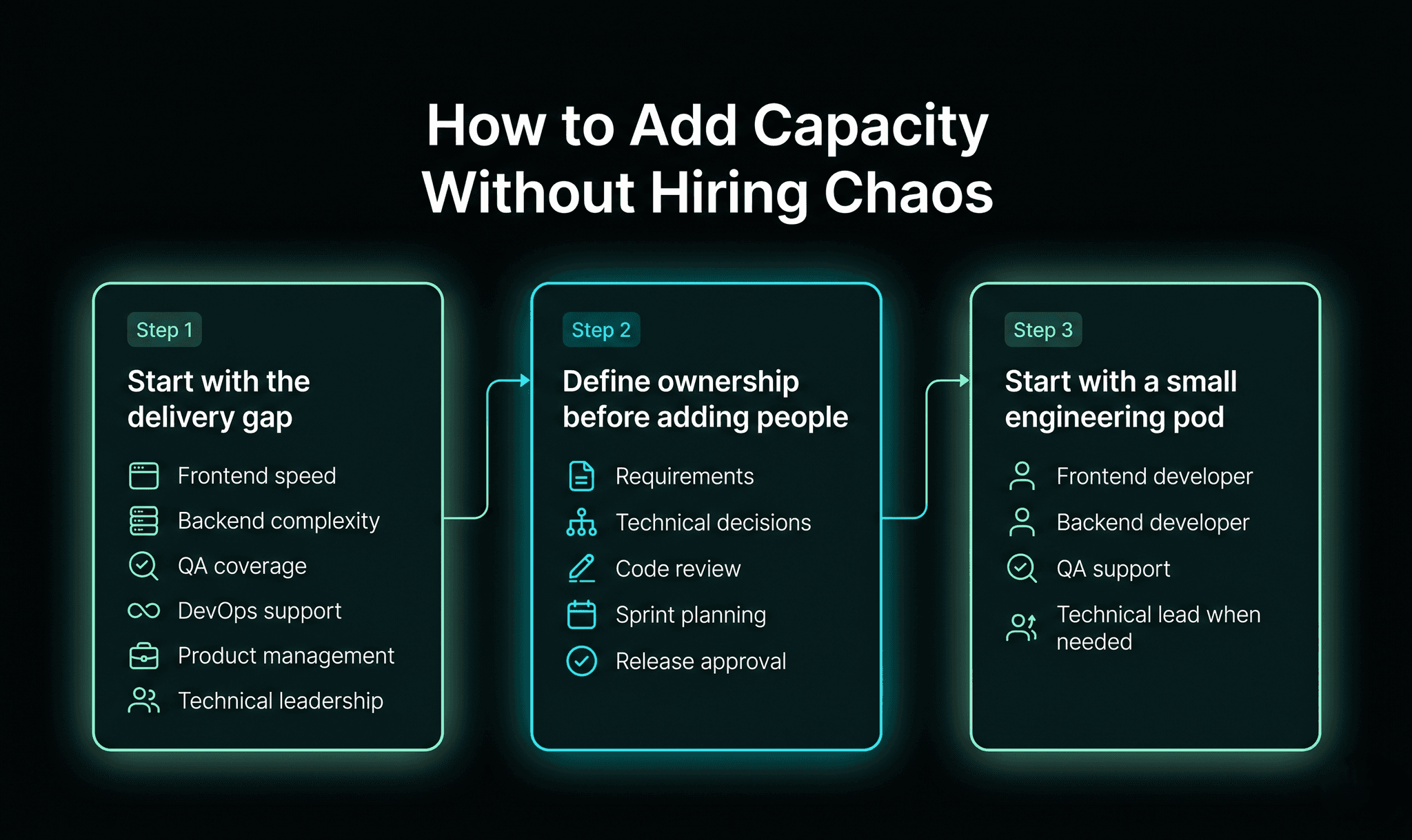
1. Start with the delivery gap, not the job title
Do not hire just because the team feels busy.
Identify what is actually slowing delivery:
- Frontend speed
- Backend complexity
- QA coverage
- DevOps support
- Product management
- Technical leadership
This helps you add the right capacity instead of adding random headcount.
2. Define ownership before adding people
More developers do not automatically create more speed.
Clarify who owns:
- Requirements
- Technical decisions
- Code review
- Sprint planning
- Release approval
This helps new capacity become productive faster.
3. Start with a small engineering pod
Seed-stage teams should avoid over-hiring too early.
Start with a focused pod:
- Frontend developer
- Backend developer
- QA support
- Technical lead when needed
This gives the team more delivery speed without creating unnecessary management load.
How Mediusware Supports SaaS Teams With Structured Engineering Capacity
Engineering capacity is not just about adding more developers.
It is about adding the right structure around product delivery.
For seed-stage SaaS teams, this structure matters because every new developer, feature, and sprint adds more coordination pressure. Without clear ownership, technical direction, and QA discipline, more capacity can quickly turn into more chaos.
Mediusware supports SaaS teams by helping them add development capacity through a structured delivery system.
Delivery support
- Dedicated dev team support
- Sprint planning and task ownership
- Flexible team scaling based on roadmap needs
Technical support
- Frontend and backend development
- QA support before releases
- Technical guidance for scalable architecture
Product support
- UI/UX support for faster product decisions
- Clear product workflows
- Faster feature clarification before development
This approach helps founders increase delivery speed without managing every technical detail themselves.
Our experience also comes from building complex software platforms where structure was critical.
For Bulk.ly, Mediusware developed a SaaS-style social media management platform with AI-powered content writing, RSS automation, bulk scheduling, multi-platform publishing, and analytics.
For CRM Runner, Mediusware worked on a business management platform that combined CRM, field service automation, dashboards, invoicing, real-time tracking, and customer engagement.
For Vida Projects, Mediusware supported an enterprise project management platform with modular architecture, task tracking, billing, reporting, collaboration, and scalable workflows.
These projects show a clear pattern. The challenge was not only writing code. It was keeping multiple moving parts organized across workflows, user roles, automation, dashboards, reporting, QA, and future scalability.
That is the type of delivery discipline SaaS teams need when they add engineering capacity. For founders, the goal is not to hire randomly or manage scattered developers.
The goal is to add a reliable engineering system that keeps the roadmap moving, reduces bottlenecks, and supports product growth without increasing hiring chaos.
Final Thoughts
Seed-stage SaaS teams do not need to hire faster just because the roadmap is growing.
They need to understand where delivery is breaking first.
Sometimes the gap is frontend speed.
Sometimes it is backend complexity.
Sometimes it is QA, architecture, product ownership, or sprint discipline.
Adding people before understanding that gap only creates more moving parts.
The safer path is to add engineering capacity around a clear delivery system.
Adding engineering capacity is not a hiring decision only. It is a delivery design decision.
If your SaaS roadmap is growing faster than your current team can deliver, Mediusware can help you add structured engineering capacity without creating hiring chaos.
Frequently Asked Questions
You can use fractional engineers, staff augmentation, or a dedicated development team.
The best option depends on your product stage, roadmap pressure, technical complexity, and how much internal management capacity you already have.

I work at the point where product decisions, system architecture, and engineering execution meet. At Mediusware, I’m accountable for how technology choices affect reliability, scale, and long-term delivery for our clients.
Featureblogs
01
Haptic Feedback: Why Touch is Becoming the Most Powerful Experience in Tech02
Why Software Companies Are Turning to Strategic Partnerships for Faster Growth03
C# vs. Java: Key Differences, Advantages, and Future Prospects04
12 Best AI Tools to Outperform ChatGPT05
The 12 Most Powerful LLMs: Powering Tomorrow’s Tech Landscape01
Haptic Feedback: Why Touch is Becoming the Most Powerful Experience in Tech02
Why Software Companies Are Turning to Strategic Partnerships for Faster Growth03
C# vs. Java: Key Differences, Advantages, and Future Prospects04
12 Best AI Tools to Outperform ChatGPT05
The 12 Most Powerful LLMs: Powering Tomorrow’s Tech LandscapeRelatedblogs
01
Introduction to System Design | System Design Course Pro | Part 102
The Art of Simplicity - How Minimalism Improved UI/UX Design03
The Software Development Life Cycle (SDLC): A Complete Guide04
Which Approach Is Best for Your Software Development Team: Scrum vs. Kanban05
How to adapt the Agile process to modern software development