- Scale SaaS development with lean teams, automation, and better architecture.
- Grow delivery capacity without adding matching overhead.
How SaaS Companies Scale Development Without Increasing Overhead
1 min read
Most SaaS products don’t struggle to grow.
They struggle to keep up with their own growth.
At first, everything works.
New users sign up. Features ship fast. The roadmap feels under control.
Then things start to slow down.
Releases take longer.
Costs increase.
The team feels busier… but output doesn’t improve.
I’ve seen this pattern play out across scaling SaaS teams.
And almost every time, the assumption is the same:
We just need more developers.
But that’s rarely the real problem.
The real issue is how the development system scales.
The Real Problem: Growth Increases Complexity, Not Just Workload
Growth doesn’t just add more work.
It increases system complexity.
But as the product scales, the environment changes.
Now you’re managing:
- Multiple feature interactions
- Increasing infrastructure demands
- Edge cases across users
- Integration dependencies
And here’s the key mistake:
Teams treat this like a workload problem.
When it’s actually a complexity problem.
Why Hiring More Developers Often Makes It Worse
Hiring feels like progress.
But without changing how the system works, it creates friction.
1. Communication Overhead Explodes
As team size increases, coordination increases even faster.
A small team aligns naturally.
A large team requires constant syncing.
According to Brooks’s Law:
Adding manpower to a late software project makes it later.
More developers = more communication paths = slower execution.
2. Costs Scale Faster Than Output
Engineering teams aren’t just salaries.
They come with:
- Onboarding time
- Management overhead
- Tooling and infrastructure costs
And here’s the problem:
Output doesn’t scale at the same rate as cost.
That’s how SaaS companies end up with high burn but slower delivery.
3. Delivery Starts Slowing Down
This is where things become counterintuitive.
More developers… but slower releases.
Because now you have:
- More dependencies
- More handoffs
- More chances for rework
Research consistently shows that streamlined teams outperform fragmented ones in delivery speed.
So the issue isn’t capacity.
It’s how that capacity is structured.
The Shift: Scaling Output Without Scaling Overhead
The best SaaS companies don’t scale by adding people.
They scale by improving systems.
Here’s what that looks like.
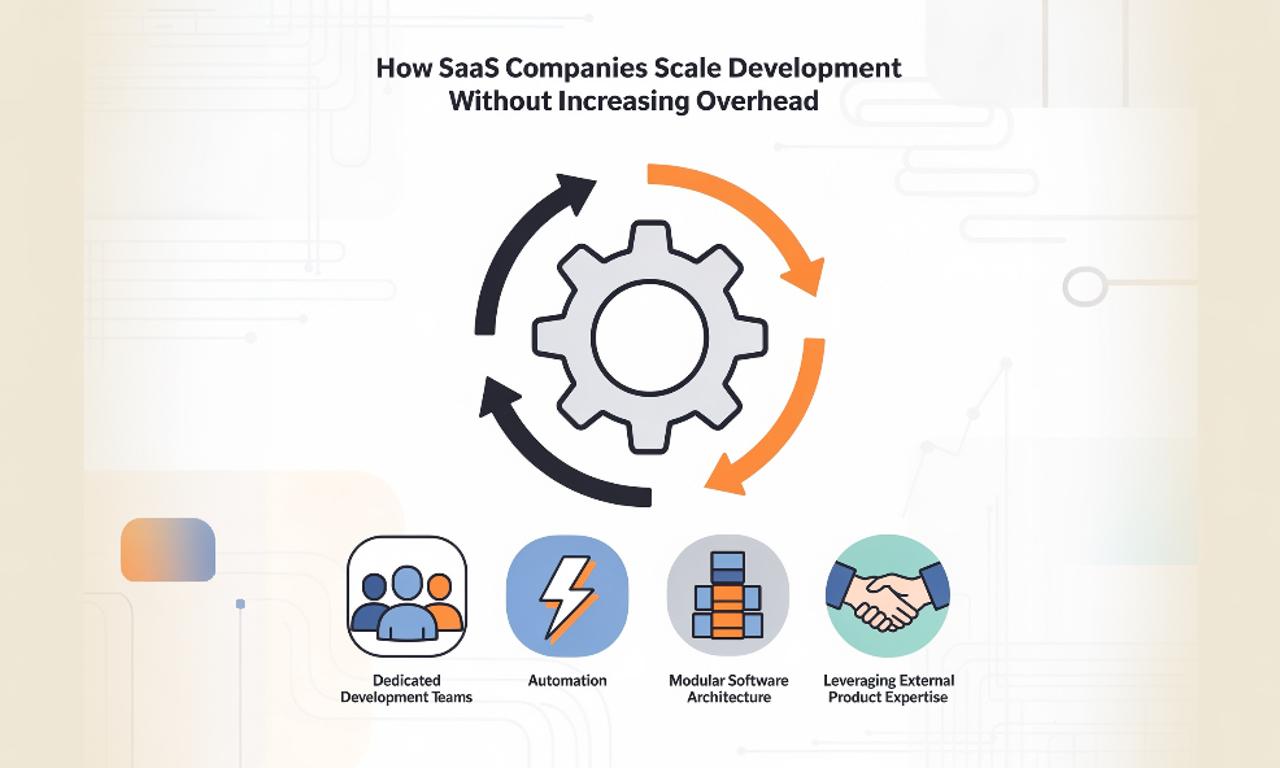
1. Extend Capacity with Dedicated Teams
Instead of hiring everything in-house, high-performing SaaS teams extend their capacity.
This is where dedicated development teams and staff augmentation come in.
Instead of months of hiring, you get:
- Immediate execution
- Specialized expertise
- Flexible scaling
- Predictable costs
This allows companies to grow output without increasing internal complexity.
2. Automate What Slows You Down
The fastest teams don’t do more work.
They remove unnecessary work.
Automation plays a huge role here:
- CI/CD pipelines
- Automated testing
- Infrastructure as code
- Deployment workflows
According to GitLab’s DevOps report:
High-performing teams deploy 200× more frequently than traditional teams.
That’s not a small improvement.
That’s a system advantage.
3. Build Modular Architecture
Architecture defines scalability more than team size.
Monolithic systems create bottlenecks.
Modern SaaS platforms move toward:
- Microservices
- API-driven systems
- Modular feature layers
This enables:
- Independent development
- Faster releases
- Lower system-wide risk
We’ve seen this approach work in platforms like Bulk.ly, where automation and scalable architecture significantly reduced manual workload while improving performance.
4. Leverage External Product Expertise
Some problems don’t need more developers.
They need better decisions.
Instead of learning through trial and error, SaaS companies often collaborate with experienced engineering partners.
This helps:
- Avoid architectural mistakes
- Accelerate development timelines
- Reduce hiring risk
- Improve scalability from day one
Why Lean Engineering Teams Win
Jeff Bezos once said:
We try to create teams that are no larger than can be fed by two pizzas.
It’s not about team size.
It’s about efficiency.
Smaller teams:
- Communicate faster
- Make decisions quickly
- Maintain clear ownership
When You Should Rethink Your Development Strategy
If you’re seeing these signals, it’s time to step back:
- Roadmaps are slipping
- Hiring isn’t improving delivery speed
- Costs are rising rapidly
- Teams spend more time coordinating than building
At this stage, adding more developers won’t solve the problem.
Changing the system will.
Final Thought
Scaling a SaaS product isn’t about building a bigger team.
It’s about building a system that can handle growth without slowing everything down.
Because what works at 5 developers breaks at 15.
And what works at 15 breaks at 50.
The companies that scale successfully understand this early.
They don’t just add capacity.
They fix how that capacity works.
Frequently Asked Questions
Because growth increases complexity faster than most teams can manage, especially when systems aren’t designed for scale.

I work with founders and leadership teams when growth moves faster than their systems, teams, or decisions. I’ve led 850+ projects for 750+ clients across 20+ countries, working across 100+ technologies and counting. I care about ownership, clarity, and building things that last beyond the launch.
Featureblogs
Relatedblogs
01
Introduction to System Design | System Design Course Pro | Part 102
The Art of Simplicity - How Minimalism Improved UI/UX Design03
The Software Development Life Cycle (SDLC): A Complete Guide04
Which Approach Is Best for Your Software Development Team: Scrum vs. Kanban05
How to adapt the Agile process to modern software developmentAuthorblogs
01
Critical PHP Security Update (October 2026): What SaaS Owners Must Check Now02
SaaS MVP Development: A Founder’s Guide for 202703
Zero Clicks, Falling Traffic: How to Win Back Revenue04
Ranking on Google in 2026: What Matters in the Age of AI Search05
How to Choose an API Development Company for Your SaaS Product