- Digital agencies can add custom software services without building an internal development team.
- A technology partner enables faster delivery, scalable teams, and complete client ownership.
How Digital Agencies Can Deliver Custom Software Without Hiring Developers
7 min read
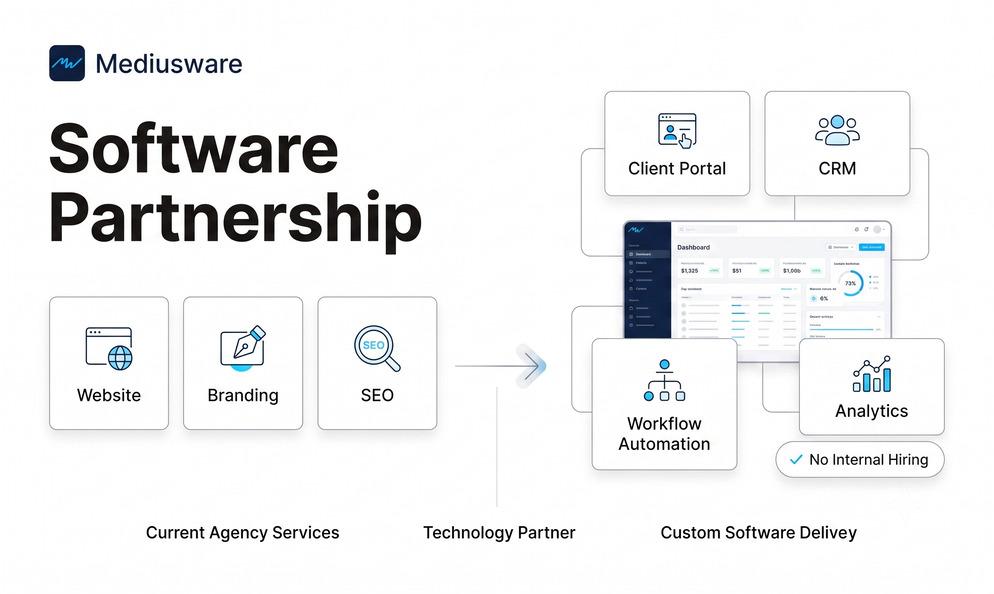
You’ve just delivered a successful website, campaign, or product redesign for a long-term client. A few weeks later, they come back with another request.
This time, they require a more advanced software solution.
They want:
- A customer portal
- Workflow automation
- A custom dashboard
- A SaaS platform
- An AI-powered solution that supports their growing business
You already have the client’s trust and understand their business.
But now you're facing a different kind of decision:
- Do you turn the opportunity away?
- Should you hire developers before you prove demand?
- Or find a way to expand your capabilities without rebuilding your agency?
More agencies are in this position as clients seek partners who solve broader business challenges, not just deliver services.
This guide explains how digital agencies can offer software development without immediately building an in-house engineering team. It covers changing client expectations.
It examines practical strategies digital agencies can use to expand their service offerings and support business growth. It explains when it makes sense to hire. It shows how agency partnerships can help you expand while keeping client relationships strong.
You’ll also see practical frameworks, industry insights, and real delivery examples.
These will help you decide which model fits your agency.
Why Client Expectations Are Changing for Digital Agencies
More agencies get requests for software, automation, integrations, and AI. Clients prefer partners who already know their business. They do not want to manage many specialized vendors.
Once an agency earns a client’s trust, it becomes easier to deepen the relationship. Hiring a new technical provider is often harder.
This shift reflects a broader change in how businesses adopt technology.
According to McKinsey’s State of AI, organizations keep expanding AI use across business functions. They aim to improve operations, enhance customer experiences, and create new business value. As digital transformation becomes part of long-term business strategy, organizations increasingly connect technology initiatives rather than treating them as isolated projects.
For agencies, this changes the conversation.
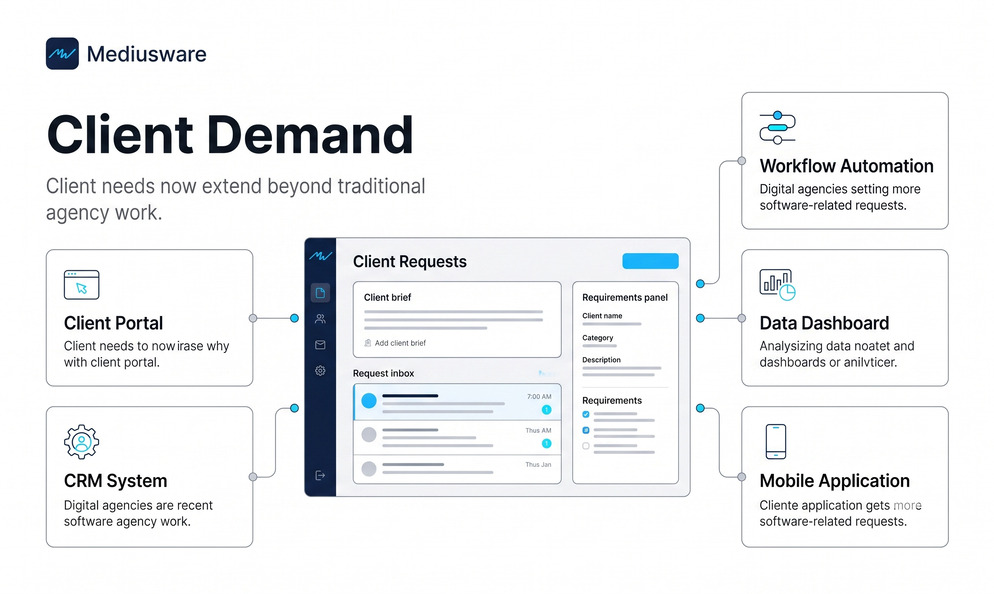
Instead of asking for another website or marketing campaign, clients are more likely to ask questions like:
- Can we automate this workflow?
- Would your agency be able to develop a customer portal?
- Can this integrate with our CRM or ERP?
- Can we transform this service into a SaaS product?
- Can AI improve how our team or customers work?
These aren't completely new projects.
They're often the next stage of an existing client relationship.
Mediusware Perspective
In our experience, clients rarely ask for software because they want new technology.
They ask because they want to solve a business problem. They also want to improve efficiency, reduce manual work, or create new growth opportunities.
Technology is the solution not the objective.
This broader shift also explains why strategic partnerships for software growth are more important. Agencies can expand capabilities without handling every technical function in-house.
Understanding why client expectations are changing is the first step. The next question is how agencies can expand their capabilities without immediately building an in-house engineering team.
How Agencies Expand Their Capabilities as Client Needs Evolve
As client expectations evolve, agencies generally expand their technical capabilities in 1 of 3 ways:
- Hiring an in-house engineering team
- Outsourcing individual projects
- Building a long-term engineering partnership
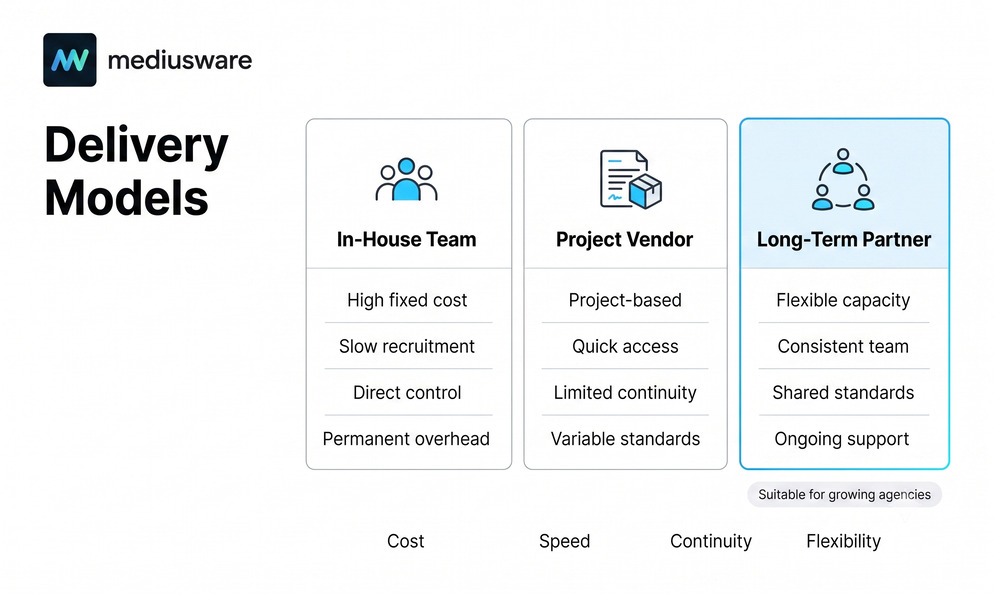
Each approach offers different advantages, costs, and levels of control.
The right choice depends on your agency's growth stage, steady client demand, and long-term business strategy. Each approach offers different advantages, costs, and levels of control.
| Criteria | In-House Engineering Team | Project Outsourcing | Engineering Partnership |
| Speed to start | Slower | Fast | Fast |
| Upfront investment | High | Low | Low |
| Scalability | Limited by hiring | Flexible | Highly scalable |
| Knowledge retention | High | Variable | High through ongoing collaboration |
| Client continuity | High | Project-based | Long-term relationship |
| Best suited for | Agencies with continuous software demand | One-off technical projects | Agencies expanding software capabilities without building an engineering department |
No single approach is right for every agency.
An agency delivering software as a core service may benefit from building an internal engineering team. Agencies with occasional technical requests may find project outsourcing sufficient.
However, agencies with steady software work often benefit from a long-term engineering partner.
It offers flexibility and steady delivery without the cost of building an engineering team.
Before choosing any model, there's one important question to answer:
Is hiring developers actually the right first step for your agency?
Is Hiring Developers the Right First Step for Your Agency?
Hiring developers can be a smart long-term strategy. This works best when software work is steady and predictable for your agency.
For agencies where engineering is a core service, an internal team can help you keep work consistent. It can build strong product knowledge over time. It also gives you more control over long-term delivery.
Hiring often makes sense when your agency:
- delivers software projects consistently
- has stable engineering demand
- can keep developers fully utilized
- has technical leadership in place
- is ready to invest in long-term delivery operations
For many agencies, however, client demand for software is still growing rather than fully established.
Hiring too early can cause problems. It can lead to fixed payroll costs.
It can create extra hiring and onboarding work. It can make team workloads uneven. It can add more management duties.
This can happen before engineering becomes a sustainable part of the business. Understanding the true cost of building an in-house development team helps agencies decide if full-time hiring makes sense.
Before hiring, ask yourself:
- Do I have software opportunities every month?
- Can I consistently keep developers fully utilized?
- Do I have the leadership to manage an engineering team?
- Is software becoming one of my core services?
If the answer to most of these questions is No, hiring may not be the right first step.
This does not require your agency to decline software opportunities.
It means exploring a delivery model that offers technical capability. Your agency can still validate demand and keep growing.
What Is an Agency Partnership Model?
An agency partnership model is a long-term collaboration. A digital agency keeps ownership of the client relationship. A trusted engineering partner provides the technical skills needed to deliver software projects.
Instead of hiring an in-house development team, the agency gets steady engineering support.
Freelancers can work well for occasional or narrowly defined tasks. However, agencies often need a more structured model when project volume, quality expectations, and client accountability increase.
Our guide explains when agencies should stop hiring freelancers. It shows the signs that temporary help is no longer enough. It also explains when to build a development partner.
How is an agency partnership different?
|
Project Outsourcing |
Agency Partnership |
|
Built around individual projects |
Built around ongoing collaboration |
|
Teams may change between engagements |
More consistent engineering support |
|
Limited continuity after delivery |
Continued support as client needs evolve |
|
Best for occasional technical work |
Best for agencies expanding delivery capability |
For agencies, the value is not simply access to developers.
Access to a dependable engineering capability while the agency continues leading strategy, communication, commercial decisions, and the client relationship.
Depending on the engagement, support may include white-label delivery, a dedicated technical team, or project-based collaboration. Mediusware’s broader partnership program supports these models while allowing agencies to remain client-facing.
To explore the available collaboration options, see the Mediusware Partnership Program.
How the Agency Partnership Model Works
Although each project is different, most agency partnerships use a similar workflow. It runs from the first client talk to long-term product support.
Typical Agency Partnership Workflow
1. Client Opportunity
The agency identifies a software opportunity through an existing client relationship and leads the initial business conversation.
2. Joint Discovery
The agency and engineering partner work together to understand the client's goals, technical requirements, timeline, and delivery priorities.
3. Solution Planning
The engineering partner helps define the technical approach, architecture, scope, estimates, and delivery plan. The agency stays the client’s main point of contact.
4. Development & Delivery
Designers, developers, QA engineers, and project managers collaborate with the agency to build, test, and launch the solution.
5. Launch & Ongoing Support
After launch, both teams continue supporting the client through maintenance, enhancements, and future product development as business needs evolve.
Throughout the process, the agency continues leading the client relationship while the engineering partner provides the technical capability needed to deliver the solution successfully.
The workflow is straightforward.
The next question is whether this approach is the right fit for your agency.
6. Shared Responsibilities in an Agency Partnership
While the workflow shows how a project moves from discovery to delivery, successful partnerships also depend on clearly defined responsibilities.
The agency continues leading the client relationship and business strategy, while the engineering partner focuses on technical execution. Both teams collaborate on key decisions to keep projects aligned with client goals.
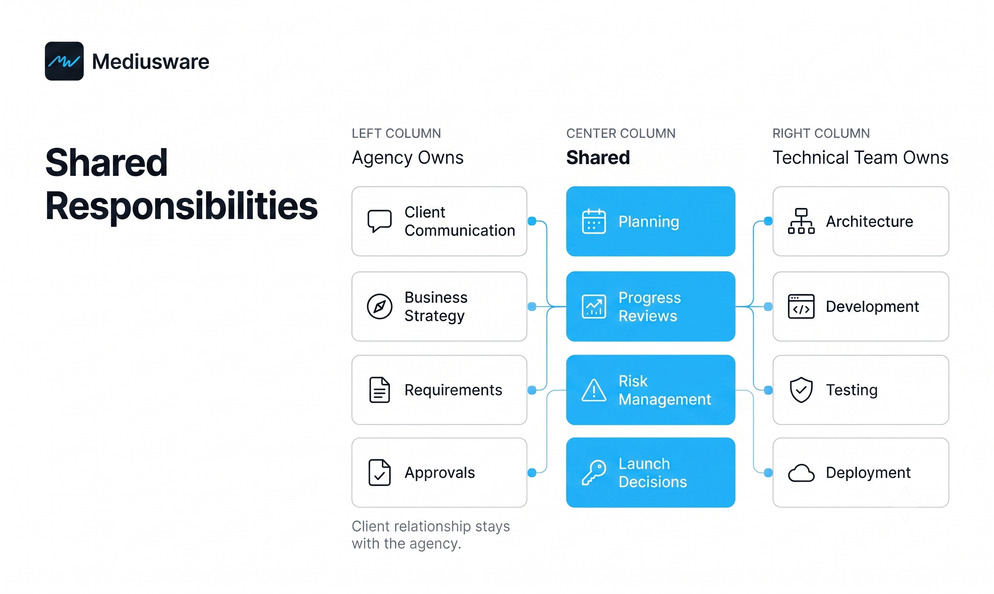 Clear ownership improves communication, reduces delivery risks, and helps both teams focus on their areas of expertise. This collaborative model allows agencies to expand their technical capabilities while maintaining a consistent client experience.
When Does an Agency Partnership Make Sense?
An agency partnership is often suitable when software demand begins to grow. It allows the agency to expand its capabilities without building and managing an internal engineering team.
|
A partnership may fit when your agency |
It may not be necessary when your agency |
|
Regularly receives software, automation, AI, or digital product requests |
Already operates a mature in-house engineering team |
|
Wants to expand services without permanent engineering overhead |
Keeps developers consistently utilized throughout the year |
|
Prefers to focus on strategy, client relationships, and growth |
Delivers software as its primary business function |
|
Needs flexible engineering expertise based on project demand |
Has technical leadership and delivery operations in place |
|
Wants to validate long-term demand before hiring internally |
Is already committed to scaling engineering as an internal capability |
The right model depends on your delivery needs and long-term strategy. Agencies that need stable engineering capacity may benefit from a dedicated development team. our guide on when agencies should use a dedicated development team explains the demand, workflow, and growth signals to evaluate.
Many agencies use partnerships to validate demand and expand their capabilities. This helps them decide whether building an internal engineering team is the right next investment.
What New Opportunities Can an Agency Partnership Unlock?
An agency partnership doesn't just help you deliver software.
It helps your agency say "yes" to opportunities that might otherwise be out of reach.
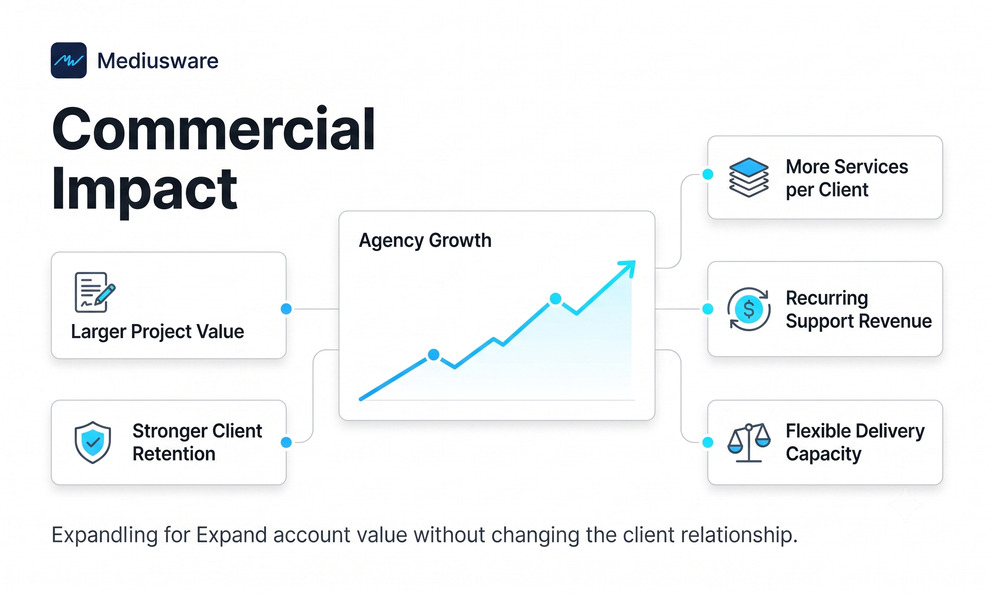
Instead of turning away projects because of limited technical capacity, you can confidently expand into higher-value engagements while keeping the client relationship you've already earned.
Build Digital Products
Many clients eventually outgrow websites and marketing campaigns.
They start asking for solutions like:
- Custom web applications
- SaaS platforms
- Customer and partner portals
- Internal business systems
These projects often become long-term business relationships rather than one-time engagements.
Modernize Existing Businesses
Not every client needs a brand-new product.
Many simply want to improve how their business operates.
Common opportunities include:
- Workflow automation
- CRM and ERP integrations
- API development
- Legacy system modernization
These conversations usually begin with solving operational problems , not selling software.
Deliver Practical AI Solutions
Clients are increasingly exploring how AI can improve productivity and customer experience.
With the right engineering partner, your agency can support projects such as:
- AI-powered automation
- AI assistants and copilots
- Knowledge search systems
- AI-enabled customer experiences
The opportunity isn't to sell AI.
It's to solve real business challenges using the right technology.
Grow Existing Client Accounts
Some of the most valuable opportunities come after the initial project is complete.
An agency partnership makes it easier to support:
- Product enhancements
- Performance optimization
- Maintenance and technical support
- New features as the client's business evolves
Growing existing client relationships is often more valuable than constantly acquiring new ones.
The real opportunity isn't offering more services.
It's becoming the partner clients rely on as their business and technology needs continue to grow.
Real-World Success: Agency Partnerships in Action
The value of an agency partnership is not measured by team size.
It is measured by the business outcomes the client receives.
When agencies combine trusted client relationships with the right engineering capability, they can deliver more complex solutions without building every technical function in-house.
Helping Businesses Scale Their Operations
CRM Runner was created to replace disconnected tools with one scalable platform for CRM, field service management, invoicing, and sales tracking.
Key outcomes
- reduced manual work through automation
- improved operational efficiency
- stronger customer engagement
- better decision-making through real-time analytics
- scalable infrastructure for long-term growth
→ Read the CRM Runner case study
Accelerating Digital Transformation
Titan Health needed more than a redesigned website.
The goal was to improve patient engagement, simplify appointment booking, strengthen e-commerce performance, and create a platform that could support future growth.
Business results
- 35% increase in session duration
- 40% increase in appointment bookings
- 50% growth in e-commerce sales
- 30% improvement in patient satisfaction
→ Explore the Titan Health success story
Delivering Industry-Specific Software
Conquest Air Cargo required a centralized platform for booking, shipment tracking, pricing, and operational management.
The solution gave customers clearer information while helping the business improve efficiency and growth.
Business results
- 35% increase in sales
- 150% return on investment
- 40% increase in customer recharge rates
- measurable results achieved within two months
How to Choose the Right Engineering Partner for Your Agency
Choosing the right engineering partner is about more than technical expertise.
The best partnerships help agencies expand their capabilities while protecting client relationships, maintaining delivery quality, and supporting long-term business growth.
Before making a decision, evaluate your potential partner against these 5 questions.
1. Do they understand how agencies work?
An engineering partner should strengthen your client relationships—not compete for them.
Look for a team that works behind the scenes, respects your ownership of the client, and adapts to your delivery process.
2. Can they support the entire delivery lifecycle?
Building software is only one part of a successful project.
A strong partner should contribute to technical discovery, solution architecture, development, quality assurance, deployment, and long-term product support.
3. Do they have proven delivery experience?
Don't rely on promises alone.
Review their case studies, business outcomes, and industry experience to understand whether they can consistently deliver projects similar to your clients' needs.
4. Can they scale as your agency grows?
Today's engagement may involve one client.
Tomorrow, it could involve multiple products or dedicated development teams.
Choose a partner with the people, processes, and delivery capacity to grow alongside your agency.
5. Do they communicate with transparency?
Successful partnerships are built on clear expectations, proactive communication, and accountability.
The right partner keeps your team informed, identifies risks early, and collaborates to solve problems before they affect the client.
Expand Your Agency Without Expanding Your Engineering Team
If there's one idea to take away from this guide, it's this:
Growing your agency isn't about hiring more people.
It's about solving more client problems.
As client expectations evolve, agencies are being asked to deliver more than websites, campaigns, or creative assets.
They're being trusted to solve broader business challenges through software, automation, integrations, and AI.
That doesn't mean every agency needs to build an in-house engineering department.
For many, a stronger strategy is to build the capability before building the headcount.
The agencies that will grow fastest are the ones that can:
- Say yes to larger opportunities
- Keep trusted client relationships
- Expand their service offerings with confidence
- Scale without unnecessary operational overhead
- Focus on business growth while partnering for engineering expertise
The goal isn't to become a software company.
The goal is to become the partner your clients continue to rely on as their business grows.
Frequently Asked Questions
Yes. Many digital agencies expand into custom software by partnering with an experienced software development company instead of building an in-house engineering team. This allows them to deliver larger technical projects, enter new markets, and grow service offerings without delaying client work to recruit specialized developers.

I work at the point where product decisions, system architecture, and engineering execution meet. At Mediusware, I’m accountable for how technology choices affect reliability, scale, and long-term delivery for our clients.