- Learn when to build, buy, or integrate AI for FinTech products.
- Use a practical framework to choose the right AI strategy.
AI in FinTech: Build, Buy, or Integrate? A Founder's Decision Framework
8 min read
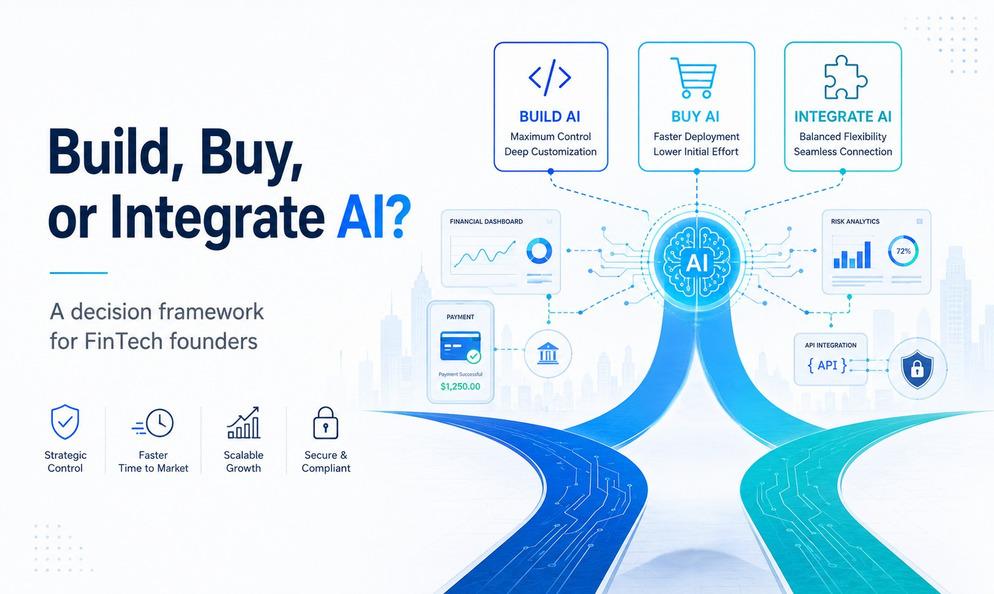
Not long ago, adding AI to a fintech product felt like an advantage. Now, it feels like a requirement.
Customers expect faster decisions. Investors want to see an AI roadmap. Competitors are introducing smarter onboarding, fraud detection, support, and risk tools.
So the pressure builds quickly:
We need AI. But what exactly should we do with it?
That is where many founders make the wrong decision. Some build everything in-house and discover the cost, talent, and compliance burden too late.
Others buy a ready-made platform that limits flexibility, creates vendor dependence, or fails to fit the product. And some integrate third-party AI services without first asking whether the feature creates real business value.
The decision affects far more than development speed.
It shapes:
- cost
- time to market
- compliance risk
- product differentiation
- scalability
- long-term control
The strongest fintech companies are not necessarily using the most advanced AI.
They are choosing the right AI approach for the right problem.
This guide gives founders a practical framework for deciding when to build, buy, or integrate AI based on business value, technical complexity, regulatory risk, available resources, and long-term product strategy.
Why the Build, Buy, or Integrate Decision Has Become So Difficult
A few years ago, FinTech founders had relatively few ways to adopt AI.
They could build an internal team, purchase an enterprise platform, or wait until the technology became more accessible.
Today, the challenge is the opposite.
Founders can choose from commercial APIs, open-source models, cloud AI services, specialized FinTech platforms, automation tools, and custom development partners.
More choice should make the decision easier.
Instead, it often creates more confusion.
The reason is that different teams evaluate AI through different priorities:
- Product wants differentiation.
- Operations wants faster implementation.
- Compliance wants greater control and auditability.
- Finance wants predictable costs.
- Engineering wants reliability, maintainability, and scalability.
Each perspective is valid.
But any one of them can lead to the wrong decision when it is considered separately from the wider product strategy.
The biggest mistake is not choosing the wrong model or vendor.
It is treating AI as a technology purchase rather than a business, product, and risk decision.
An AI capability can affect product architecture, regulatory exposure, operating costs, data governance, vendor dependency, and long-term control. It must also fit the wider FinTech technology stack, rather than operate as an isolated feature.
Before comparing build, buy, and integrate, founders should answer one question:
Does this AI capability create a meaningful competitive advantage, or does it primarily help the product operate more efficiently?
That distinction matters.
Capabilities that define the product experience, depend on proprietary data, or directly influence risk and financial decisions may justify greater ownership.
Common supporting capabilities may be faster and more economical to buy or integrate.
Not every valuable capability needs to be built.
The right strategy depends on how closely the AI connects to your competitive advantage, how much control the business requires, and what the company can realistically maintain over time.
The Founder's AI Decision Framework: 5 Questions to Answer Before Choosing Any AI Strategy
Before comparing models, vendors, or development costs, founders need a clear AI strategy that connects AI initiatives to measurable business outcomes and expected ROI.
Otherwise, the decision starts with technology, follows market pressure, and ends with unnecessary complexity.
These 5 questions help determine how much ownership, control, and investment an AI capability actually requires.
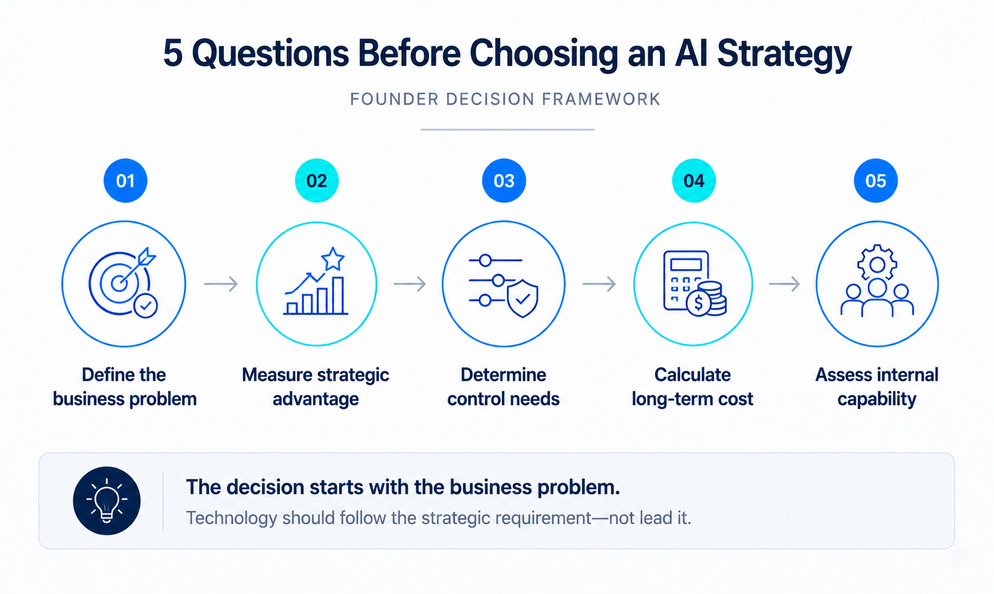
1. What Business Problem Are We Trying to Solve?
Start with the outcome, not the tool.
Are you trying to reduce fraud losses, shorten onboarding, automate compliance reviews, lower support costs, or improve underwriting accuracy?
The objective should be specific enough to measure.
“Add AI to onboarding” is not a clear goal.
“Reduce manual onboarding reviews by 30% without increasing compliance risk” is.
Founders should also determine whether the initiative responds to a validated customer or operational need, rather than competitor activity, investor pressure, or AI hype.
Decision signal: Do not choose whether to build, buy, or integrate until the expected outcome and success metric are clear.
2. Will AI Create a Meaningful Product Advantage?
Some AI capabilities create competitive advantage. Others are valuable but increasingly expected.
The real question is whether owning more of the capability will make the product meaningfully better, harder to copy, or more valuable to customers.
Ask:
- Will customers choose the product because this capability performs better?
- Does it improve through proprietary data or business-specific knowledge?
- Could competitors achieve a similar result using the same vendor?
A proprietary fraud model, risk engine, or financial recommendation system may directly influence how the product competes.
A standardized summarization, transcription, or support function may not justify the same investment.
Decision signal: Build or heavily customize when ownership strengthens long-term differentiation. Buy or integrate when the capability performs a standardized supporting function.
3. What Level of Control Does the Business Need?
Control matters most when AI touches sensitive data, financial decisions, compliance workflows, or customer trust.
Founders need to know:
- whether outputs must be explainable or auditable
- where customer data will be stored and processed
- whether high-risk outputs require human review
- how much vendor dependency and workflow customization the business can accept
More control can create strategic and regulatory value. But it also increases implementation time, cost, and operational responsibility.
Buying or integrating a third-party system does not remove accountability. The FinTech company remains responsible for how the capability affects its customers, data, and decisions.
Decision signal: Greater regulatory exposure, data sensitivity, or financial impact strengthens the case for greater architectural control and governance.
4. What Is the True Long-Term Cost?
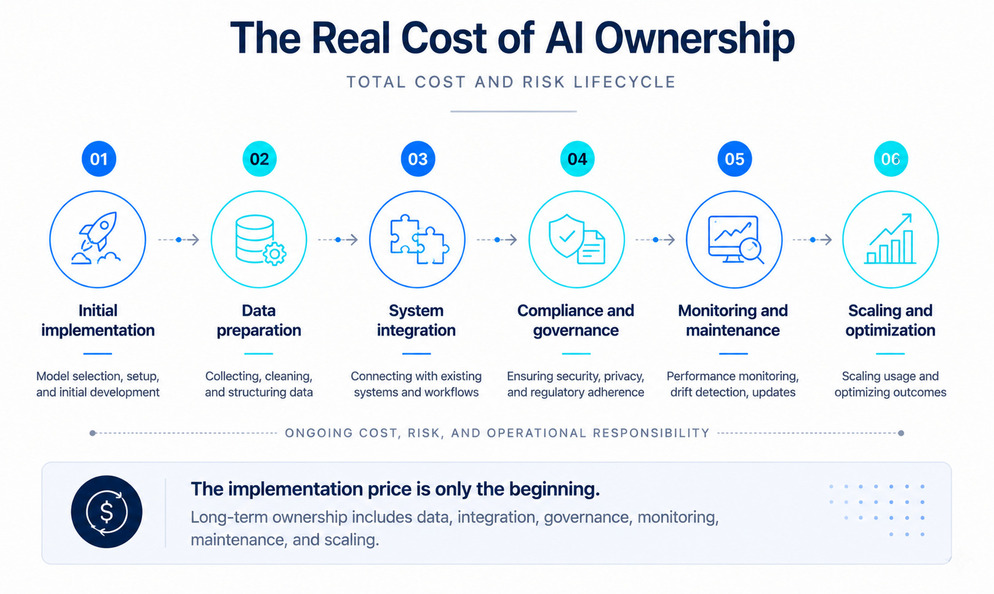
The initial build estimate or license fee is only the beginning.
A realistic estimate of the total cost of AI development should include data preparation, integration, infrastructure, usage fees, monitoring, compliance, ongoing support, and potential switching costs.
A low-cost API may become expensive as usage grows.
A custom system may reduce vendor dependency but require more infrastructure, specialized expertise, and continuous maintenance.
The cheapest option at launch may become the most expensive one at scale.
Decision signal: Compare the full lifecycle cost of each option, not only the cost of the first release.
5. What Are the Regulatory, Security, and Compliance Requirements?
In FinTech, AI decisions must account for data privacy, security, explainability, auditability, vendor risk, and operational resilience.
Before choosing a strategy, ask:
- What data will the AI access?
- Can its outputs be reviewed and audited?
- Which regulations apply?
- Who is responsible if the vendor or system fails?
The FCA’s research into the long-term impact of AI on retail financial services reinforces why founders must plan for evolving governance, consumer protection, and regulatory expectations.
Decision implication: Build when control and auditability are critical. Buy when a trusted vendor can prove compliance and security. Integrate when speed matters, but your team can still control data, outputs, and vendor risk.
5. Can Our Team Support the Capability Over Time?
AI requires ongoing ownership after launch. Someone must monitor performance, manage incidents, review vendor changes, maintain data quality, and approve updates.
The responsibility differs by strategy:
- Build: highest internal ownership
- Buy: lower technical burden, higher vendor dependence
- Integrate: shared responsibility across APIs, data flows, and quality controls
A simple test:
If no one can own performance, risk, incidents, and future changes, your team is not ready to build the capability internally.
Using recognized AI governance practices can help define ownership, monitoring, and accountability across the AI lifecycle.
Decision implication: Build only when your team can operate and improve the system. Buy when internal capability is limited. Integrate when your team can manage vendors, APIs, controls, and fallback processes.
When Building AI Creates a Competitive Advantage
Building AI makes sense when owning the capability directly strengthens why customers choose your fintech product.
That may include proprietary fraud detection, risk scoring, underwriting, financial recommendations, or decision logic that improves as your data grows.
Building is more likely to be justified when:
- AI directly affects a core customer outcome
- Proprietary data improves performance over time
- existing vendors cannot support the required workflow
- control, customization, or explainability is commercially important
- your team can maintain the capability long-term
In these cases, the models, workflows, and data become business assets rather than replaceable software components.
Ownership gives you greater control over how decisions are made, how sensitive data is handled, and how the system evolves as regulatory and customer requirements change.
When those conditions are present, custom AI development may be justified because the capability becomes part of the company’s long-term advantage.
But ownership also creates responsibility.
Building AI requires engineering talent, infrastructure, governance, monitoring, and ongoing model improvement. It is rarely the fastest or cheapest route to market.
For that reason, founders should avoid building standardized capabilities that already exist and do not meaningfully differentiate the product.
When Buying AI Is the Smarter Business Decision
Not every AI capability needs to become intellectual property.
Buying is often the better choice when the capability is mature, standardized, and unlikely to differentiate your fintech product.
It makes the most sense when:
- Speed to market matters
- Reliable vendors already exist
- The feature follows established industry standards
- Ongoing maintenance would add unnecessary cost
- Ownership provides little strategic value
Identity verification is a good example.
Many fintech companies use third-party providers instead of building document verification, biometric matching, and fraud checks from scratch. The same logic can apply to regulatory screening, document processing, payment orchestration, and customer support automation.
Buying does not reduce innovation.
It allows your team to avoid rebuilding proven technology and focus on the parts of the product that customers actually value.
Our broader AI development guide explores how build, buy, and hybrid approaches compare across different business contexts.
The main risk is choosing a solution that becomes difficult to customize, expensive to scale, or too restrictive as the product evolves.
When a ready-made tool is useful but still needs to fit deeply into your workflow, integration may offer the better balance.
When AI Integration Delivers the Best Balance of Speed and Control
Not every AI decision requires building from scratch or buying a complete solution.
Integration works best when a proven AI capability already exists, but the way it fits into your fintech product creates the real business value.
A company may integrate identity verification, document processing, payment intelligence, or customer support while keeping its risk models, underwriting logic, and customer workflows proprietary.
Integration is usually the better fit when:
- Speed matters
- The workflow still requires customization
- Vendor lock-in creates long-term risk
- AI must connect deeply with existing systems and data
The real challenge is not connecting the model. It is making sure the capability works securely across customer journeys, compliance requirements, and existing infrastructure.
A flexible integration strategy allows the business to replace or expand AI tools without rebuilding the entire product. Mediusware’s AI integration service support this kind of secure, scalable implementation.
Build vs. Buy vs. Integrate: Which AI Strategy Fits Your FinTech Product?
There is no universally best AI strategy.
The right choice depends on what role AI plays in your product, how quickly you need to launch, and how much ownership your business requires as it grows.
Use the comparison below to identify which approach best matches your priorities.
|
Decision factor |
Build |
Buy |
Integrate |
|
Time to market |
Slowest |
Fastest |
Fast to moderate |
|
Initial investment |
High |
Low to moderate |
Moderate |
|
Customization |
Very high |
Limited |
High |
|
Ownership |
Full |
Vendor-owned |
Shared |
|
Vendor dependency |
Low |
High |
Moderate |
|
Maintenance burden |
High |
Low |
Moderate |
|
Compliance control |
High |
Shared with the vendor |
High when designed correctly |
|
Differentiation potential |
Highest |
Low |
Moderate to high |
|
Best suited for |
Proprietary capabilities central to the product |
Mature, standardized functions |
Proven technology requiring custom workflows |
Choose Build If...
- AI directly differentiates your product.
- Proprietary data improves performance over time.
- Full control, customization, or explainability is essential.
- Long-term ownership justifies the higher investment.
- Your team can maintain and improve the capability over time.
Choose Buy If...
- Speed to market is the priority.
- The capability is already mature and standardized.
- Trusted vendors can meet your security and compliance needs.
- Building it internally would add little competitive value.
- Your team wants to avoid unnecessary maintenance.
Choose Integrate If...
- Proven AI technology already exists.
- Your workflows still require meaningful customization.
- AI must connect with existing systems, data, and customer journeys.
- Future flexibility matters.
- You want to reduce the risk of long-term vendor lock-in.
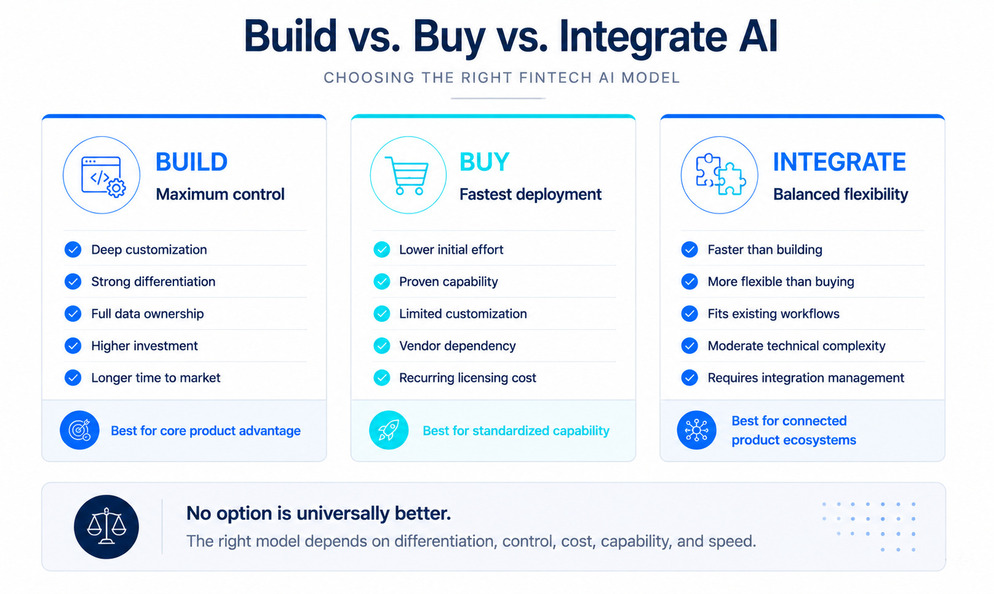
The goal is not to own every AI capability. It is to own the capabilities that create lasting business value.
5 Costly AI Strategy Mistakes FinTech Founders Should Avoid
Choosing the right AI strategy is about more than selecting the latest model or platform.
Many fintech projects struggle because critical business decisions are made before the technology is properly aligned with the product, customers, and long-term goals.
Avoid these 5 mistakes before investing in AI.
1. Starting with AI Instead of the Business Problem
Many teams evaluate AI models or vendors before defining the problem they are trying to solve.
Without a clear business objective, even the most advanced AI solution can become an expensive feature with little measurable impact.
Better approach: Start with the customer problem, then choose the AI strategy that best supports the business outcome.
2. Building Capabilities That Don't Differentiate Your Product
Some capabilities, such as identity verification, document processing, and compliance screening, are already mature and widely available.
Building them from scratch often increases development time and cost without creating a stronger competitive position.
Better approach: Build what makes your product unique. Consider buying or integrating capabilities that are already proven.
3. Underestimating the Total Cost of Ownership
The initial implementation is only one part of the investment.
Infrastructure, security, monitoring, governance, compliance, and ongoing model improvements all require continuous resources as the product grows.
Better approach: Evaluate the full lifecycle cost, not just the initial development or licensing expense.
4. Treating Compliance as a Later Phase
In fintech, AI decisions affect customer trust, data privacy, explainability, and regulatory compliance from the beginning.
Addressing these requirements after deployment often leads to delays, rework, and higher costs.
Better approach: Make compliance and governance part of the AI strategy from day one.
5. Choosing a Strategy That Cannot Adapt
The AI tools you choose today may not be the ones your business needs two years from now.
A rigid architecture can create unnecessary vendor dependency and make future changes expensive.
Better approach: Choose an AI strategy that gives your business the flexibility to evolve as customer expectations, regulations, and technology change.
The best AI strategy is not the one with the most advanced technology. It is the one that solves the right business problem, supports long-term growth, and continues creating value as your fintech product evolves.
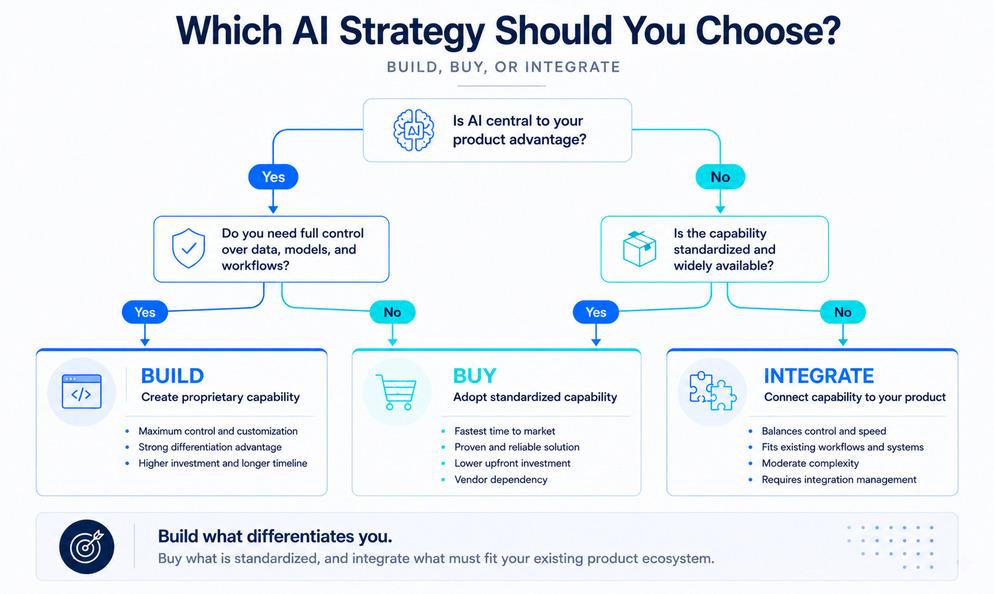
Final Thoughts: Choose the AI Strategy That Fits Your Business, Not the Hype
There is no universally right AI strategy for every fintech company.
The right decision depends on three things: the business problem you're solving, the level of control you need, and the long-term investment your team can realistically support.
If AI creates your competitive advantage, building may be the right investment.
If the capability is mature and standardized, buying is often the faster and more cost-effective choice.
If you need proven technology that still fits your unique workflows, integrating existing AI solutions may provide the best balance between speed and flexibility.
Before committing your budget or product roadmap, ask yourself three questions:
- Does this AI capability differentiate our product?
- What level of ownership and control do we actually need?
- Can our team support this capability over the long term?
The answers to those questions will often make the right strategy clear.
The goal is not to adopt more AI. It is to make better business decisions with AI decisions that create lasting value for your customers and sustainable growth for your business.
Frequently Asked Questions
There is no universally best option. Build AI when the capability creates a meaningful product advantage and requires high control. Buy AI when the capability is standardized and speed matters most. Integrate AI when you need proven functionality that fits your existing workflows, products, and customer experience.

I work at the point where product decisions, system architecture, and engineering execution meet. At Mediusware, I’m accountable for how technology choices affect reliability, scale, and long-term delivery for our clients.