- Spot the right moment to extend your development team and keep delivery moving smoothly.
- Learn how a flexible team extension model helps growing companies scale with speed and focus.
When It’s Time to Extend Your Development Team
1 min read

Most products don’t slow down because of bad ideas.
They slow down because the team building them can’t keep up anymore.
At first, it’s subtle.
A feature takes a little longer.
A sprint carries over.
A roadmap starts slipping quietly.
Then one day, you realize something uncomfortable:
You’re no longer limited by vision.
You’re limited by execution.
And that’s where most companies get stuck.

The Problem Isn’t Obvious Until It Is
Here’s what I’ve seen across growing SaaS teams and product companies:
They don’t fail suddenly.
They slow down gradually.
And because it’s gradual, it’s easy to ignore.
You assume:
Next sprint will fix it.
Once we hire, things will stabilize.
But they don’t.
Because this isn’t a short-term issue.
It’s a structural one.
The Real Signals You’re Hitting a Capacity Wall
Most teams miss the moment because they’re looking for big problems.
But the real signals are small, consistent, and repeatable.
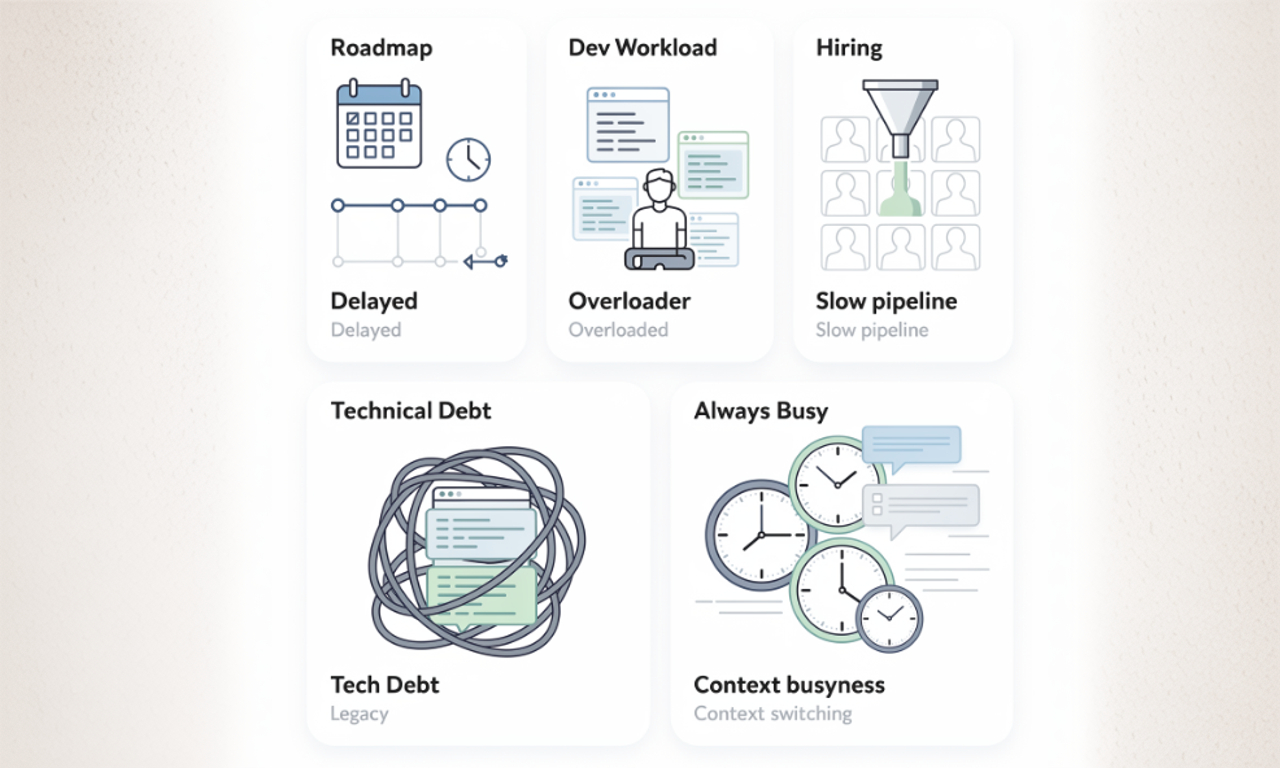
1. Your roadmap keeps slipping
Not because of bad planning, but because there’s simply too much to build.
2. Senior developers are doing low-impact work
Bug fixes. Repetitive tasks. Support work.
High-value time gets diluted.
3. Hiring can’t keep up with demand
You need developers now.
Hiring takes months.
And growth doesn’t wait.
4. Technical debt starts becoming permanent
Shortcuts turn into structure.
Future scalability becomes a risk.
5. Everyone is busy, but output doesn’t increase
This is the biggest red flag.
Busyness creates the illusion of progress.
But output tells the truth.
Why Most Companies Misdiagnose the Problem
The default reaction is always the same: We need to hire more developers.
It sounds logical.
But in reality, hiring introduces friction before it creates value:
- Long recruitment cycles
- Onboarding time
- Ramp-up delays
- Risk of wrong hires
So instead of speeding up, teams slow down even more.
The Shift Most High-Growth Teams Make
The best teams don’t ask: Should we hire more people?
They ask: How do we increase delivery capacity without slowing down?
Because scaling is not about headcount.
It’s about removing constraints.
This is where thinking changes.
From control → capacity.

When Extending Your Team Becomes the Right Move
Not every team needs this.
But when these conditions are true, extending your team becomes the smarter path:
1. You need speed, not hiring delays
You can’t wait 2–3 months to add capacity.
2. You already know what to build
The problem isn’t direction.
It’s execution.
3. You want flexibility
Scale up when needed.
Scale down when priorities shift.
4. You want to protect your core team
Your internal team should focus on:
- Architecture
- Core systems
- Critical decisions
Not everything else.
What Extending Your Team really Means
This is where most confusion happens.
This is not outsourcing.
It’s not throwing tasks over the wall.
It’s integration.
Done right, extended developers:
- Join your standups
- Follow your processes
- Work inside your systems
- Collaborate daily with your team
They don’t feel external.
They feel like part of your team, just without the hiring delay.
How High-Growth Teams Structure This
From experience, the teams that scale cleanly follow a simple model:
1. Keep strategy in-house
Your core team owns:
- Product direction
- Architecture
- Decision-making
2. Extend for execution
Extended teams handle:
- Feature development
- QA and testing
- Performance improvements
3. Build a hybrid system
Not fully in-house.
Not fully outsourced.
A blended team designed for speed.
This reduces bottlenecks without losing control.
The Cost of Waiting Too Long
Most teams delay this decision because they think they’re saving cost.
They’re not.
They’re creating hidden losses:
- Missed market opportunities
- Slower product evolution
- Team burnout
- Compromised quality
We’ve seen teams spend months trying to fix productivity…
When the real issue was simple:
They didn’t have enough execution capacity.
A Simple Way to Know If You’re There
Ask yourself: If we had 2–3 strong developers today…
What would change?
- Would we ship faster?
- Would we reduce backlog?
- Would we unlock new opportunities?
If the answer is a lot…
Then this isn’t a process problem.
It’s a capacity problem.
Where Most Teams Hesitate And Why It’s Fixable
The hesitation is valid.
Most teams worry about:
- Losing control
- Quality dropping
- Communication gaps
But these are not model problems.
They are execution problems.
When done right:
- Developers are properly vetted
- Communication is structured
- Work is transparent
- Quality is controlled
The model works.
A Pattern We’ve Seen Repeatedly
Across startups and scaling teams, one pattern shows up again and again:
Teams that extend early → scale faster
Teams that wait → spend months catching up
It’s not about working harder.
It’s about removing the bottleneck earlier.
So, When Is the Right Time?
Not when everything breaks.
Not when your team is burned out.
But when you start seeing early signals:
- Delays
- Bottlenecks
- Capacity gaps
That’s the moment to act.
Final Thought
Scaling a product isn’t just about building more.
It’s about building the ability to keep building:
Consistently.
Predictably.
Without friction.
And sometimes, the smartest move isn’t hiring more people.
It’s extending your team in a way that unlocks speed without losing control.
Frequently Asked Questions
If your roadmap keeps slipping, your team is constantly overloaded, and hiring can’t keep up with demand, you’re likely facing a capacity problem, not a process problem. The key signal is simple: if adding 2–3 developers today would significantly speed things up, it’s time to extend.

I work at the point where product decisions, system architecture, and engineering execution meet. At Mediusware, I’m accountable for how technology choices affect reliability, scale, and long-term delivery for our clients.
Featureblogs
Relatedblogs
01
Staff Augmentation vs Outsourcing02
Charting Your QA Career: Pathways to Growth and Expertise in Software Quality Assurance03
The Role of QA in API Integration Testing04
Top 10 Soft Skills Every Software Developer Should Master05
Looking for the Best Outstaffing Mobile App Partner? Here Are the Top 11 in the USA!Authorblogs
01
How Digital Agencies Can Deliver Custom Software Without Hiring Developers02
AI in FinTech: Build, Buy, or Integrate? A Founder's Decision Framework03
How to Choose a SaaS MVP Development Company04
How Seed-Stage SaaS Teams Add Engineering Capacity Without Hiring Chaos05
Why Seed-Stage SaaS Startups Struggle to Ship Fast