- When hiring slows delivery, SaaS teams should consider dedicated dev teams.
- Internal teams own strategy; dev teams increase execution capacity.
When Should a SaaS Company Stop Hiring and Switch to a Dev Team?
1 min read
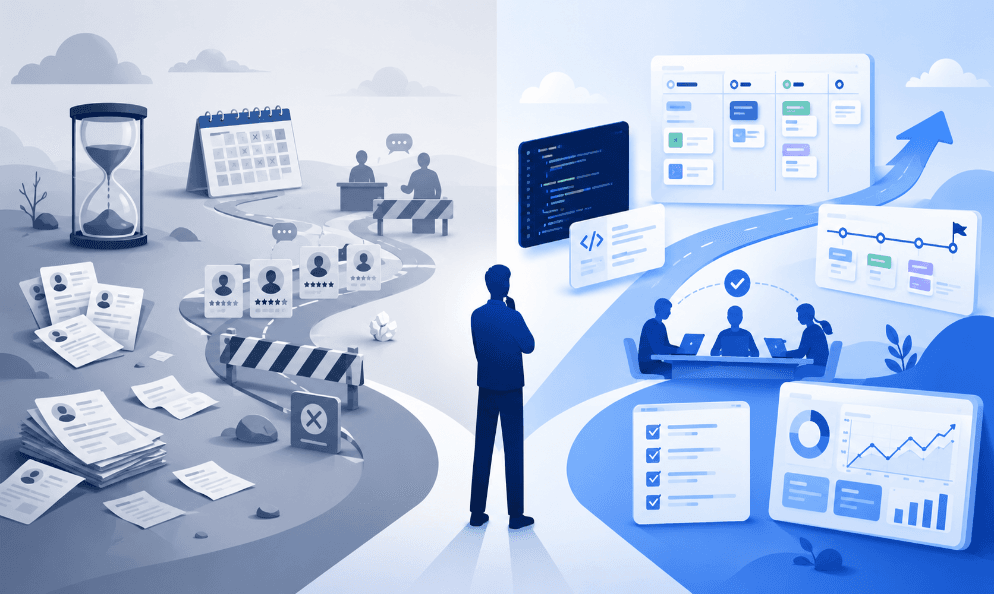
Hiring more developers feels like the obvious move when a SaaS company starts growing.
More users create more requests.
More requests create more tickets.
More tickets create more pressure on the product team.
So the founder says:
Let’s hire more engineers.
But after a certain point, hiring one developer at a time stops solving the real problem.
The roadmap still moves slowly.
Senior engineers still feel overloaded.
Bugs still interrupt feature work.
New hires still need time to understand the product.
That is when a SaaS company needs to ask a better question:
Do we need more employees, or do we need a dedicated dev team that can help us ship faster?
Hiring Is Not Always the Same as Scaling
Hiring means adding people.
Scaling means increasing output without creating more confusion.
Those are not the same thing.
A SaaS company can hire three developers and still move slowly if the team structure is unclear.
A company can also add one focused dev team and quickly reduce pressure on its internal team.
The difference is not only talent.
The difference is execution.
When your SaaS product is growing, your engineering team needs more than extra hands. It needs a clear delivery system.
For companies that need structured engineering support, Mediusware’s Dedicated Team engagement model is designed to help teams extend delivery capacity without disrupting their existing workflow.
When Hiring Still Makes Sense
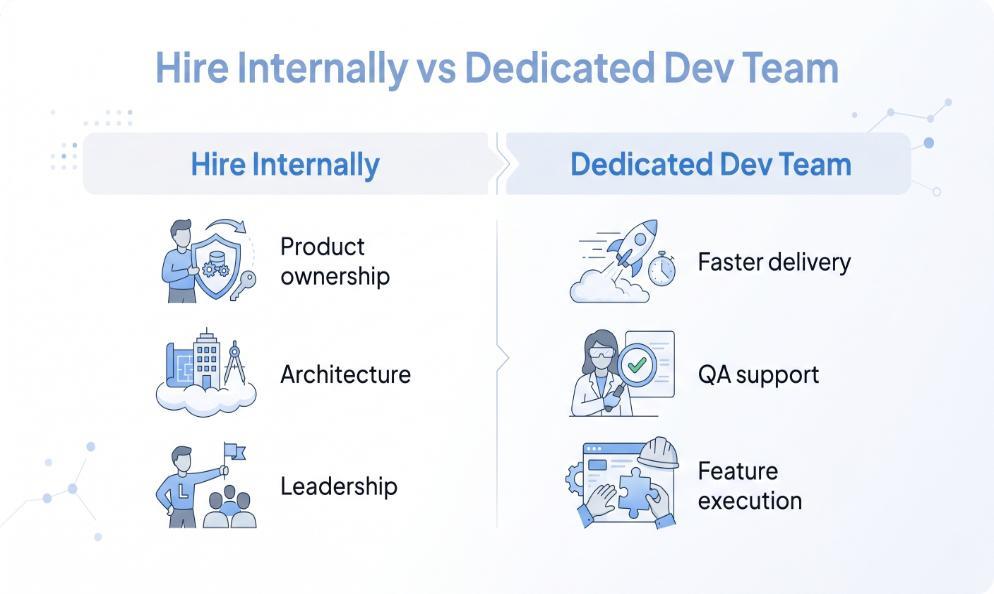
Hiring internally is still the right choice when the role is tied to long-term product ownership.
For example, you should hire internally when you need:
- A technical lead
- A product architect
- A founding engineer
- An engineering manager
- A long-term infrastructure owner
These roles need deep product context.
They need to understand your users, business model, technical decisions, and future roadmap.
You should not outsource your core product thinking.
Your internal team should own that.
But not every development need requires a full-time hire.
That is where many SaaS companies start losing time.
Signs Hiring Is Slowing You Down
At first, hiring feels productive.
You write the job post.
You review profiles.
You take interviews.
You compare candidates.
But weeks pass.
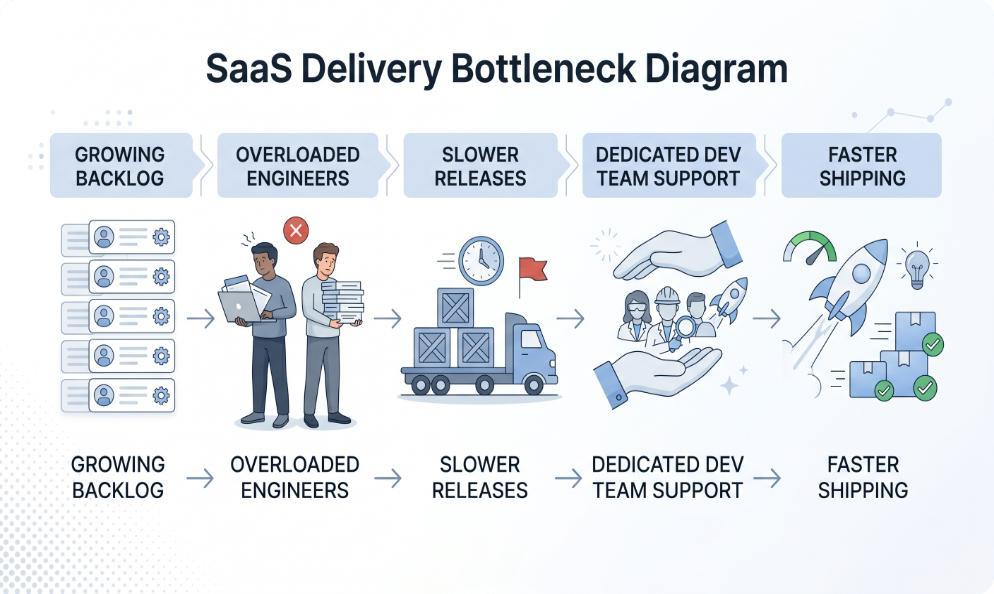
The backlog keeps growing.
Your current team is still fixing bugs, supporting customers, reviewing code, and trying to ship new features.
At this stage, hiring becomes another workload.
Here are the signs:
- Hiring takes months, but delivery pressure is urgent
- Senior engineers spend too much time interviewing
- New hires take too long to become productive
- Your backlog keeps growing after every sprint
- Bug fixes keep delaying feature work
If this sounds familiar, your problem may not be headcount.
Your problem may be delivery capacity.
Why SaaS Teams Hit This Wall
SaaS products become more complex as they grow.
In the beginning, a small team can move fast.
Everyone knows the product.
The roadmap is simple.
The codebase is easier to manage.
Customer requests are easier to handle.
But growth changes everything.
Now you have:
- More users
- More edge cases
- More integrations
- More support tickets
- More product modules
- More technical debt
The same team that once moved fast now spends more time maintaining what already exists.
That is normal.
But if the company keeps solving every bottleneck by hiring one person at a time, speed may not improve fast enough.
Because every new hire needs time, context, training, review, and support.
When a Dedicated Dev Team Becomes the Better Option
A dedicated dev team becomes useful when your SaaS company knows what needs to be built, but your internal team does not have enough capacity to build it fast enough.
This is different from hiring random freelancers.
A dedicated dev team gives you a structured delivery unit.
Depending on your needs, that team may include:
- Frontend developers
- Backend developers
- QA engineers
- UI/UX designers
- DevOps engineers
- Project coordination support
Instead of adding one person and hoping they can cover every gap, you add a team that can own a defined part of delivery.
That could be:
- A new product module
- A dashboard rebuild
- API development
- Performance improvement
- Technical debt cleanup
- QA and release support
- Mobile app development
- Feature backlog execution
Your internal team still owns product direction.
The dev team helps execute faster.
That balance is important.
For broader product development needs, Mediusware’s Software Development Services cover scalable software, web apps, mobile apps, and enterprise systems.
The Simple Decision Framework
Here is a simple way to decide.
Keep hiring internally when:
- The role requires deep product ownership
- The person will shape architecture long-term
- You need someone close to leadership decisions
- The work is sensitive or business-critical
- You are building your core engineering leadership
- You can wait for a longer hiring cycle
Switch to a dev team when:
- You need delivery speed now
- Your roadmap is clear, but execution is slow
- Your internal team is overloaded
- You need multiple skill sets at once
- The work can be scoped clearly
- Hiring is taking too long
- Growth is being blocked by engineering capacity
This is not always an either-or decision.
Many SaaS companies need both.
They keep a strong internal team for product ownership and use a dedicated dev team to increase delivery capacity.
Mediusware’s Software Dedicated Team model is built around this exact need: giving companies a focused team that can work with their existing workflow and help move product delivery faster.
What a Good Dev Team Should Actually Do?
A good dev team should not behave like an outside vendor waiting for tasks.
It should work like an extension of your product team.
That means the team should understand:
- Your product goals
- Your sprint process
- Your technical standards
- Your communication style
- Your release expectations
- Your customer priorities
The best dev teams do more than write code.
They help move work from idea to release with less friction.
They ask questions early.
They document clearly.
They test properly.
They communicate blockers.
They protect delivery quality.
For a SaaS company, that is more valuable than simply adding another developer to payroll.
A Practical Example
Imagine a SaaS company with five internal engineers.
The team is responsible for:
- Core platform maintenance
- Customer bug fixes
- New feature development
- Integrations
- Infrastructure support
- Code reviews
- Product planning
Now the company wants to launch a new analytics module in three months.
Hiring two or three developers may take the full quarter.
Even after hiring, those developers still need onboarding.
A dedicated dev team can help faster if the scope is clear.
The internal team can define the architecture, product logic, and success criteria.
The dev team can handle frontend development, backend implementation, QA, and release support.
The company does not lose control.
It gains execution speed.
For example, Mediusware’s Quiri case study shows how complex data interaction can be turned into a clearer product experience with the right software development approach.
Another relevant example is EasyAsk, where Mediusware helped build a customizable e-commerce platform with ERP integration, payment handling, and scalable user experience.
How to Switch Without Creating Chaos
Switching to a dev team only works when the setup is clear.
Do not hand over a vague backlog and expect perfect delivery.
Start with a focused scope.
For example:
- One module
- One product area
- One technical improvement
- One release cycle
- One backlog category
Then define the basics:
- What needs to be built?
- Who approves technical decisions?
- Who reviews code?
- What does “done” mean?
- How often will updates happen?
- What tools will the team use?
Clarity at the start prevents confusion later.
The goal is not to replace your team’s workflow.
The goal is to support it.
If your SaaS product is still early-stage, you may also want to read Mediusware’s SaaS MVP Checklist to understand how to launch with focus before scaling development.
Common Mistakes to Avoid
SaaS companies often get poor results from external teams because they treat the relationship casually.
Avoid these mistakes:
- Hiring only based on hourly rate
- Starting without clear scope
- Giving unclear product requirements
- Skipping QA responsibilities
- Not assigning an internal owner
A dev team works best when expectations are clear and outcomes are measurable.
You should know what the team owns, how progress is tracked, and what business result the work supports.
If you are still in the early product stage, you may also want to read Mediusware’s guide on how to build a minimum viable product. It explains why founders should focus on essential features, user feedback, and fast iteration before overbuilding.
So, When Should You Stop Hiring and Switch?
You should stop hiring one by one and switch to a dedicated dev team when hiring becomes slower than the problem you are trying to solve.
That is the cleanest answer.
If your roadmap is stuck, your team is overloaded, and your growth depends on faster product delivery, a dev team may be the smarter move.
Not because hiring is bad.
But because hiring is not always the right tool for every stage of SaaS growth.
Sometimes you need permanent employees.
Sometimes you need a focused delivery team.
The best SaaS companies know the difference.
Modern software team thinking also supports this idea. Team Topologies explains that software delivery improves when teams are structured around clear ownership, healthy collaboration, and steady flow of valuable software.
Final Thought
The goal is not to build the largest engineering team. The goal is to build the right delivery system.
Your internal team should focus on product direction, architecture, customer understanding, and long-term technical quality.
A dedicated dev team can support execution, reduce bottlenecks, and help you ship without putting every task on your core engineers.
If your SaaS roadmap is moving faster than your hiring pipeline, it may be time to rethink the model. Mediusware helps SaaS companies extend engineering capacity with dedicated development teams that fit into existing workflows and support faster delivery.
Frequently Asked Questions
A SaaS company should stop hiring one by one when hiring becomes slower than product delivery needs. If the roadmap is stuck and the team is overloaded, a dev team may be a better option.

I work at the point where product decisions, system architecture, and engineering execution meet. At Mediusware, I’m accountable for how technology choices affect reliability, scale, and long-term delivery for our clients.
Featureblogs
Relatedblogs
01
Introduction to System Design | System Design Course Pro | Part 102
The Art of Simplicity - How Minimalism Improved UI/UX Design03
The Software Development Life Cycle (SDLC): A Complete Guide04
Which Approach Is Best for Your Software Development Team: Scrum vs. Kanban05
How to adapt the Agile process to modern software developmentAuthorblogs
01
How Digital Agencies Can Deliver Custom Software Without Hiring Developers02
AI in FinTech: Build, Buy, or Integrate? A Founder's Decision Framework03
How to Choose a SaaS MVP Development Company04
How Seed-Stage SaaS Teams Add Engineering Capacity Without Hiring Chaos05
Why Seed-Stage SaaS Startups Struggle to Ship Fast