- Discover how custom AI agents automate content creation, repurposing, and publishing across platforms.
- Learn how scalable AI systems streamline workflows and improve content performance over time.
Stop Writing Manual Posts: Learn AI Agents That Automate Content
1 min read
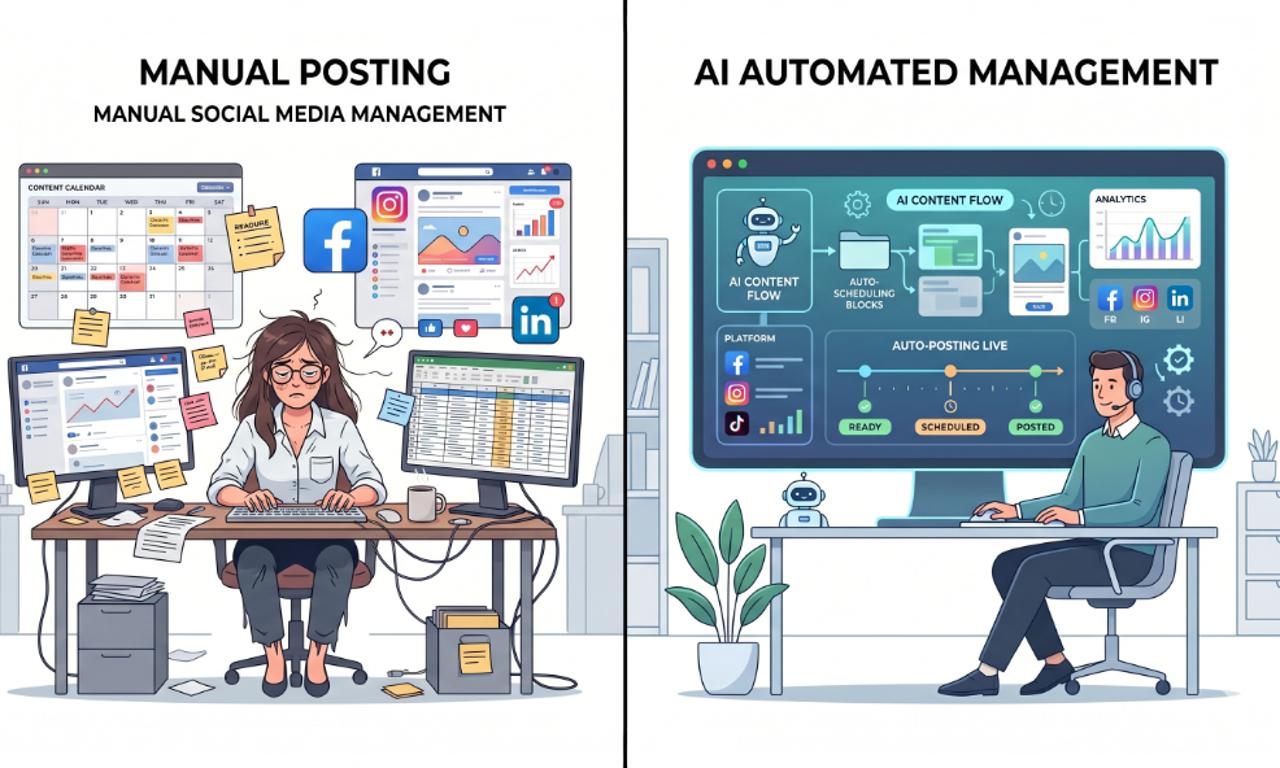
Most teams don’t struggle with ideas.
They struggle with consistency.
You plan content.
Write posts.
Schedule manually.
Repurpose across platforms.
And somehow, it still feels slow.
That’s because manual posting isn’t a content problem.
It’s a system limitation.
Jensen Huang, NVIDIA:
The next generation of software systems will continuously improve themselves.
That shift is already happening in content.
Why Manual Content Workflows Break Down
Manual workflows fail in predictable ways:
-
Memory-driven execution
Someone has to remember what to post and when.
-
Limited scalability
One person can’t manage multiple platforms effectively.
-
Wrong use of AI
Most teams use AI like a writing assistant, not a system.
According to HubSpot, over 60% of marketers spend time on repetitive tasks instead of strategy.
That’s where growth slows down.
What AI Agents Actually Do And Why It Changes Everything
AI agents are not tools.
They are autonomous systems with defined goals.
Instead of waiting for prompts, they:
- Understand content objectives
- Pull data from connected systems
- Generate structured content
- Adapt tone for each platform
- Schedule automatically
- Learn from engagement
You don’t manage posts anymore.
You manage the system that produces them.
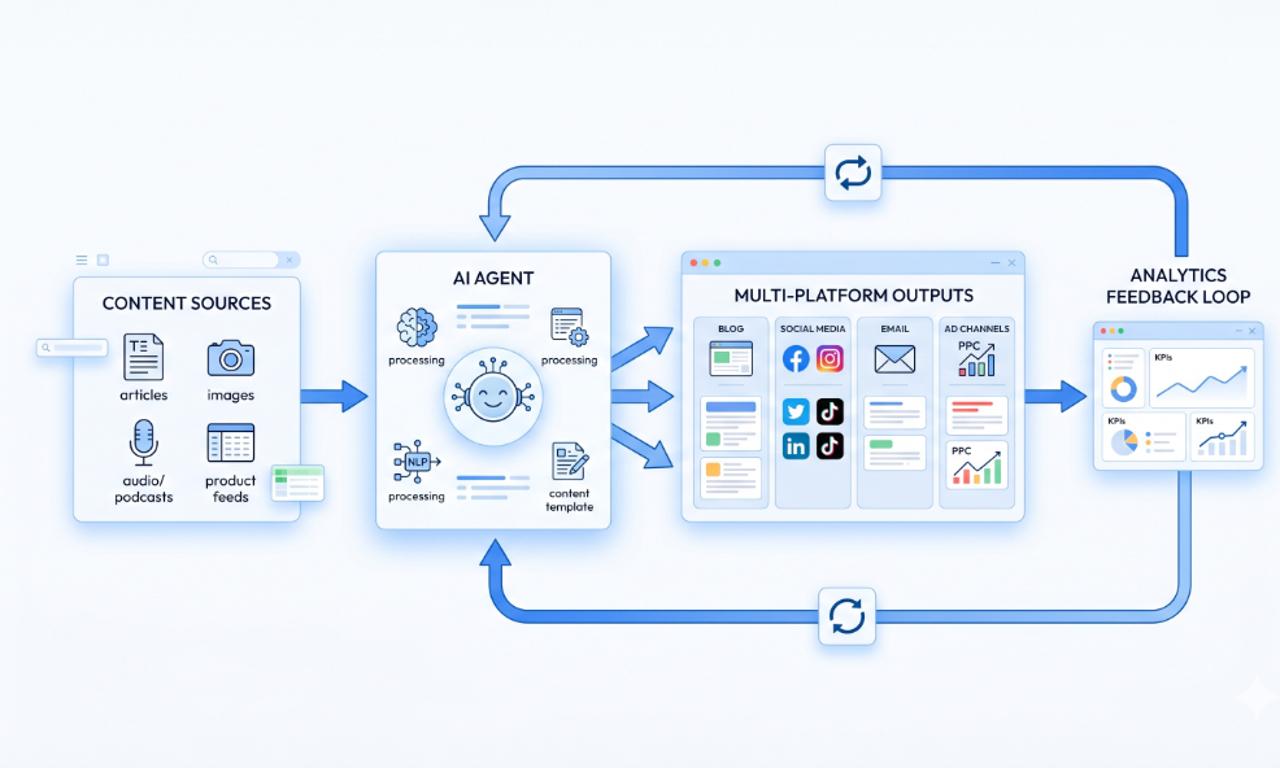
How AI Agents Automate Content End-to-End
Let’s simplify the architecture.
1. Define Clear Content Goals
Before automation, clarity is required.
Your system must align with:
- Lead generation
- Authority building
- SEO growth
- Product education
Without this, automation just amplifies noise.
2. Connect Real Data Sources
AI agents don’t create in isolation.
They pull from:
- Blog libraries
- Product updates
- CRM insights
- Analytics dashboards
Platforms like Bulk.ly automate content creation and scheduling using structured inputs, reducing manual effort significantly.
3. Use Structured Content Frameworks
Instead of random prompts, agents follow:
- Brand voice rules
- Tone guidelines
- Platform constraints
- CTA structures
This ensures consistency without supervision.
4. Repurpose Across Platforms Automatically
One input becomes multiple outputs:
- LinkedIn posts
- X threads
- Instagram captions
- Email summaries
- SEO snippets
No rewriting required.
Just intelligent transformation.
5. Build a Feedback Loop
This is where real leverage happens.
AI agents:
- Track engagement
- Analyze performance
- Adjust tone and format
- Improve future outputs
Manual workflows can’t evolve like this.
Tools vs AI Agents
| Capability | AI Tools | AI Agents |
| Execution | Manual | Autonomous |
| Input | Prompt-based | Goal-driven |
| Learning | None | Continuous |
| Integration | Limited | Deep |
| Scalability | Low | High |
Tools help you write faster.
Agents help you scale intelligently.
Why Most AI Content Automation Fails
AI doesn’t fail.
Bad implementation does.
Common mistakes:
- No structured workflow
- No brand rules
- No system integration
- No feedback loop
- Expecting one prompt to solve everything
Automation without architecture creates chaos.
When You Actually Need an AI Content Agent
You should consider it if you:
- Post across multiple platforms
- Have a growing content library
- Spend 10+ hours weekly on content
- Struggle with repurposing
- Want scalable visibility
At that point, manual execution becomes a bottleneck.
How We Build AI Content Systems at Mediusware
At Mediusware, we don’t build AI writers.
We build content infrastructure.
Our approach focuses on:
- Business-aligned goal modeling
- Secure system architecture
- API-driven integrations
- Controlled prompt frameworks
- Continuous optimization loops
From platforms like Bulk.ly, we’ve seen:
- 90% reduction in manual scheduling
- 35% increase in engagement
That’s the difference between effort and system design.
The Shift: From Content Creation to System Thinking
Content teams are not disappearing.
They are evolving into:
- Strategy owners
- System designers
- Performance optimizers
AI handles repetition.
Humans handle direction.
Frequently Asked Questions
AI tools generate content on demand.
AI agents operate continuously with goals, data, and optimization.

I work at the point where product decisions, system architecture, and engineering execution meet. At Mediusware, I’m accountable for how technology choices affect reliability, scale, and long-term delivery for our clients.
Featureblogs
Relatedblogs
Authorblogs
01
How Digital Agencies Can Deliver Custom Software Without Hiring Developers02
AI in FinTech: Build, Buy, or Integrate? A Founder's Decision Framework03
How to Choose a SaaS MVP Development Company04
How Seed-Stage SaaS Teams Add Engineering Capacity Without Hiring Chaos05
Why Seed-Stage SaaS Startups Struggle to Ship Fast