- How autonomous AI agents enhance modern QA pipelines with adaptive, risk-based testing.
- Why intelligent test systems improve release confidence in fast-scaling DevOps environments.
The Role of Autonomous AI Agents in Modern QA Pipelines
1 min read
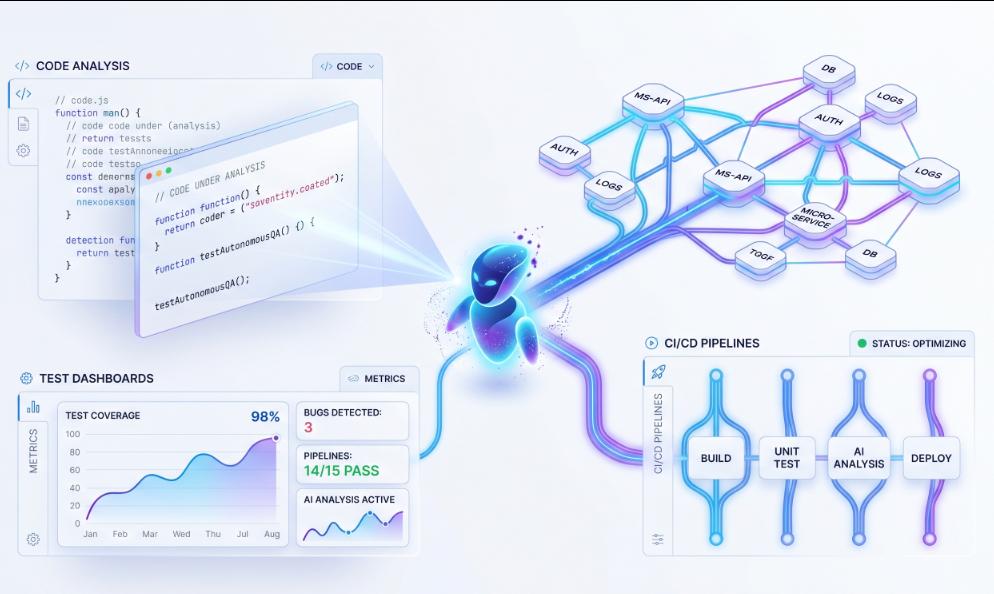
At NVIDIA’s 2025 AI Systems discussion, Jensen Huang said:
The next generation of software systems will continuously improve themselves.
That shift is already happening.
AI is helping teams write code faster, refactor systems, and ship features quickly. But QA pipelines? Most are still running on static scripts built for a slower world.
And that’s where the real problem starts.
When development accelerates, but testing stays rigid, QA becomes the bottleneck.
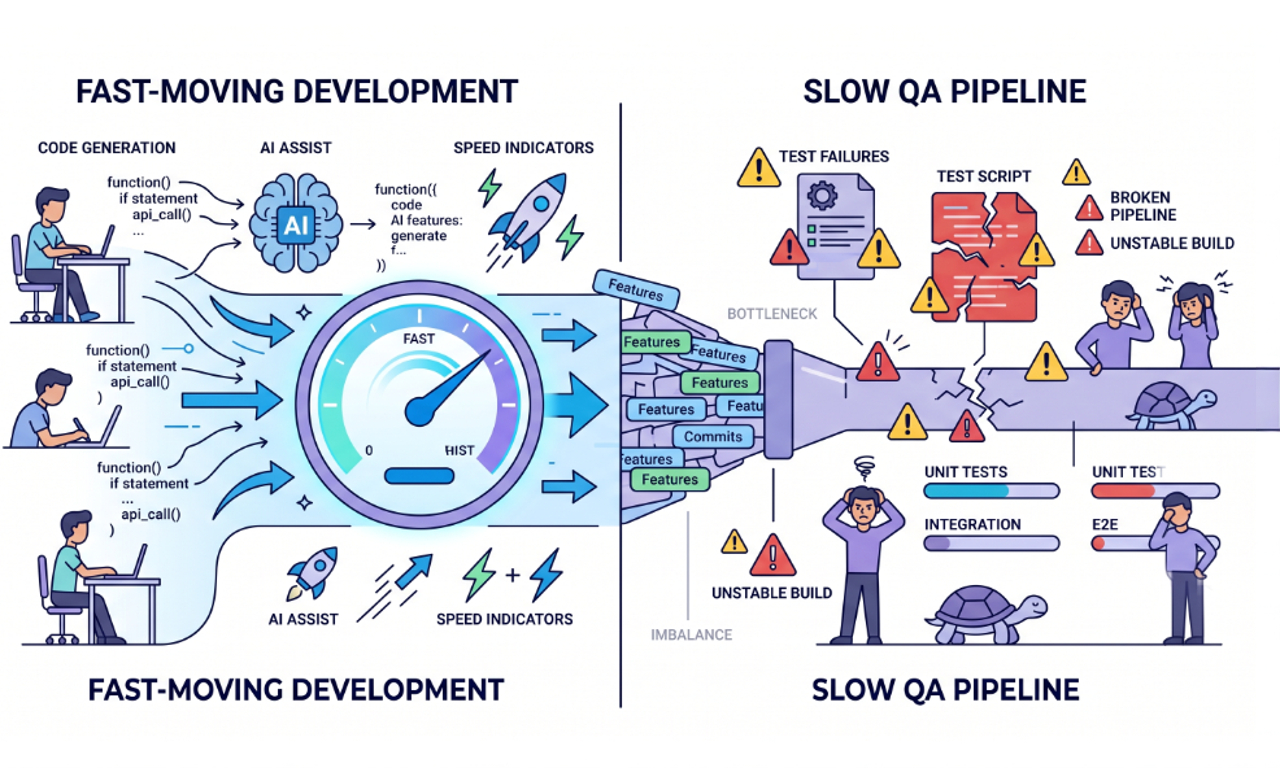
Not because teams are inefficient.
Because scripts don’t think.
Why Traditional Test Automation Is Breaking Down
Most QA automation still relies on:
- Fixed selectors
- Predefined test cases
- Rigid validation flows
This model assumes stability.
Modern systems are anything but stable.
- UI changes weekly
- APIs evolve constantly
- Microservices expand continuously
- AI-assisted coding increases release frequency
According to GitHub’s developer research, engineers now spend more time reviewing AI-generated code than writing repetitive logic, significantly increasing output.
But here’s the gap:
Faster code → Same testing model → Slower releases.
That imbalance doesn’t scale.
What Are Autonomous AI Agents in QA?
Autonomous AI agents bring adaptive intelligence into testing.
They don’t just execute tests. They:
- Generate test coverage dynamically
- Adapt to UI and API changes
- Prioritize high-risk components
- Analyze failures deeply
- Learn continuously from system behavior
Gartner predicts that 40% of enterprise workflows will include autonomous decision agents in the near future.
QA pipelines are one of the first places this shift makes sense.
Where Autonomous AI Agents Create Real Impact
1. Intelligent Test Case Generation
Manual test expansion doesn’t keep up with feature velocity.
Autonomous agents analyze:
- Code diffs
- Commit history
- Dependency maps
- Past defect patterns
Then generate risk-weighted test coverage automatically.
In real SaaS systems, regression scope often grows faster than QA capacity. Intelligent generation closes that gap.
2. Self-Healing Test Suites
One of the biggest hidden costs in QA is maintenance.
Traditional automation breaks when:
- UI selectors change
- DOM structure shifts
- Minor attributes update
Autonomous systems fix this by:
- Detecting selector drift
- Adapting dynamically
- Validating behavior instead of structure
Instead of constant fixing, QA shifts to supervision.
3. Risk-Based Test Prioritization
Not all tests matter equally.
AI-driven QA prioritizes based on:
- High-change modules
- Revenue-critical flows
- Defect history
- System dependencies
Traditional vs Autonomous QA
| Area | Traditional QA | Autonomous QA |
| Test Execution | Full suite every time | Risk-based selection |
| Maintenance | Manual fixes | Self-healing |
| Coverage | Static | Dynamic |
| Debugging | Manual investigation | AI-driven analysis |
This reduces test cycles without sacrificing confidence.
4. Intelligent Root Cause Analysis
Traditional pipelines say:
Test failed.
Autonomous agents ask:
- Is it UI regression?
- Backend issue?
- Data inconsistency?
- Environment instability?
By analyzing logs, commits, and patterns, AI reduces debugging time significantly.
In fast-moving teams, debugging often takes more time than development. This flips that equation.
5. Continuous Learning from Production
Staging never reflects real-world complexity.
Autonomous QA systems monitor:
- Production errors
- User behavior
- Performance anomalies
- Edge-case interactions
Then feed that data back into testing.
This creates a closed feedback loop, which is critical for scalable systems.
How This Changes the Role of QA Engineers
AI doesn’t replace QA engineers.
It upgrades them.
Instead of:
- Writing and maintaining scripts
They focus on:
- Risk modeling
- System design
- Edge-case strategy
- AI governance
This aligns with how modern platforms like CRM Runner, built with scalable architecture and real-time analytics, rely on intelligent systems rather than manual processes.
QA becomes less about execution, more about decision-making.
When Should You Adopt Autonomous QA?
You should seriously consider this shift if:
- Regression cycles are slowing releases
- Test maintenance is consuming too much time
- Flaky tests reduce CI/CD trust
- Deployment frequency is increasing
- AI is already used in development
If your system evolves but your QA doesn’t, growth will eventually stall.
The Strategic Shift
Automation was step one.
Autonomy is step two.
This isn’t just about faster testing.
It’s about intelligent release confidence.
Teams that adopt autonomous QA won’t just ship faster.
They’ll ship smarter.
Frequently Asked Questions
An autonomous AI agent is a system that automatically generates, runs, and improves tests based on code changes, system behavior, and real-world data.

I work at the point where product decisions, system architecture, and engineering execution meet. At Mediusware, I’m accountable for how technology choices affect reliability, scale, and long-term delivery for our clients.
Featureblogs
Relatedblogs
01
How to Create a Stunning WordPress Website in 2024: Step-by-Step Tutorial02
How Mediusware Empowered Protesters, Strengthened the Economy & Showcased Employee Resilience in the 2024 Movement03
Mastering Error Handling in Rust with Essential Techniques04
Best Practices for Writing Clean Code05
Let's Deep Dive Into Threads with RustAuthorblogs
01
How Digital Agencies Can Deliver Custom Software Without Hiring Developers02
AI in FinTech: Build, Buy, or Integrate? A Founder's Decision Framework03
How to Choose a SaaS MVP Development Company04
How Seed-Stage SaaS Teams Add Engineering Capacity Without Hiring Chaos05
Why Seed-Stage SaaS Startups Struggle to Ship Fast