- Structured engineering teams increase delivery speed while maintaining clarity and control.
- Automation and modular architecture enable scalable development without added complexity.
How to Add Development Capacity Without Increasing Management Complexity
1 min read
Most products don’t slow down because they run out of ideas.
They slow down because growth makes everything harder to manage.
You hire more developers…
But suddenly:
- Communication breaks
- Decisions slow down
- Delivery becomes unpredictable
And now you’re stuck in a loop where adding people creates more problems than it solves.
I’ve seen this pattern repeatedly.
The real challenge isn’t adding capacity.
It’s adding capacity without adding chaos.

Why Scaling Teams Creates Complexity
Scaling feels simple. Reality is not.
Most teams assume:
More developers = more output
But what actually happens:
- More developers → more communication channels
- More coordination → slower decisions
- More dependencies → higher delivery risk
According to the Standish Group CHAOS Report, 66% of software projects face delivery issues due to complexity and coordination problems.
So the problem isn’t capacity.
It’s structure.
As Fred Brooks said:
Adding manpower to a late software project makes it later.
What High-Performing Teams Do Instead
From what I’ve seen working with scaling SaaS teams:
The best teams don’t grow bigger.
They grow smarter.
Instead of growing blindly, They focus on:
- Independent execution
- Clear ownership
- Minimal dependencies
This creates:
- Faster decisions
- Fewer blockers
- predictable delivery
Less coordination = more speed.

5 Proven Ways to Add Development Capacity Without Increasing Complexity
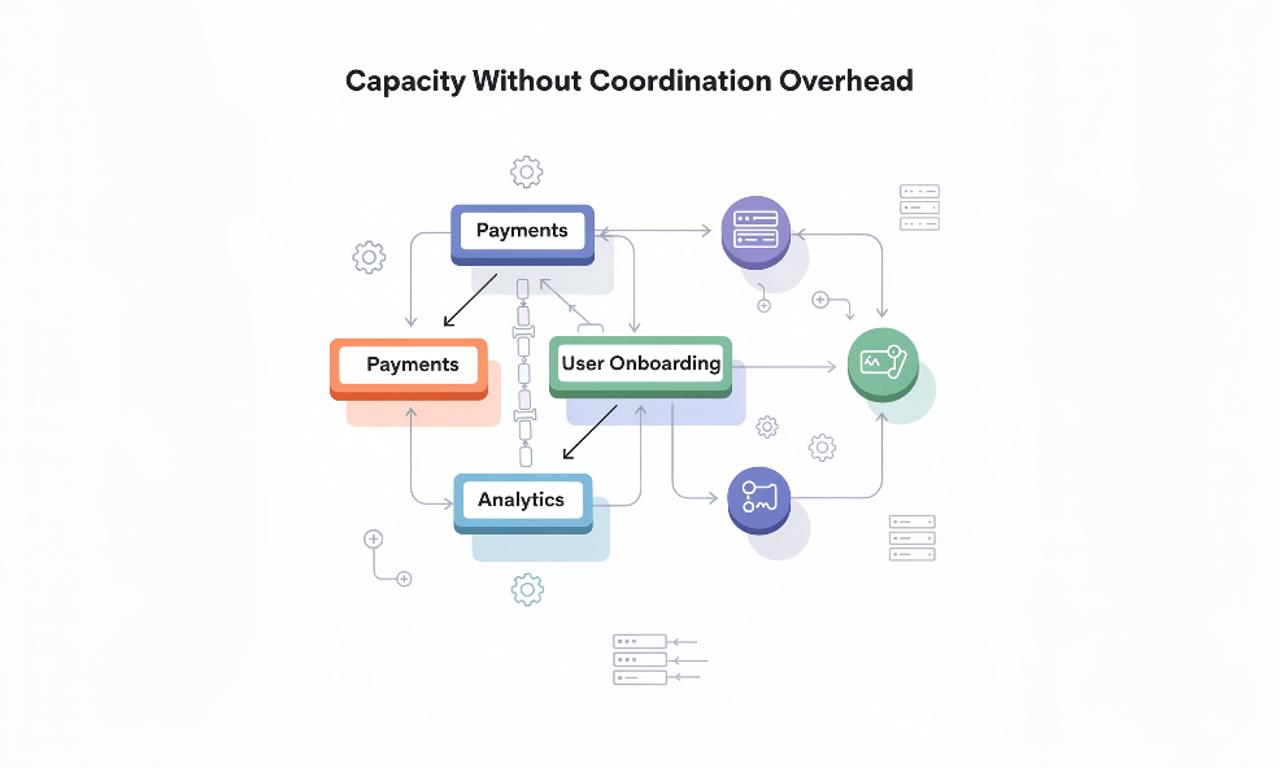
1. Build Small, Autonomous Pods
Instead of one big team:
- Create 3–5 person pods
- Assign each pod a domain
Example:
- Pod A → Payments
- Pod B → User onboarding
- Pod C → Analytics
This leads to:
- Fewer communication channels
- Faster execution
- Clear accountability
This model is widely used by companies like Amazon's Two-Pizza Teams model.
2. Define Clear Ownership
Remove shared responsibility. Create clarity.
When ownership is unclear:
- Decisions get delayed
- Bugs stay unresolved
- Accountability disappears
Instead:
- Assign one owner per feature/module
- Define clear boundaries
This results in:
- Faster decisions
- Cleaner execution
- Reduced management effort
At Mediusware, we’ve seen platforms like CRM Runner, where structured ownership improved operational efficiency.
3. Invest in Scalable Architecture Early
Your system must scale before your team can.
Common mistakes:
- Monolithic codebase
- Tight coupling between modules
- No API boundaries
Better approach:
- Modular architecture
- Microservices (when needed)
- Clear API contracts
According to Google Cloud Architecture Framework, modular systems reduce team dependency and enable parallel development.
This creates:
- Fewer dependencies
- Faster releases
- Independent teams
This is where strong software development services become critical for long-term scalability.
4. Replace Coordination with Automation
Don’t add managers. Add systems.
Instead of manual coordination:
- Use CI/CD pipelines
- Automate testing
- Automate deployments
- Monitor systems proactively
This results in:
- Less manual effort
- Fewer delays
- Faster delivery cycles
For example, Bulk.ly reduced up to 90% of manual operational effort through automation.
Automation reduces dependency on people.
5. Add Capacity Through External Teams
Scale without increasing internal complexity.
Instead of hiring slowly:
This enables:
- Faster scaling
- Stable delivery
- Reduced internal overhead
The Mistake Most Teams Make
They scale people, not systems.
Typical approach:
- Hire → Add managers → Slow down
But, High-performing teams scale like this:
- Structure → Automate → Delegate → Accelerate
This leads to:
- Cleaner workflows
- Faster execution
- Scalable systems
How Modern Teams Actually Scale
They optimize for clarity, not control.
High-performing teams:
- Focus on systems over headcount
- Reduce dependencies first
- Design for independent execution
This results in:
- Faster delivery
- Less friction
- Predictable growth
Platforms like Vida Projects follow this approach using modular systems and automation.
Scaling is a design problem, not a hiring problem.
Scaling Without Chaos Starts With Structure
If your delivery is slowing down, the issue isn’t your team.
It’s your system.
The teams that scale successfully:
- Don’t just add developers
- They design how work flows
Ready to Scale Without Slowing Down?
If you’re facing delivery delays, growing backlog, or coordination challenges, then your system needs restructuring.
At Mediusware, we help increase development capacity without increasing management complexity. Book a free engineering consultation and discover how to increase your development capacity without increasing management overhead.
Frequently Asked Questions
Focus on removing bottlenecks improve architecture, automate workflows, and create independent teams.

I work with founders and leadership teams when growth moves faster than their systems, teams, or decisions. I’ve led 850+ projects for 750+ clients across 20+ countries, working across 100+ technologies and counting. I care about ownership, clarity, and building things that last beyond the launch.
Featureblogs
Relatedblogs
01
Integrating Redux with React: A Comprehensive Guide02
Laravel pagination and filtering with already loaded data as array in memory03
React + Three.js + React Three Fiber: Crafting Interactive 3D views in Web Applications04
Advanced Caching Strategies for Django Applications05
Implementing Roles and Permissions in Laravel Using Guard-LaravelAuthorblogs
01
Building a Financial SaaS Around Real Business Cash Decisions02
Critical PHP Security Update (October 2026): What SaaS Owners Must Check Now03
SaaS MVP Development: A Founder’s Guide for 202704
Zero Clicks, Falling Traffic: How to Win Back Revenue05
Ranking on Google in 2026: What Matters in the Age of AI Search