Quick Summary
- Clarity: Explain the help offered.
- Navigation: Make destinations clear.
- Contact: Explain the next step.
- Ownership: Define ongoing responsibilities.
Quick Summary
A parent arrives on a support website with a practical question, Can you help with what my family needs?
Before making contact, they need to understand the service, what participation involves, and what happens next. A welcoming homepage begins that conversation. The pages behind it must make the offer clear.
This was the context behind a parent and caregiver coaching website developed with Mediusware. The intended offering was to help parents learn how to advocate for their children.
The supplied designs show service explanations, resources, events, related-service links, and contact pathways across desktop and mobile presentations.
Project follow-up records document development delivery and later technical assistance involving hosting, domain access, and server configuration.
Together, these materials offer a useful perspective on family-support website design: how to connect a specialist service with an understandable next step, while keeping the website’s promise aligned with its operations.
The original concept centered on coaching parents and caregivers so they could advocate for their children themselves.
That distinction matters. Education, coaching, resource coordination, and direct representation involve different responsibilities.
A visitor needs to understand which kind of support a service provides before deciding whether to contact it.
For example, “advocacy support” could describe help preparing questions for a school meeting.
A visitor might interpret the same phrase as someone attending the meeting and representing the family. The wording needs enough detail to resolve that uncertainty.
A family-support website therefore needs to explain the offer at the level of participation:
These are content requirements for a clear service journey. They should be agreed with the service owner before becoming promises on a page.
For this project, the coaching concept is documented. The available records do not establish the original discovery process or detailed acceptance criteria.
The practical lesson comes from the service model itself: the website must help visitors understand the kind of help they are considering.
The supplied service-page designs provide a useful structure to examine.
An introductory section names the service and presents a contact button. Further down, an explanation, supporting content, benefit cards, related services, and an inquiry form give visitors more context.
This arrangement creates several opportunities to answer a visitor’s questions. The introduction can establish relevance.
The detailed explanation can clarify the work involved. Related services can help someone explore a different option when the first page does not match their needs.
Each section needs a distinct purpose. Repeating broad promises such as “personalized support” or “expert guidance” adds little unless the page explains what those phrases mean in practice.
A useful service-page content model is,
| Visitor question | Information the page should provide |
| Is this relevant to my family? | Intended audience and situations supported |
| What help will I receive? | Specific activities, outputs, and service boundaries |
| What will I need to do? | Participation and preparation requirements |
| How do I begin? | A clearly labeled inquiry route |
| What happens afterward? | The confirmed follow-up process |
This is a recommended model for evaluating the supplied design, rather than a claim that every answer was implemented.
It also helps keep content accurate. A page describing an assessment service, for example, should explain the nature of that assessment.
The service name alone cannot establish whether it involves an introductory conversation, support planning, or another process.
The goal is to give visitors enough information to make an informed inquiry.
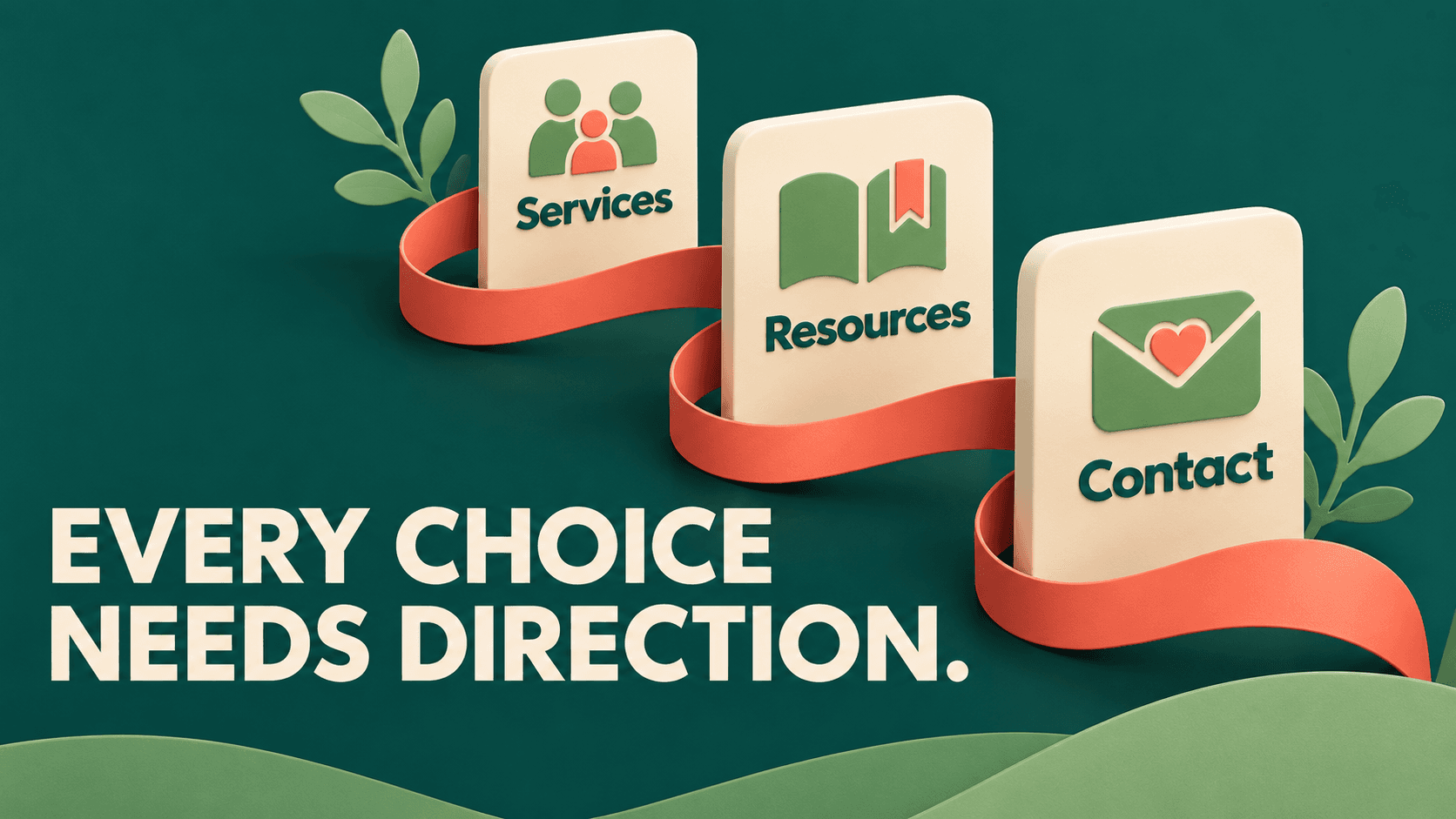
The designs bring services, resources, events, and contact options into the website’s navigation. Service cards also provide routes to more detailed pages.
The next question is whether each choice communicates its destination clearly.
Nielsen Norman Group describes how people use link wording and surrounding context to judge where to go next. A useful label helps visitors predict what they will find before opening the page.
This principle is especially relevant when service categories contain unfamiliar terminology.
A heading such as “Resource Coordination” can be supported by a short explanation of what coordination involves.
The accompanying link can reinforce that destination instead of relying on a repeated “View Details” label.
For example, the following are illustrative content improvements:
| General label | More descriptive alternative |
| View Details | Explore caregiver workshops |
| Learn More | Understand the coaching service |
| Resources | Browse family-support guides. |
The final wording should match the actual content and service.
Navigation also needs consistency between the homepage and deeper pages. If the homepage introduces a service using one phrase, the destination page should make the relationship recognizable.
Visitors should not have to determine whether two different labels describe the same offering.
Clear navigation connects the visitor’s question with the website’s vocabulary.
The supplied design includes an inquiry form with name, email, phone, subject, and message fields.
Its visible presence establishes a contact route in the design. It does not establish how submissions are processed, who receives them, or what response a visitor should expect.
Those operational questions should shape the form’s content.
Before someone submits an inquiry, the page should explain what the form is for and what information is necessary.
After submission, the experience should confirm what happened and describe the next step using a process the organization can support.
For a family-support inquiry, practical design questions include:
An introductory form should request information appropriate to that stage. If a brief description is enough to begin the conversation, the page can say so.
Response expectations also need careful wording. Any stated response time should reflect the team’s confirmed capacity. Clear expectations help the website’s contact pathway fit the service behind it.
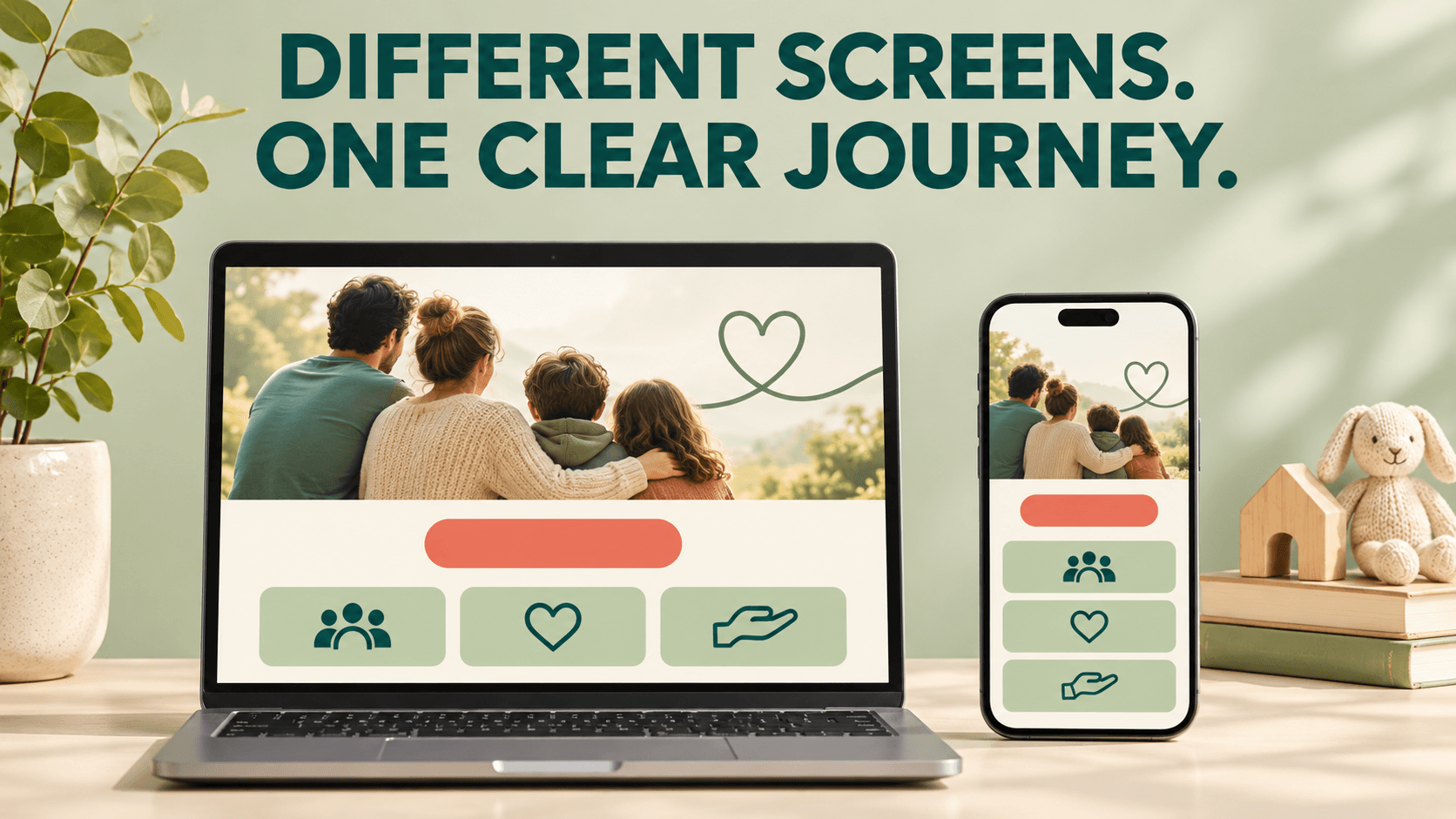
The project materials show desktop and mobile presentations of the website, including service content, navigation, and account-related screens.
These visuals allow discussion of how content is arranged across screen sizes. They do not establish completed browser testing, working account functionality, or accessibility conformance.
For a responsive service website, the important question is whether the same journey remains understandable on a smaller screen.
A visitor should still be able to identify the service, read its explanation, explore related information, and find the contact route.
Content order matters because sections that sit beside one another on desktop become a longer sequence on mobile.
That makes mobile review a content exercise as well as a layout exercise. Essential service information should appear in a useful order, and contact options should remain easy to recognize.
Accessibility requires further evaluation. W3C’s preliminary checks cover areas such as headings, contrast, text resizing, keyboard access, visible focus, and form labels.
For this project, the appropriate claim is that desktop and mobile designs were supplied. A formal assessment would be needed to establish how the implemented website performs for different users and assistive technologies.
The project’s follow-up records bring another part of website delivery into view: ongoing access and operation.
Hosting cancellation and recovery options were discussed in January 2026. A later discussion covered domain/DNS changes and server configuration.
These records document technical follow-up but do not confirm successful restoration or the website’s current deployment status.
The broader delivery lesson is practical. A website depends on recurring services and account access after development work ends.
For a similar project, a useful operational handover would identify:
| Area | Ownership question |
| Domain | Who controls the account and renews the registration? |
| Hosting | Who maintains the subscription and receives notices? |
| Backups | What is backed up, and who verifies recovery? |
| Content | Who can update service information and contact details? |
| Support | Who responds when the website becomes unavailable? |
| Restoration | What access and materials are needed to bring it back? |
These are recommended handover requirements. The available project evidence does not confirm that this complete package was delivered.
Discussing them early helps connect development with the client’s ability to keep operating the website.
The appropriate hosting arrangement depends on the application and maintenance needs; the important starting point is clear responsibility.

That is the supported delivery account. The available materials do not establish an independently reviewed acceptance record, current availability, adoption, or commercial performance.
Mediusware’s documented contribution includes website/application development and subsequent technical assistance.
The supplied designs provide a basis for examining service presentation, navigation, contact pathways, and responsive layouts.
Future evaluation could examine whether visitors understand the offering, find relevant service pages, and complete appropriate inquiries.
Useful measures would include:
Each measure needs a defined method and baseline before it can support an improvement claim.
The project’s value as a learning example lies in the connection between the service promise and the website experience.
A family should be able to understand the available help, recognize their own role, and take a clear next step. Development, content, and ongoing ownership all contribute to making that journey work.
To support coaching that helps parents and caregivers advocate for their children.