Short Summary
- Runtime: Respect production limits.
- Integration: Improve existing systems.
- Priorities: Address manual workflows first.
- Roadmap: Separate delivery from proposals.
Short Summary

A scraping script can retrieve the right information and still be unsuitable for its production environment.
In one discussion about an existing data-collection platform, processing a single record reportedly took approximately 30–40 minutes.
The shared server allowed five minutes of execution.
That gap made the task larger than getting a scraper to return data. The work had to fit the operating environment, integrate with existing code, and avoid interrupting other developers and testers.
Mediusware’s engagement involved PHP/Python grabber development, troubleshooting, and technical planning within that established system. Later discussions expanded into public data imports, AI-assisted extraction, and a possible external product.
The useful story is how those priorities were considered together: protect the operating platform, address immediate manual work, and give broader automation ambitions a realistic sequence.
The client already had a scraping platform with an administrative interface, PHP/Python scripts, databases, and operational infrastructure.
Its internal users included developers, testers, and data operations staff. Their work involved creating grabbers, testing scripts, parsing source information, and preparing datasets for downstream use.
The engagement therefore began within an existing technical environment. New work needed to respect its execution limits and integration requirements.
Several connected difficulties appeared in the project record:
| Work area | Reported difficulty |
| Environment setup | PHP/Python setup and integration issues delayed use of some grabbers. |
| Execution | Some processing exceeded the server’s permitted runtime. |
| Shared infrastructure | Long-running or looping scripts could interrupt other work. |
| Requirements | Misunderstandings led to additional QA exchanges. |
| Maintenance | Source changes and blocking created recurring scraper work. |
| Data imports | Downloading, preparation, and database loading required manual effort. |
These issues called for different responses. A runtime problem needed engineering investigation. An unclear expected output needed a better requirement. A manual import process needed workflow analysis.
Treating all of them as a single request to “automate scraping” would have hidden the decisions needed to make progress.
The intake supports Mediusware’s involvement in PHP/Python grabber development and troubleshooting.
The documented work included environment setup, runtime and timeout issues, browser automation, and headless-mode behaviour. Client conversations also covered requirements, completed tasks and future technical directions.
Later planning explored AI-assisted scraping and public-data imports.
The scope matters because this was an inherited platform. The available evidence does not support claiming that Mediusware built the entire system, its public website or its underlying data estate.
It also distinguishes development activity from production readiness. A script can be completed while integration remains unfinished. A reported timeout fix can address a particular issue without establishing sustained reliability across the platform.
For engineering teams, those distinctions make progress easier to assess and communicate.
The clearest engineering tradeoff concerned execution time.
In the February 3 discussion, one example reportedly required approximately 30–40 minutes per record against a five-minute server limit. The documented direction was to retain that limit to protect the shared environment.
The discussion considered reducing detail-page processing from approximately 40 pages to one or two pages per record.
That introduced a concrete tradeoff: process less information in a pass to make the workload more compatible with the permitted runtime.
| Consideration | Implication |
| Preserve the execution limit. | Keep the shared environment’s protection in place. |
| Reduce work per record. | Narrow what a single pass attempts. |
| Preserve data requirements | Establish which details remain necessary. |
| Confirm the result. | Use execution records and output checks. |
The available intake documents the decision under discussion, but it does not establish the resulting production runtime.
A useful acceptance record would connect the implementation to both execution time and output completeness. Finishing sooner would only address part of the problem if required information were missing.
The broader lesson is to make operating constraints visible in the task definition. Runtime, resource use and integration behavior belong alongside the expected data output.
The existing platform was PHP-heavy and already contained a substantial scraper estate.
A full rewrite was not the preferred direction described in the discussions. The client needed improvements within the operating system, which made compatibility and existing knowledge relevant to the plan.
Python remained part of the technical conversation. In July, a Python-first proof of concept was proposed, with later PHP adaptation or a Python fallback considered.
That proposal should remain a proposal in the project story. Its value was the opportunity to explore an approach before committing to a larger integration.
For teams working with an inherited system, the decision needs more detail than a language preference:
Those questions help define the cost of introducing another component. They also give a proof of concept a useful purpose: resolve a specific uncertainty before expanding the scope.
The intake records requirements misunderstandings and QA back-and-forth.
For a grabber, “collect this information” leaves several important questions open. A task needs to establish the required fields, expected formats, handling of missing values, and the conditions for completion.
A practical acceptance example can make those expectations concrete.
| Requirement | Example of what to define |
| Input | Approved source and record type |
| Output | Required fields and formats |
| Missing information | Which values may be empty and how they are represented |
| Completion | Whether all detail pages or a defined subset must be processed |
| Failure | How an unsuccessful job is reported |
| Production behaviour | Runtime limit and integration expectations |
This is a recommended way to address the reported problem. The available records do not establish that this exact process was adopted.
The purpose is to give development and testing the same reference point. When a task returns from QA, the team should be able to identify whether the implementation missed an agreed condition or the requirement itself needs clarification.
Public-data imports had become an immediate priority in the client discussions.
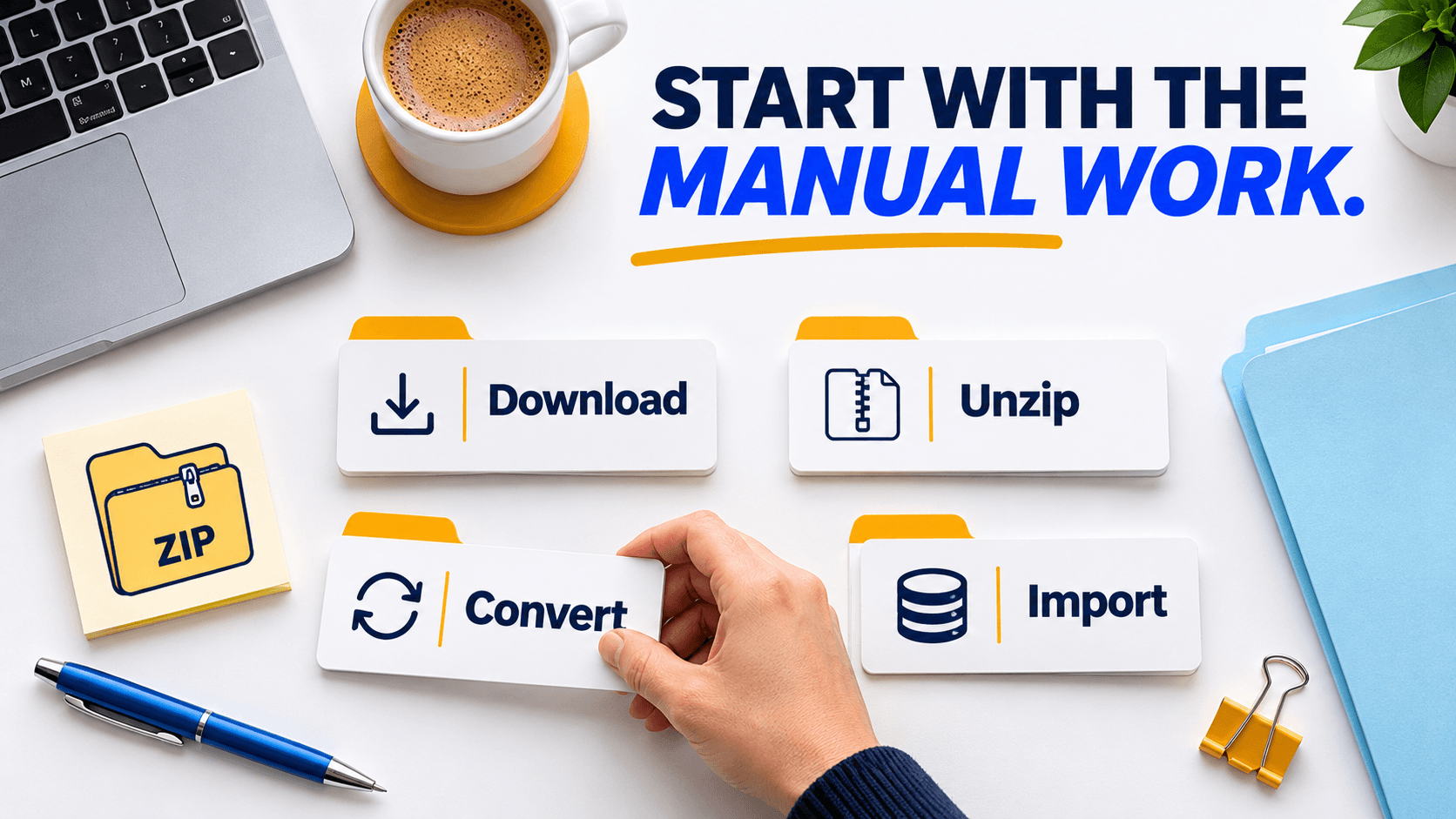
The described process involved downloading files, unzipping them, converting formats, and loading data into a database. Secretary of State records and professional-license data were among the examples.
The client also reported that limited time could leave some updates delayed by three or four months. That was a reported baseline for some updates, not a measured platform-wide freshness figure.
Professional-license files introduced another difficulty: formats varied, and an existing import script was not available for that workflow.
This made import automation a concrete opportunity, but it still needed definition.
A focused starting scope would identify the source files, required fields, mapping rules, and conditions for accepting an import. It would also need a clear way to handle files that do not match expectations.
The discussion was still scoping this work. The article therefore cannot claim that an automated pipeline subsequently eliminated delays or saved a particular number of hours.
What it demonstrates is a useful prioritization choice: start with a specific recurring workflow whose inputs and outputs can be examined.
The conversations also explored a potential external product through which customers could create scraping workflows using accounts and AI-assisted tools.
That ambition introduced a wider product scope than maintaining internal grabbers.
An external service would need defined customer journeys, operating expectations, support responsibilities, and commercial boundaries. It would also depend on the underlying collection workflows behaving consistently.
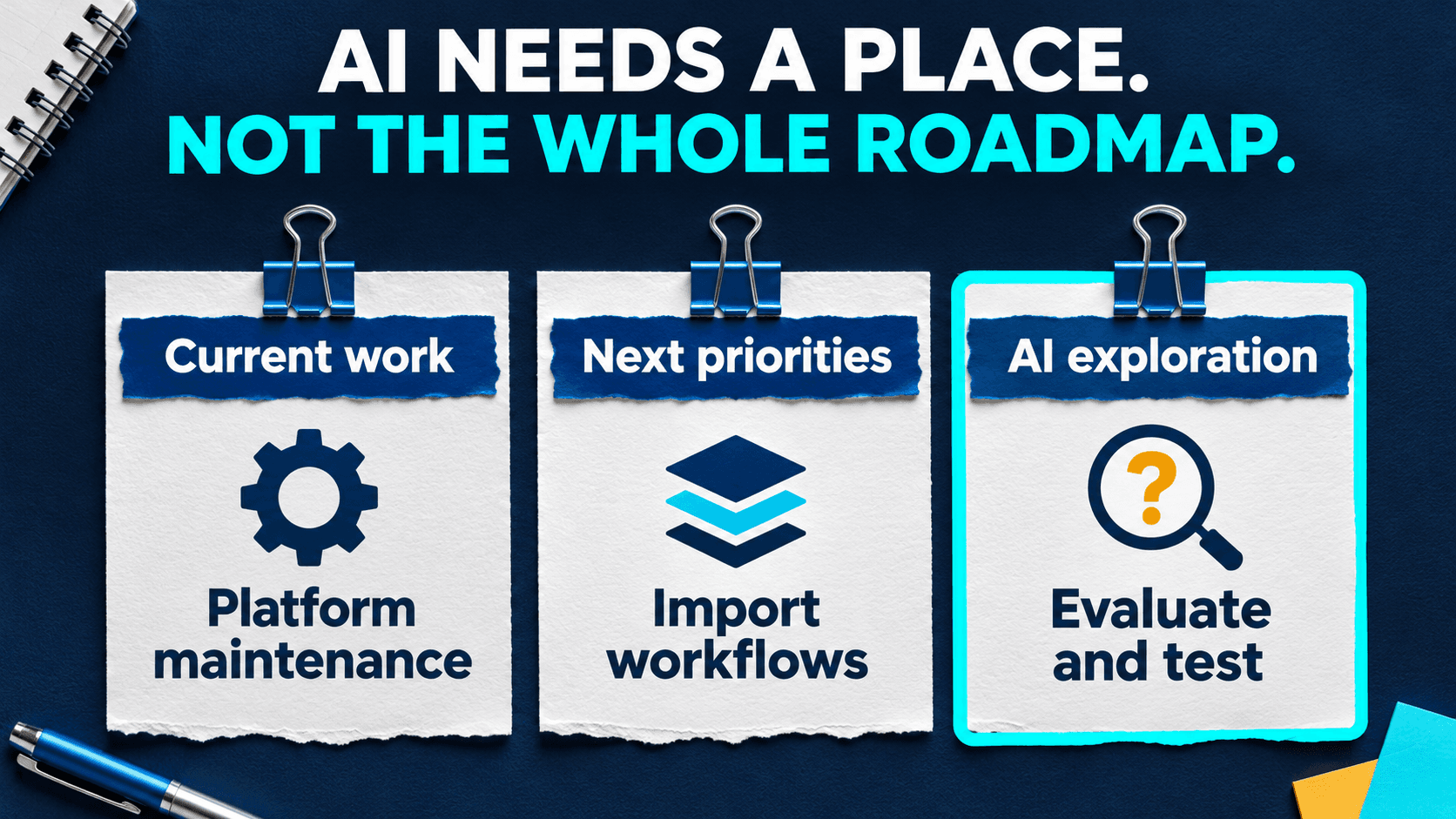
The client’s stated direction was to improve the internal system first. Also, public-data imports became the immediate priority ahead of broader AI scraping improvements.
The sequence reflected the client’s current operational needs.
| Direction | Place in the discussion |
| Existing grabber development and troubleshooting | Ongoing work |
| Internal-system improvements | Nearer-term direction |
| Public-data import automation | Immediate July priority |
| Broader AI-assisted capabilities | Further exploration |
| External self-service product | Longer-term ambition |
The available material does not establish execution of a final approved roadmap. It does show why the roadmap needed to distinguish immediate work from future possibilities.
AI-assisted extraction, field detection, and reduced maintenance effort were explored during the engagement.
These ideas addressed relevant concerns, including source changes and the effort required to maintain scrapers. However, discussing an approach does not establish a delivered capability.
A useful AI proposal needs a bounded evaluation. The team must define which uncertainty it is trying to resolve and what evidence would justify further investment.
For example, an extraction experiment could assess required-field coverage, handling of missing information, review effort, and operating cost. Its results would then inform an integration decision.
The same discipline applies to claims about self-healing. Detecting that a source has changed, proposing an adjustment and safely accepting corrected output are separate steps.
The supplied record does not establish a released self-healing system. Keeping that boundary explicit preserves the distinction between the engagement’s documented development work and its exploratory directions.
The project intake supports an existing PHP/Python development engagement, troubleshooting activity and technical planning.
It also records dated progress observations. Earlier setup issues were reported resolved in February, while production integration remained incomplete. A timeout issue was subsequently reported solved, although the associated ticket and release were not supplied.
Later client feedback acknowledged completed work while continuing to raise operational and communication concerns.
That mixed picture is useful. It shows why individual task completion, production integration and sustained operational performance need separate evidence.
The available material does not establish final before-and-after results for runtime, update freshness, downtime, manual effort or maintenance cost.
For a future outcome assessment, the most useful measures would be:
Each measure needs a defined scope, date range and responsible owner.
This engagement illustrates the decisions involved in extending an established data-collection platform.
The execution limit shaped how much work a grabber could attempt. Existing code influenced integration choices.
Manual imports gave the roadmap a concrete operational priority. AI and external-product ideas needed a separate evaluation path.
For teams maintaining similar systems, a focused improvement plan begins with the work already happening: its inputs, constraints, expected outputs and recurring failure points.
Improving an existing scraping platform within shared-server limits and integration requirements.