- Slow development delays revenue, weakens trust, and increases SaaS churn risk.
- Faster delivery helps SaaS teams ship, learn, and scale with confidence.
The Hidden Cost of Slow Development in SaaS Companies
6 min read
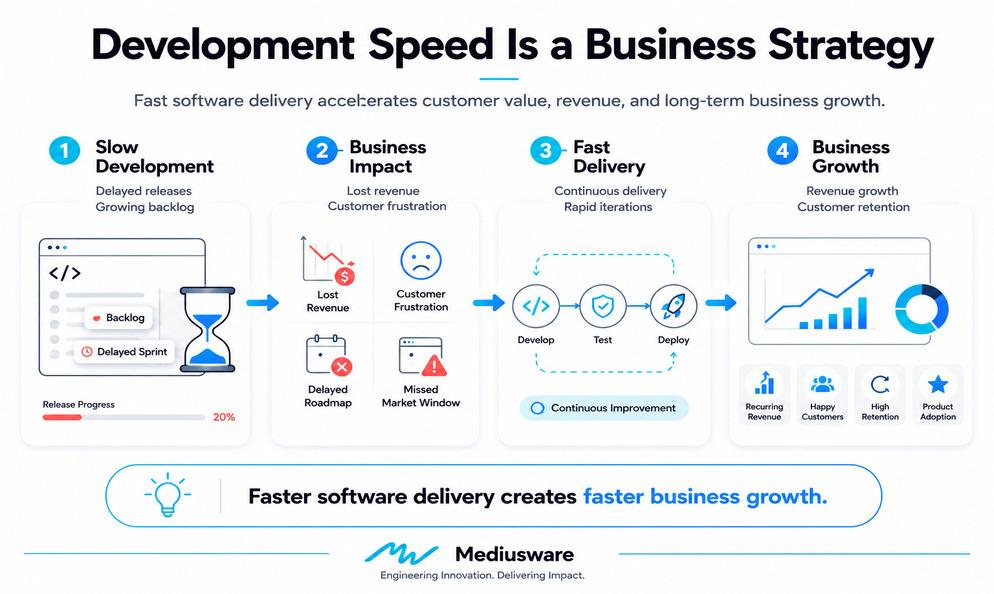
Most SaaS companies don’t fail because the idea is bad. They fail because the product moves too slowly.
Features take months instead of weeks. Roadmaps keep slipping. Developers spend more time fixing old problems than building new value.
Meanwhile, competitors are shipping faster, learning faster, and winning customers earlier.
In SaaS, slow development is not just an engineering problem. It is a growth problem.
It delays revenue. It weakens customer trust. It makes retention harder. And every unresolved technical problem can make the next release even slower.
Google Cloud’s DORA research tracks software delivery through metrics such as change lead time, deployment frequency, recovery time, failure rate, and rework. The reason is simple: strong engineering teams are not measured only by how much code they produce, but by how reliably they turn changes into working software.
The problem is that many SaaS companies respond to slow delivery by pushing developers harder or hiring more people.
That is not always the right fix.
In this guide, I’ll break down where slow SaaS development actually costs your business, how to find the real bottleneck, and what to fix before adding more engineering capacity.
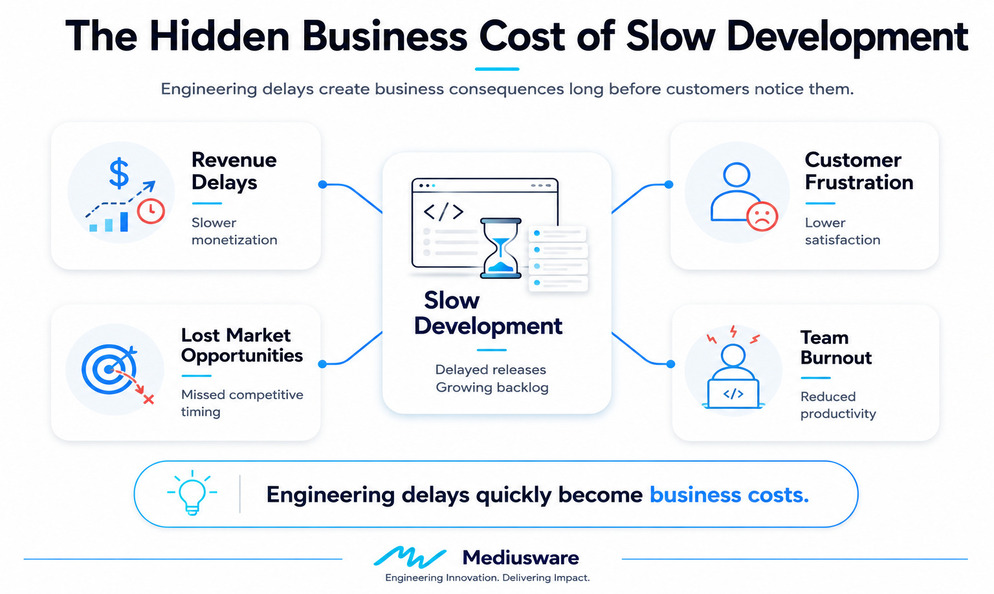 The important word is hidden.
The Real Problem Is the Delivery Gap
Your market can tell you exactly what it needs, and you can still lose the opportunity because your product cannot respond fast enough.
A customer asks for an integration. Sales finds a feature that could help close a larger deal. Product knows what needs to change.
But the release still takes months.
That gap between learning what the market needs and shipping a useful response is what I call the Delivery Gap.
Imagine an enterprise customer asks for SSO in January, but the feature does not ship until June.
Engineering delivered the feature. The customer waited five months.
The real cost is not only the engineering time. It is the business value you could not capture while waiting.
When this keeps happening across the roadmap, it can point to deeper development bottlenecks that slow SaaS growth.
For SaaS leaders, the better question is:
How quickly can your company turn a useful market signal into customer value?
Why Is Slow Development Dangerous for SaaS Companies?
Slow development is dangerous because SaaS companies depend on fast learning.
You ship. Customers react. Your team learns. Then you improve the product.
When releases take months, that entire loop slows down.
A delayed feature does not only delay the feature. It delays the customer feedback and usage data you need to make the next product decision.
That can affect:
- Sales because important features stay unavailable
- Retention because customer problems remain unresolved
- Expansion because larger accounts keep waiting
- Product adoption because improvements reach users later
- Market position because competitors keep learning while you wait
Over time, those delays can create an execution gap that slows SaaS growth.
The goal is not to make developers rush.
It is to shorten the path between:
Customer signal → Product decision → Release → Feedback
The shorter that loop becomes, the faster your company can learn what customers actually need.
How Does Slow Development Delay Revenue?
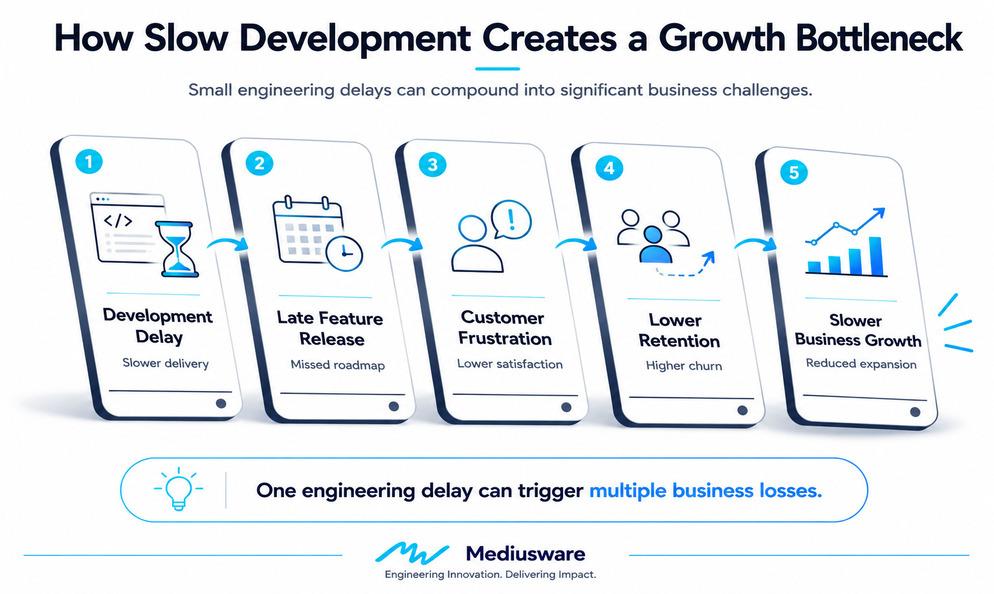
Slow development delays revenue because important product improvements reach customers later than expected.
If customers are waiting for integrations, reporting dashboards, workflow automation, mobile improvements, or AI features, delays can directly affect buying decisions.
For SaaS companies, features are not just technical assets.
They are revenue levers.
A delayed feature can block:
- New sales
- Enterprise deals
- Upsells
- Retention improvements
- Expansion revenue
Development Delay vs Revenue Impact
| Development Delay | Revenue Impact |
| Delayed integration | Enterprise prospects wait or choose another tool |
| Delayed onboarding improvement | Trial users fail to activate |
| Delayed performance fix | Existing users lose trust |
| Delayed reporting feature | Expansion revenue slows |
| Delayed automation feature | Competitors look more attractive |
Slow development does not always show up immediately in financial reports.
But over time, it quietly leaks revenue.
How Does Slow Development Increase Customer Churn?
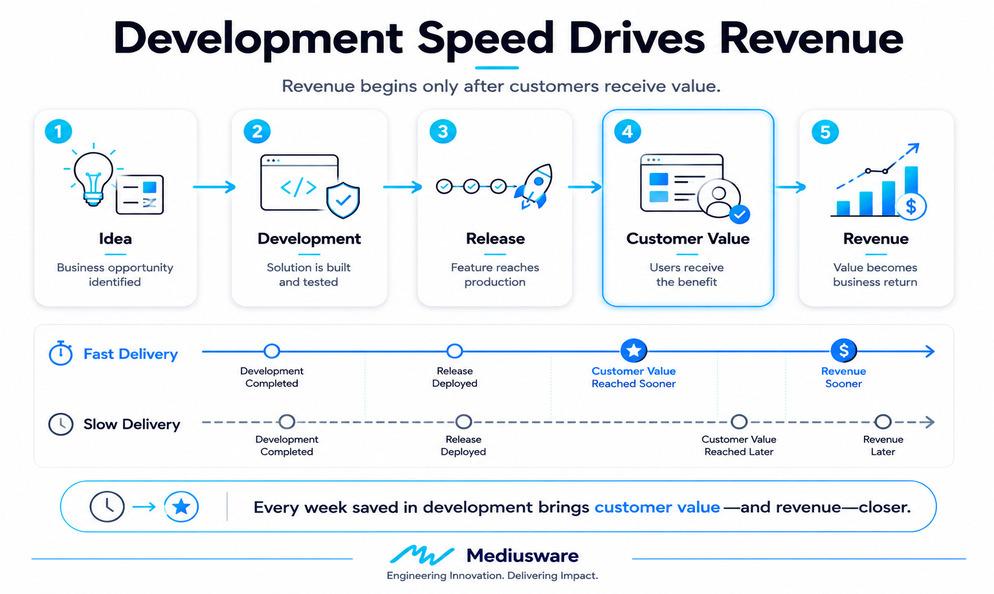
Slow development increases customer churn because users lose trust when product problems stay unresolved for too long.
Customers may not always say:
We are leaving because your development is slow.
Instead, they feel the symptoms:
- Bugs stay too long
- UX feels outdated
- Requested features never arrive
- Workflows remain frustrating
- Competitors start looking better
That is why SaaS companies cannot separate engineering speed from customer experience.
They are connected.
What Causes Slow Development in SaaS Companies?
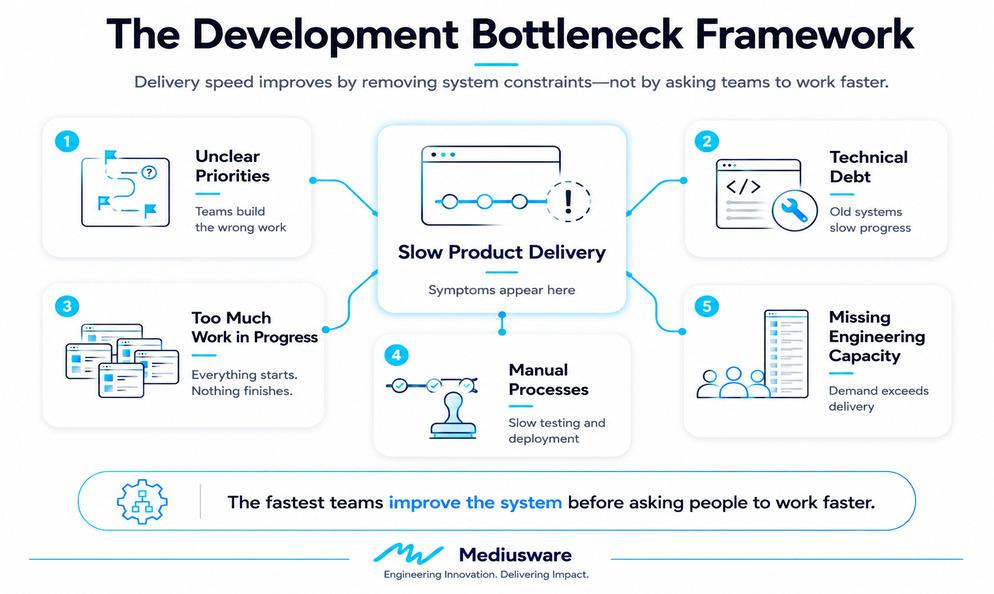
Slow development in SaaS companies is usually caused by technical debt, overloaded teams, unclear priorities, poor architecture, weak QA systems, slow approvals, and insufficient development capacity.
Most SaaS companies do not slow down because of one single issue.
They slow down because several small bottlenecks compound.
| Cause | What Happens |
| Technical debt | Simple changes take too long |
| Small engineering team | Roadmap becomes bigger than capacity |
| Poor architecture | Scaling and integrations become difficult |
| Unclear priorities | Developers spend time on low-impact work |
| Manual QA | Releases slow down |
| Weak communication | Rework increases |
| No delivery metrics | Leaders cannot identify bottlenecks |
Slow development is usually a system problem, not an individual developer problem.
Why Does Technical Debt Slow SaaS Companies Down?
Technical debt slows SaaS companies down because old shortcuts make future development harder.
Early-stage SaaS teams often move quickly to validate the product.
That is normal.
But after validation, the architecture must mature.
If it does not, every future release becomes harder.
Signs technical debt is slowing your SaaS company:
- Small changes take too long
- Developers avoid touching certain parts of the codebase
- Releases create unexpected bugs
- QA cycles keep expanding
- New features break old workflows
At this point, technical debt is no longer just a technical issue.
It becomes a business risk.
What Data Shows the Business Cost of Software Delays?
Software delivery delays can create measurable business costs through missed timelines, reduced responsiveness, lower competitiveness, and wasted capacity.
Gearset’s 2025 deployment research, reported by ITPro, found that software deployments were delayed across more than 80% of surveyed UK businesses, with average delays of 3.8 months and an estimated annual cost of £107,000 per organization.
For SaaS companies, even a 3-month delay can mean:
- A missed market window
- Lost customer trust
- Delayed revenue
- Slower learning
- More investor pressure
- More time for competitors to catch up
This is why development speed should be treated as a business metric.
Not just an engineering metric.
Does Fast Development Mean Lower Quality?
Fast development does not have to mean lower quality.
Strong SaaS teams aim for controlled speed.
That means they ship smaller releases, improve QA, use delivery metrics, strengthen architecture, and reduce deployment risk.
Fast but unstable teams create customer risk.
Stable but slow teams create growth risk.
High-performing SaaS teams need both.
What Do Fast SaaS Development Teams Do Differently?
Fast SaaS teams do not just write code faster.
They build better delivery systems.
| Fast SaaS Teams | Slow SaaS Teams |
| Ship small releases often | Wait months for big releases |
| Measure delivery performance | Guess where bottlenecks are |
| Reduce technical debt early | Let technical debt compound |
| Align product and engineering | Work with unclear priorities |
| Improve product experience continuously | Delay product improvements |
| Add capacity before crisis | Wait until teams are overloaded |
| Balance speed and stability | Choose either speed or stability |
Fast SaaS teams are not careless.
They are structured.
How Can SaaS Companies Improve Development Speed?
SaaS companies can improve development speed by finding where delivery slows down, simplifying the roadmap, improving architecture, and giving the team enough capacity to execute.
Start with the delivery workflow.
Look at where work gets stuck:
- Planning
- Design handoff
- Development
- Code review
- QA
- Deployment
- Feedback collection
Then review the roadmap.
Prioritize features based on:
- Revenue impact
- Retention impact
- User pain
- Technical urgency
- Product strategy
This helps the team stop chasing everything and focus on the work that actually moves the business forward.
A focused roadmap helps the team move faster.
A bloated roadmap creates confusion.
Where Does Mediusware Fit In?
Mediusware helps SaaS companies reduce development bottlenecks, improve product delivery, strengthen architecture, and scale engineering capacity.
Good development is not just about writing code.
It is about helping founders reduce risk, move faster, and build products users trust.
Across SaaS platforms, AI systems, automation products, analytics tools, healthcare platforms, e-commerce systems, LMS platforms, and enterprise management solutions, one pattern is clear:
SaaS companies that scale successfully treat development speed as a business strategy.
Not just a technical function.
Final Answer: Why Should SaaS Companies Fix Slow Development Early?
SaaS companies should fix slow development early because delays compound into missed revenue, weaker customer trust, growing technical debt, and slower product learning.
A slow sprint can become a delayed roadmap, and a delayed roadmap can quickly become lost growth.
In SaaS, speed is not about rushing; it is about building the right things faster, with less friction and more confidence.
Frequently Asked Questions
Slow development in SaaS means a software company takes too long to release features, fix bugs, improve product experience, or respond to customer needs. It is usually caused by technical debt, overloaded teams, unclear priorities, poor architecture, or weak delivery systems.

I work with founders and leadership teams when growth moves faster than their systems, teams, or decisions. I’ve led 850+ projects for 750+ clients across 20+ countries, working across 100+ technologies and counting. I care about ownership, clarity, and building things that last beyond the launch.
Featureblogs
Relatedblogs
01
Introduction to System Design | System Design Course Pro | Part 102
The Art of Simplicity - How Minimalism Improved UI/UX Design03
The Software Development Life Cycle (SDLC): A Complete Guide04
Which Approach Is Best for Your Software Development Team: Scrum vs. Kanban05
How to adapt the Agile process to modern software developmentAuthorblogs
01
Critical PHP Security Update (October 2026): What SaaS Owners Must Check Now02
SaaS MVP Development: A Founder’s Guide for 202703
Zero Clicks, Falling Traffic: How to Win Back Revenue04
Ranking on Google in 2026: What Matters in the Age of AI Search05
How to Choose an API Development Company for Your SaaS Product