Large engineering teams often slow product delivery due to increasing communication, coordination, and complexity, not lack of talent. Modern companies are shifting toward lean, cross-functional teams supported by AI and flexible scaling models to maintain speed and efficiency. The real advantage today comes from building smarter engineering systems, not bigger teams.
Why Lean Engineering Teams Are Replacing Large Development Departments
1 min read
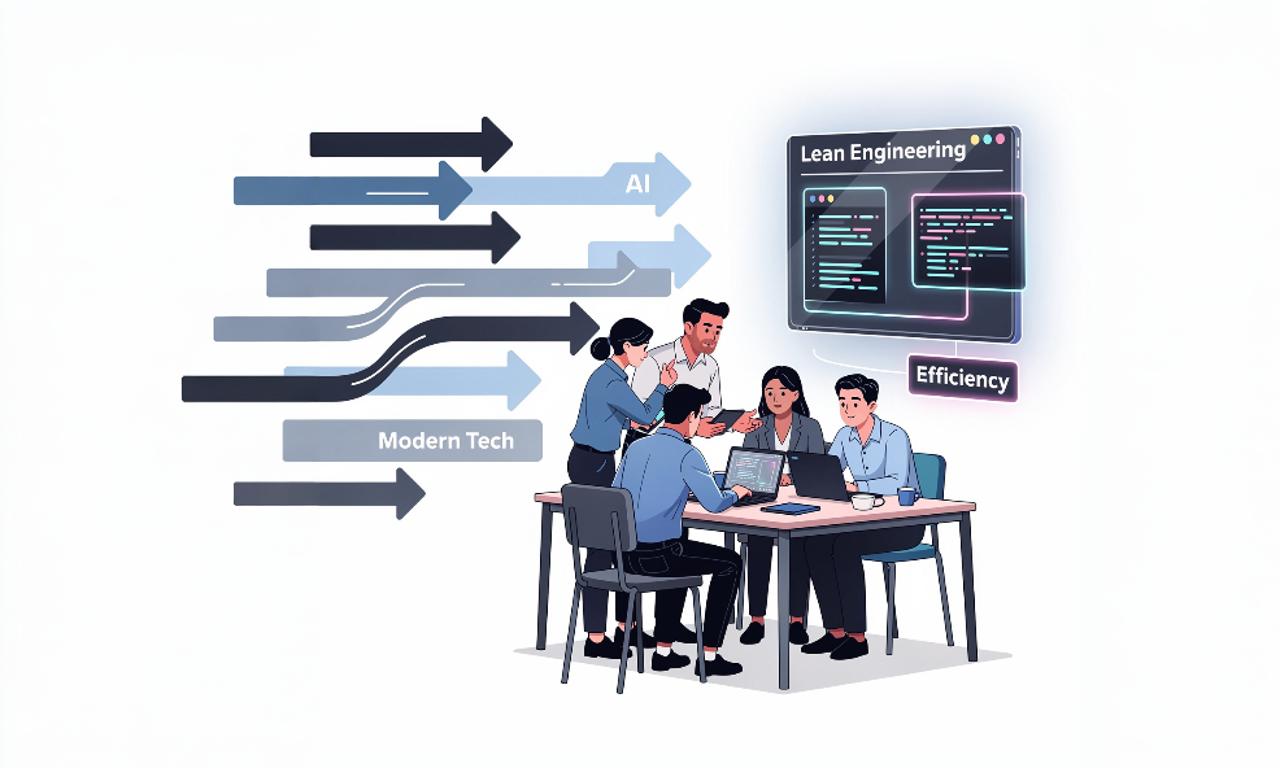
Most companies don’t slow down because they lack developers.
They slow down because too many developers create too much coordination.
At first, growth feels simple.
More demand → hire more engineers → ship faster.
But then something shifts.
Delivery slows.
Decisions take longer.
Teams feel busy… but progress feels smaller.
That’s the moment many companies realize:
The problem isn’t capacity, it’s structure.

Why Large Engineering Teams Start Breaking Down
On paper, bigger teams should move faster.
In reality, they often do the opposite.
Because every new developer doesn’t just add output, they add communication, dependencies, and complexity.
Here’s what starts happening:
- Decisions require more alignment
- Communication loops multiply
- Work overlaps across teams
- Ownership becomes unclear
This is exactly where many growing products get stuck.
Not because the team lacks talent.
But because the system can’t scale with the team.
The Rise of Lean Engineering Teams
This is why many modern product companies are shifting toward lean engineering teams.
Not smaller for the sake of cost
But smaller for the sake of speed.
They prioritize:
- Clear ownership
- Fast decision-making
- Minimal dependencies
- End-to-end responsibility
Instead of large departments, they operate as small product squads.
Each squad typically includes:
- Engineers
- Designers
- Product thinkers
And most importantly,
They can ship without waiting for five other teams.
Why Lean Teams Move Faster
Lean teams align naturally with how humans work best.
They reduce cognitive load.
They reduce communication overhead.
They increase clarity.
That’s exactly what large teams violate.
Lean teams fix it by:
- Limiting coordination layers
- Keeping ownership tight
- Making decisions closer to execution
The result?
Faster shipping.
Higher accountability.
Better product momentum.
AI Is Accelerating This Shift
Another major reason behind this shift is AI.
Developers today are no longer working alone.
With tools like GitHub Copilot and AI-assisted workflows, teams can:
- Generate repetitive code faster
- Reduce debugging time
- Automate testing workflows
Which means:
The same output no longer requires the same team size.
This is a fundamental shift.
It’s not just about efficiency.
It’s about changing the economics of building software.
The New Model: Flexible Engineering Capacity
Instead of building massive in-house teams, companies are moving toward flexible models.
A typical setup now looks like:
- A lean internal core team
- External engineering support when needed
- Specialized experts for specific problems
This approach solves a major problem:
You scale capacity without permanently increasing complexity.
You don’t carry unnecessary overhead.
You don’t slow down your core team.
You stay lean and expand only when required.
Why This Works for Growing Products
From what we’ve seen working with scaling teams, this model works because it aligns with reality.
Growth is not constant.
Some months demand speed.
Some require stability.
Some need specialization.
A rigid, large team struggles to adapt.
A lean + flexible model adjusts instantly.
That leads to:
- Faster delivery
- Less hiring pressure
- Better cost control
- Access to broader expertise
And most importantly,
A system that scales without breaking.
The Future of Engineering Teams
The future isn’t about building the biggest team.
It’s about building the most effective system.
That system usually includes:
- Lean product squads
- AI-assisted development
- Flexible scaling models
- Strong architectural foundations
Because in modern software:
- Speed doesn’t come from team size
- It comes from system design
Final Thoughts
Large teams feel powerful.
Lean teams actually move.
And in a world where speed defines success
That difference matters more than ever.
Let’s Continue the Conversation
If your delivery is slowing as your team grows,
There’s a good chance it’s not a hiring issue, it’s a structure issue.
That’s exactly what we help solve at Mediusware.
Frequently Asked Questions
A small, cross-functional development team designed to deliver products faster with fewer coordination bottlenecks.

I work at the point where product decisions, system architecture, and engineering execution meet. At Mediusware, I’m accountable for how technology choices affect reliability, scale, and long-term delivery for our clients.
Featureblogs
Relatedblogs
01
Integrating Redux with React: A Comprehensive Guide02
Laravel pagination and filtering with already loaded data as array in memory03
React + Three.js + React Three Fiber: Crafting Interactive 3D views in Web Applications04
Advanced Caching Strategies for Django Applications05
Implementing Roles and Permissions in Laravel Using Guard-LaravelAuthorblogs
01
How Digital Agencies Can Deliver Custom Software Without Hiring Developers02
AI in FinTech: Build, Buy, or Integrate? A Founder's Decision Framework03
How to Choose a SaaS MVP Development Company04
How Seed-Stage SaaS Teams Add Engineering Capacity Without Hiring Chaos05
Why Seed-Stage SaaS Startups Struggle to Ship Fast