- Non-technical founders often delay product development searching for a technical co-founder.
- Validation, smart tool selection, and smart hiring can lead to MVPs in as little as 8 weeks.
You Don't Need a Technical Co-Founder to Launch Your SaaS
1 min read

Most founders who come to us believe the same myth: that without a technical co-founder, building a software product is impossible. They spend months searching for a CTO, delaying everything. Meanwhile, their idea sits untouched.
Here's what we've learned from helping dozens of non-technical founders: the bottleneck is almost never technical skill. It's decision paralysis not knowing what to prioritize, which tools to trust, or when to stop planning and start building.
This guide cuts through the noise. No generic advice. Just a clear path from idea to launched MVP in as little as 8 weeks.
Why most non-technical founders stall
Before we get into solutions, it helps to name the real problems because they're not what you might expect.
Problem 01: Waiting for the "right" technical partner
Finding a trustworthy technical co-founder takes 6–18 months on average. Most founders who wait that long have either given up on the idea or lost momentum entirely. The market moves faster than hiring.
Problem 02: Over-engineering the idea before validating it
Non-technical founders often over-compensate by spending months on wireframes, pitch decks, and "requirements documents" before a single user has seen the product. This is planning anxiety disguised as productivity.
Problem 03: Treating "build" and "launch" as separate phases
The best MVPs are built and tested simultaneously. The founders who succeed fastest treat every week as a learning sprint, not a construction phase to be completed before anyone sees the work.
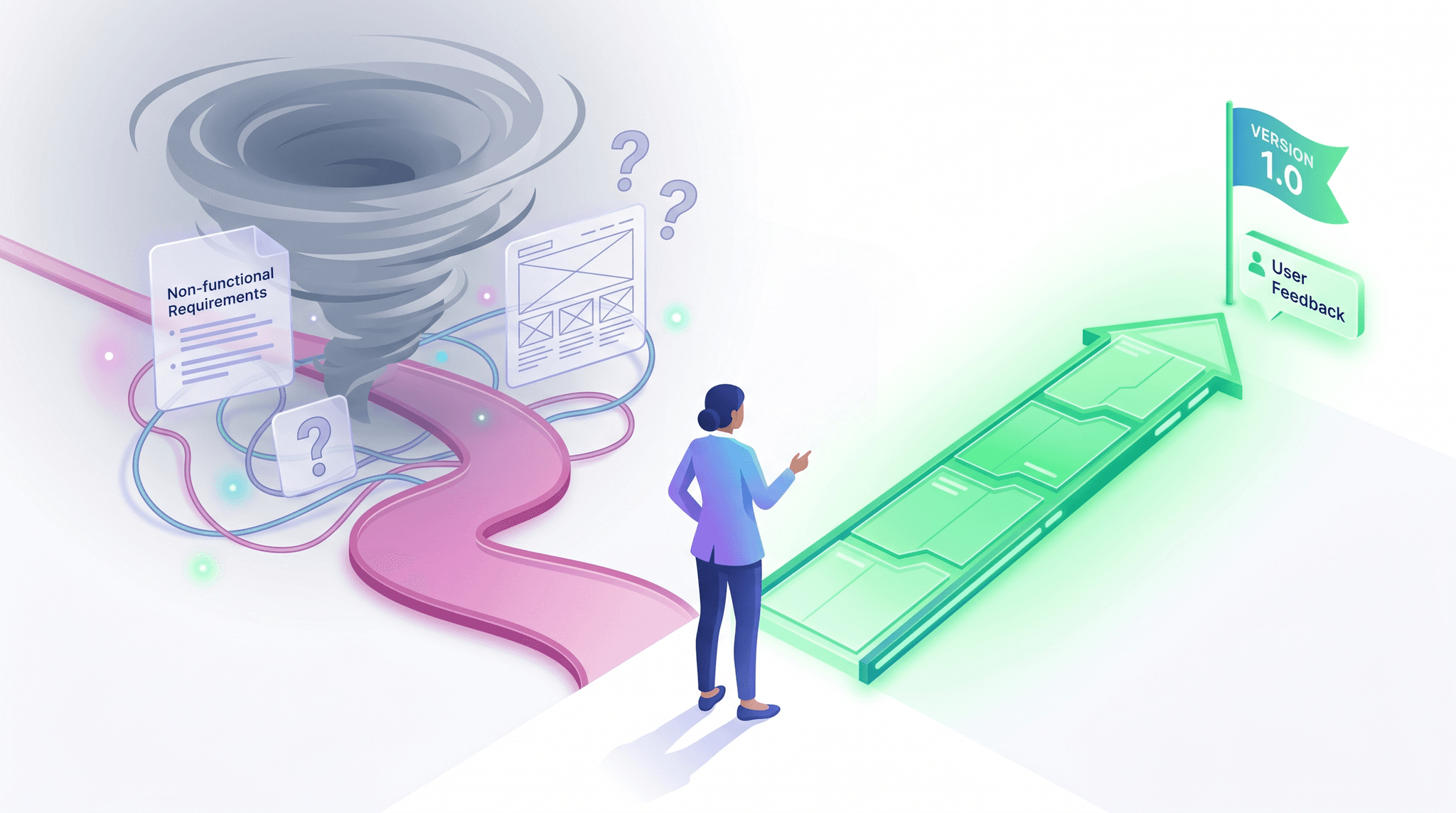
The 5-step framework that actually works
Step 1: Validate before you build anything
The biggest waste of an early-stage budget is building a product nobody wants.
Before writing a single line of code or paying anyone else to spend two weeks doing this instead:
Create a simple landing page (Carrd or Webflow works fine) that describes your product and what problem it solves. Add a waitlist signup.
Then drive 200–500 people to it through LinkedIn posts, Reddit threads, or a small ad spend. If fewer than 5% sign up, your messaging is wrong or the problem isn't painful enough to act on.
According to Reid Hoffman, Co-founder of LinkedIn
If you're not embarrassed by the first version of your product, you've launched too late.
Validation doesn't mean certainty. It means you have enough signal to justify the next step, not proof that success is guaranteed.
Here's a practical tip you may follow: Run 5–10 video calls with people who signed up for your waitlist. Ask them what they currently use to solve the problem. Their workarounds tell you more than any survey.
Step 2: Choose the right tool for your specific product
No-code and low-code platforms have matured dramatically. The question isn't "should I use them?" but "which one fits my product type?"
Here's a clear breakdown:
| Tool | Best for | Starting price | Limitation |
| Bubble | Complex web apps with databases, user accounts, workflows | $29/mo | Steeper learning curve; slower performance at scale |
| Webflow | Content-driven sites, landing pages, CMS-based products | $14/mo | Not suitable for complex app logic |
| Adalo | Simple mobile apps, internal tools | $36/mo | Limited to simpler functionality |
| Glide | Apps built from Google Sheets or Airtable data | $25/mo | Data must fit a spreadsheet model |
| Zapier | Automating workflows between existing tools | $20/mo | Not an app builder, a connector |
If your MVP needs logic that none of these can handle cleanly, that's your signal to bring in a freelancer for specific features, not to abandon the approach entirely.
Step 3: Hire smart, not expensive
When no-code platforms hit their limits, the right move isn't hiring a full-time developer. It's hiring a specialist for a defined scope, ideally someone who has built MVPs before and can move fast without hand-holding.
Platforms like Toptal and Contra give you access to senior freelancers. For agencies, look for ones that publish their process and can show you real MVPs they've shipped, not just portfolios of polished redesigns.
But before any hire: Write a one-page product brief. Define the 3 core features, the user flow, and what "done" looks like. Vague briefs produce vague work and expensive revisions.
Step 4: Cut scope ruthlessly
The features that feel essential at the planning stage rarely matter to early users. What matters is the one thing that solves the core problem, everything else is noise.
A useful tip to exercise: write down every feature you want. Then ask, "If I removed this, would my first 100 users still get value?" If the answer is yes, cut it. You can add it in version two when you have user feedback indicating it's actually needed.
According to Des Traynor, Co-founder of Intercom
It's not about having the most features. It's about having the right ones for the right people at the right time.
Your MVP should do one thing exceptionally well. That's it.
Step 5: Ship, measure, repeat
Once you launch, resist the urge to immediately build more. Spend the first four weeks obsessively watching how people use what you've built.
Tools like Hotjar (session recordings), PostHog (product analytics), and Canny (user feedback) give you a clear picture without needing a data analyst.
The patterns that emerge, where users drop off, what they click on first, and what they email you asking for, are your product roadmap. Not your original plan.
Real-world result: What this looks like in practice
One of our clients, a former HR manager, came to us with an idea for a leave management tool built specifically for remote teams in North Carolina (USA).
- In week 1, we validated the concept with a Webflow landing page and 12 user interviews.
- By week 4, we had a working Bubble prototype.
- By week 8, she had 340 paying users and a clear list of the three features to build next, none of which were on her original roadmap.
The product she launched wasn't the product she planned. It was better because real users shaped it.
See our client testimonials about their experience working with Mediusware.
Final Thoughts
Building a software product doesn't require a technical co-founder, but it does demand a commitment to learning faster than you build.
We at Mediusware have helped over 60 non-technical founders launch MVPs that real users actually pay for. Besides, we will map out your fastest path to launch and ensure real users shape your success.
Frequently Asked Questions
No-code tools run $25–$100/month. If you need freelance help for custom logic, budget $2,000–$6,000 for a focused 4–6 week engagement. Total cost for a working MVP: typically $3,000–$8,000. Significantly less than a full development hire.

I work with founders and leadership teams when growth moves faster than their systems, teams, or decisions. I’ve led 850+ projects for 750+ clients across 20+ countries, working across 100+ technologies and counting. I care about ownership, clarity, and building things that last beyond the launch.
Featureblogs
Relatedblogs
01
Introduction to System Design | System Design Course Pro | Part 102
The Art of Simplicity - How Minimalism Improved UI/UX Design03
The Software Development Life Cycle (SDLC): A Complete Guide04
Which Approach Is Best for Your Software Development Team: Scrum vs. Kanban05
How to adapt the Agile process to modern software developmentAuthorblogs
01
SaaS MVP Development: A Founder’s Guide for 202702
Zero Clicks, Falling Traffic: How to Win Back Revenue03
Ranking on Google in 2026: What Matters in the Age of AI Search04
How to Choose an API Development Company for Your SaaS Product05
Why Software Companies Are Turning to Strategic Partnerships for Faster Growth