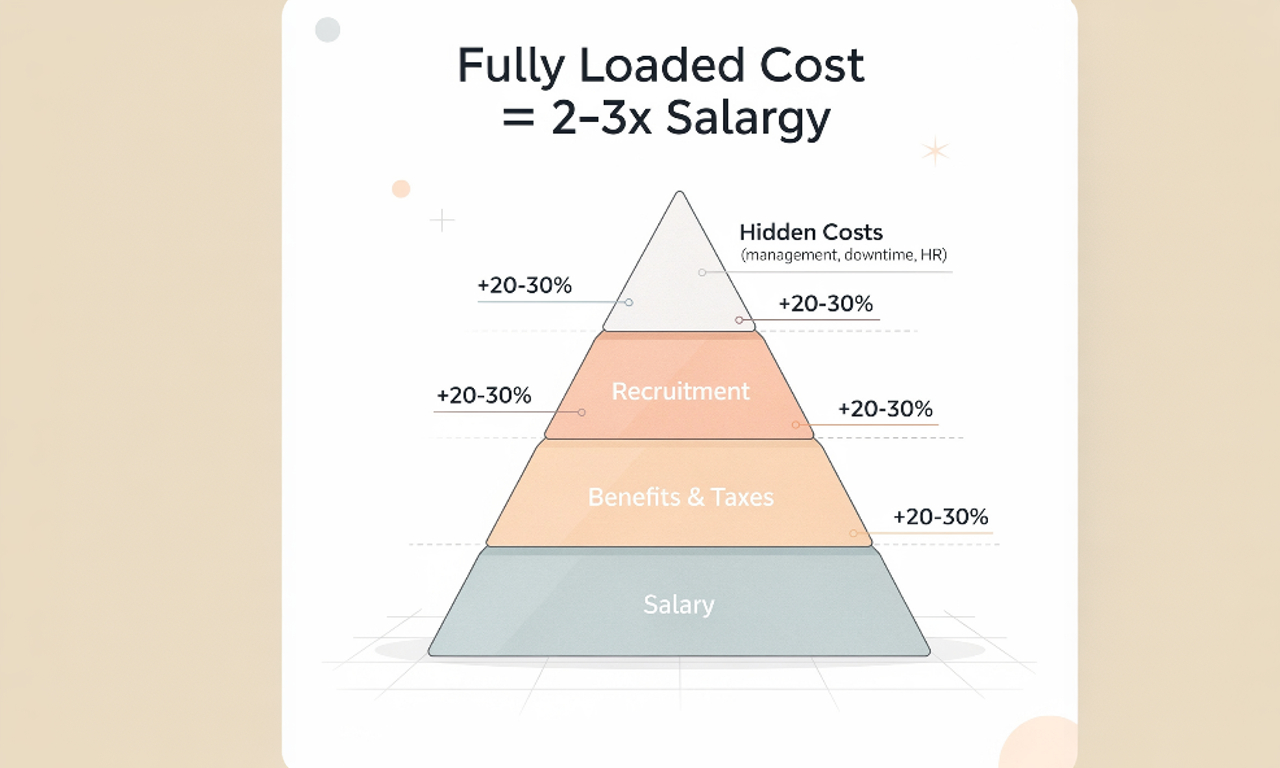
- In-house teams often cost 2–3x more than expected due to hidden expenses beyond salaries.
- These overlooked costs quietly reduce margins and create operational strain.
- Flexible alternatives enable more scalable, cost-efficient growth without long-term risk.
The Real Cost of Building an In-House Development Team for Agencies
1 min read
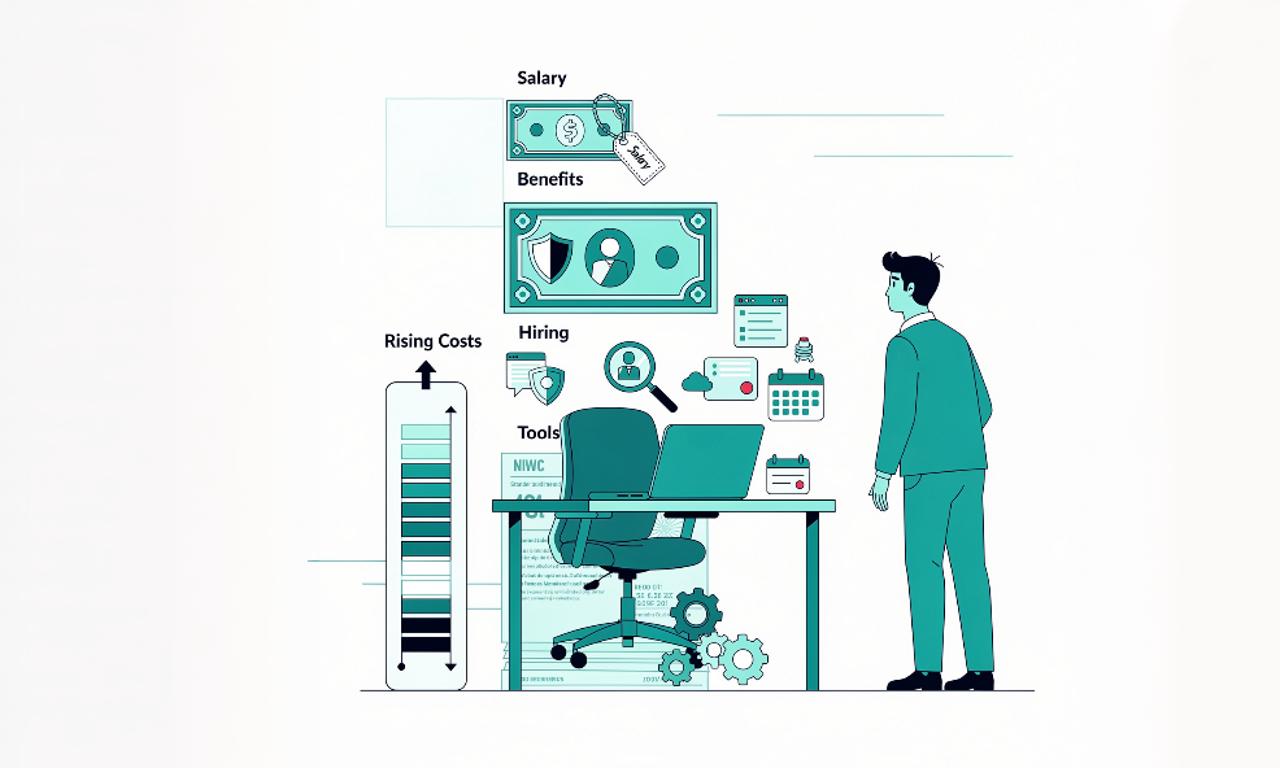
Most agencies don’t lose money on bad hires, but they lose money on underestimated costs.
Hiring an in-house development team feels like control.
More ownership. Faster execution. Better alignment.
But here’s what we’ve seen repeatedly:
- Agencies plan for salaries.
- But end up paying 2–3x more than expected.
And the gap doesn’t come from one big mistake.
It comes from small, ignored costs stacking up.
Why This Problem Exists And Why Most Agencies Get It Wrong
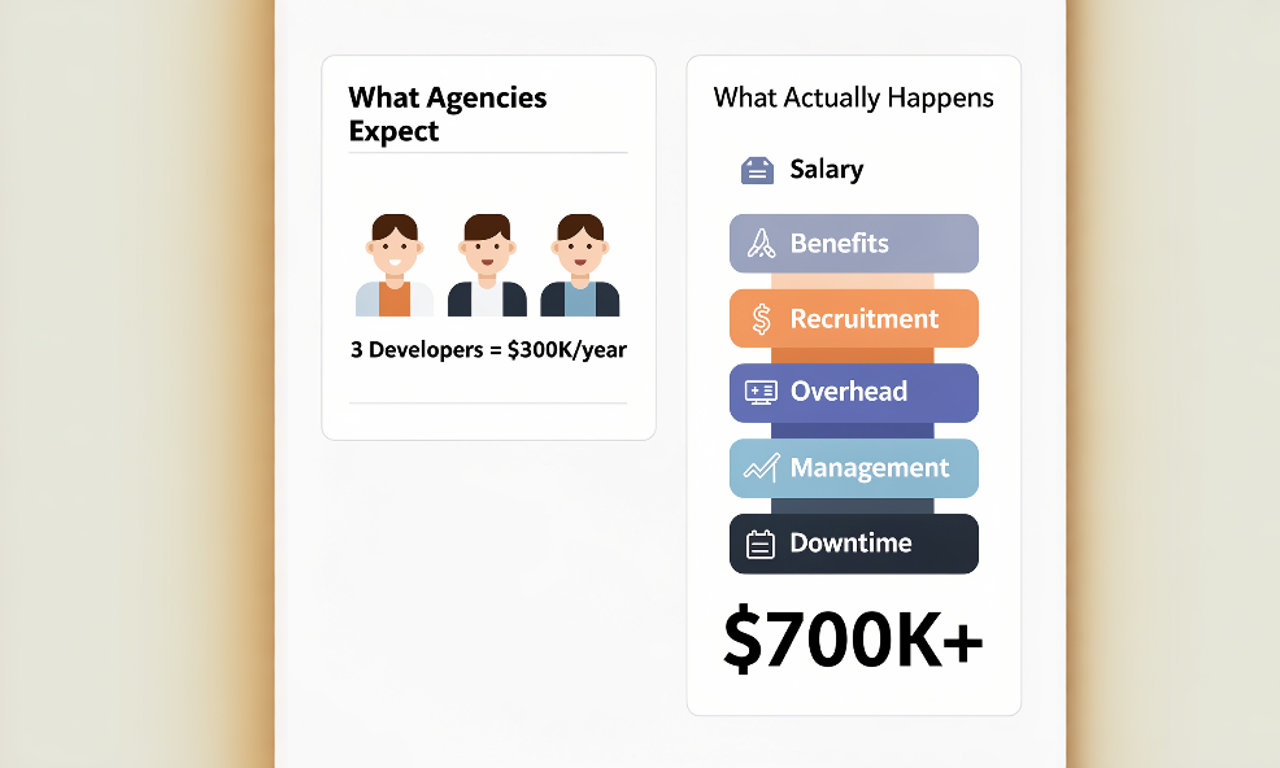
Most agency owners calculate like this:
“3 developers × $100K = $300K/year.”
That’s the visible cost.
But the real cost includes:
- People who aren’t fully utilized
- Hiring cycles that repeat
- Management bandwidth you didn’t plan for
- Tools, infrastructure, downtime
So instead of a clean $300K…
You quietly end up at $700K+
The Cost Breakdown
Let’s simplify this the way a CFO sees it.
1. Salary (The Only Cost You Planned For)
A small team:
- 1 Senior
- 2 Mid-level
~$300K–$360K/year
That’s where most planning stops.
2. Benefits & Taxes (The Silent Multiplier)
Add 30–40% on top immediately:
- Insurance
- Taxes
- Retirement contributions
Your $300K → becomes ~$420K–$500K
This is where Loss Aversion kicks in:
You’re not gaining talent, you’re losing margin silently.
3. Recruitment (The Cost That Repeats)
Hiring is not a one-time.
Reality:
- Developers stay ~18–24 months
- You rehire more often than you expect
Each hire costs:
- $15K–$40K (recruiters)
- Time from the senior team
- 2–3 months of low productivity
Multiply that over time → it compounds fast.
4. Overhead (The Cost You Normalize)
Per developer, per year:
- Tools & licenses
- Devices
- Infrastructure
- Training
~$10K–$25K per developer
For a team → another $30K–$75K/year.
5. Hidden Costs (The Real Budget Killers)
This is where most agencies underestimate everything.
- Management time → senior leaders pulled into delivery.
- Idle capacity → paying devs during slow months.
- Skill gaps → still outsourcing parts anyway.
- HR complexity → compliance, reviews, issues.
These don’t show up in spreadsheets, but they hit your margins hardest.
The Fully Loaded Reality
Now put everything together:
- Salary
- Benefits
- Hiring
- Overhead
- Downtime
- Management
A 3-dev team = ~$700K–$800K/year
Not because developers are expensive.
But because the system around them is.
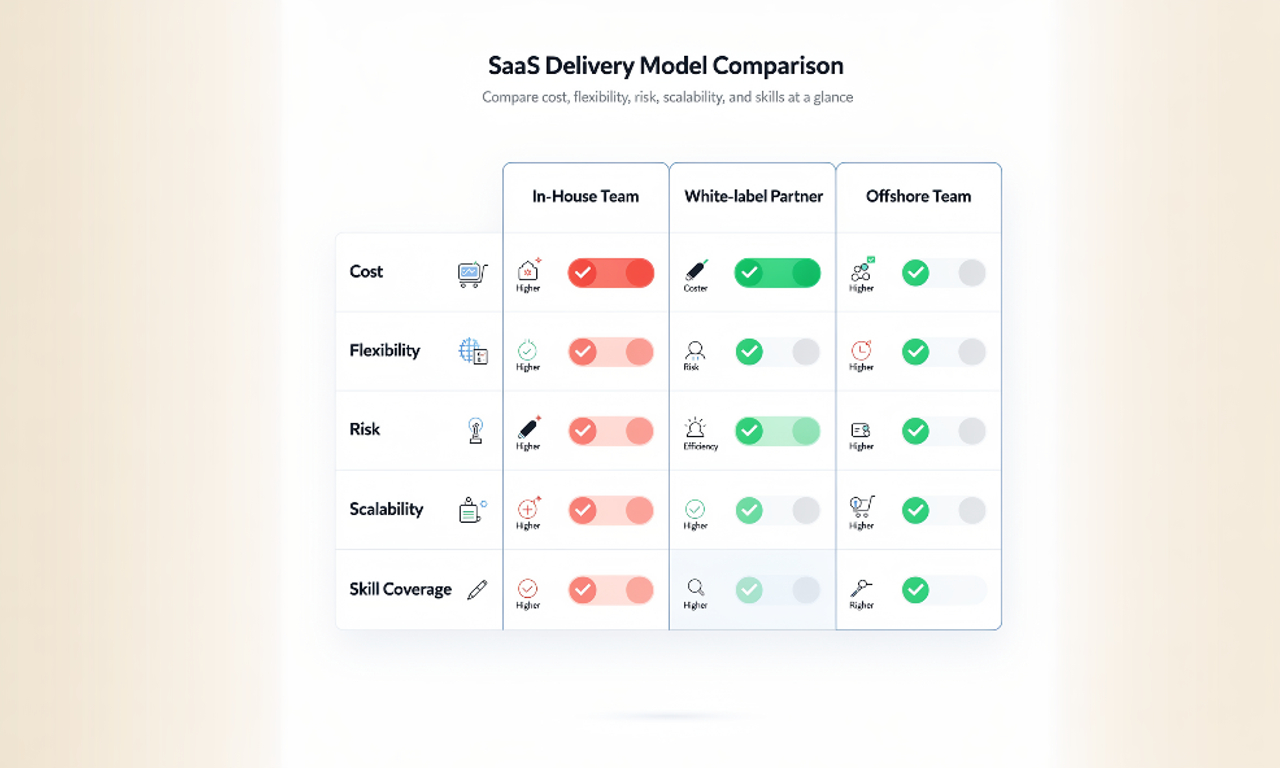
In-House vs Alternatives (What You’re Actually Buying)
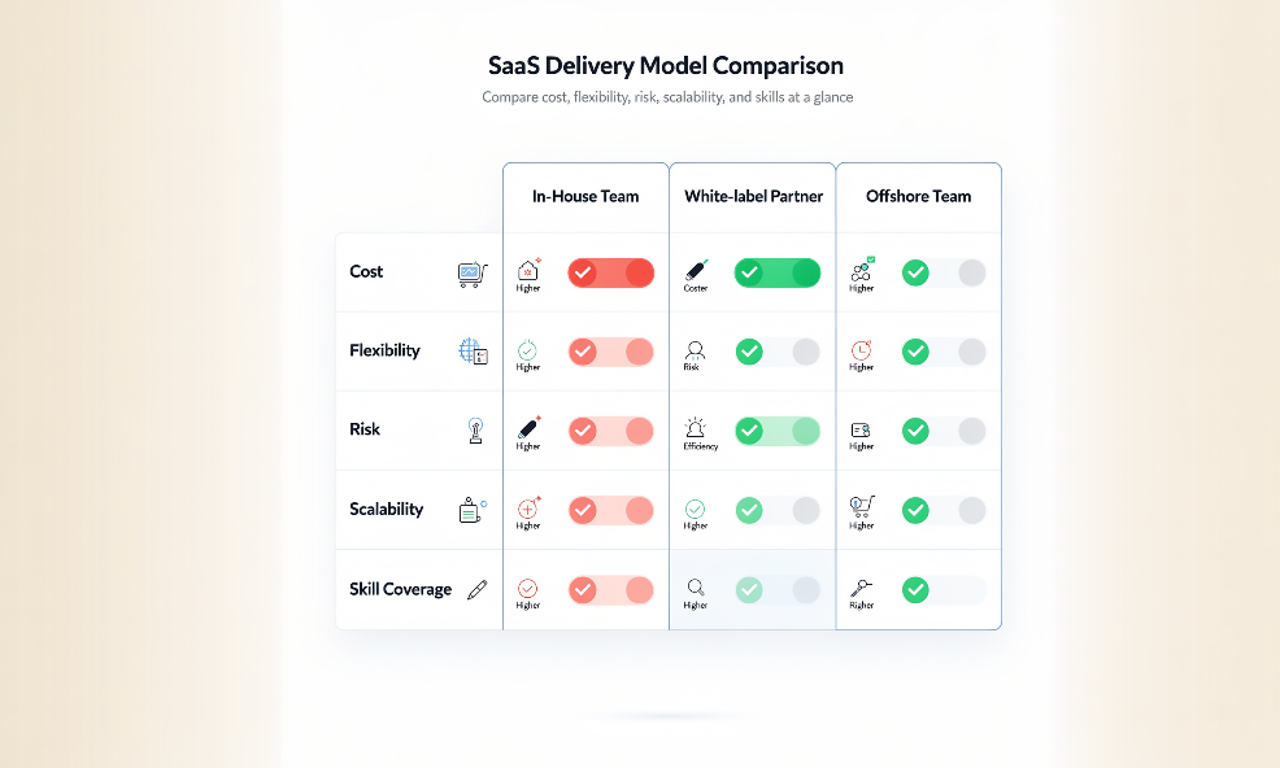
Here’s the real comparison:
| Model | Cost | Flexibility | Risk |
| In-house | High (~$700K+) | Low | High |
| White-label partner | Medium | High | Low |
| Freelancers | Variable | Medium | Medium |
| Offshore | Lower | Medium | Medium |
The key difference is not price.
It’s cost structure.
In-house = fixed cost
Others = variable cost
And fixed cost is dangerous when demand fluctuates.
When In-House Actually Makes Sense
This isn’t a “never build in-house” argument.
It works when:
- You have consistent, predictable work
- You’re building internal IP/products
- Tech is your core differentiator
- You operate at larger scale (15+ devs)
Otherwise, you’re taking on operational complexity without leverage.
The Questions Most Agencies Don’t Ask (But Should)
Before hiring, ask:
- What happens if projects slow down?
- Can we fully utilize developers year-round?
- Do we have leadership bandwidth to manage them?
- What’s our 3-year cost projection (not year 1)?
If you can’t answer these clearly,
you’re not planning, you’re guessing.
The Bottom Line
Building an in-house team isn’t wrong.
It’s just expensive in ways most people don’t see early.
And by the time you realize it…
The cost is already locked in.
That’s why many agencies shift to flexible development models, not to save money, but to protect margins and stay adaptable.
Frequently Asked Questions
It’s not just salary. Once you include benefits, taxes, recruitment, tools, and management, the total cost is typically 2–3x the base salary.

I work with founders and leadership teams when growth moves faster than their systems, teams, or decisions. I’ve led 850+ projects for 750+ clients across 20+ countries, working across 100+ technologies and counting. I care about ownership, clarity, and building things that last beyond the launch.
Featureblogs
Relatedblogs
01
Smart Contracts vs. Regular Contracts02
SDLC vs Agile System Development: Phases, Pros and Cons, and Common Grounds03
Why Mediusware Limited is Your Perfect Global Outstaffing Partner04
10 Best B2B Software Companies in the USA for 2025 – Find Your Perfect Partner!05
Why Leading Agencies Partner with Mediusware for Scalable Tech SolutionsAuthorblogs
01
SaaS MVP Development: A Founder’s Guide for 202702
Zero Clicks, Falling Traffic: How to Win Back Revenue03
Ranking on Google in 2026: What Matters in the Age of AI Search04
How to Choose an API Development Company for Your SaaS Product05
Why Software Companies Are Turning to Strategic Partnerships for Faster Growth