- Engineering bottlenecks come from systems that fail to scale with complexity.
- As products grow, teams spend more time on maintenance and coordination, slowing delivery with hires.
- The solution is better architecture, workflows, and team structure so speed becomes natural.
When Your Engineering Team Becomes the Bottleneck in Product Delivery
1 min read
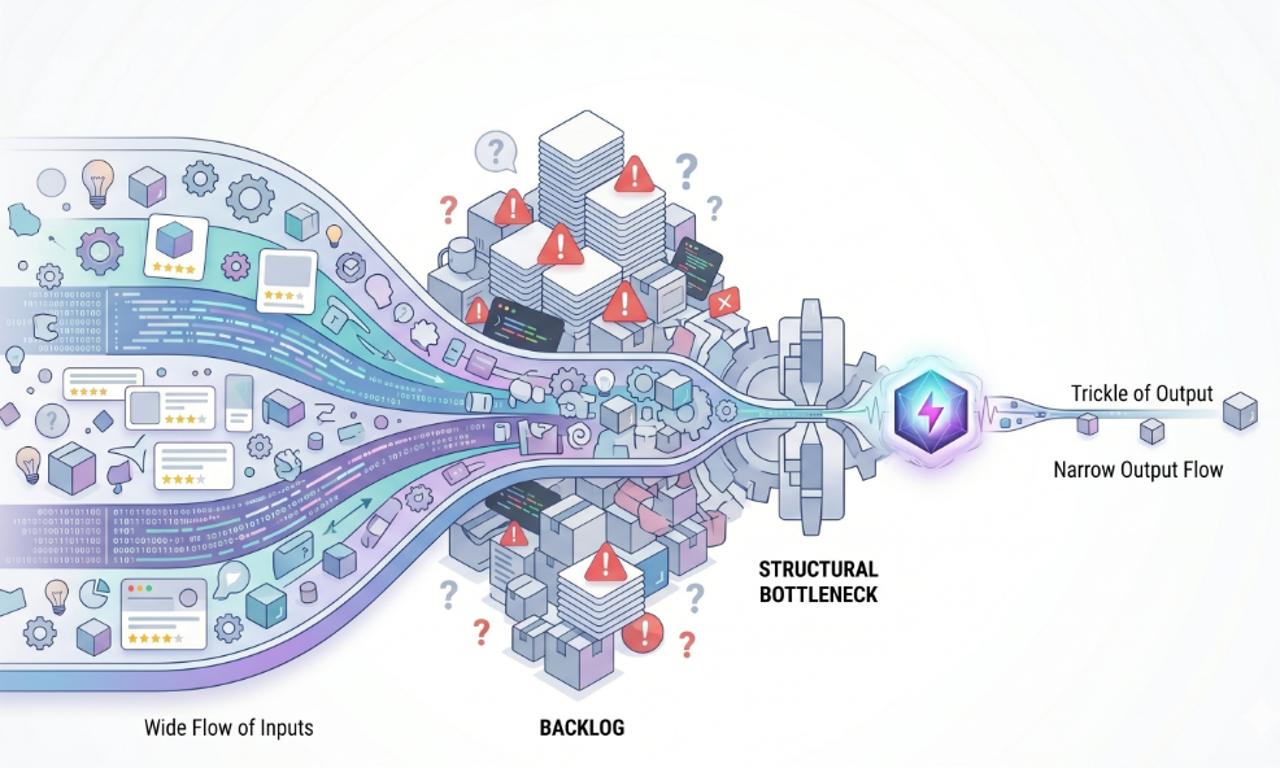
Most products don’t slow down because of lack of ideas.
They slow down because their engineering system can’t keep up with growth.
At first, everything feels fast.
Small team.
Quick releases.
Clear communication.
Then something shifts.
Features that should take 2 weeks start taking 2 months.
Roadmaps slip.
Customer requests pile up.
And suddenly, a difficult question shows up in leadership meetings:
Why are we slowing down… even after hiring more engineers?
Here’s the uncomfortable truth:
- Your engineers are not the bottleneck.
- Your system is.
The Real Problem: Growth Exposes System Weakness
Early-stage speed comes from simplicity.
But growth introduces:
- More dependencies
- More infrastructure
- More decisions
And without proper structure, complexity spreads fast.
According to McKinsey, improving developer workflows and systems can boost productivity by 20–40%.
So the question is not:
Do we need better developers?
It’s:
Do we have a system that allows developers to move fast?
Feature Development vs. Maintenance Reality
Most leaders assume engineers spend most of their time building new features.
They don’t.
According to the Stripe Developer Productivity Report, Developers spend 42% of their time on maintenance, debugging, and infrastructure.
That’s nearly half your engineering capacity.
So when delivery slows, it’s not always inefficiency.
It’s this:
Your team is maintaining more than they’re building.
Complexity Scales Faster Than Teams Expect
As your product grows, so does hidden complexity:
- Legacy systems
- Multiple APIs
- Third-party integrations
- Data pipelines
- DevOps layers
Without structured architecture, this turns into friction.
Google Cloud reports that technical debt alone consumes 20–30% of development capacity.
That means:
A significant portion of your team is solving yesterday’s problems.
Communication Becomes the Silent Bottleneck
Early teams move fast because communication is simple.
But scaling introduces layers:
Product → Tech Lead → Dev → QA → DevOps → Release
Each layer adds delay.
Individually small.
Collectively massive.
Here’s the key insight:
Speed is not just about how fast you code. It’s how fast you decide.

Why Hiring More Engineers Often Backfires
The default solution is obvious:
Let’s hire more developers.
But this creates a new problem.
Fred Brooks explained it decades ago:
Adding manpower to a late software project makes it later.
New engineers need time to understand:
- Architecture
- Systems
- Tools
- Decisions
Without proper onboarding and structure, hiring reduces velocity before improving it.
The Real Cost of Engineering Bottlenecks
This isn’t just an engineering issue.
It affects the entire business:
- Product teams lose confidence
- Marketing delays launches
- Sales loses momentum
- Customers lose patience
Eventually:
Customer expectations move faster than your roadmap
And that gap is where growth breaks.
How High-Performing Teams Fix This
The best teams don’t just hire more people.
They redesign how engineering works.
1. They Separate Responsibilities
Instead of one overloaded team:
- Product teams
- Platform teams
- DevOps teams
- QA automation
This reduces dependency conflicts.
Faster delivery becomes predictable.
2. They Invest in Scalable Architecture Early
High-performing teams prioritize:
- Modular systems
- API-first development
- CI/CD pipelines
- Automated testing
This reduces long-term friction.
If you're exploring scalable systems, this is exactly where custom software development services come into play, building architecture that grows with your product, not against it.
3. They Reduce Decision Friction
They remove unnecessary layers.
Developers talk directly to:
- Product
- Design
- Architecture
Faster decisions → faster delivery.
4. They Use Small, Focused Engineering Pods
Instead of large teams:
- Cross-functional pods
- Clear ownership
- Independent execution
When External Engineering Capacity Becomes Strategic
Sometimes the issue is simple:
You don’t have enough capacity at the right time.
This happens when:
- Demand spikes
- Roadmaps shift
- Hiring is slow
Smart teams don’t panic-hire.
They scale through staff augmentation.
This allows them to:
- Ship faster
- Reduce risk
- Stay flexible
We’ve seen this pattern repeatedly across product companies.
The teams that scale fastest don’t just grow internally.
They extend intelligently.
A Pattern We See Across Growing Products
After working with multiple product teams, one thing is clear:
Engineering rarely fails because of skill.
It fails because:
The system didn’t evolve with the product.
Once teams fix:
- Architecture
- Workflow
- Team structure
Something interesting happens:
Delivery speeds up again.
Momentum returns.
And engineering becomes a growth engine, not a bottleneck.
Frequently Asked Questions
Engineering bottlenecks usually occur when teams handle too many responsibilities, such as infrastructure maintenance, technical debt, and feature development simultaneously.

I work at the point where product decisions, system architecture, and engineering execution meet. At Mediusware, I’m accountable for how technology choices affect reliability, scale, and long-term delivery for our clients.
Featureblogs
Relatedblogs
01
Integrating Redux with React: A Comprehensive Guide02
Laravel pagination and filtering with already loaded data as array in memory03
React + Three.js + React Three Fiber: Crafting Interactive 3D views in Web Applications04
Advanced Caching Strategies for Django Applications05
Implementing Roles and Permissions in Laravel Using Guard-LaravelAuthorblogs
01
How Digital Agencies Can Deliver Custom Software Without Hiring Developers02
AI in FinTech: Build, Buy, or Integrate? A Founder's Decision Framework03
How to Choose a SaaS MVP Development Company04
How Seed-Stage SaaS Teams Add Engineering Capacity Without Hiring Chaos05
Why Seed-Stage SaaS Startups Struggle to Ship Fast