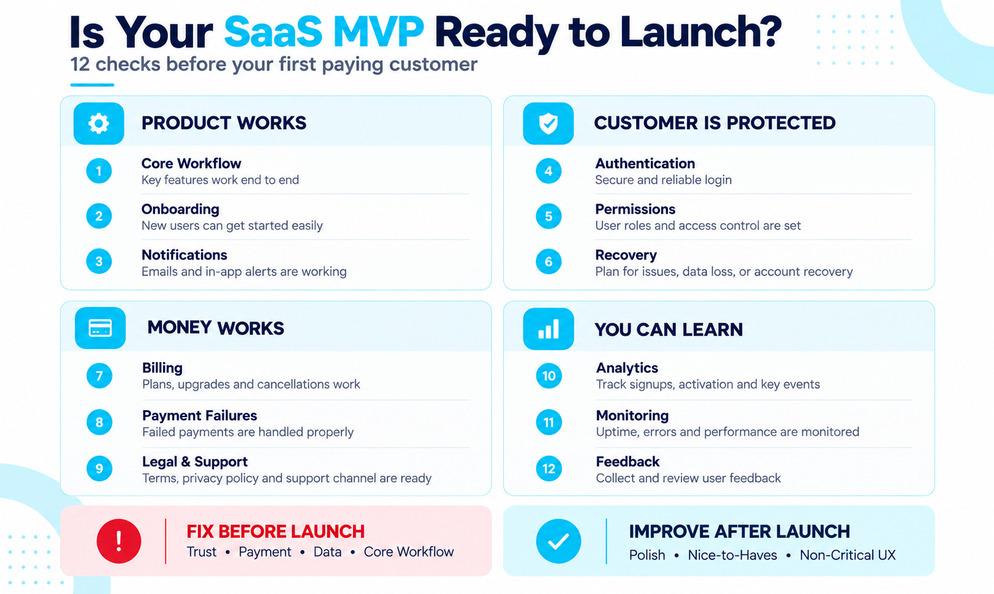
Building a lean MVP requires a disciplined approach.
Here’s a step-by-step process to help you avoid overbuilding and focus on what really matters:
-
Step 1 – Identify Core Features
Focus only on the features that directly address the core problem.
The MVP should solve the primary issue your target audience is facing and nothing more.
MoSCoW Method: Use this framework to categorize features:
- Must-Have: Core MVP features that are absolutely necessary for solving the problem.
- Should-Have: Valuable but not critical for day one.
- Could-Have: Nice to have but not needed for the MVP.
- Won’t-Have: Features that can be left out entirely for the MVP.
-
Step 2 – Validate Assumptions Early
Before you write a single line of code, validate your idea with real users.
- Cognitive Load: Keep your validation process simple and user-friendly. Avoid overwhelming users with unnecessary complexity.
- Buffer’s Validation Example: Buffer validated their product idea by creating a simple landing page, describing the product, and collecting emails from interested users. They received over 100,000 sign-ups before building the product.
Key questions to ask before building:
- Is there a real problem here?
- Have I talked to 10–20 potential users about this problem?
- Are people paying for a solution, even if it's imperfect?
- Would someone pay for my solution, even in its most basic form?
-
Step 3 – Focus on UX and User Feedback
Even a lean MVP needs a smooth and intuitive user experience. Ensure that the product’s core flow is easy to navigate and solve the problem quickly.
- Smooth Interaction: Ensure that key features are easy to use and quick to access. The fewer decisions users need to make, the better their experience.
- Simple Onboarding: The first-time user experience (onboarding) should lead users directly to the core value your MVP provides.
-
Step 4 – Limit Scope to Launch Quickly
Launch as quickly as possible to gather real-world feedback. The faster you can test, the faster you can adjust.
Feature Freeze: Once you’ve validated the core problem and user flow, freeze the feature list and focus on launching. Anything beyond the core features can wait for later iterations.