- CTOs scale teams through small autonomous units, scalable architecture, and clear ownership.
- Automation, DevOps, and strong culture enable fast, reliable product delivery.
How CTOs Can Scale Engineering Teams Without Breaking Delivery
1 min read
Growth is supposed to feel like progress.
More users.
More demand.
More opportunities to build.
But for most CTOs, growth creates something else.
Delivery slows down.
Releases become riskier.
Teams feel busier… but less productive.
I’ve seen this pattern repeatedly.
And it’s not a talent problem.
It’s a system problem.

According to the State of DevOps Report, elite teams deploy 973× more frequently than low performers not because they have more engineers, but because they operate differently.
That’s the shift most teams miss.
Scaling engineering isn’t about adding people.
It’s about designing systems where people can move fast without breaking delivery.
Why Scaling Teams Often Slows Everything Down
Most CTOs respond to growth the same way:
We need more developers.
It feels logical.
But without changing how the system works, more people create more complexity, not more speed.
Here’s where things start breaking.
1. Communication Starts Replacing Progress
Here’s the hidden math most teams ignore:
- 5 developers → 10 communication paths
- 15 developers → 105 communication paths
That’s not growth.
That’s explosion.
This is exactly what Brooks’ Law highlights:
Adding manpower to a late software project makes it later.
What this turns into:
- More meetings
- More alignment discussions
- More waiting
Instead of shipping faster, teams spend more time talking than building.
2. Your Architecture Becomes the Bottleneck
Early systems are built for speed.
Not scale.
And that works—until your team grows.
Then everything starts breaking:
- One change affects multiple areas
- Deployments become risky
- Teams depend on the same codebase
This creates a dependency web.
And dependencies are where delivery slows down.
That’s why companies like Netflix and Amazon moved toward modular systems and microservices, not for trend, but for team independence.
If you're dealing with this, this is where custom software development services become critical, not just building features, but designing scalable systems.
3. No One Truly Owns Anything
As teams scale without structure:
- Work overlaps
- Decisions stall
- Accountability disappears
Everyone is involved.
No one is responsible.
High-performing teams solve this differently:
Every product area has a clear owner.
Spotify’s squad model is a great example: small teams, clear scope, full accountability.
4. Process Starts Slowing the System
When things get messy, companies add process.
- More approvals.
- More reporting.
- More layers.
It feels like control.
But it creates friction.
- Engineers wait for approvals
- Decisions take longer
- Momentum disappears
Now the system is heavier than the work itself.
How High-Performing CTOs Actually Scale Teams
Here’s where the shift happens.
The best CTOs don’t just scale teams.
They redesign how work happens.
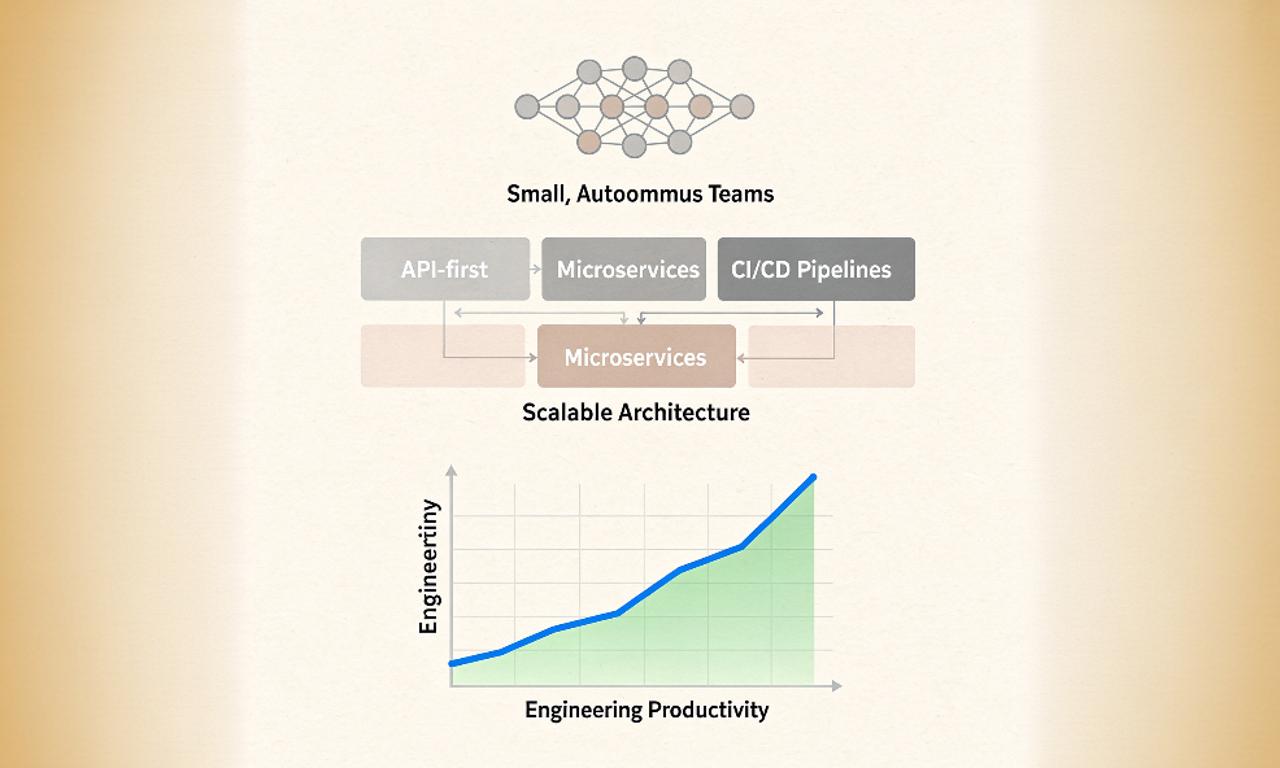
1. Build Small, Autonomous Teams
Instead of large departments, they build independent units.
Typical structure:
- Backend
- Frontend
- DevOps support
- Product owner
Each team owns a specific outcome.
No waiting. No cross-team dependency for every task.
Amazon’s rule is simple:
If a team is too big to be fed by two pizzas, it’s too big.
Small teams move faster because they:
- Communicate less
- Decide faster
- Own outcomes fully
2. Design Architecture for Independence
You can’t scale teams if your system forces them to depend on each other.
Modern teams prioritize:
- API-first design
- Modular systems or microservices
- Cloud-native infrastructure
- CI/CD pipelines
This allows multiple teams to work in parallel without blocking each other.
At Mediusware, we often see teams struggle not because of execution, but because early architecture decisions weren’t built for scale.
For example, platforms like CRM Runner show how modular architecture and automation enable smoother operations as teams grow.
3. Automate Everything That Slows You Down
Manual processes don’t scale.
They break under pressure.
High-performing teams automate:
- Testing
- Deployments
- Infrastructure
- Monitoring
According to DORA, strong CI/CD practices lead to 7× fewer deployment failures.
Automation doesn’t just improve speed.
It protects delivery.
4. Measure What Really Matters
If you can’t see bottlenecks, you can’t fix them.
That’s why great CTOs rely on DORA metrics:
- Deployment frequency
- Lead time for changes
- Mean time to recovery (MTTR)
- Change failure rate
These metrics give clarity.
And clarity reduces guesswork.
5. Build a Culture That Surfaces Problems Early
Technology scales systems.
Culture scales behavior.
Google’s Project Aristotle found:
Psychological safety is the #1 factor in high-performing teams.
When engineers can speak early:
- Problems don’t grow silently
- Risks are reduced
- Teams move faster with confidence
The Real Role of a CTO at Scale
At early stages, CTOs write code.
At scale, they design systems.
The role shifts from:
How do we build this?
To:
How do we build a system where teams can build this independently?
That includes:
- Architecture
- Team structure
- Workflows
- Culture
Because at scale, speed is no longer about effort.
It’s about design.
Final Thought
Adding more engineers doesn’t guarantee faster delivery.
In many cases, it does the opposite.
The CTOs who scale successfully understand one thing:
- Growth doesn’t break teams.
- It exposes weak systems.
Fix the system, and teams will move faster naturally.
Frequently Asked Questions
Engineering teams slow down when communication complexity, unclear ownership, and architectural limitations increase. Without proper structure, more developers create coordination challenges rather than productivity gains.

I work at the point where product decisions, system architecture, and engineering execution meet. At Mediusware, I’m accountable for how technology choices affect reliability, scale, and long-term delivery for our clients.
Featureblogs
Relatedblogs
01
Integrating Redux with React: A Comprehensive Guide02
Laravel pagination and filtering with already loaded data as array in memory03
React + Three.js + React Three Fiber: Crafting Interactive 3D views in Web Applications04
Advanced Caching Strategies for Django Applications05
Implementing Roles and Permissions in Laravel Using Guard-LaravelAuthorblogs
01
How Digital Agencies Can Deliver Custom Software Without Hiring Developers02
AI in FinTech: Build, Buy, or Integrate? A Founder's Decision Framework03
How to Choose a SaaS MVP Development Company04
How Seed-Stage SaaS Teams Add Engineering Capacity Without Hiring Chaos05
Why Seed-Stage SaaS Startups Struggle to Ship Fast