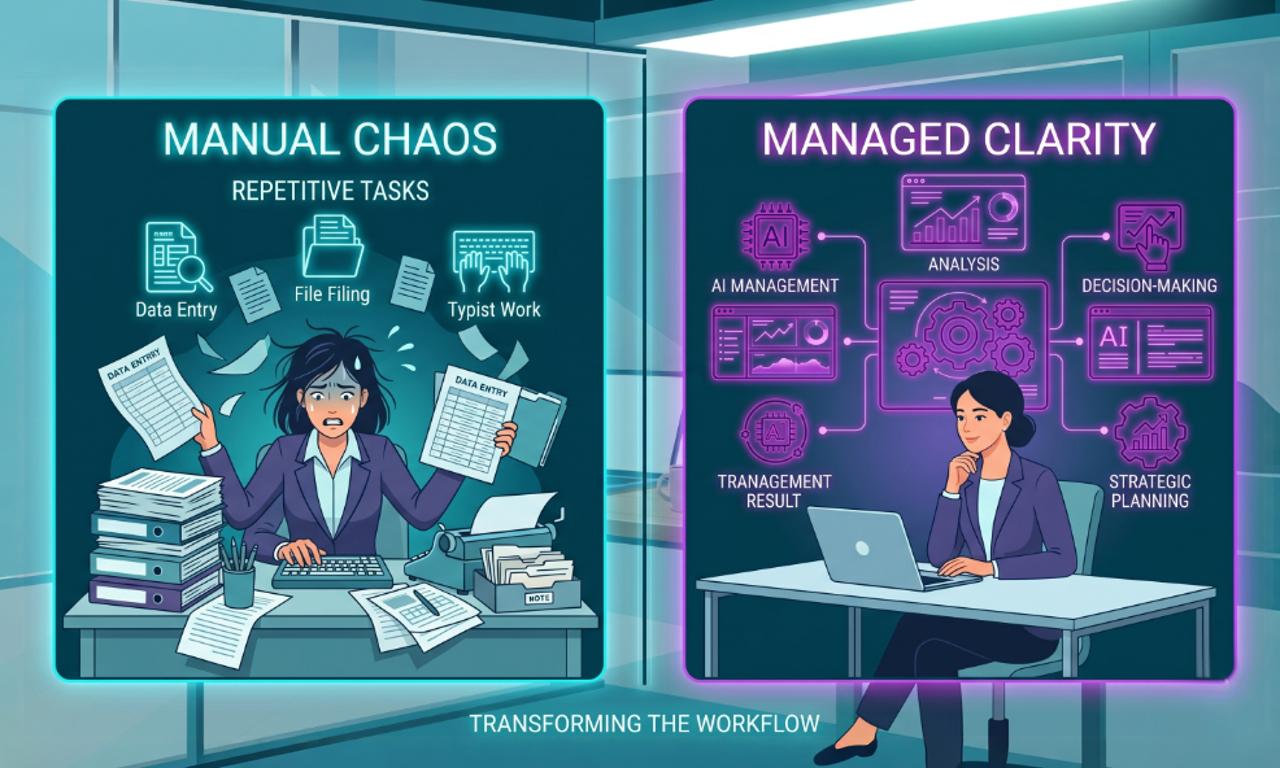
- AI replaces repetitive tasks, allowing humans to focus on strategy, judgment, and decision-making.
- Career growth now depends on using AI effectively, not competing against it.
Beyond the Hype: Is AI Really Stealing Your Job?
Published on: 27 February 2026
Last updated on: 7 August 2026

When ChatGPT launched, it didn’t feel like a tool.
It felt like a threat.
Quietly, people across industries asked themselves the same question:
Am I about to become irrelevant?
Now in 2026, the answer looks a lot more complicated than the headlines suggested.
AI didn’t replace people. It replaced friction.
But "friction" isn't the whole story either. AI is changing work. Some roles are shrinking. New ones are appearing. And inside many jobs, repetitive tasks are being automated while judgment, communication, strategy, and decision-making still depend heavily on people.
The World Economic Forum estimates that shifts across technology, demographics, economics, and other forces could create 170 million jobs and displace 92 million by 2030, resulting in a net increase of 78 million roles. AI is one important part of that transformation, but it is not the only force reshaping employment.
The International Labour Organization points to an equally important distinction: AI exposure does not automatically mean job replacement. Its research looks at occupations at the task level because GenAI can change parts of a job without eliminating the entire role.
That changes the question.
Instead of asking:
Will AI take my job?
A more useful question is:
Which parts of my job can AI do, and where does human judgment still create the most value?
That is what this guide will break down.
We’ll look at what the data actually says, which kinds of work are changing fastest, what humans still do better, and how to use AI without handing over the thinking that makes your work valuable.
The Reality Check: What the Data Says
Before opinions, let’s look at facts:
| Insight | What It Means |
| AI will create 78 million net new jobs | More opportunity than loss |
| ~79% of layoffs aren’t AI-related | Fear is overstated |
| AI-skilled workers earn up to 56% more | Skill shift = income shift |
Andrew Ng says:
AI is the new electricity.
Meaning: It won’t replace industries, it will power them.
Why This Feels Familiar And Why It Matters
We’ve seen this pattern before.
-
ATMs Didn’t Kill Banking
They removed repetitive work.
Bankers moved into advisory roles.
-
Spreadsheets Didn’t Kill Accounting
They removed manual calculations.
Accountants became strategic partners.
Same pattern. New technology.
Machines handle repetition.
Humans move up the value chain.
The Real Shift: Tasks vs Jobs
Most people misunderstand AI because they confuse two things:
- Task → A single action
- Job → A collection of responsibilities
What’s Actually Happening
AI is not replacing jobs.
It’s removing tasks inside jobs.
Think of your role like this:
- Emails
- Reports
- Meetings
- Decisions
AI takes the first three.
You focus on the last one.
The Unbundling Effect
By 2026, 40% of enterprise apps include AI agents.
That means:
- Repetitive tasks → automated
- Human time → redirected
You’re not losing work.
You’re losing low-value work.
That’s a promotion, not a threat.
Who Does What Now?
| AI Handles | Humans Own |
| Data processing | Decision making |
| Repetition | Strategy |
| Speed tasks | Judgment |
| Organization | Relationships |
This is the new division of labor.
Which Jobs Are Actually Changing?
Not all jobs are affected equally.
1. High Exposure Roles
These follow clear rules:
- Basic customer support
- Entry-level content writing
- Routine bookkeeping
- Admin coordination
AI handles these because they’re predictable.
2. High Human-Value Roles
These involve complexity:
- Healthcare professionals
- Skilled trades
- Leadership roles
- Creative direction
AI supports them, but doesn’t replace them.
3. The Middle Ground
This is where the real shift happens:
- Teachers → AI handles grading
- Lawyers → AI handles research
- Marketers → AI handles drafts
Your job doesn’t disappear.
It evolves.
What AI Still Can’t Do
This is where you win.
1. Real Empathy
AI can simulate care.
It cannot feel it.
2. Judgment Under Uncertainty
AI needs past data.
Humans handle the unknown.
3. Strategic Thinking
AI follows instructions.
Humans question them.
These are now premium skills.
How Smart Professionals Use AI
Top performers don’t “use tools.”
They orchestrate systems.
-
The Old Way
- Gather data → 3 hours
- Format → 1 hour
- Decide → 30 minutes
-
The New Way
- AI gathers + formats → 30 seconds
- You analyze → 3 hours
That’s leverage.
3 Simple Ways to Start Today
You don’t need to be technical.
1. The “First Draft” Rule
Never start from scratch.
Let AI create version 0.1.
2. The Meeting Upgrade
Use AI for notes.
Focus on conversation.
3. The “Stupid Task” Audit
Find repetitive work.
Automate it first.
Where This Is Heading
At Mediusware, we’ve seen this shift across projects.
For example:
- Platforms like Bulk.ly reduced manual work by 90% using automation.
- Teams didn’t shrink.
- They shifted to strategy and growth.
That’s the real pattern.
The Real Risk Most People Ignore This
AI won’t replace you.
But someone who uses AI will outperform you.
That’s the actual competition.
Frequently Asked Questions
No. It replaces repetitive tasks, not full roles. Human judgment is still required.

I work with founders and leadership teams when growth moves faster than their systems, teams, or decisions. I’ve led 850+ projects for 750+ clients across 20+ countries, working across 100+ technologies and counting. I care about ownership, clarity, and building things that last beyond the launch.
Featureblogs
Relatedblogs
Authorblogs
01
SaaS MVP Development: The Complete Founder’s Guide for 202702
Zero Clicks, Falling Traffic: How to Win Back Revenue03
Ranking on Google in 2026: What Matters in the Age of AI Search04
How to Choose an API Development Company for Your SaaS Product05
Why Software Companies Are Turning to Strategic Partnerships for Faster Growth