- Scalable systems help teams deliver faster with fewer dependencies.
- Clear ownership, automation, and modular architecture drive consistent growth.
How Growing Tech Companies Avoid Development Bottlenecks
1 min read
Most tech companies don’t slow down because of bad developers.
They slow down because their development system can’t handle growth.
Everything feels fine at 5 engineers.
At 25, things start breaking quietly.
Releases take longer.
Teams wait on each other.
Roadmaps slip without clear reasons.
And the worst part?
It doesn’t feel like a failure.
It feels like just part of scaling.

What Development Bottlenecks Really Look Like
Bottlenecks rarely look like a complete stop.
They show up as friction.
You’ll notice things like:
- Features taking longer than expected
- Teams blocking each other
- Increasing bug fixes and rework
- Roadmaps slipping despite active work
This is where most teams misdiagnose the problem.
They assume it’s a talent issue.
It’s not.
According to Google Cloud’s DevOps research, high-performing teams deploy 208x more frequently than low performers.
That gap isn’t skill.
It’s system design.
Why Bottlenecks Appear as You Grow
Growth doesn’t create problems.
It exposes weak systems.
Here’s where things start breaking:
1. The Monolith That Can’t Keep Up
Early systems are tightly connected.
Fast to build, hard to scale.
One small change starts affecting everything.
Result → slower releases, higher risk, more hesitation.
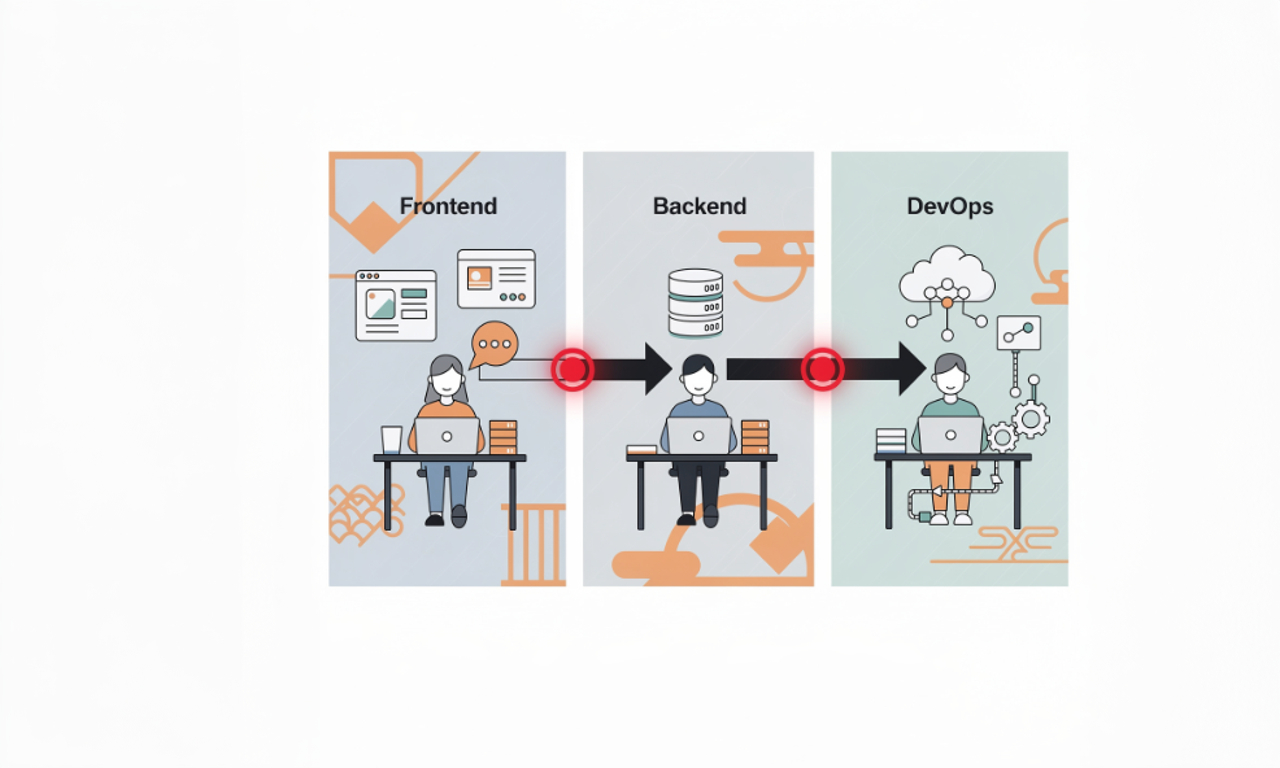
2. Teams Become Dependent Queues
Frontend waits on backend.
Backend waits on DevOps.
DevOps waits on approvals.
That’s not a team.
That’s a queue system.
And queues don’t scale.
3. No Clear Ownership
When ownership is shared, responsibility disappears.
- Bugs sit unresolved
- Decisions get delayed
- Systems become everyone’s problem
Which means… no one truly owns them.
4. Manual Work Everywhere
Manual testing.
Manual deployment.
Manual monitoring.
At small scale, it works.
At growth stage, it becomes the bottleneck.
Because manual = delay.
5. Weak Technical Planning
Good developers can still build fragile systems.
Without scalable architecture:
- Teams spend more time fixing than building
- Complexity grows faster than output
- Every release feels risky
We’ve seen this pattern repeatedly across SaaS teams.
The Real Cost That Most Teams Ignore
Bottlenecks are not just engineering problems.
They directly impact business performance.
- Slower feature delivery
- Missed market opportunities
- Increased development cost
- Lower team morale
According to McKinsey:
Companies that optimize engineering productivity can improve delivery speed by 20–30%.
That’s not optimization.
That’s competitive advantage.
How High-Growth Companies Avoid Bottlenecks
The companies that scale well don’t just hire more people.
They design systems that scale.
1. Small, Autonomous Teams
Instead of one large team, they create smaller units.
Each team owns:
- A product area
- A service
- A clear business outcome
This reduces dependencies and increases speed.
As Bezos put it:
If a team can’t be fed with two pizzas, it’s too big.
2. Scalable Architecture (At the Right Time)
They evolve architecture as complexity grows:
Monolith → Modular → Microservices (when needed)
This allows:
- Independent deployments
- Faster iteration
- Reduced system-wide risk
At Mediusware, we’ve implemented similar scalable systems in platforms like CRM Runner, where centralized complexity was reduced through modular architecture for better performance and scalability.
3. Automate Everything Possible
High-performing teams automate:
- Testing
- Deployment (CI/CD)
- Monitoring
This removes human delay and reduces errors.
Automation is not efficiency.
It’s scale enablement.
4. Clear Ownership Structure
Every system has:
- One responsible team
- One clear decision-maker
No overlap.
No confusion.
Just accountability.
5. Strong Developer Experience (DX)
This is where most teams underinvest.
But it matters more than they think.
Great teams optimize for:
- Faster local environments
- Clean documentation
- Internal tooling
Because developer friction = company slowdown.
6. Continuous Technical Health Investment
They don’t just build features.
They balance:
- Feature development
- Technical debt reduction
Ignoring technical debt is one of the fastest ways to create bottlenecks.
The Better Question Most Teams Miss
Most teams ask: How do we build faster?
High-performing teams ask: How do we remove friction?
Because speed is not about effort.
It’s about flow.
Common Mistakes Growing Companies Make
Even strong teams fall into these traps:
- Hiring more developers without fixing structure
- Over-engineering too early
- Ignoring DevOps practices
- Delaying architecture decisions
We’ve seen teams double in size…
and still deliver slower.
That’s the bottleneck effect.
Where Most Teams Actually Need Help
From our experience, the problem is rarely talent.
It’s usually:
- System design issues
- Workflow inefficiencies
- Architecture limitations
If you’re seeing:
- Slower releases
- Increasing dependencies
- Growing complexity
You’re not facing a hiring problem.
You’re facing a scaling problem.
Build Systems That Scale, Not Just Teams
Growth should make your company faster.
Not slower.
But that only happens when your development system is designed for scale.
If you’re already feeling friction in delivery, this is usually the moment to rethink:
- Architecture
- Team structure
- Engineering workflows
This is exactly where structured engineering systems and scalable development approaches make the difference.
Final Thought
The companies that win aren’t the ones that work harder.
They’re the ones that remove friction earlier.
And once you see that…
You stop scaling teams.
You start scaling systems.
Frequently Asked Questions
A development bottleneck is any point in the software process where work slows down due to dependencies, system limitations, or inefficient workflows.

I work at the point where product decisions, system architecture, and engineering execution meet. At Mediusware, I’m accountable for how technology choices affect reliability, scale, and long-term delivery for our clients.
Featureblogs
Relatedblogs
01
Integrating Redux with React: A Comprehensive Guide02
Laravel pagination and filtering with already loaded data as array in memory03
React + Three.js + React Three Fiber: Crafting Interactive 3D views in Web Applications04
Advanced Caching Strategies for Django Applications05
Implementing Roles and Permissions in Laravel Using Guard-LaravelAuthorblogs
01
How Digital Agencies Can Deliver Custom Software Without Hiring Developers02
AI in FinTech: Build, Buy, or Integrate? A Founder's Decision Framework03
How to Choose a SaaS MVP Development Company04
How Seed-Stage SaaS Teams Add Engineering Capacity Without Hiring Chaos05
Why Seed-Stage SaaS Startups Struggle to Ship Fast