- Enterprise voice agents automate high-volume conversations with instant 24/7 customer communication.
- Scalable voice AI integrates speech recognition, NLP, and enterprise systems for intelligent automation.
A Complete Roadmap for Scaling Enterprise Communication with Voice Agents
1 min read

Enterprise communication doesn’t break because of volume.
It breaks because the system behind it wasn’t built to handle real conversations at scale.
Calls pile up. Customers wait. Teams get overloaded.
And somewhere in that chaos, response time turns into lost revenue.
Voice agents are often seen as the solution.
But here’s what I’ve seen repeatedly:
Most voice AI projects fail not because the AI is weak, but because the architecture behind it can’t handle real-world complexity.
Latency. Context. Integrations. Edge cases.
That’s where things collapse.
What Are Voice Agents?
Voice agents are AI systems that understand and respond to spoken language in real time.
But the real shift isn’t “voice.”
It’s how users interact with systems.
Instead of navigating menus, users simply talk.
Modern voice agents can:
- Understand natural language
- Maintain conversation context
- Trigger backend actions
- Integrate with business systems
- Escalate when needed
Think of them as a front layer for enterprise systems, not just a support tool.
Why Enterprises Are Moving Toward Voice AI?
1. Demand Is Outpacing Teams
As products scale, communication grows faster than hiring capacity.
A mid-scale SaaS company can easily generate:
- Hundreds of calls daily
- Thousands of repetitive queries
- Continuous onboarding questions
According to IBM, AI-powered automation can handle up to 80% of routine customer interactions.
That’s not optimization. That’s survival.
2. Customers Expect Instant Responses
Waiting 15–20 minutes on hold is no longer acceptable.
A Salesforce report found that 73% of customers expect companies to understand their needs instantly.
Voice agents enable:
- 24/7 availability
- Instant interaction
- Zero queue dependency
3. Repetitive Queries Drain Teams
In most organizations:
- 60–70% of calls are repetitive.
Examples:
- Order status
- Password resets
- Appointment booking
Automating these frees human agents to focus on complex problems.
IVR vs Intelligent Voice Agents
Many companies assume voice AI is simply an improved IVR system.
In reality, the difference is architectural.
| Feature | Traditional IVR | AI Voice Agents |
| Interaction | Menu-based | Conversational |
| Logic | Scripted | Context-aware |
| Flexibility | Limited | Dynamic |
| Experience | Frustrating | Natural |
| Scalability | Low | High |
IVR forces users to adapt to the system.
Voice agents adapt to the user.
Where Voice Agents Create the Most Impact
1. Customer Support
- Handle high-volume queries
- Reduce wait times
- Lower support costs
2. Sales & Lead Qualification
- Qualify inbound leads
- Gather requirements
- Schedule demos automatically
3. Appointment Scheduling
Used heavily in:
- Healthcare
- Logistics
- Service businesses
Voice agents can:
- Book
- Confirm
- Reschedule
- Send reminders
4. Internal Operations
Employees can:
- Check HR policies
- Request leave
- Access data
- Interact with dashboards
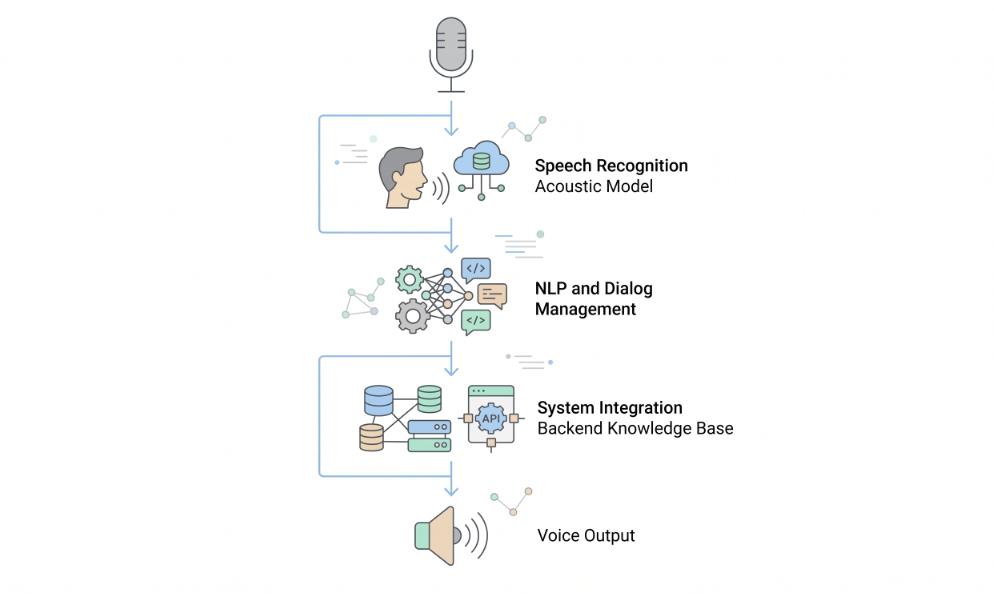
The Architecture Behind Scalable Voice Agents
This is where most systems fail.
A working voice agent isn’t a tool.
It’s a stack of tightly integrated systems.
Here's how:
1. Speech Recognition (ASR)
Converts voice → text
Modern systems reach 95%+ accuracy
2. Natural Language Processing (NLP)
Understands:
- Intent
- Context
- Entities
3. Dialogue Management
Controls:
- Conversation flow
- Context retention
- Response logic
- Escalation
4. Enterprise Integrations
This is the real value layer.
Common integrations:
- CRM systems
- ERP platforms
- Ticketing tools
- Databases
Example: See how enterprise platforms like CRM Runner unify operations across systems.
5. Text-to-Speech (TTS)
Converts responses → natural voice
Modern neural TTS sounds almost human.
A Simple Way to Think About It
Voice agents don’t replace systems. They replace the friction between users and systems.
Key Benefits
- 24/7 communication without scaling teams
- Lower operational costs
- Faster response times
- Massive scalability
- Better user experience
Common Mistakes That Break Voice AI Projects
1. Treating It Like a Simple Bot
Voice agents require real architecture, not scripts.
2. Ignoring Backend Integration
Without system access, it’s just a talking FAQ.
3. No Escalation Design
Not every conversation should stay automated.
4. No Feedback Loop
Voice systems improve only with real usage data.
Implementation Roadmap
Phase 1: Identify High-Volume Use Cases
Start with predictable tasks.
Phase 2: Build Integration Layer
Connect systems first, not last.
Phase 3: Launch a Controlled Pilot
Test accuracy and flow.
Phase 4: Expand Across Departments
Scale gradually.
Phase 5: Optimize with Data
Use transcripts and analytics.
The Future of Enterprise Communication
We’re moving toward:
- Autonomous support systems
- Multilingual voice agents
- AI-driven call centers
- Voice-controlled enterprise dashboards
Voice will become a default interface, not an add-on.
Frequently Asked Questions
An enterprise voice agent is an AI-powered conversational system that can understand spoken language, respond naturally, and interact with backend business systems. Unlike traditional IVR systems, voice agents can manage multi-step conversations, retrieve information from CRM or databases, and automate workflows such as scheduling, customer support, or account verification.

I work at the point where product decisions, system architecture, and engineering execution meet. At Mediusware, I’m accountable for how technology choices affect reliability, scale, and long-term delivery for our clients.
Featureblogs
Relatedblogs
Authorblogs
01
How Digital Agencies Can Deliver Custom Software Without Hiring Developers02
AI in FinTech: Build, Buy, or Integrate? A Founder's Decision Framework03
How to Choose a SaaS MVP Development Company04
How Seed-Stage SaaS Teams Add Engineering Capacity Without Hiring Chaos05
Why Seed-Stage SaaS Startups Struggle to Ship Fast