- How fintech teams design secure, scalable systems based on their growth stage.
- Practical guidance on architecture, performance, and compliance for long-term fintech success.
Fintech Software Development: Processes, Technologies & Key Trends
1 min read

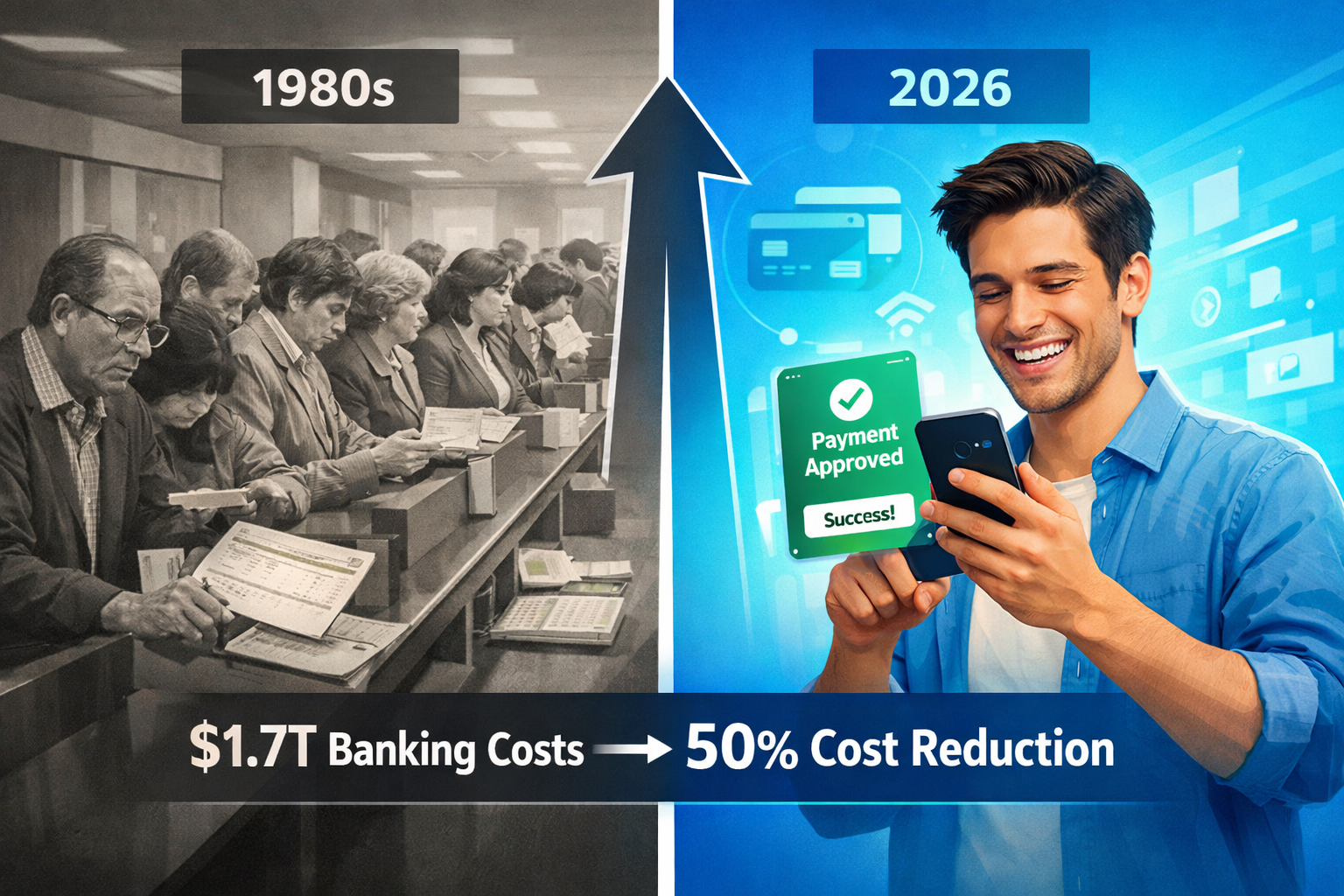
Picture 1980s banking, long branch lines, checks taking 5 days to clear, brokers only for the rich. Errors cost banks $1.7 trillion yearly. Customers paid high fees for slow service. No apps, no instant transfers, just paper and wait.
Fast-forward to 2026, tap your phone, money moves in 3 seconds. Fintech changed it all. What started with 1950s credit cards exploded with 2000s smartphones. Now AI, blockchain power apps for 1.2 billion users worldwide. Banks charge $340 per customer yearly.
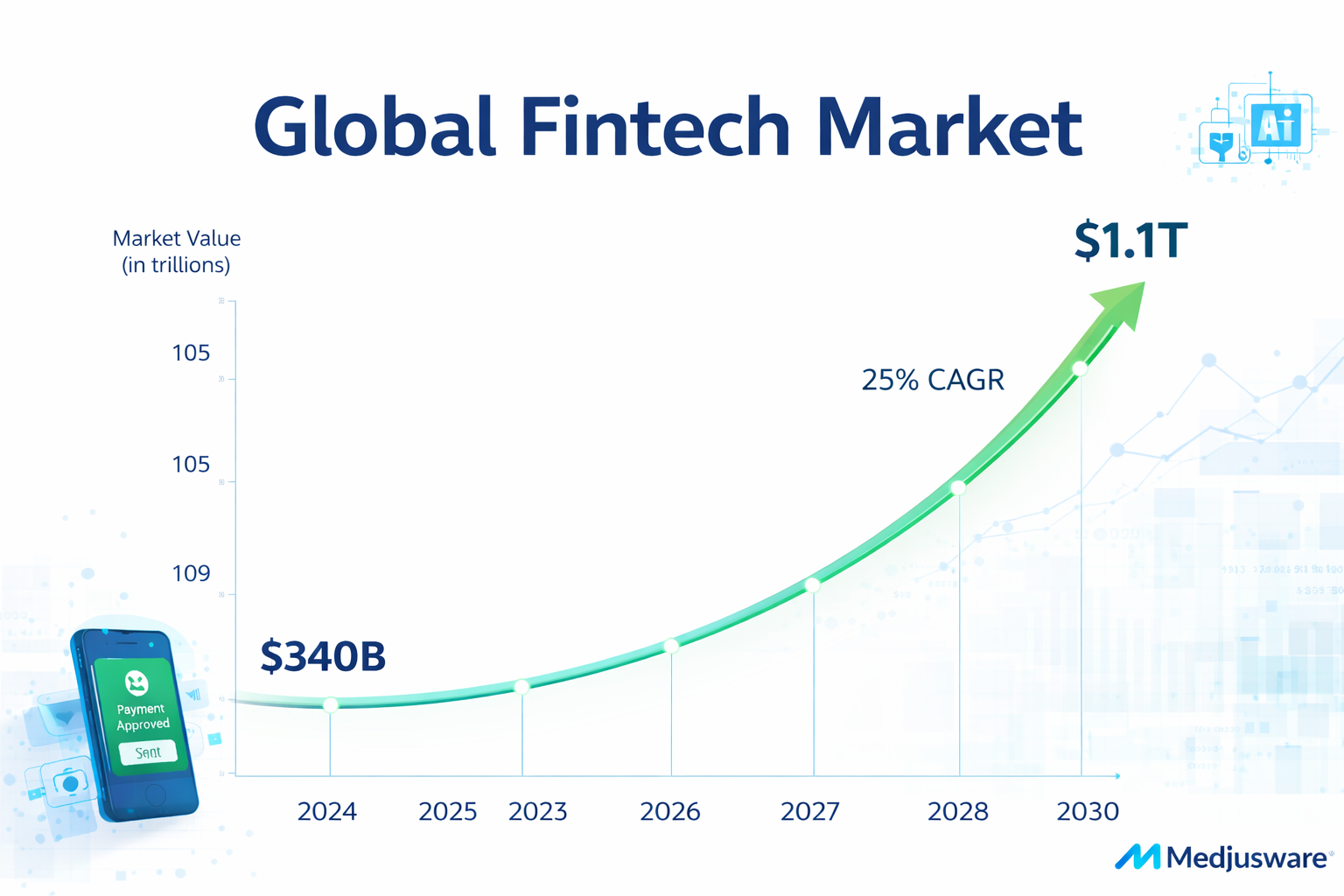
Fintech cuts that 50%. During COVID, usage jumped 40% as people ditched branches. The global market tells the real story: $340 billion in 2024, racing to $1.1 trillion by 2030 at 25% growth.
Why the boom? 6.8 billion smartphones connect everyone. AI slashes fraud 30%. Open banking rules spark innovation.
In this article, we explore how fintech software gets built, top technologies, hottest trends, and why invest now. From market growth to future-proof strategies, get the roadmap to ride this wave.
The Growing Fintech Market: Opportunities for Innovation and Growth
The fintech market grows fast. It creates big chances for new ideas and business wins. Investors pour money into startups. Companies build better tools every year.
Global Fintech Market Size and Growth
From Current Market Value Fintech reached $340 billion in 2024. Experts predict $1.1 trillion by 2030. This means 25% growth each year. Asia leads with fast adoption. North America follows close.
Key Drivers of Growth
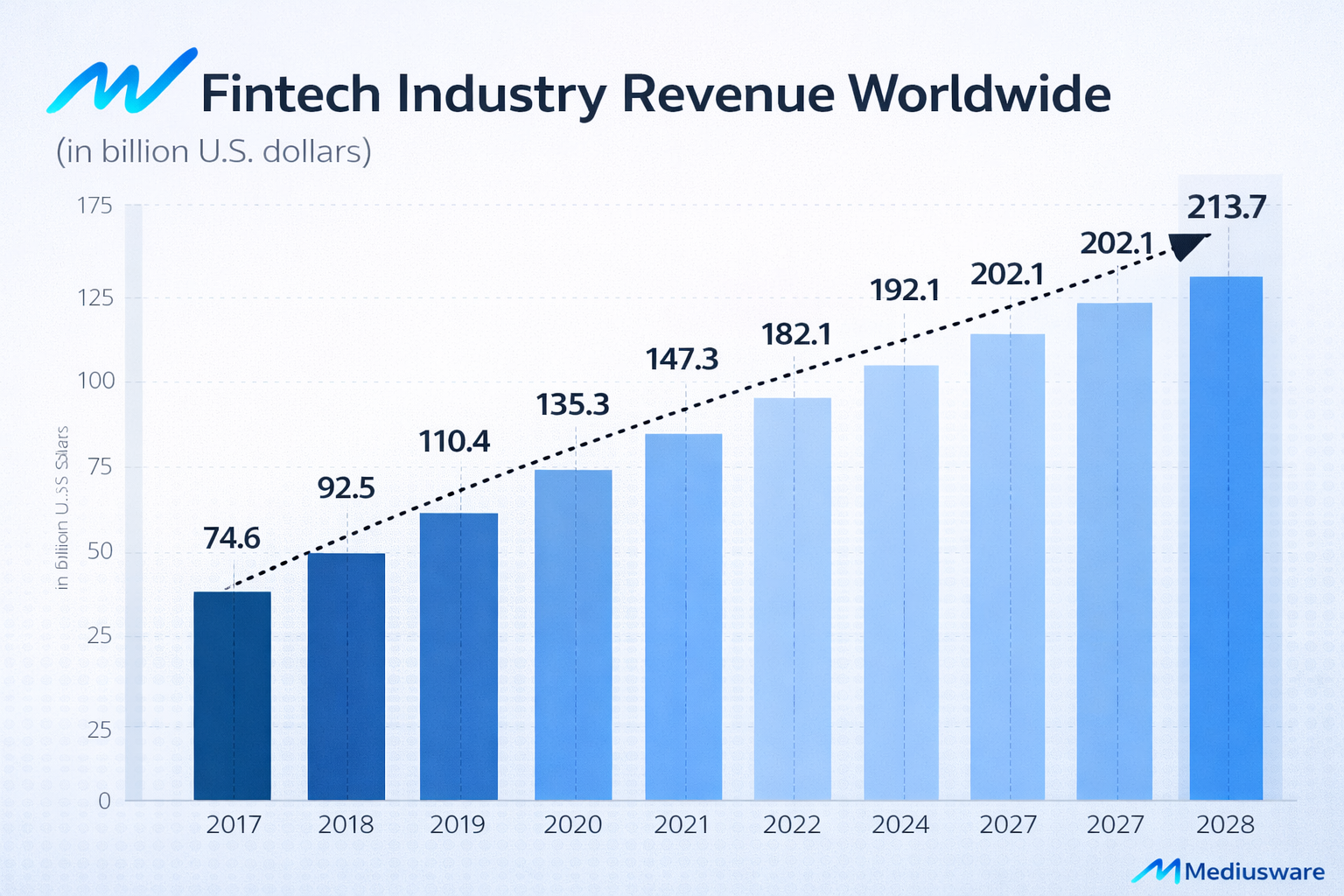
Smartphones drive the boom. Over 6.8 billion people use them now. AI fights fraud and speeds service. Rules like open banking help share data safely. Young users want digital wallets over cash.
Fintech Adoption Across Industries
Fintech changes many financial sectors. Each industry uses it differently. All see fast growth and happy customers.
Banking and Payments
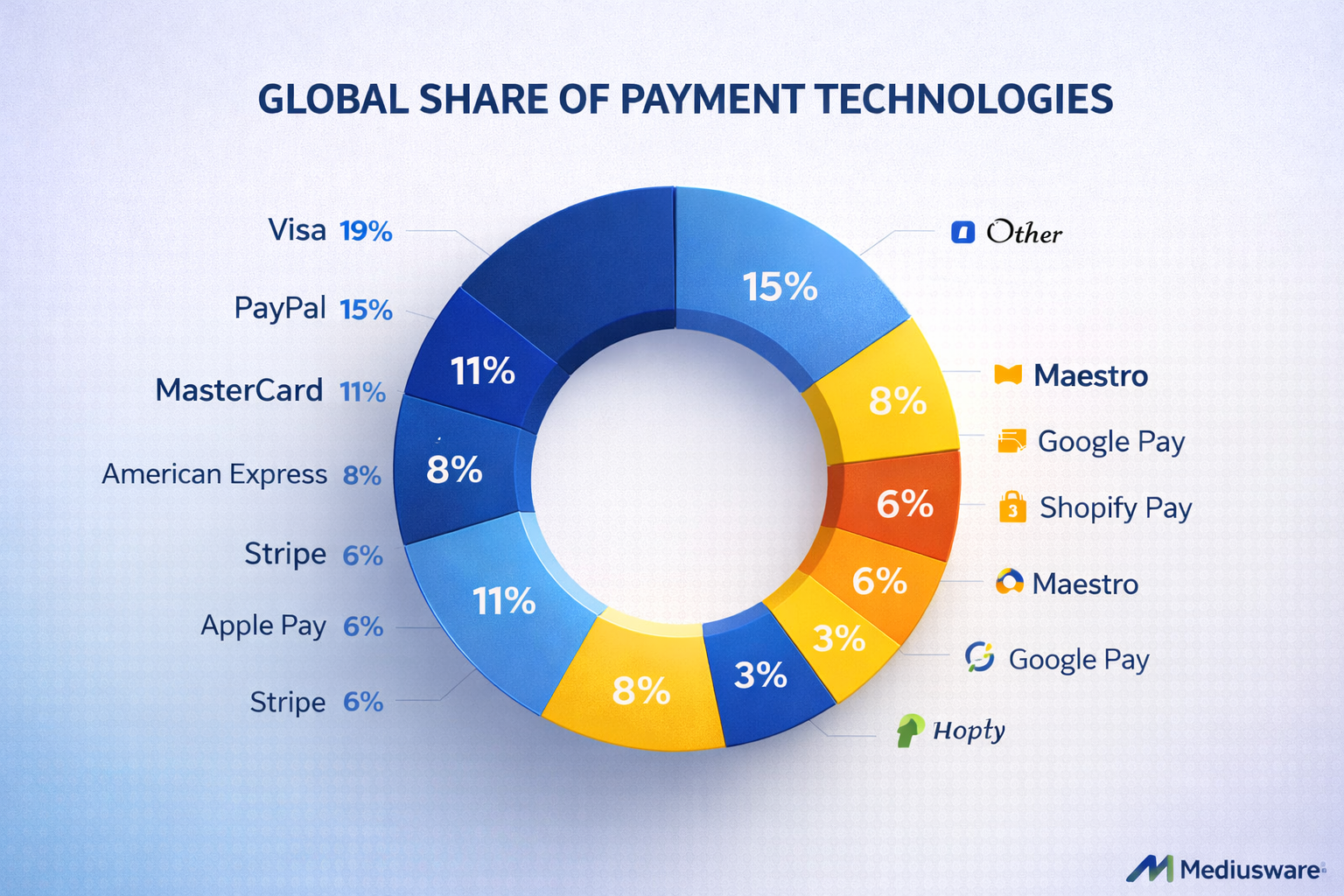
Digital payments lead fintech. Apps like Stripe and PayPal handle $8 trillion yearly. Mobile wallets grew 20% in 2025. Users send money across borders in 2 seconds.
Insurance (InsurTech)
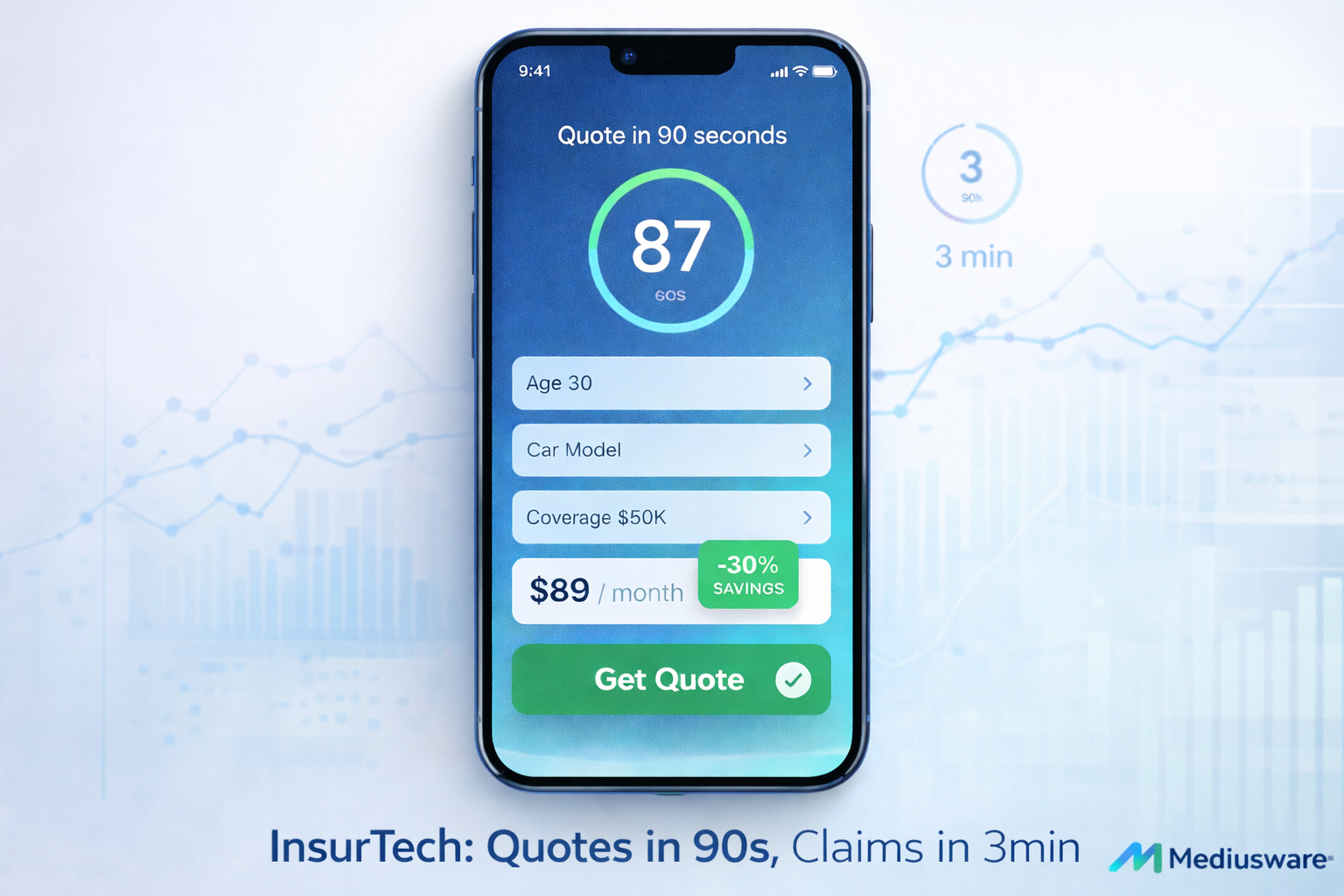
InsurTech fixes slow claims. Apps give quotes in 90 seconds. Lemonade pays claims in 3 minutes. The market is expected to grow to $200 billion by 2030. Customers save 30% on premiums.
Wealth Management (WealthTech)
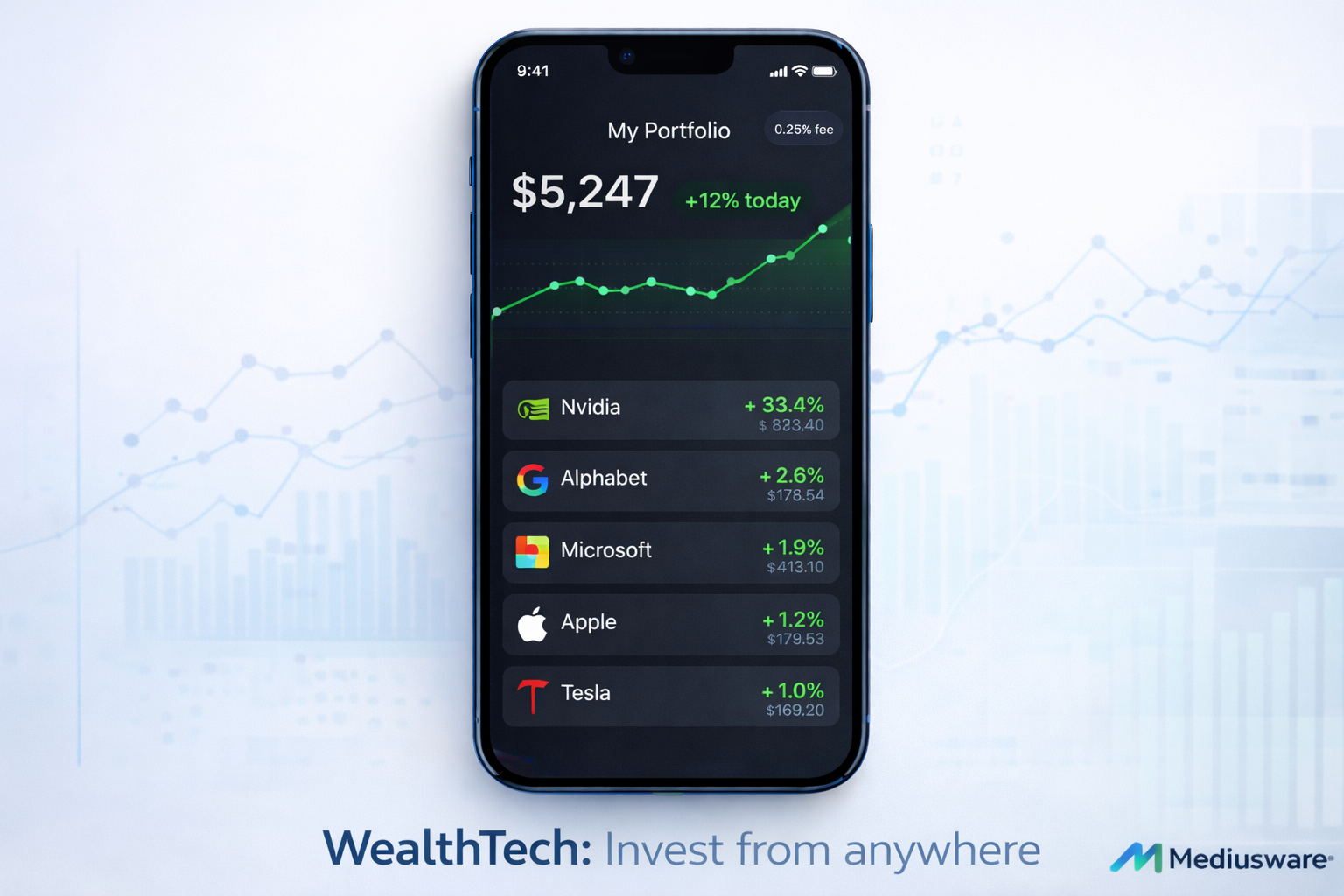
WealthTech opens investing to everyone. Robinhood leads commission-free trading with 25M+ users. Robo-advisors charge just 0.25% fees. The market grows 16% yearly.
Fintech fits every money need. Banking goes instant. Insurance gets smart. Wealth opens wide. All cut costs and speed service.
Core Processes in Fintech Software Development
Fintech apps need careful steps. Each phase builds trust and speed. Good process means secure money apps that scale fast.
Discovery and Planning
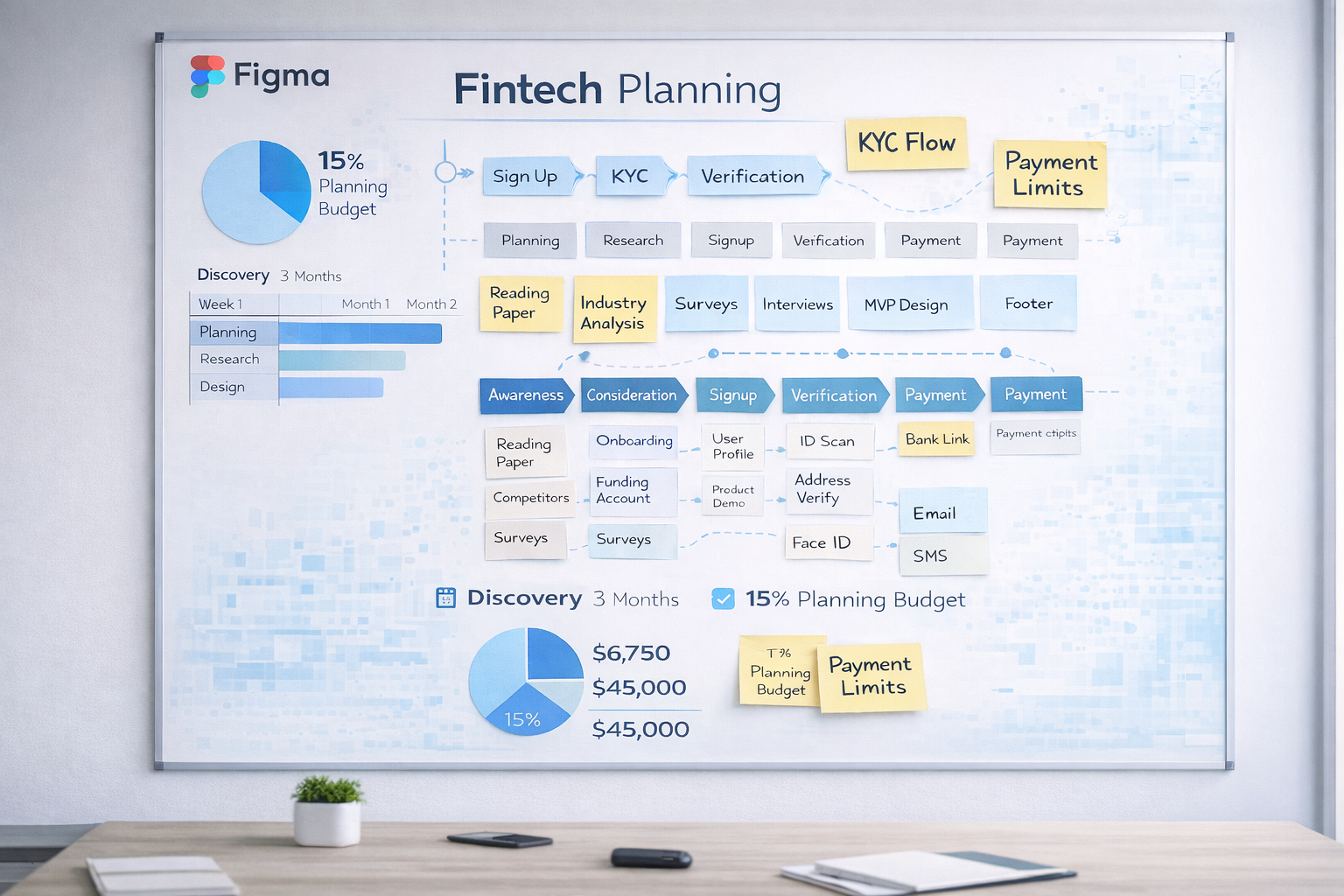
Start with user needs. Talk to banks, customers, and regulators. Map money flows and pain points. Create a requirements doc with features like KYC, payments, and fraud checks. Plan tech stack and timeline. Budget 10-15% of the project here.
Design and Prototyping
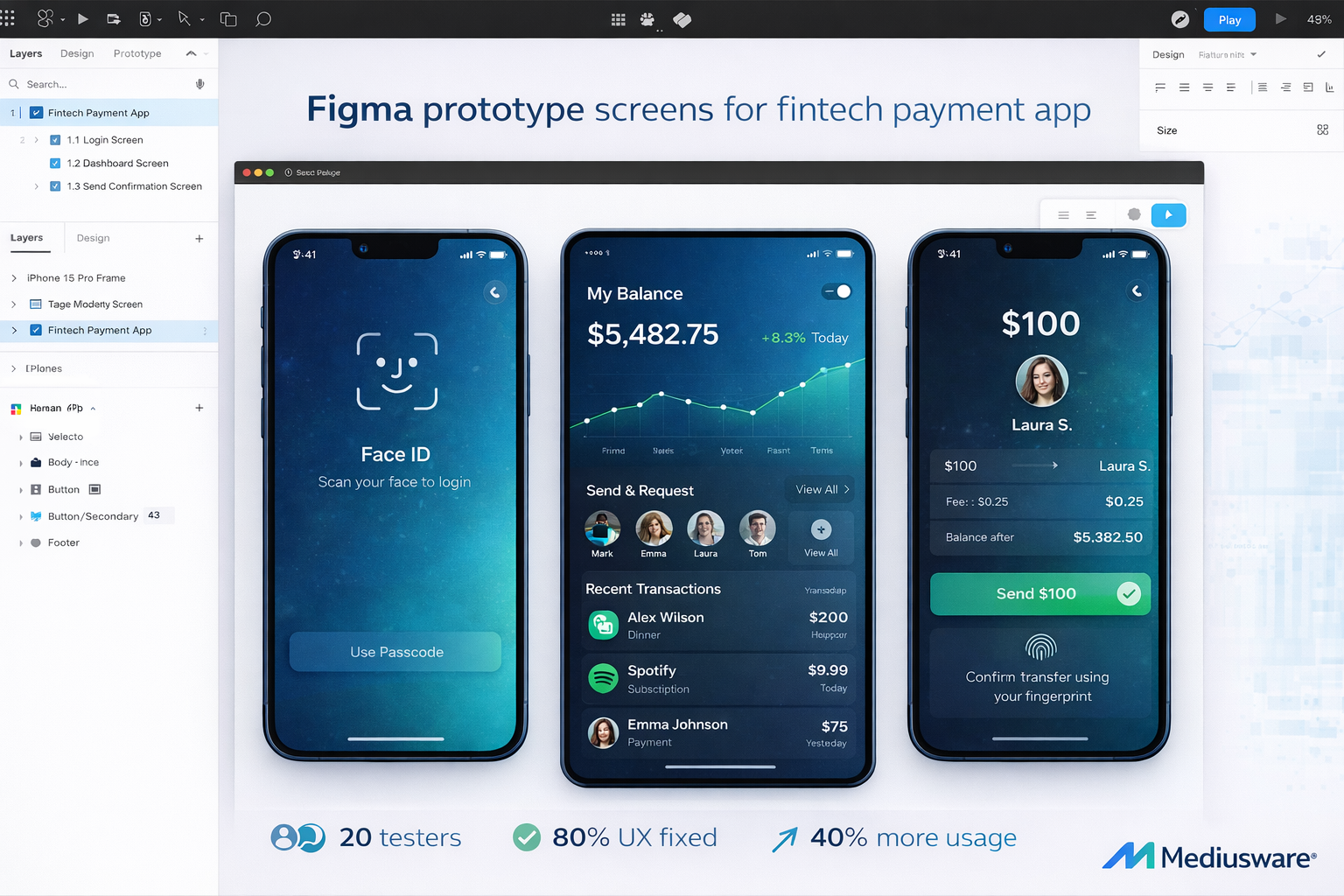
Make user-friendly screens. Finance users want simple flows. Design login, dashboard, transaction screens. Use Figma for prototypes. Test with 20 real users. Fix 80% UX issues before code starts. Add biometric login and dark mode. Fintech apps see 40% more use with good design.
Development and Testing
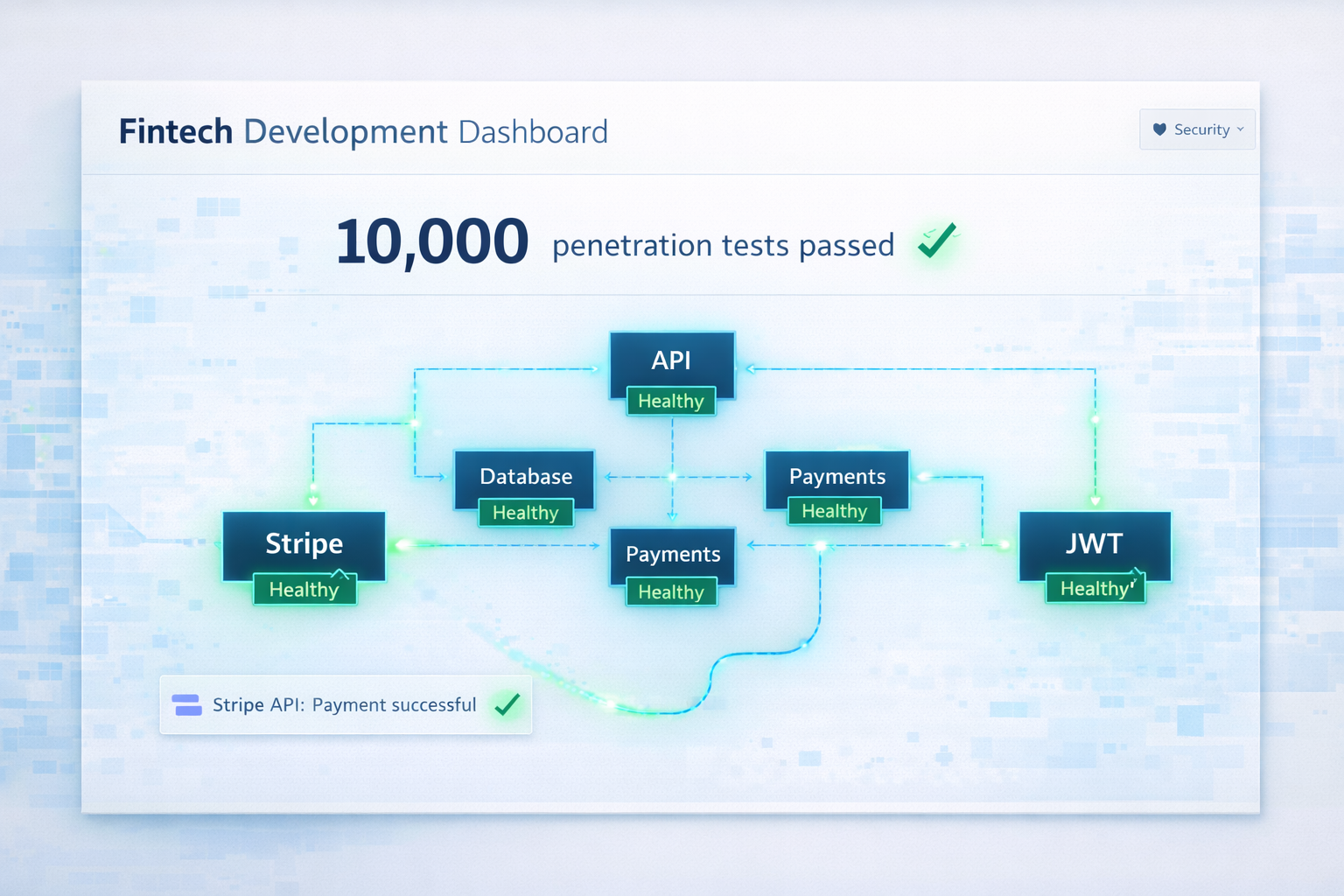
Code frontend with React Native. Backend uses Node.js or Python. Integrate Stripe and Plaid APIs. Build microservices for scale. Test for security daily. Run 10,000 fake attacks. Fix bugs before launch.
Deployment and Maintenance
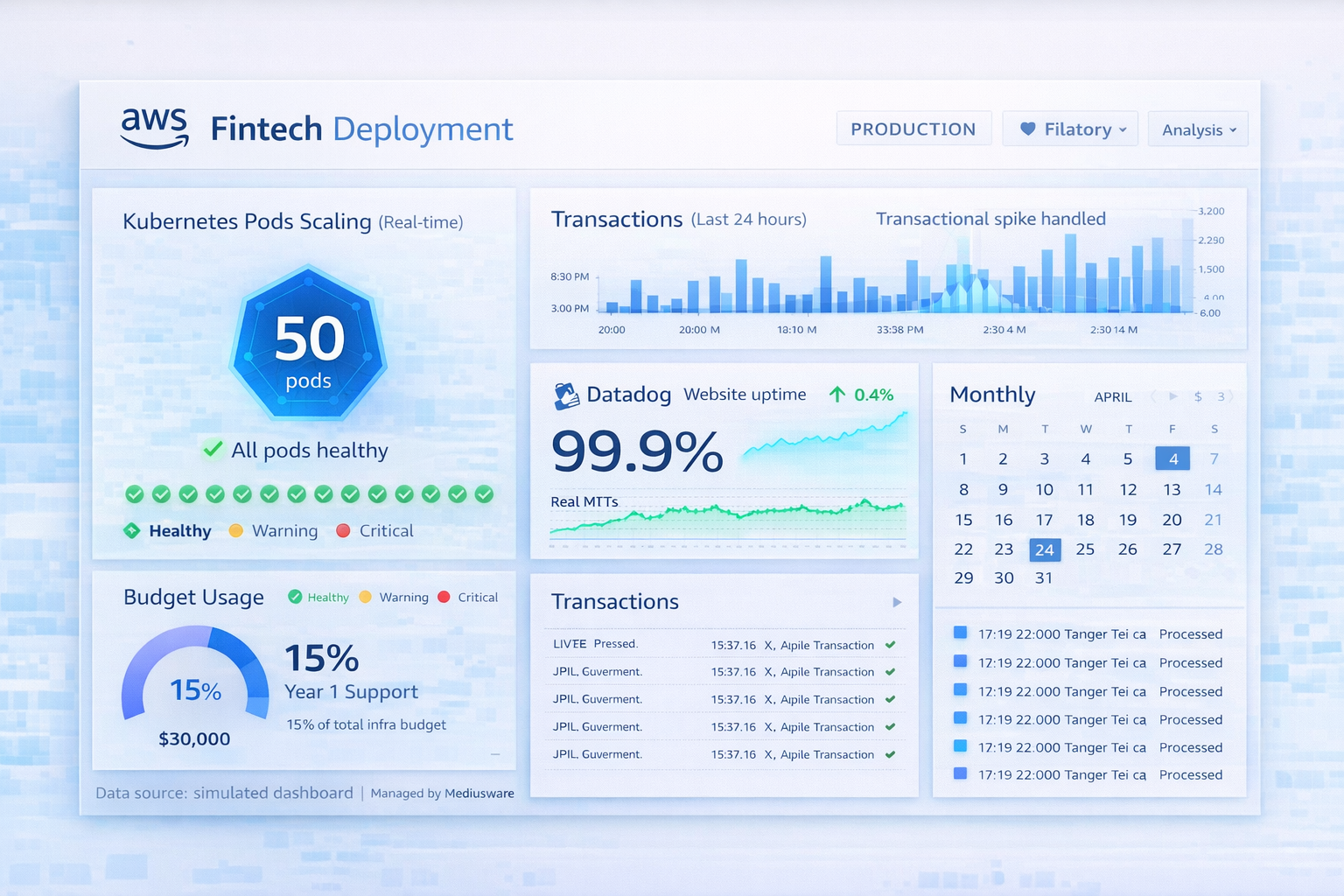
Launch on AWS or Google Cloud. Use Kubernetes for auto-scale. Monitor 24/7 with Datadog. Update monthly for new rules. Fix issues in hours, not days. Plan 15% budget for year 1 support. Good maintenance keeps 95% uptime.
The right process builds users' trust in apps. Each step cuts the risk 25%. Fintech success starts with smart planning.
Technical Architecture for Fintech Applications
Fintech needs rock-solid tech foundations. Right architecture handles millions of transactions securely. Wrong choices crash under pressure.
Microservices vs Monolithic Architecture
Fintech apps face unique demands. Monolithic works for startups. Microservices power scaleups. Choose right one saves 40% engineering time.
|
Feature |
Monolithic Architecture |
Microservices Architecture |
Winner (Fintech 2026) |
|
Development Speed |
3 months MVP |
6 months initial setup |
Monolith (early-stage startups) |
|
Scaling |
Scale the entire application |
Scale only payments or specific services |
Microservices (10M+ users) |
|
Team Size |
1–5 developers |
20+ developers |
Microservices (large teams) |
|
Downtime Risk |
One bug can crash the whole app |
Payments and core services stay live |
Microservices (99.99% uptime) |
|
Cost (Year 1) |
~$80K |
~$120K |
Monolith (MVP budgets) |
|
Tech Debt |
Grows quickly over time |
Managed per service |
Microservices (long-term health) |
|
Adoption in 2026 |
35% of startups |
82% of scaleups |
Microservices dominant |
What this really means:
Monoliths win early. But Microservices win at scale.
The Fintech Smart Path (What Actually Works)
Most successful fintechs don’t start with microservices.
They evolve into them.
|
Phase |
Timeline |
Architecture |
Focus |
|
Phase 1 |
Months 1–6 |
Monolith |
MVP with Payments + KYC |
|
Phase 2 |
Month 7+ |
Hybrid |
Extract Payments as Microservice |
|
Phase 3 |
Year 2 |
Full Microservices |
Scale all core fintech services |
Real Fintech Example:
Square started with a monolithic system.
As volume grew, they shifted to serverless microservices, isolating payments and transaction processing.
Result:
- 40% infrastructure cost reduction
- Higher uptime
- Faster feature releases
This pattern repeats across modern fintech.
Simple Rules You Can Actually Use
If you remember nothing else, remember this:
|
Metric |
Recommendation |
|
< 100K users |
Monolithic architecture |
|
1M+ transactions/day |
Microservices immediately |
|
Need fast MVP |
Monolith |
|
Need high uptime + scale |
Microservices |
Frontend Technologies (React Native, Flutter)
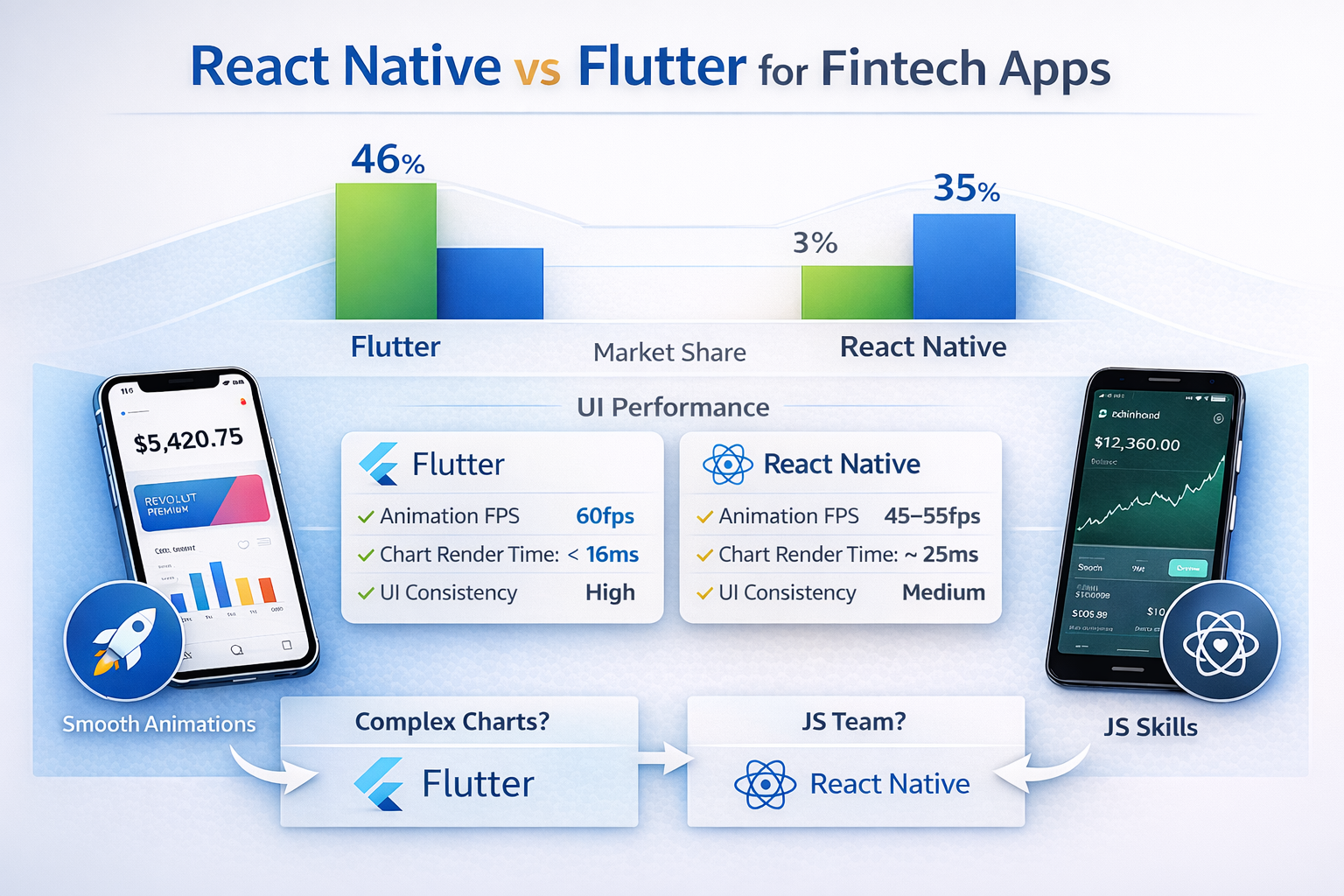
Frontend performance directly affects trust in fintech apps, which is why React Native and Flutter lead mobile app development in 2026, helping teams ship faster with near-native performance and up to 40% less development effort.
React Native suits JavaScript teams building fast MVPs, while Flutter excels in delivering smooth animations, consistent UI, and complex fintech dashboards.
- React Native: 35% market. JavaScript team? Use it. Robinhood, Stripe apps built here.
- Flutter: 46% market, faster animations. Revolut and Google Pay use it. Pixel-perfect UI across iOS/Android.
Pick rule: Complex charts/animations = Flutter. JS team = React Native.
Backend & Database Stack
Node.js with PostgreSQL = fintech gold standard 2026. Handles millions of transactions securely.
Backend choices:
- Node.js (52% fintechs): Real-time payments, fast APIs. Perfect for Stripe integrations.
- Python/Django (41%): AI fraud detection, analytics. Powers risk scoring.
Database Stack:
- PostgreSQL: ACID transactions guarantee money safety.
- Redis: Session cache, 1ms reads for user sessions.
- RabbitMQ: Payment queues ensure zero lost transactions.
This stack powers Revolut, Stripe, and Nubank. Build once, scale forever.
API Gateways and Security Layers
API Gateway protects your fintech "front door." Manages 10,000+ daily calls with security and analytics.
Top gateways for fintech 2026:
- Kong: Open source, Kubernetes-native. 3,000+ plugins for auth/rate limiting.
- Amazon API Gateway: AWS-native, serverless scaling. Perfect for Lambda + Cognito.
Security stack:
- JWT + OAuth2: Token-based auth (industry standard)
- WAF: Blocks SQL injection, DDoS (Cloudflare/AWS Shield stop 99% attacks)
- Rate limiting: 1,000 calls/user/minute prevents abuse
Observability targets:
- Log every API call (ELK stack)
- 100ms response time goal (fintech standard)
- 99.99% uptime SLA with auto-scaling
Real fintech stats: Nubank runs 15,000+ APIs through Kong. Gateway catches 95% issues before core systems. Zero downtime deploys with blue-green strategy.
Build secure, observable APIs from day one. Gateways = your 24/7 security guard + traffic cop.
Technologies Driving Fintech Software Development
Three technologies power modern fintech apps. Blockchain secures transactions. AI fights fraud. Cloud scales everything. Each solves real money problems.
Blockchain and Cryptocurrencies
Blockchain = unchangeable digital ledger. Perfect for money transfers without banks.
Key uses:
- Cross-border payments (Ripple sends $ in 4 seconds)
- Smart contracts (auto-pay loans when conditions met)
- Stablecoins (USDC moves $50B monthly, zero volatility)
Simple benefits:
- Cuts fees 80% vs SWIFT
- 24/7 settlement (no bank hours)
Real apps: Binance, Coinbase, use it daily.
AI and Machine Learning
AI = smart brain for money decisions. Learns patterns, spots fraud instantly.
Daily fintech AI work:
- Fraud detection (blocks 98% fake transactions)
- Credit scoring (approves 30% more loans accurately)
- Chatbots (answers 80% customer questions)
Simple example: Enter card details → AI checks 100 patterns in 50ms → Approve or block.
Cloud Computing and APIs
Cloud = rent servers that grow/shrink. APIs = app-to-app communication.
Cloud leaders:
- AWS (31% market): Handles Stripe's 1M payments/sec
- Google Cloud (12%): Nubank's 70M users
APIs make fintech work:
- Stripe API: Accept payments in 3 lines code
- Plaid API: Connect 12,000 banks instantly
- Twilio API: SMS 2FA codes
Result: Apps handle Black Friday spikes without crashing. 99.99% uptime guaranteed.
Key Trends Shaping the Future of Fintech
Four trends define fintech 2026-2030. Open banking unlocks data. Mobile-first reaches billions. AI personalizes money. DeFi cuts middlemen.
Open Banking and Data Sharing
According to Mordor Intelligence Open banking lets apps access bank data safely. Customers save 25% on loans by comparing offers.
Key facts:
- 150M Americans use Plaid to connect banks
- 2.5B Europeans covered by PSD2 rules
- One-click consent, full user control
Result: Apps find the best mortgage rates instantly.
The Rise of Mobile-first Solutions
90% of new users start on phones. Venmo (90M US), Revolut (45M Europe) prove it.
Mobile wins:
- QR payments: 1 second vs 30-second cards
- 3.5B global users by 2027
- Works offline, no internet needed
Banks lose: 40% customers prefer mobile-only apps.
AI in Personalized Finance
AI knows your money better than you. Analyzes spending, predicts cash flow.
Daily examples:
- Skip 2 coffees, invest $10 alerts
- Auto-adjusts savings goals monthly
- Chime/Cleo serve 20M Americans
Proven: Users save average $500/year automatically.
The Growth of Decentralized Finance (DeFi)
DeFi = banking without banks. Smart contracts replace loans and savings accounts.
Real uses:
- 8% yields on stablecoins (vs 0.1% banks)
- Instant crypto loans, no credit checks
- $250B locked globally (2026)
Leaders: Uniswap, Aave, Coinbase Wallet dominate.
These trends create $1T opportunities. Mobile + AI + DeFi serve next 4 billion unbanked worldwide.
Benefits of Custom Fintech Software Development
Custom fintech software fits your business perfectly. Off-the-shelf apps force compromises. Custom builds win long-term.
Aligned to Your Business Needs
Build exactly what your customers want. No extra features wasting money.
Key wins:
- Match your exact workflows (lending, payments, compliance)
- White-label branding, no competitor logos
- Integrate with your existing CRM/ERP systems
- Specific rules for your market (USA lending laws, Europe PSD2)
Result: 35% higher customer adoption vs generic apps.
Enhanced Security and Compliance
Your data, your control. Custom = security built for your exact risks.
Security advantages:
- Encryption matching your data sensitivity
- Custom AML/KYC matching your customer types
- PCI-DSS Level 1 from day one
- Audit-ready compliance reports
Real difference: Generic apps share security with 1,000 others. Custom = yours alone.
Scalability for Future Growth
Grow from 1K to 10M users without rewrite. Custom architecture plans for 10x growth.
Scale smart:
- Microservices grow one piece at a time
- Cloud auto-scaling handles Black Friday spikes
- Database sharding for 100M transactions
- Zero-downtime deploys during peak hours
Proven: Custom fintechs handle 5x traffic spikes vs generic platforms.
So, Custom = your competitive edge. Also, Perfect fit with ironclad security and infinite scale = unbeatable advantage.
Development Costs & ROI
Custom fintech costs $80K-$500K. ROI hits 300% in 18 months. Numbers beat off-the-shelf long-term.
Custom Fintech Project Pricing
MVP starts at $80K, full platforms $300K-$500K According to 2026 pricing.
- Discovery and Design: $15K-$40K (15% budget)
- Development: $40K-$250K (60% budget)
- Compliance/Security: $20K-$100K (25% budget)
- Year 1 Support: $15K-$50K (10-15% annual)
USA/Europe rates: $100-$180/hour. Offshore: $40-$70/hour.
Typical Timelines and Budget Ranges
|
Project Type |
Timeline |
Budget Range |
|
Payment MVP |
3-5 months |
$80K-$150K |
|
Digital Banking |
6-9 months |
$200K-$350K |
|
Full Platform |
9-15 months |
$350K-$500K+ |
Compliance adds 25-40% to base costs (PCI-DSS, GDPR).
ROI Case Studies and Metrics
Real fintech ROI numbers:
- 40-50% operational savings Year 1 (automation)
- 2-5x fraud reduction = direct profit
- 300% ROI in 18 months (McKinsey fintech report)
- Customer acquisition drops 35% with branded apps
Example: Payment gateway replaced Stripe → 65% fee savings ($1.2M Year 2 profit).
Mediusware Case Studies
Mediusware delivered real fintech wins. Proven track record across payment systems.
Payment Gateway Success Stories
CRM Runner - Custom CRM for fintech sales teams:
- 150% sales conversion increase
- Integrated payment APIs + customer analytics
- Live in 4 months
Explore: CRM Runner Case Study
Digital Banking Transformations
Bulk-ly - Bulk payment processing platform:
- Processes 10K payments/hour
- Custom security + compliance layer
- 99.9% uptime first year
Explore: Bulk-ly Case Study
Bangladesh Fintech Wins
Local payment gateway (confidential client):
- 2M transactions/month capacity
- bKash/Nagad API integration
- 45% cost reduction vs foreign providers
These prove Mediusware delivers ROI. Real clients, real numbers, real results.
Mediusware's Fintech Services
Mediusware builds complete fintech solutions. From payments to compliance, full-stack delivery with proven results.
Digital Payment Solutions
-
Custom Payment Gateway Development
Build your own Stripe alternative. Accept cards, wallets, crypto. PCI-DSS Level 1 compliant from launch. Global currencies + local methods.
- Mobile Payment Integration
Apple Pay, Google Pay, QR codes. One SDK works everywhere. 99.9% transaction success rate guaranteed.
Banking Solutions
- Core Banking Systems
Modern core banking replacement. Real-time accounts, transfers, loans. Microservices architecture scales to millions.
- Digital Banking Platforms
White-label mobile and web banking. Customer onboarding in 90 seconds. Full admin dashboard included.
Blockchain and Cryptocurrency Solutions
-
Blockchain Development
Private blockchains for enterprise. Smart contracts for loans, payments. Ethereum/Solana compatible.
- Cryptocurrency Solutions
On-ramps, wallets, exchanges. Multi-chain support (ETH, BSC, Polygon). Custodial + non-custodial options.
Financial Analytics and AI Solutions
-
Predictive Analytics Tools
Cash flow forecasts, churn prediction. 95% accuracy on spending patterns. Daily actionable insights.
-
AI for Fraud Detection & Risk Management
Real-time transaction scoring. Blocks 98% fraud before completion. 50ms decision time.
Regulatory and Compliance Solutions
- AML and KYC Solutions
Automated identity verification. Global sanctions screening. 99% accuracy rate.
-
RegTech Development
PSD2, GDPR, CCPA compliant. Automated reporting. Audit-ready documentation.
Mediusware is your end-to-end fintech partner. One team handles architecture, compliance, and deployment. Live demos available.
Choosing the Right Fintech Software Development Partner
Your partner determines success or failure. Wrong choice = compliance fines, delays, lost trust. On the other hand, Right partner = 6-month launch, scalable growth.
Expertise and Experience in Fintech
Look beyond general software skills. Fintech demands specialized knowledge.
Must verify:
- 3+ live payment platforms (not just "apps")
- PCI-DSS Level 1 certification (handles card data)
- Experience with Stripe/Plaid/Twilio APIs
- Compliance with GDPR, PSD2, SOC2 standards
Red flags: Generic portfolios, "we can learn fintech," no security certs.
Custom Solutions vs. Off-the-Shelf
Custom wins long-term despite higher upfront cost.
|
Metric |
Custom Development |
Off-the-Shelf |
|
Initial Cost |
$250K-$500K |
$30K-$100K |
|
Time to Market |
6-12 months |
1-3 months |
|
Flexibility |
✅ 100% control |
Limited features |
|
3-Year Costs |
$600K total |
$450K+ (subscriptions) |
|
Scalability |
✅ Unlimited |
Vendor limits |
|
Exit Value |
✅ Sell entire IP |
Ongoing license fees |
Strategy: Off-the-shelf MVP → Custom Year 2.
Importance of Ongoing Support
Launch Day 1 = biggest risk. Plan 15-20% Year 1 budget for support.
Essential guarantees:
- 4-hour critical issue resolution
- Monthly compliance updates (regs change)
- 24-hour security patches
- Dedicated 24/7 phone support
Truth: 68% of fintech failures happen post-launch from poor support.
Final Thoughts: Building the Future of Finance
Fintech success is not driven by tools or frameworks, but by timing and discipline in technical decision-making. The strongest platforms align architecture, performance, security, and compliance with the stage of the business, not short-term industry trends.
Speed matters early. As scale increases, resilience and trust become non-negotiable. Knowing when to shift priorities is what enables sustainable growth and protects long-term value.
The next generation of fintech leaders will be defined by how deliberately they build, scale, and manage risk.
If you're planning your next fintech solution and want a trusted technology partner to support you, let’s talk.
Frequently Asked Questions
The best fintech stack depends on the product stage. Early-stage startups often benefit from simpler architectures and faster development frameworks, while scaleups require more modular, resilient systems to handle growth and compliance.

I work at the point where product decisions, system architecture, and engineering execution meet. At Mediusware, I’m accountable for how technology choices affect reliability, scale, and long-term delivery for our clients.
Featureblogs
Relatedblogs
01
Smart Contracts vs. Regular Contracts02
SDLC vs Agile System Development: Phases, Pros and Cons, and Common Grounds03
Why Mediusware Limited is Your Perfect Global Outstaffing Partner04
10 Best B2B Software Companies in the USA for 2025 – Find Your Perfect Partner!05
Why Leading Agencies Partner with Mediusware for Scalable Tech SolutionsAuthorblogs
01
How Digital Agencies Can Deliver Custom Software Without Hiring Developers02
AI in FinTech: Build, Buy, or Integrate? A Founder's Decision Framework03
How to Choose a SaaS MVP Development Company04
How Seed-Stage SaaS Teams Add Engineering Capacity Without Hiring Chaos05
Why Seed-Stage SaaS Startups Struggle to Ship Fast