Scaling projects isn’t about hiring more developers; it’s about fixing your delivery system. Teams that grow efficiently rely on structure, not headcount.
How Client Projects Scale Without Hiring More Developers
1 min read
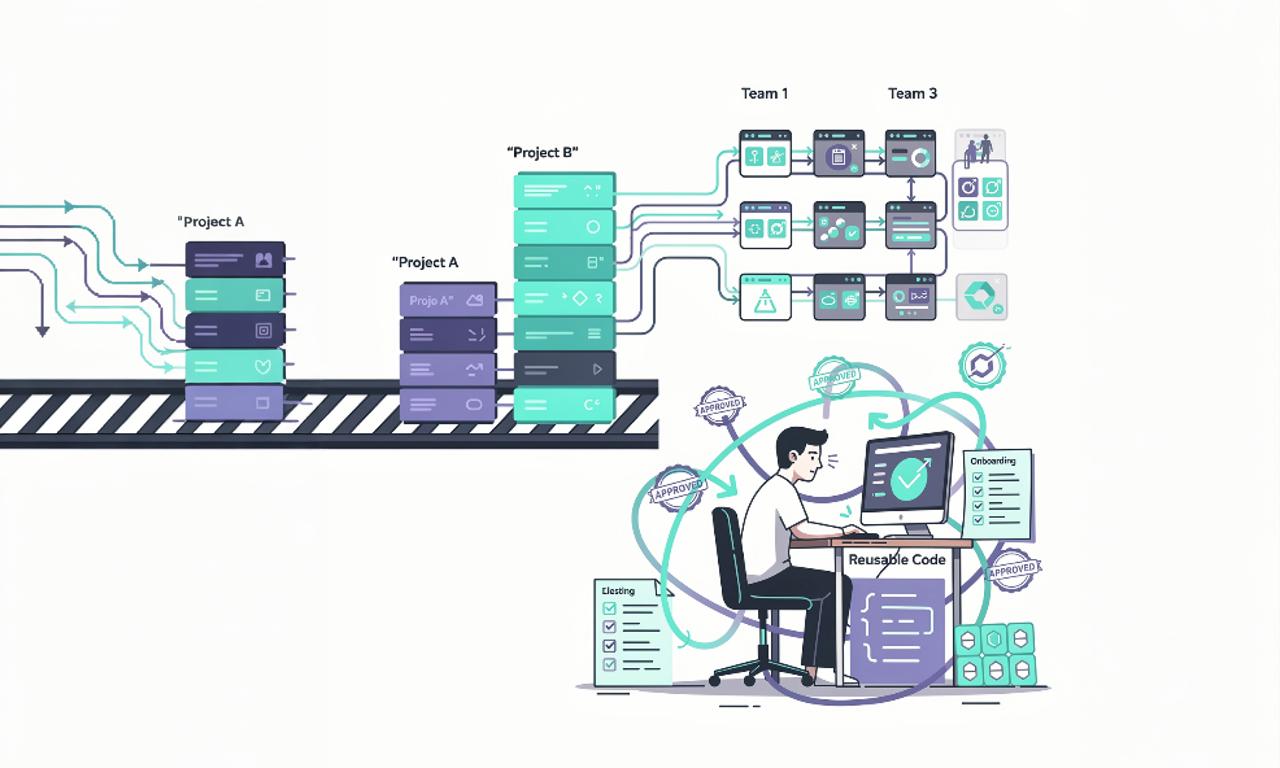
Most teams don’t struggle to grow because demand is missing. They struggle because more client projects expose delivery weaknesses that were already there.
I’ve seen teams assume the answer is to hire more developers, when the real bottleneck is usually structure, ownership, and workflow design. When project volume increases, the instinct to add headcount feels logical. But hiring rarely fixes what is actually slowing delivery down.
SHRM reports that 75% of organizations struggled to fill full-time roles, while Deloitte says skilled talent and agility have become major reasons companies use third-party sourcing models. That matters because the pressure to deliver grows faster than most teams can hire.
The real problem is not capacity alone
More client work does not automatically require more developers.
What it usually reveals is:
- Unclear project ownership
- Too many approval layers
- Fragile delivery processes
- Repeated work that was never standardized
- A few key developers becoming bottlenecks for everything
That is why one new project can make an entire team feel overloaded even before anyone is truly at full capacity.
The mistake is treating scaling like a staffing problem first. In practice, it is often a systems problem wearing a staffing mask.
Why hiring more developers often makes scaling harder first
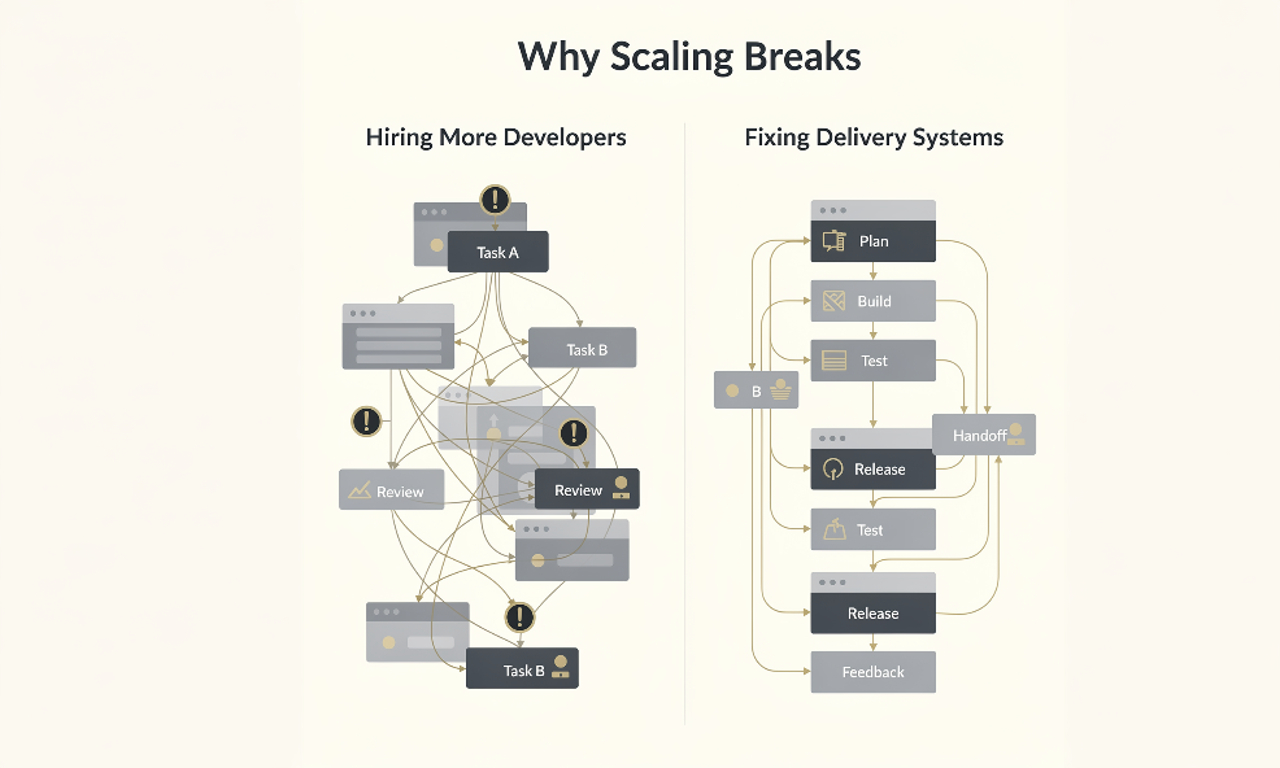
Hiring adds people, but it also adds communication paths, onboarding time, review overhead, and coordination cost.
A new developer does not instantly create delivery speed. They need context. They need process clarity. They need working documentation. They need stable ownership boundaries. If those things are weak, every new hire increases complexity before they increase output.
That is why teams often feel slower right after expanding.
Instead of creating immediate relief, they create:
- More handoffs
- More meetings
- More dependency conflicts
- More inconsistencies in quality
- More time spent aligning instead of building
So the project count goes up, payroll goes up, and predictability goes down.
The market is already moving toward flexible delivery models
This shift is bigger than one team’s internal process.
Deloitte’s 2024 Global Outsourcing Survey says:
80% of executives plan to maintain or increase investment in third-party outsourcing, while Grand View Research estimates the global IT services outsourcing market reached about $744.6 billion in 2024 and could grow to $1.219 trillion by 2030.
That does not mean every team should outsource blindly. It means the market is increasingly rewarding delivery models built around flexibility, speed, and access to specialized capability.
A better question changes the entire strategy
The wrong question is: How many more developers do we need?
The better question is: What is preventing our current team from delivering more smoothly?
That shift changes the solution completely. Because once you ask the right question, the real issues become visible:
- The work is not modular enough
- Delivery depends too heavily on specific individuals
- Repeated tasks are still being rebuilt from scratch
- Project intake is inconsistent
- Priorities change faster than execution systems can absorb
These are not hiring problems. These are design problems inside the delivery model.
What actually helps teams scale client projects
The teams that scale most effectively usually make three moves before they make major hiring decisions.
1. They standardize repeated work
Every client project has unique goals, but not every delivery action should be unique.
High-performing teams reduce friction by standardizing what repeats:
- Sprint structures
- Onboarding flows
- QA checklists
- Reusable components
- Documentation templates
- Communication rituals
This cuts decision fatigue and speeds up execution without lowering quality.
2. They reduce dependency chains
If every important decision, review, or technical direction has to go through the same two people, scale breaks quickly.
Stronger teams restructure work into clearer modules with clearer ownership. That means:
- Fewer bottlenecks
- More parallel execution
- Faster reviews
- Less confusion over who owns what
This is where a lot of “capacity issues” disappear.
3. They expand capability more intelligently
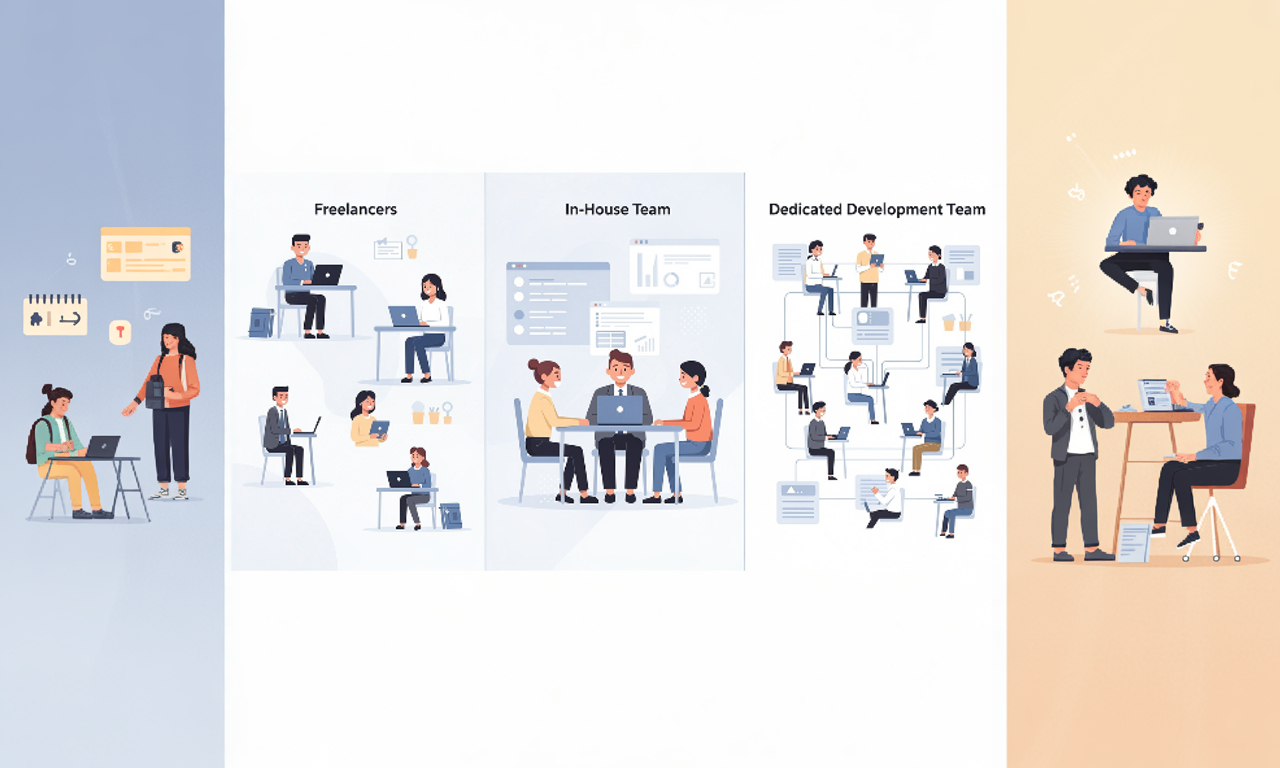
Sometimes the right answer is not another full-time hire. Sometimes it is targeted support, white-label capacity, specialist help, or a dedicated external delivery layer that fits the workflow already in place.
That kind of model gives teams room to take on more work without permanently increasing fixed overhead.
For teams exploring that route, Mediusware’s agency partnership model and broader software development services are designed for exactly this kind of scale-without-chaos challenge.
A useful rule: systems before headcount
One of the clearest principles here is simple:
Skilled talent and agility join cost reduction as key drivers for outsourcing.
That line matters because it reflects what many teams learn too late: scaling is no longer just about adding labor. It is about building a delivery model that stays fast when complexity increases.
If your current workflow is unstable, more people will amplify the instability. If your workflow is structured, even a small team can handle significantly more than expected.
A practical framework for scaling without immediate hiring
If client demand is growing and the team already feels stretched, this is the framework I would use first:
Step 1: Find the actual bottleneck
Ask where projects really slow down. Is it:
- Scoping?
- Development?
- QA?
- Approvals?
- Communication?
- Deployment?
You cannot fix scale if the real constraint is still hidden.
Step 2: Separate custom work from repeatable work
Map out what is truly unique and what can be reused. Most teams underestimate how much repeatable work exists inside supposedly custom projects.
Step 3: Clarify ownership
Every important piece of delivery should have a clear owner.
Not the dev team or someone will handle it. A real owner.
Step 4: Build overflow capacity before the emergency
The worst time to solve a scaling issue is when deadlines are already slipping.
This is where a trusted external partner, dedicated support model, or white-label capability can protect delivery quality before stress becomes visible to the client.
Mediusware’s dedicated developer support is one option for teams that need that kind of flexible extension layer.
What this looks like when done well
The strongest teams do not scale by turning every growth moment into a hiring rush.
They scale by creating a system where:
- Delivery is repeatable
- Ownership is clear
- Execution can run in parallel
- Specialized support can be added when needed
- Clients feel consistency, not strain
That is how project volume grows without quality falling apart. And that is usually the point where teams stop saying, We need more developers, and start saying, We need a smarter delivery model.
Final Thoughts
Client projects rarely become difficult only because there is too much work. They become difficult because the delivery model behind that work was never built to scale.
More developers can help in the right situation, but they are not the first fix for structural friction. The better move is to strengthen the system, reduce dependency, and create flexible capacity before growth turns into chaos.
Scale Client Delivery Without Adding Delivery Chaos.
If your team is taking on more client work but delivery is getting slower, messier, or harder to predict, the issue may not be hiring at all. It may be the way delivery is structured. Let’s talk,
Frequently Asked Questions
Yes, in many cases they can. Most scaling issues come from workflow inefficiencies, unclear ownership, and dependency bottlenecks, not just a lack of developers. By improving systems, standardizing processes, and reducing friction, teams can handle significantly more work without increasing headcount.

I work at the point where product decisions, system architecture, and engineering execution meet. At Mediusware, I’m accountable for how technology choices affect reliability, scale, and long-term delivery for our clients.
Featureblogs
Relatedblogs
01
Integrating Redux with React: A Comprehensive Guide02
Laravel pagination and filtering with already loaded data as array in memory03
React + Three.js + React Three Fiber: Crafting Interactive 3D views in Web Applications04
Advanced Caching Strategies for Django Applications05
Implementing Roles and Permissions in Laravel Using Guard-LaravelAuthorblogs
01
How Digital Agencies Can Deliver Custom Software Without Hiring Developers02
AI in FinTech: Build, Buy, or Integrate? A Founder's Decision Framework03
How to Choose a SaaS MVP Development Company04
How Seed-Stage SaaS Teams Add Engineering Capacity Without Hiring Chaos05
Why Seed-Stage SaaS Startups Struggle to Ship Fast