- Explains how Flask enables fast, flexible Python web and API development.
- Helps teams compare Flask with other frameworks to choose the right fit.
What Is Flask? Speed, Control, and Flexibility
1 min read
We’ve all been there at some point. You start a Python project thinking it’ll stay simple. A few endpoints, a small interface, nothing complicated.
Then the framework starts deciding things for you. Extra structure. Extra rules. Extra weight you didn’t ask for. Suddenly, moving fast feels slower than it should.
If you’re nodding right now, you’re not alone. Most teams don’t struggle with Python. They struggle with tools that add friction before it’s needed.
With you in mind, think about what you actually want from a framework. The ability to ship quickly today without boxing yourself in tomorrow. Flask has earned its place by doing exactly that. It stays lightweight when your product is small and flexible enough to grow when the stakes are higher.
There’s a trade-off, though. Flask won’t enforce patterns or protect you from poor decisions. It assumes you know where you’re going. For experienced teams, that’s freedom. For unprepared ones, it can turn into chaos.
What makes Flask interesting in 2025 is the future it fits into. Python continues to dominate APIs, internal tools, data platforms, and AI-driven products. Frameworks that respect simplicity and control tend to age better in that environment.
So the real question isn’t whether Flask is popular.
It’s whether this level of freedom is right for what you’re building next.
What Is Flask?
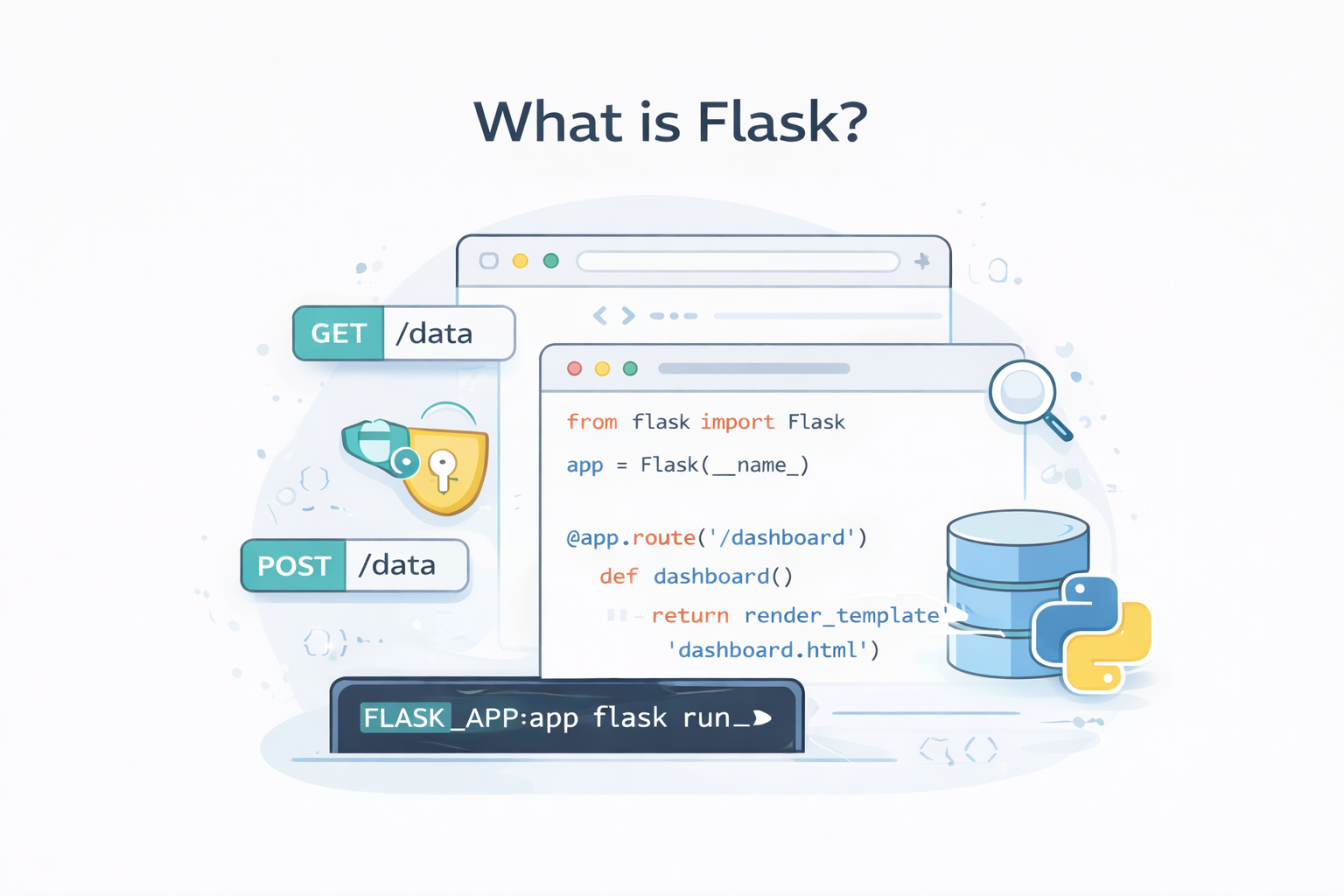
Flask is a lightweight Python web framework used to build web applications, APIs, and backend services without forcing a rigid project structure.
That definition only matters when you see it in action.
Imagine you’re building an internal dashboard for your operations team. You need:
- A login screen
- A few API endpoints
- A simple interface to visualize data
With Flask, you can start with a single file, define routes, return data, and deploy. No mandatory folder structure. No hidden conventions. As the project grows, you split things into modules, add authentication, connect databases, or introduce background tasks.
Flask doesn’t make those decisions for you. It lets you decide when and how complexity enters the system.
That’s the core philosophy.
Flask vs Other Python Frameworks
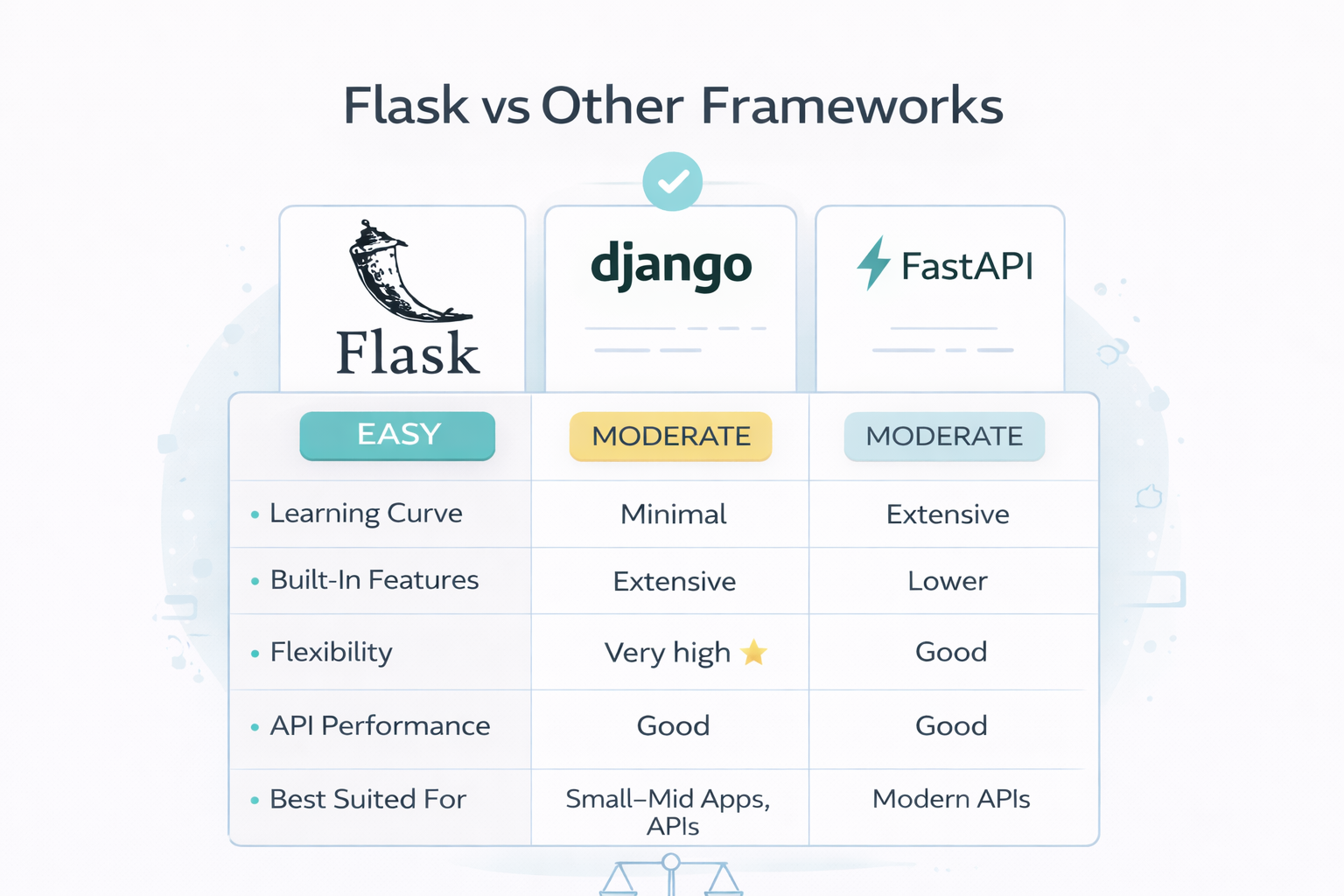
This is where most developers pause. So let’s make the differences clear.
|
Feature |
Flask |
Django |
FastAPI |
|
Learning curve |
Low |
Medium–High |
Medium |
|
Built-in features |
Minimal |
Extensive |
Moderate |
|
Flexibility |
Very high |
Lower |
High |
|
API performance |
Good |
Good |
Excellent |
|
Best suited for |
Small–mid apps, APIs |
Large platforms |
Modern APIs |
According to a Senior Python Engineer, with 10+ years of production experience, said-
Flask works best when architecture matters more than scaffolding. It gives teams room to design systems instead of adapting to them.
This table highlights why Flask still holds its ground. It doesn’t compete by doing more. It competes by doing less, intentionally.
Flask for Web Application Development
Flask is commonly used to build dynamic web applications where control matters.
It supports:
- URL routing
- Request handling
- Template rendering
- Database integration
For example, a SaaS admin panel with custom workflows often fits Flask better than opinionated frameworks. You control how users move through the system, how logic is layered, and how features evolve.
When paired with tools like Jinja2 and SQLAlchemy, Flask becomes powerful without becoming heavy. You’re choosing clarity over automation.
Flask for API Development
Flask remains a reliable choice for API development, especially for teams that value predictability.
Why teams still use Flask for APIs:
- Clean request and response handling
- Full control over HTTP methods
- Mature ecosystem and tooling
- Easy REST integration
Extensions like Flask-RESTful help streamline common patterns such as input validation and response serialization, while still keeping the core simple.
For internal services and partner-facing APIs, this balance works extremely well.
Flask and Microservices Architecture
Flask’s lightweight nature makes it a natural fit for microservices.
Each service can:
- Handle a single responsibility
- Scale independently
- Communicate via APIs
This approach reduces coupling and lowers long-term maintenance risk. If one service changes, the rest of the system remains stable.
That’s why Flask is often found behind platforms that value long-term maintainability over flashy abstractions.
Rapid Prototyping and Proofs of Concept
Speed matters early on.
Flask is frequently used for:
- MVPs
- Proofs of concept
- Internal tools
- Feature experiments
You can validate ideas quickly without committing to heavy infrastructure. If the idea proves valuable, the same codebase can evolve instead of being rewritten.
That ability to grow without throwing work away is one of Flask’s quiet strengths.
Data Visualization With Flask
Flask works well for data-driven applications and dashboards.
When combined with libraries like:
- Matplotlib
- Plotly
- Bokeh
Teams can build interactive dashboards that update based on user input and support real decision-making. Flask’s templating system allows data to be rendered dynamically without complex frontend frameworks.
This setup is common in analytics tools, operational dashboards, and reporting systems where clarity matters more than animation.
How Flask Projects Typically Move From Idea to Production
Successful Flask projects often follow a simple flow.
- Discovery
Teams clarify goals, constraints, and user needs before writing code.
- Wireframing
Basic flows and layouts are mapped so backend logic supports real usage patterns.
- Development
Routes, business logic, and database connections are built in layers.
- Testing
Unit and integration tests ensure stability as features expand.
- Deployment
Applications are deployed to cloud or on-prem environments with flexible configuration options.
Flask doesn’t dictate this process. That’s exactly why experienced teams like it.
Benefits of Flask for Software Development
- Flexibility and Modularity
You choose the libraries, tools, and architecture. Flask adapts to your needs.
- Simplicity Without Limitations
Minimal design keeps projects readable and easier to maintain over time.
- Python Advantage
Readable syntax, strong community support, and a massive ecosystem give Flask long-term stability.
When Flask Is Not the Right Choice
Flask isn’t always the best option.
Avoid Flask if:
- You need strict conventions for large junior teams
- You rely heavily on auto-generated features
- Your project demands extensive built-in tooling from day one
Framework choice is about fit, not popularity.
Final Thoughts
Flask isn’t trying to be everything. And that’s exactly why it works.
If you value control, clarity, and long-term flexibility, Flask gives you room to think instead of forcing early decisions. Used well, it grows with your product. Used poorly, it exposes weak planning.
The framework won’t save your architecture.
But it also won’t get in your way.
If you’re evaluating Flask for your next build, take a moment to define what freedom means for your team. The right framework makes the journey quieter, not louder.
Frequently Asked Questions
Flask is used to build Python web applications, APIs, and backend services. It’s commonly chosen for small to medium projects where flexibility and speed matter.

I work at the point where product decisions, system architecture, and engineering execution meet. At Mediusware, I’m accountable for how technology choices affect reliability, scale, and long-term delivery for our clients.
Featureblogs
01
Haptic Feedback: Why Touch is Becoming the Most Powerful Experience in Tech02
Why Software Companies Are Turning to Strategic Partnerships for Faster Growth03
12 Best AI Tools to Outperform ChatGPT04
Is Golang Still the Right Choice in 2025?05
C# vs. Java: Key Differences, Advantages, and Future Prospects01
Haptic Feedback: Why Touch is Becoming the Most Powerful Experience in Tech02
Why Software Companies Are Turning to Strategic Partnerships for Faster Growth03
12 Best AI Tools to Outperform ChatGPT04
Is Golang Still the Right Choice in 2025?05
C# vs. Java: Key Differences, Advantages, and Future ProspectsRelatedblogs
01
How to Create a Stunning WordPress Website in 2024: Step-by-Step Tutorial02
How Mediusware Empowered Protesters, Strengthened the Economy & Showcased Employee Resilience in the 2024 Movement03
Mastering Error Handling in Rust with Essential Techniques04
Best Practices for Writing Clean Code05
Let's Deep Dive Into Threads with RustAuthorblogs
01
How Digital Agencies Can Deliver Custom Software Without Hiring Developers02
AI in FinTech: Build, Buy, or Integrate? A Founder's Decision Framework03
How to Choose a SaaS MVP Development Company04
How Seed-Stage SaaS Teams Add Engineering Capacity Without Hiring Chaos05
Why Seed-Stage SaaS Startups Struggle to Ship Fast