- Generative AI strategy helps organizations identify high-impact use cases and integrate workflows.
- Businesses measure AI success through productivity gains, cost savings, and customer experiences.
The Ultimate Guide to Generative AI Strategy: Frameworks and ROI Metrics
1 min read

Most companies aren’t struggling to try generative AI anymore.
They’re struggling to make it actually work at scale.
I’ve seen teams build impressive demos, AI chatbots, content generators, and automation tools.
But months later, those same systems are either underused, disconnected, or quietly abandoned.
Not because the technology failed.
Because there was no strategy behind it.
Generative AI doesn’t create value by existing.
It creates value when it’s tied to real workflows, real data, and real business outcomes.
What Is a Generative AI Strategy?
A generative AI strategy is not about choosing tools.
It’s about deciding where AI should create value and how that value will be measured.
It answers three critical questions:
- Where does AI create the highest impact?
- How will it integrate into existing systems?
- How will success be measured?
Without these answers, AI stays experimental.
With them, it becomes a core business capability.
Why Generative AI Strategy Is Now Critical
AI is no longer optional.
McKinsey estimates generative AI could add trillions of dollars to the global economy.
At the same time, most enterprises are already adopting AI APIs or building AI-powered systems.
But here’s the gap most teams don’t see:
Adoption ≠ impact
The companies that win are not the ones using AI.
They’re the ones structuring it correctly from day one.
Why Most Generative AI Initiatives Fail
Let’s be honest, most AI projects don’t fail technically.
They fail structurally.
1. Technology-First Thinking
Teams start with tools instead of problems.
The result? Impressive demos with no real business value.
2. Weak Data Foundations
AI is only as good as the data behind it.
Poor pipelines lead to inconsistent outputs and low trust.
3. No Defined ROI
If success isn’t measurable, investment becomes questionable.
4. Isolated Experiments
Different teams build separate AI solutions that never connect.
No shared system. No scalability.
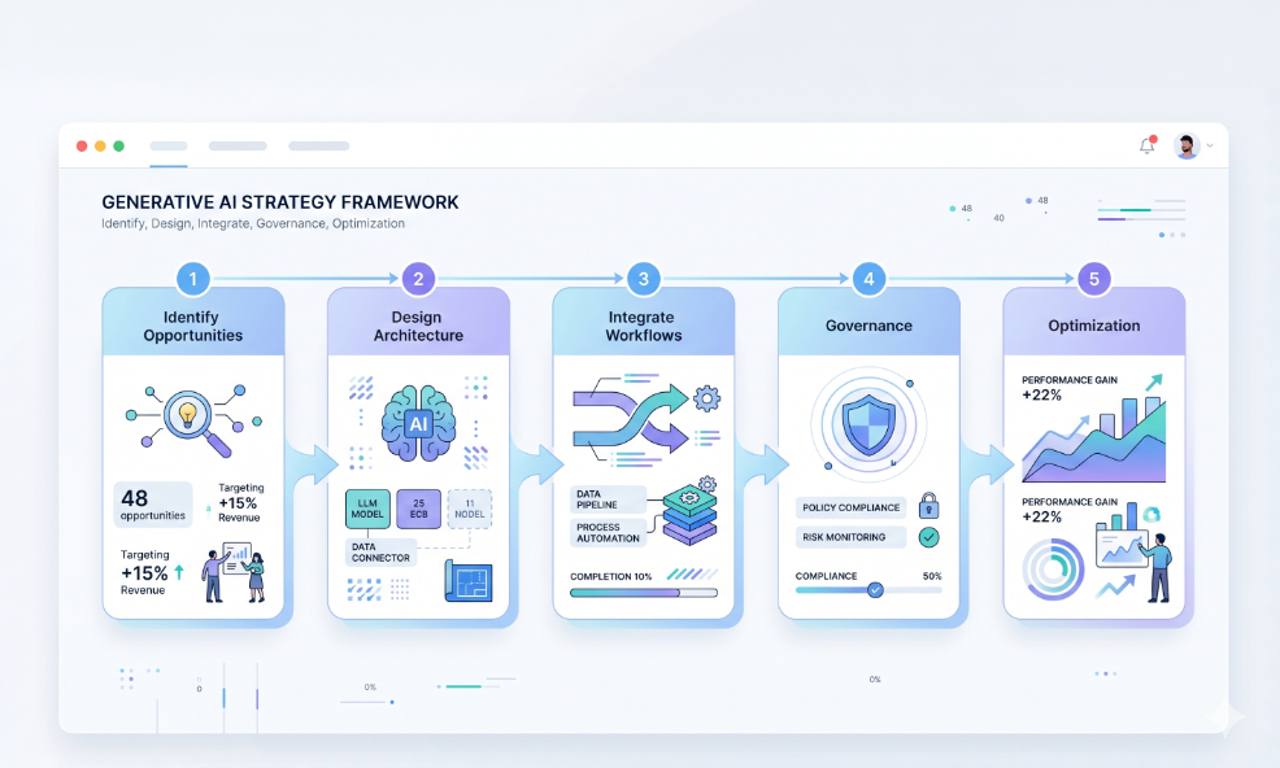
A Practical Framework for Building a Generative AI Strategy
The difference between experimentation and scale is structure.
Here’s how strong teams approach it.
1. Identify High-Impact Opportunities
Start with business value, not AI capability.
Focus areas typically include:
- Customer experience (chat assistants, personalization)
- Operations (automation, document processing)
- Product features (AI copilots, content generation)
The key is simple:
If it doesn’t improve speed, cost, or experience, it’s not a priority.
2. Design the Right AI Architecture
Once the opportunity is clear, architecture decisions matter.
Common patterns include:
- RAG systems → for knowledge retrieval and assistants
- Fine-tuned models → for domain-specific accuracy
- AI agents → for multi-step automation
This is where most teams underestimate complexity.
Because AI is not a feature, it’s a system.
3. Integrate AI into Real Workflows
This is where value actually happens.
AI should live inside:
- CRM systems
- Customer support platforms
- Internal tools
- Product interfaces
If users need to “go somewhere else” to use AI…
It won’t scale.
4. Implement Governance Early
AI introduces risks most teams ignore early:
- Data privacy
- Output reliability
- Security exposure
Strong teams build:
- Human-in-the-loop systems
- Monitoring pipelines
- Prompt and model controls
Governance is not optional, it’s foundational.
5. Continuously Optimize
AI is not static.
Performance improves through:
- Feedback loops
- Model tuning
- Usage data
The teams that win treat AI like a living system, not a finished product.
How to Measure Generative AI ROI
This is where most strategies break.
Because teams track technical metrics instead of business outcomes.
Focus on what actually matters:
1. Productivity Gains
How much faster are teams completing work?
2. Cost Reduction
Where has automation reduced operational expenses?
In many cases, companies see 20–40% cost savings in repetitive workflows.
3. Revenue Impact
Is AI improving conversion, retention, or upsell?
4. Customer Experience
Measure:
- Response time
- Resolution rate
- Satisfaction (CSAT)
Better experience = long-term growth.
Real-World Generative AI Use Cases
This is already happening across industries.
- Healthcare → automated documentation and research
- E-commerce → product content and recommendation engines
- Marketing → campaign generation and optimization
- Software → AI copilots and testing automation
- Enterprise systems → internal knowledge assistants
The pattern is clear:
AI is not replacing systems.
It’s enhancing how systems operate.
From Experiments to AI Platforms
Every company goes through the same evolution:
Stage 1: Experimentation
Small pilots, isolated tools
Stage 2: Workflow Integration
AI embedded into operations
Stage 3: Platform Development
Centralized AI infrastructure across the organization
The real shift happens in Stage 3.
That’s when AI stops being a feature…
And becomes part of your core architecture.
Final Thoughts
Generative AI is not a tool decision.
It’s a system design decision.
The companies that win are not the ones experimenting faster.
They’re the ones building structured, scalable AI foundations.
Because in the end, the advantage isn’t AI itself.
It’s how well your systems are built to use it.
Frequently Asked Questions
A generative AI strategy is a structured plan that aligns AI capabilities with business goals, workflows, and measurable outcomes.

I work at the point where product decisions, system architecture, and engineering execution meet. At Mediusware, I’m accountable for how technology choices affect reliability, scale, and long-term delivery for our clients.
Featureblogs
01
Top 8 Python GUI Frameworks for Developers02
C# vs. Java: Key Differences, Advantages, and Future Prospects03
Why Software Companies Are Turning to Strategic Partnerships for Faster Growth04
Haptic Feedback: Why Touch is Becoming the Most Powerful Experience in Tech05
The 12 Most Powerful LLMs: Powering Tomorrow’s Tech Landscape01
Top 8 Python GUI Frameworks for Developers02
C# vs. Java: Key Differences, Advantages, and Future Prospects03
Why Software Companies Are Turning to Strategic Partnerships for Faster Growth04
Haptic Feedback: Why Touch is Becoming the Most Powerful Experience in Tech05
The 12 Most Powerful LLMs: Powering Tomorrow’s Tech LandscapeRelatedblogs
Authorblogs
01
How Digital Agencies Can Deliver Custom Software Without Hiring Developers02
AI in FinTech: Build, Buy, or Integrate? A Founder's Decision Framework03
How to Choose a SaaS MVP Development Company04
How Seed-Stage SaaS Teams Add Engineering Capacity Without Hiring Chaos05
Why Seed-Stage SaaS Startups Struggle to Ship Fast