- AI agents improve support when built on structured knowledge systems like FAQs and documentation.
- Combining AI, knowledge bases, and human expertise creates faster, reliable customer support.
What Happens to Support Quality When You Replace Your FAQ with an AI Agent?
1 min read
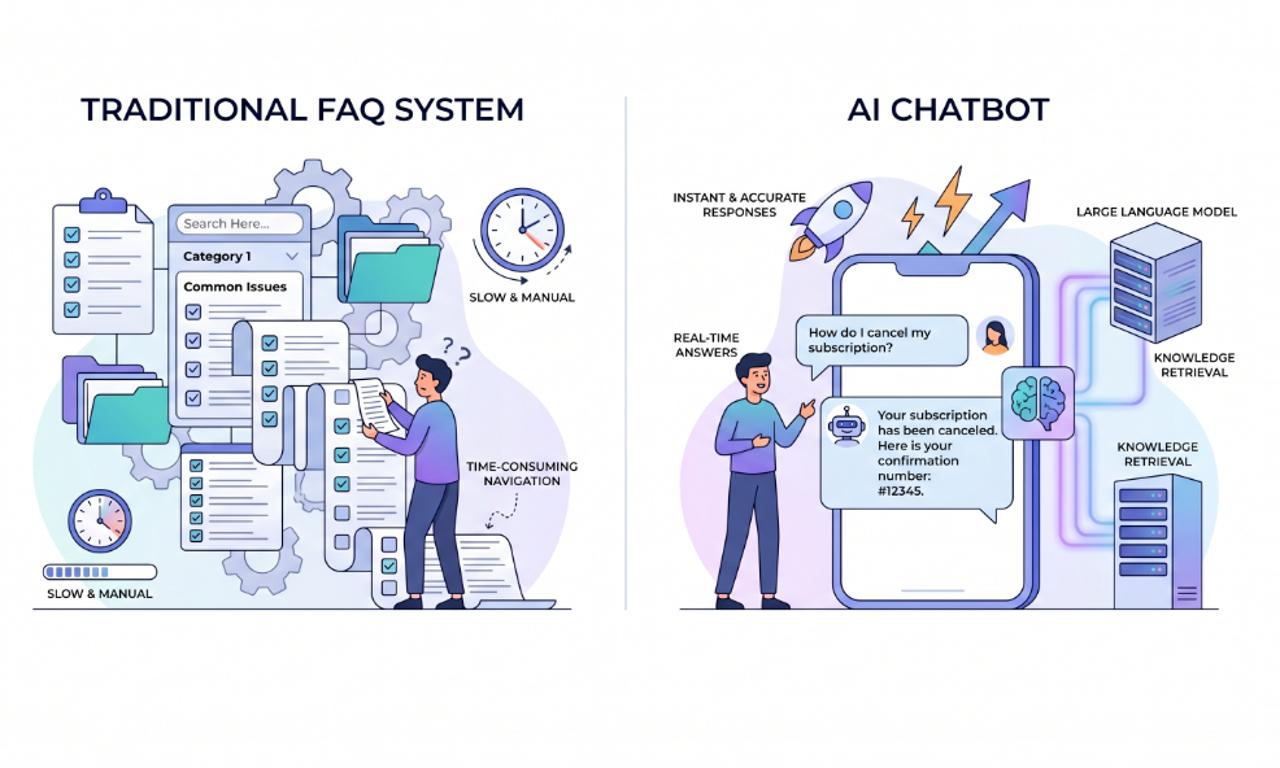
Many companies are rushing to replace their FAQ pages with AI agents.
At first, it sounds like progress.
Why ask customers to click through help articles when an AI can answer instantly?
But this is where many teams get caught off guard.
Support may become faster, yet not necessarily better.
Responses start sounding polished but inconsistent.
Some answers are incomplete.
Some are overly confident.
Some miss the real issue entirely.
And in most cases, the problem is not the AI itself.
The problem is that companies are trying to replace the wrong layer of the support system.
Why More Companies Are Replacing FAQs with AI Agents?
Customer behavior has changed.
People expect answers immediately.
They do not want to wait for a support email.
They do not want to dig through a long help center just to solve a simple problem.
At the same time, support volume keeps growing.
So the promise of AI feels hard to ignore.
One AI agent can handle hundreds of conversations at once.
It can reduce pressure on support teams.
It can stay available 24/7.
And thanks to modern SaaS tools, it can be deployed surprisingly fast.
That is exactly why many businesses treat AI as the next version of support.
But that assumption creates a dangerous shortcut.
Because FAQs and AI agents are not the same thing.
They do not solve the same problem.
The Job Your FAQ Was Quietly Doing All Along
Most teams underestimate the value of a good FAQ system.
An FAQ page is not just a list of answers.
It gives your business:
- verified answers
- consistent explanations
- documented workflows
- a shared source of truth
That matters more than most teams realize.
Customers rely on it.
Support agents rely on it.
Onboarding teams rely on it.
Product teams often rely on it too.
Without that structure, knowledge starts spreading across disconnected places:
- old support tickets
- Slack messages
- email threads
- internal notes
- chatbot history
Once that happens, support may still look active, but it becomes harder to control.
And when knowledge becomes fragmented, support quality usually drops before anyone notices.
What Actually Breaks When AI Replaces the Knowledge Layer?
This is where things start to go wrong.
1. Inconsistent answers
AI agents generate responses dynamically.
That means two customers can ask the same question and receive slightly different answers.
Sometimes the difference is small.
Sometimes it changes meaning.
Either way, consistency starts slipping.
And in support, inconsistency creates doubt very quickly.
2. Confident but wrong responses
This is one of the biggest risks in AI support.
Large language models are good at sounding certain, even when the answer is flawed.
That is acceptable in brainstorming.
It is dangerous in customer support.
A fast answer is only useful if it is accurate.
3. No clear source of truth
Once the FAQ or help documentation disappears, the business often loses its central reference point.
Now answers live inside conversations instead of inside a system.
That makes updates harder.
It makes review harder.
It makes governance harder.
And over time, nobody is fully sure which answer is actually correct.
4. Harder quality control
When support depends on dynamic output, monitoring quality becomes more difficult.
You are no longer reviewing a fixed article.
You are reviewing a moving stream of generated responses.
That creates real risk around trust, compliance, accuracy, and customer experience.
AI and FAQs Are Not Competitors
This is the core misunderstanding.
FAQs store knowledge.
AI agents help people access knowledge.
Those are not competing roles.
They are complementary roles.
A good FAQ system organizes what is true.
A good AI agent helps customers reach that truth faster.
That is why AI works best as an interface layer, not as a replacement for the knowledge layer underneath it.
The moment AI has to answer without clear documentation behind it, it starts filling gaps.
And support should never depend on guessing.
The Right Way to Use AI in Customer Support
The strongest support systems are layered.
They usually look something like this:
- product documentation
- help center or knowledge base
- FAQ system
- AI support assistant
- human escalation path
In that model, the AI agent is not trying to invent support.
It is guiding the customer toward trusted information.
It can summarize steps.
It can surface the right article.
It can handle repetitive questions.
And when the issue gets more complex, it can escalate to a human.
That combination gives you what support actually needs:
speed, consistency, and accountability.
When AI Truly Improves Support Quality
AI can absolutely improve support.
But only in the right role.
It performs best when handling:
- repetitive high-volume questions
- onboarding guidance
- simple troubleshooting flows
- support ticket classification
- routing users to the right documentation
In these situations, AI reduces workload and improves accessibility.
But even then, the quality of the experience still depends on the quality of the underlying knowledge base.
AI does not remove the need for documentation.
It increases the importance of documentation.
A Practical Example: AI Works Better When the System Beneath It Is Structured
We have seen this principle clearly in Quiri, an AI-powered data interaction platform built by Mediusware.
Quiri allows users to ask questions in natural language and receive insights through interactive charts and reports.
On the surface, it feels conversational.
But the system does not depend on AI improvisation.
Behind that interface is a structured reporting and query system that helps the platform return reliable outputs instead of invented ones.
Its core capabilities include:
- natural language query processing
- session-based query management
- interactive data visualization
- structured reporting dashboards
That is the lesson many support teams miss.
The AI layer feels like the product.
But the real quality comes from the structured system underneath it.
The same principle applies to customer support.
If you want better answers, you do not start by removing the FAQ.
You start by strengthening the knowledge behind the AI.
What You Should Measure After Launching an AI Support Agent?
A lot of companies launch AI support and only measure speed.
That is not enough.
If you want to know whether support quality is actually improving, track metrics like:
1. Answer accuracy
Are customers receiving correct and usable answers?
2. Escalation rate
How often does the AI need human intervention?
3. Customer satisfaction
Do users feel their issue was resolved clearly and confidently?
4. Repeat questions
Are customers coming back with the same issue because the first answer failed?
5. Time to resolution
Is the journey becoming faster without creating more friction?
These metrics tell you whether the AI is reducing support load or quietly creating more of it downstream.
Final Thoughts
Replacing an FAQ with an AI agent is not automatically an upgrade.
In many cases, it simply removes the structure that made support reliable in the first place.
That is why the best support systems do not choose between documentation and AI.
They combine both.
FAQs and knowledge bases protect accuracy.
AI improves access.
Human support handles complexity.
When those three layers work together, support becomes faster without becoming fragile.
And that is the real goal.
Frequently Asked Questions
Not fully. AI can improve access to answers, but it still needs a structured FAQ or knowledge base behind it.

I work at the point where product decisions, system architecture, and engineering execution meet. At Mediusware, I’m accountable for how technology choices affect reliability, scale, and long-term delivery for our clients.
Featureblogs
Relatedblogs
Authorblogs
01
How Digital Agencies Can Deliver Custom Software Without Hiring Developers02
AI in FinTech: Build, Buy, or Integrate? A Founder's Decision Framework03
How to Choose a SaaS MVP Development Company04
How Seed-Stage SaaS Teams Add Engineering Capacity Without Hiring Chaos05
Why Seed-Stage SaaS Startups Struggle to Ship Fast