- Discover the 7 types of AI agents that are transforming industries and driving the autonomy revolution.
- Learn how AI agents enhance decision-making, efficiency, and collaboration in business applications.
Understanding the 7 Types of AI Agents Driving the Autonomy Revolution
1 min read

Most teams don’t struggle with AI adoption.
They struggle with understanding what kind of AI they actually need.
We’ve seen companies build “AI agents” that fail in production simply because they picked the wrong architecture.
Too simple → no real value.
Too complex → breaks under real-world conditions.
That’s the real problem.
If you’re building or planning AI systems in 2026, you don’t need more AI.
You need the right type of AI agent for the job.
Why Understanding AI Agent Types Matters
According to IBM’s AI research, over 60% of AI projects fail due to poor problem-agent alignment.
Also, IBM Research found
AI systems fail not because of bad models, but because they are applied to the wrong problems.
This is exactly what we see in real projects.
For example, in systems like CRM Runner, automation works because tasks are structured and predictable, not because the AI is smart.
The type of agent matters more than the model itself.
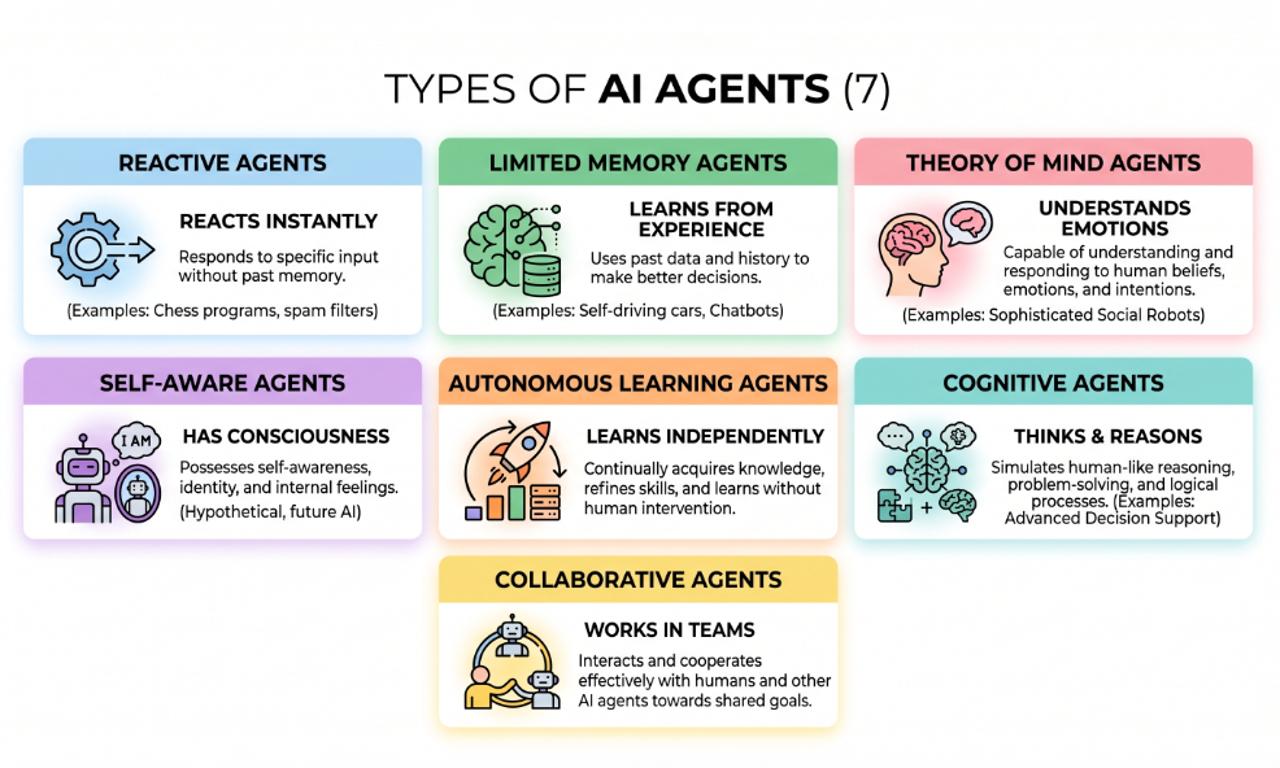
The 7 Types of AI Agents
Here’s a clear breakdown you can actually use.
1. Reactive Agents (Fast but Limited)
These agents respond instantly but don’t learn.
Best for:
- Rule-based automation
- Simple workflows
- High-volume repetitive tasks
Example:
Basic chatbots or automated workflows.
Reality:
Reliable, but zero intelligence growth.
2. Limited Memory Agents (Context-Aware Systems)
They remember recent data and use it to improve decisions.
Best for:
- Recommendation systems
- Predictive workflows
- Real-time optimization
Example:
Self-driving logic or dynamic pricing systems.
Trade-off:
Better decisions, but still short-term memory only.
3. Theory of Mind Agents (Human-Aware AI)
These try to understand human behavior, emotions, and intent.
Best for:
- Customer experience
- Healthcare interaction
- Personalization
Example:
Emotion-aware assistants.
Reality check:
Still early-stage. Mostly simulated empathy, not real understanding.
4. Self-Aware Agents (Still Theoretical)
These would understand their own state and decisions.
Best for:
- Future autonomous systems
- Complex adaptive environments
5. Autonomous Learning Agents (Self-Improving Systems)
These continuously learn and improve without manual updates.
Best for:
- Fraud detection
- Growth optimization
- AI-driven analytics
Example:
Systems that adjust marketing strategies automatically.
Why they matter:
They scale intelligence over time, not just execution.
6. Cognitive Agents (Problem-Solving AI)
These mimic human reasoning.
Best for:
- Decision support
- Complex workflows
- Financial analysis
Example:
AI systems that analyze markets or risks.
Key strength:
Can handle multi-step reasoning problems.
7. Collaborative Agents (Multi-Agent Systems)
Multiple agents working together with humans or other agents.
Best for:
- Complex systems
- Enterprise automation
- Cross-functional workflows
Example:
Multi-agent systems coordinating logistics or operations.
Trend:
This is where AI is heading in 2026.
Quick Comparison Table
| Agent Type | Learning Ability | Best Use Case | Limitation |
| Reactive | None | Simple automation | No adaptation |
| Limited Memory | Short-term | Recommendations | Context limited |
| Theory of Mind | Behavioral | UX & interaction | Not mature |
| Self-Aware | Hypothetical | Future AI | Not real yet |
| Autonomous Learning | Continuous | Optimization | Needs data quality |
| Cognitive | Reasoning | Complex decisions | Resource heavy |
| Collaborative | Multi-agent | Enterprise systems | Architecture complexity |
Where Most Teams Get It Wrong
From real deployments, we consistently see 3 mistakes:
1. Using reactive agents for complex workflows
→ leads to brittle systems
2. Overengineering with cognitive agents too early
→ slows development
3. Ignoring collaboration between agents
→ limits scalability
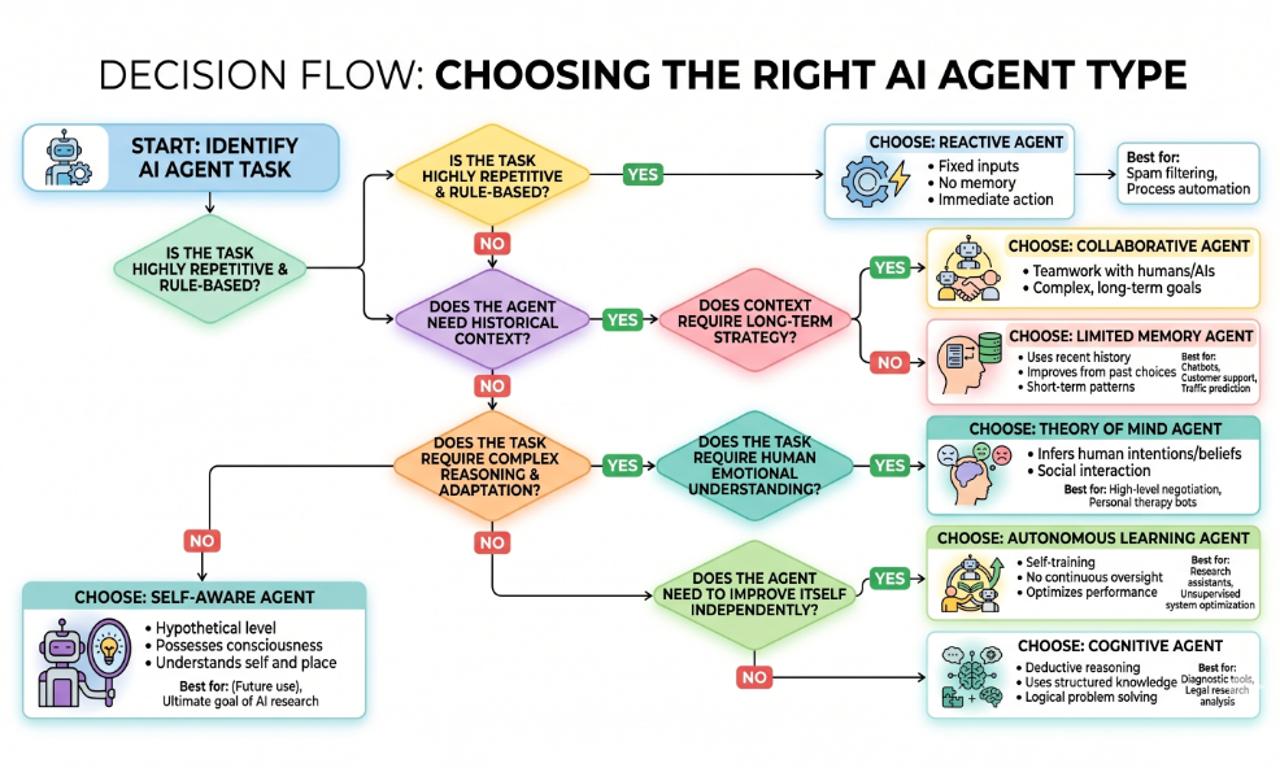
How to Choose the Right Agent
Ask these 3 questions:
- Is the task repetitive → use Reactive
- Does it need context → use Limited Memory
- Does it require decisions → use Cognitive or Autonomous
- Is it complex workflow → use Collaborative (MAS)
This alone eliminates most architectural mistakes.
How AI Agents Are Actually Used in Real Systems
From platforms like:
- Bulk.ly → uses automation agents to handle content workflows at scale.
- Lensix → applies intelligent agents for security monitoring and risk detection.
- Quiri → uses AI agents to turn natural language into actionable data insights.
Pattern you’ll notice:
No single agent type solves everything.
Real systems combine multiple types.
Challenges You Should Not Ignore
Even the best agent design fails without:
- Data quality → bad input = bad decisions
- Clear boundaries → agents must know when to stop
- Human oversight → autonomy still needs control
According to McKinsey, companies that combine AI with human workflows see up to 40% higher productivity gains.
Frequently Asked Questions
An AI agent is software that can observe data, make decisions, and take actions automatically.

I work at the point where product decisions, system architecture, and engineering execution meet. At Mediusware, I’m accountable for how technology choices affect reliability, scale, and long-term delivery for our clients.
Featureblogs
Relatedblogs
Authorblogs
01
How Digital Agencies Can Deliver Custom Software Without Hiring Developers02
AI in FinTech: Build, Buy, or Integrate? A Founder's Decision Framework03
How to Choose a SaaS MVP Development Company04
How Seed-Stage SaaS Teams Add Engineering Capacity Without Hiring Chaos05
Why Seed-Stage SaaS Startups Struggle to Ship Fast