- Discover key differences between AI agents and multimodal models, and how each serves business needs.
- Discover how combining AI agents and multimodal models drives automation and data insights.
Understanding the Core Differences Between AI Agents and Multimodal Models
1 min read
Most teams don’t struggle with AI adoption because of lack of tools.
They struggle because they choose the wrong type of intelligence for the problem.
We’ve seen this repeatedly.
A company invests in a powerful multimodal model…
But expects it to automate workflows.
Or they build an AI agent…
When all they needed was better data interpretation.
The result?
Wasted budget, slow ROI, and unnecessary complexity.
If you’re evaluating AI seriously, this distinction is not optional.
It’s foundational.
What Are AI Agents and Multimodal Models?
Let’s simplify this without the hype.
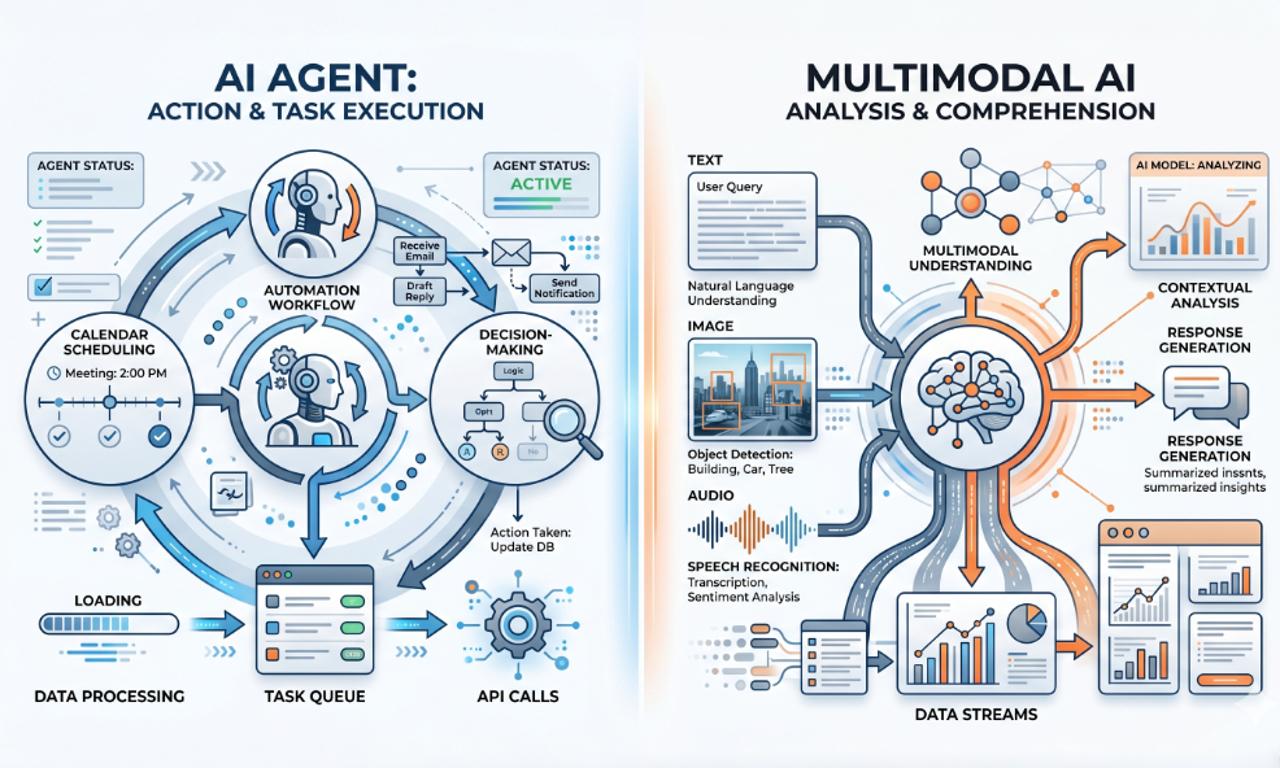
1. AI Agents → Systems That Act
AI agents don’t just understand data.
They decide, execute, and adapt.
They operate in loops:
- Observe data
- Make decisions
- Take actions
- Learn from outcomes
Example:
- Auto-scheduling meetings
- Managing inventory
- Running workflows without manual input
2. Multimodal Models → Systems That Understand
Multimodal models process different types of input:
- Text
- Images
- Audio
- Video
But they don’t act on their own.
They interpret.
Example:
- Analyzing product images
- Generating captions
- Detecting defects in visuals
The Real Difference: Action vs Understanding
This is where most confusion happens.
| Capability | AI Agents | Multimodal Models |
| Role | Execute tasks | Interpret data |
| Behavior | Dynamic, continuous | Static, input-response |
| Output | Actions + decisions | Insights + analysis |
| Use Case | Automation | Understanding |
Simple rule:
- If you need something to do → AI Agent.
- If you need something to understand → Multimodal Model.
Why Most Teams Get This Wrong
The mistake is not technical.
It’s strategic.
Teams assume:
Better AI = more powerful model.
That’s incomplete.
The real question is:
Where does intelligence need to sit in your workflow?
We’ve seen companies over-invest in complex systems.
When a simple perception layer would solve the problem faster.
And others rely only on models
while their operations still depend on humans.
That’s the gap.
Static vs Dynamic Systems
1. Multimodal Models = Static Intelligence
They respond when prompted.
- Upload → Analyze
- Input → Output
No continuity.
No initiative.
2. AI Agents = Dynamic Systems
They operate continuously.
- Monitor changes
- Trigger actions
- Adjust in real time
This is what enables true automation.
Cost vs Complexity: What Should You Choose?
Let’s make this practical.
1. Use Multimodal Models when:
- You need analysis, classification, or generation.
- Your workflows are still human-driven.
- Cost efficiency matters.
2. Use AI Agents when:
- You need end-to-end automation.
- Decisions must happen in real time.
- You want systems that improve over time.
Real Example: How This Works in Practice
Take Bulk.ly, a Mediusware platform built to simplify social media management.
- Multimodal models help generate content, captions, and insights.
- AI agents automate scheduling, publishing, and optimization.
The impact?
- Massive reduction in manual work
- Smarter posting decisions
- Scalable content workflows
In fact, automation like this has helped reduce manual scheduling effort by up to 90% while improving engagement significantly.
That’s the difference between tools…
and systems that actually scale.
Why the Best Systems Use Both
This isn’t a competition.
It’s a stack.
- Multimodal models = eyes and ears
- AI agents = brain and hands
Together, they create:
- Intelligent systems
- Autonomous workflows
- Continuous optimization
We’ve applied this pattern across platforms like Erthô and CRM Runner.
Where data interpretation feeds directly into automated actions.
Final Thought
Most AI conversations focus on capability.
Very few focus on fit.
That’s where real leverage comes from.
If your system only understands but doesn’t act,
you’re still doing the work.
If your system acts without understanding,
you’re risking bad decisions.
The goal is balance.
Frequently Asked Questions
AI agents take action and automate tasks. Multimodal models analyze and understand data.

I work at the point where product decisions, system architecture, and engineering execution meet. At Mediusware, I’m accountable for how technology choices affect reliability, scale, and long-term delivery for our clients.
Featureblogs
Relatedblogs
Authorblogs
01
How Digital Agencies Can Deliver Custom Software Without Hiring Developers02
AI in FinTech: Build, Buy, or Integrate? A Founder's Decision Framework03
How to Choose a SaaS MVP Development Company04
How Seed-Stage SaaS Teams Add Engineering Capacity Without Hiring Chaos05
Why Seed-Stage SaaS Startups Struggle to Ship Fast