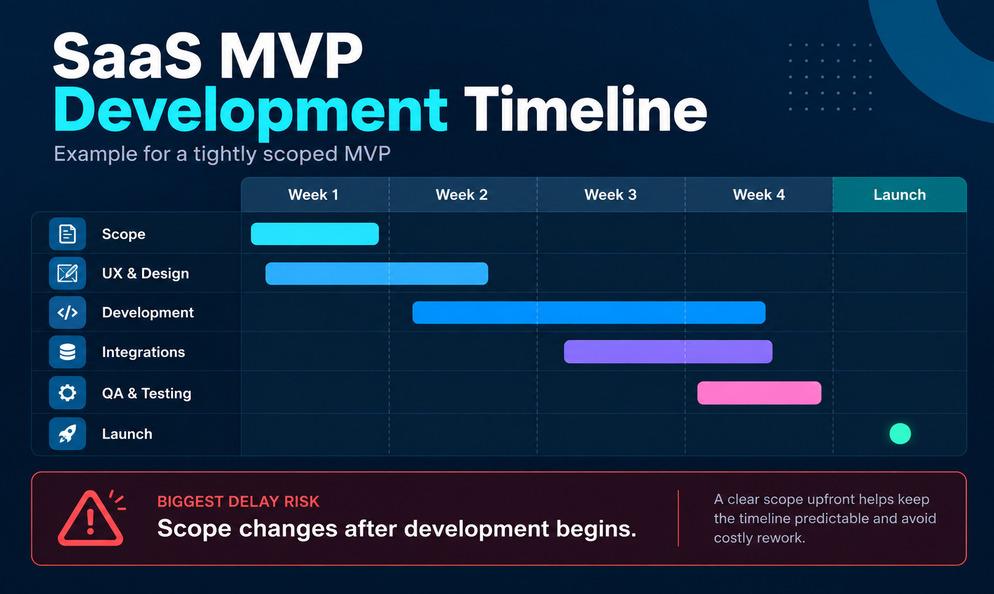
Once development starts, delays usually come from execution dependencies rather than the original scope alone.
1. Slow approvals
Design feedback, product decisions, and unanswered questions can leave the team waiting or force development to pause.
2. Integration uncertainty
Payments, authentication, CRMs, analytics tools, and third-party APIs can introduce dependencies the team cannot fully control.
3. Changing requirements mid-build
Even with a clear starting scope, changing business rules can force completed work to be redesigned, rebuilt, or retested.
4. QA exposes connected issues
A change in one workflow can affect permissions, data, integrations, or another user journey. Fixing one visible issue may create work elsewhere.
5. Feature dependencies
Some features cannot be completed independently. When one underlying component slips, several later tasks can move with it.
That is why keeping version one intentionally narrow matters. Our guide on Lean MVP Strategy: Build Less, Validate Faster explains how to reduce unnecessary complexity before it becomes a delivery problem.
AWS recommends loosely coupled application components to reduce dependency risk and improve resilience. The goal isn’t to remove every dependency, but to keep only the ones worth the added time and complexity.