- LLMs and RAG improve healthcare workflows when grounded in trusted data and guided by human oversight.
- Safe deployment focuses on clear data boundaries, explainable retrieval, and predictable clinical support.
Deploying LLMs and RAG in Healthcare: A Safety Guide
1 min read

Healthcare never had the luxury of “move fast and break things.” A minor UI bug in fintech is an inconvenience. A hallucinated answer in a clinical workflow is a liability.
That’s why deploying Large Language Models (LLMs) and Retrieval-Augmented Generation (RAG) in healthcare demands a fundamentally different mindset. The challenge isn’t whether these systems are powerful enough. They already are. The real challenge is whether they can be trusted, controlled, and explained inside environments where patient safety, compliance, and accountability are non-negotiable.
This guide focuses on how healthcare organizations can deploy LLMs and RAG systems safely, without overwhelming teams or introducing hidden risk.
Where LLMs and RAG Actually Fit in Healthcare
The most successful healthcare AI deployments share one thing in common: they assist, they don’t decide.
LLMs and RAG systems work best in areas where speed and clarity matter, but final judgment remains human-led. Common examples include:
- Clinical documentation summarization from encounter notes
- Guideline and policy retrieval for clinicians at point of care
- Patient communication drafts reviewed by care teams
- Administrative workflows, such as prior authorization or discharge summaries
What these use cases have in common is intent. The AI system supports cognition, not replaces it. The moment an LLM is treated as an autonomous decision-maker, risk increases sharply.
Safety Starts With Data Boundaries, Not Models
Most healthcare AI failures don’t start with the model. They start with unclear data boundaries.
Before choosing tools or prompts, teams must define:
- What data the system can access
- Whether patient data is stored or retained
- How outputs are logged and audited
Inference-only designs are often the safest starting point. Patient data flows in, an answer is generated, and nothing persists beyond the immediate task. This approach limits exposure while still delivering value.
To make this distinction clear, here’s a simple comparison:
|
Approach |
Data Handling |
Traceability |
Healthcare Readiness |
|
Raw LLM |
Unbounded |
None |
Low |
|
LLM + RAG |
Source-restricted |
High |
Strong |
|
Human-Only |
Manual |
High |
Limited scale |
The takeaway is straightforward: control beats convenience in healthcare AI.
Why RAG Matters More Than Raw Model Power
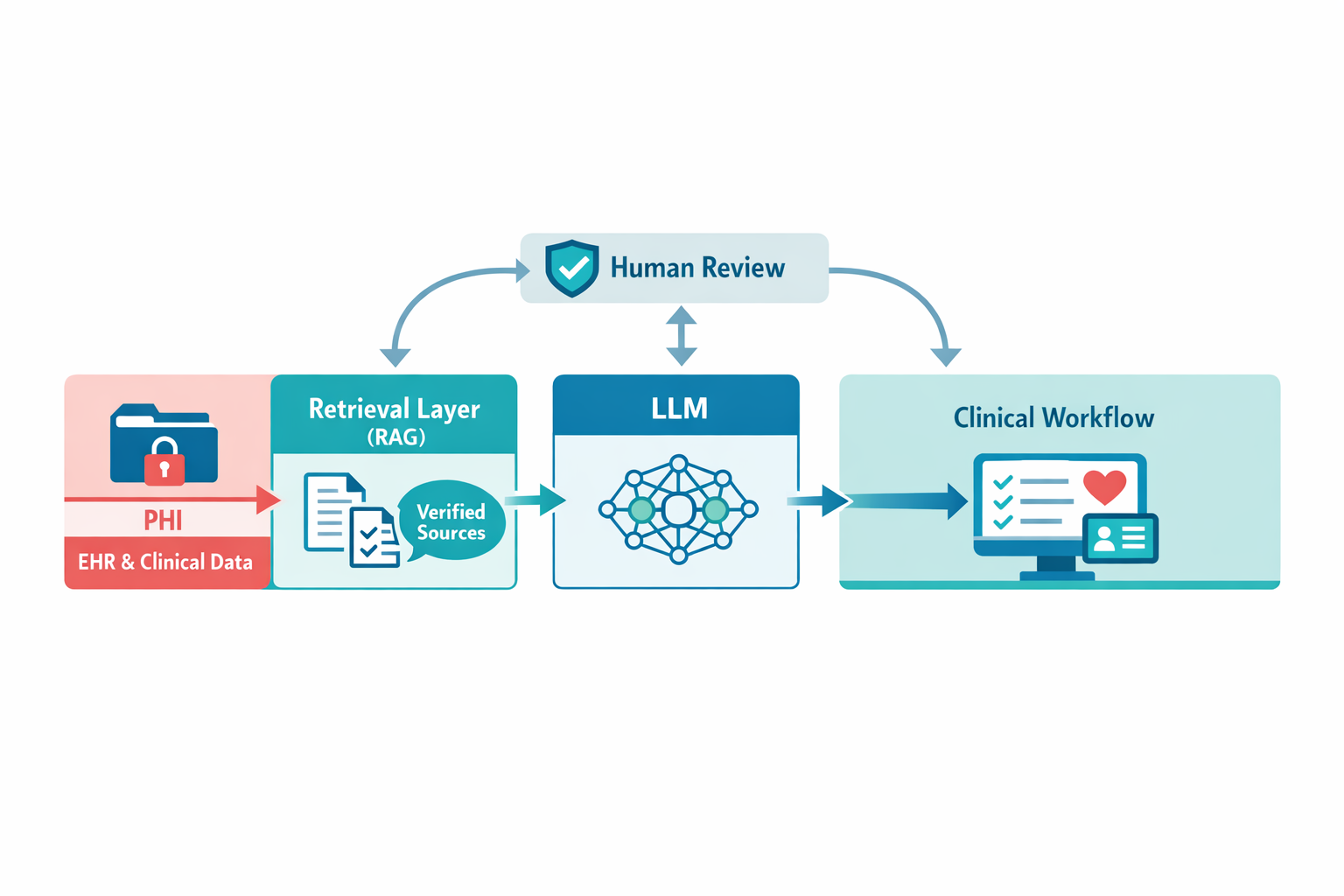
In healthcare, correctness matters more than eloquence.
LLMs are probabilistic by nature. They generate answers that sound right, even when they’re wrong. RAG reduces this risk by grounding responses in approved, traceable sources such as clinical guidelines, internal protocols, or curated medical literature.
A well-designed RAG system ensures:
- Answers are based on known documents, not model memory
- Sources can be cited and reviewed
- Clinicians can understand why a response was generated
For example, a clinical decision support tool that references internal treatment guidelines and links directly to those documents builds confidence. One that produces fluent but uncited advice does not.
In healthcare, retrieval quality beats model size every time.
Human in the Loop Is Not Optional
No matter how advanced the system, healthcare AI must remain reviewable and interruptible.
Human-in-the-loop design means:
- Clinicians review AI output before action
- High-risk responses trigger manual confirmation
- Users can override or reject AI suggestions
This is not a limitation. It’s a feature. A discharge summary drafted by an LLM saves time. A clinician approving it ensures safety. That partnership is the future of healthcare AI, not full automation.
From Pilot to Production Without Breaking Trust
Many teams succeed in pilots and fail in production because they scale too quickly.
A safer rollout follows a staged approach:
- Start with non-critical workflows
- Limit exposure to small user groups
- Monitor outputs, overrides, and failure patterns
- Expand only when behavior is predictable
Production readiness isn’t about accuracy alone. It’s about consistency under real clinical pressure. Systems must behave reliably across edge cases, messy inputs, and incomplete data.
Trust is earned slowly in healthcare and lost instantly.
Governance, Compliance, and Operational Reality
Safe deployment doesn’t end at launch.
Healthcare LLM systems require ongoing governance:
- Clear access controls and role-based permissions
- Audit logs for prompts, retrievals, and outputs
- Version tracking for models and knowledge sources
- Defined rollback and shutdown mechanisms
From an operational perspective, boring is good. Predictable systems outperform clever ones. In regulated environments, stability builds confidence with clinicians, compliance teams, and leadership alike.
Healthcare Example: Clinical Knowledge Assistant
Consider a hospital deploying an internal clinical knowledge assistant.
Instead of querying the open web, the system retrieves:
- Approved internal protocols
- Specialty-specific guidelines
- Recent institutional updates
A clinician asks a question during rounds. The system responds with a summarized answer and direct citations. The clinician verifies and proceeds.
No patient data is stored. No decisions are automated. The workflow improves without introducing risk.
That’s safe GenAI in practice.
Explore: Our Healthcare related Case Study
Final Thoughts: Safe AI Is the Only Scalable AI
LLMs and RAG systems are already reshaping healthcare workflows. The organizations seeing real impact aren’t the ones chasing novelty. They’re the ones designing for safety, clarity, and trust from day one.
In healthcare, the goal isn’t to replace professionals. It’s to give them better tools, cleaner information, and more time to focus on patient care. When deployed thoughtfully, Generative AI doesn’t increase risk.
It reduces cognitive load, operational friction, and burnout. And that’s how it earns its place in modern healthcare.
Build Safe AI for Healthcare?
Explore how we help teams design LLM and RAG systems with clinical safety, clear governance, and human oversight at the core.
Frequently Asked Questions
Yes, when strict data boundaries, access controls, and human review are in place. Inference-only designs reduce exposure significantly.

I work at the point where product decisions, system architecture, and engineering execution meet. At Mediusware, I’m accountable for how technology choices affect reliability, scale, and long-term delivery for our clients.
Featureblogs
Relatedblogs
Authorblogs
01
How Digital Agencies Can Deliver Custom Software Without Hiring Developers02
AI in FinTech: Build, Buy, or Integrate? A Founder's Decision Framework03
How to Choose a SaaS MVP Development Company04
How Seed-Stage SaaS Teams Add Engineering Capacity Without Hiring Chaos05
Why Seed-Stage SaaS Startups Struggle to Ship Fast