- Smart scaling focuses on systems, structure, and flexible capacity to maintain fast delivery.
- High-performing teams grow efficiently by reducing complexity and improving engineering flow.
Why Scaling Engineering Teams Internally Is Slower Than You Think
1 min read
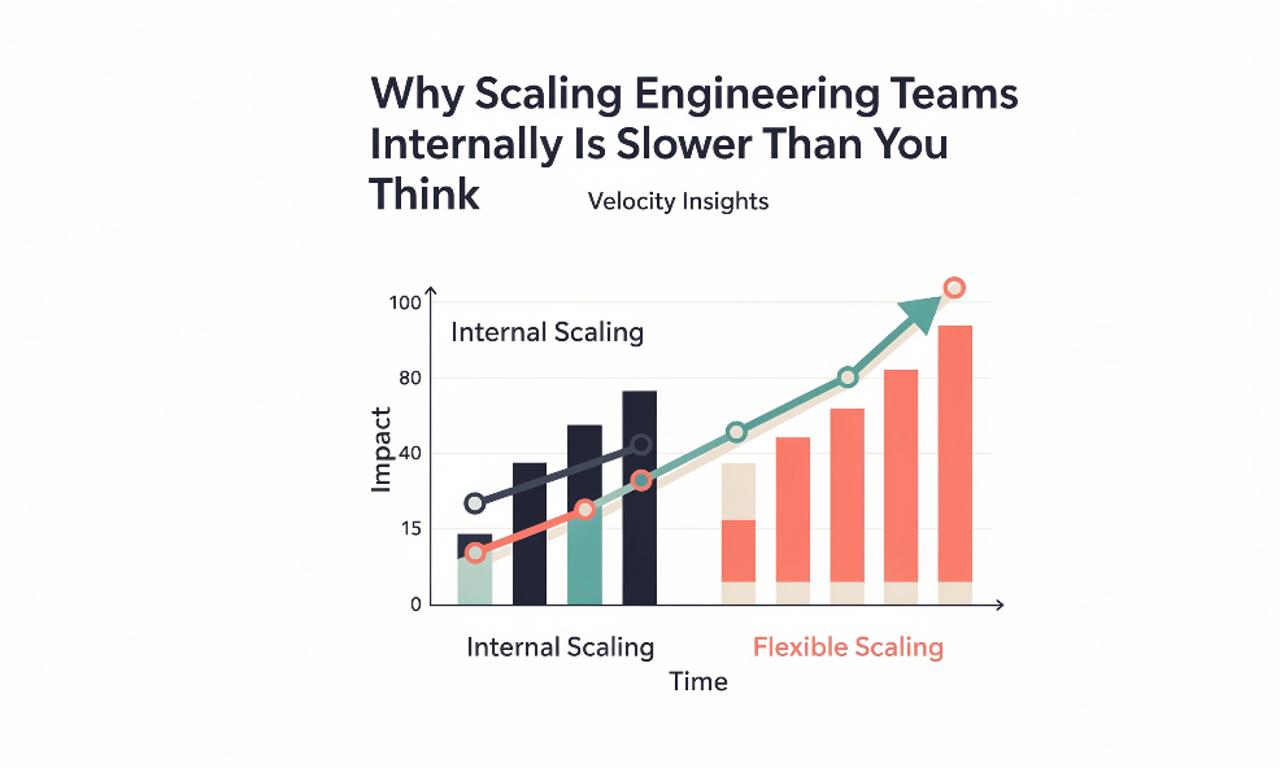
Scaling an engineering team sounds simple: hire more developers, ship faster, grow quicker.
But in reality, internal scaling often slows teams down before it speeds them up.
And if you’ve felt this friction, you’re not alone, it’s one of the most common bottlenecks in growing product companies.
The Illusion of Just Hiring More Developers
Most leaders assume that adding more engineers directly increases output. But software doesn’t scale like a factory.
According to Fred Brooks, The Mythical Man-Month:
Adding manpower to a late software project makes it later.
This is not just theory. According to the 2024 State of DevOps Report (Google Cloud), high-performing teams focus more on team structure and delivery flow than team size.
More people ≠ more productivity
More people = more communication, onboarding, coordination
Why Internal Scaling Feels Slow
Let’s break down what really happens when you scale internally.
1. Hiring Takes Longer Than Expected
Finding the right engineers is not instant.
- 30–60 days average hiring cycle (LinkedIn Talent Insights)
- Additional 2–3 months to reach productivity
- High risk of wrong hires
So while you think you're scaling, you're actually waiting.
2. Onboarding Slows Down Existing Teams
Every new developer needs:
- Codebase understanding
- Architecture clarity
- Process training
This pulls your senior engineers away from actual development. Instead of moving faster, your core team becomes a support system.
3. Communication Overhead Grows Exponentially
As team size increases:
- More meetings
- More dependencies
- More coordination
The communication paths increase rapidly.
A team of:
- 5 engineers → 10 communication paths
- 10 engineers → 45 communication paths
That’s not linear growth—it’s exponential complexity.
4. Decision-Making Becomes Slower
Small teams decide quickly. Larger teams need:
- Alignment meetings
- Cross-team approvals
- Documentation layers
This creates decision bottlenecks, especially in fast-moving startups.
5. Technical Debt Multiplies Faster
When new engineers join quickly:
- Code consistency drops
- Standards vary
- Shortcuts increase
According to Stripe Developer Report, developers spend over 40% of their time dealing with technical debt. That’s a huge invisible slowdown.
The Real Cost of Internal Scaling
Most teams only calculate salary cost. But the hidden costs include:
- Delayed product releases
- Slower feature delivery
- Increased bug rates
- Burnout in senior engineers
And ultimately: Lost market opportunities
What High-Performing Teams Do Differently
From our experience working with scaling SaaS and product teams, the fastest-growing companies don’t rely only on internal hiring.
They focus on scalable engineering systems, not just team size.
1. Keep Core Teams Small and Focused
- Small autonomous teams move faster
- Clear ownership reduces confusion
- Less communication overhead
2. Build Scalable Architecture Early
A strong architecture allows:
- Faster onboarding
- Easier collaboration
- Independent feature delivery
For example, platforms like CRM Runner were designed with scalable backend systems to support growth without slowing performance.
3. Use External Development Capacity Strategically
Instead of hiring everything internally:
- Extend your team when needed
- Scale up or down based on demand
- Avoid long hiring cycles
This is where flexible development capacity becomes a competitive advantage.
4. Invest in DevOps and Automation
High-performing teams:
- Automate deployments
- Use CI/CD pipelines
- Reduce manual processes
According to DORA metrics, elite teams deploy multiple times per day, while low performers deploy monthly. That’s not about team size, it’s about systems.
5. Prioritize Engineering Culture
Scaling is not just about code.
It’s about:
- Ownership mindset
- Clear communication
- Continuous improvement
This is what keeps teams fast, even as they grow.
Internal vs Flexible Scaling: A Smarter Perspective
| Factor | Internal Scaling | Flexible Scaling |
| Hiring Speed | Slow | Fast |
| Cost Flexibility | Fixed | Adjustable |
| Risk | High | Controlled |
| Scalability | Limited | On-demand |
| Delivery Speed | Slows initially | Maintained |
The smartest companies combine both.
A Pattern We See Repeatedly
In working with growing startups and agencies, we often see this pattern:
- Teams hire aggressively
- Delivery slows down
- Deadlines slip
- Leadership gets frustrated
Then they shift to a hybrid model and things stabilize. That’s not coincidence. It’s a shift from people-first scaling → system-first scaling.
Scaling Smarter, Not Just Bigger
Scaling engineering teams is not about hiring faster; it’s about building a system that can grow without breaking. The companies that win are not the ones with the biggest teams. They’re the ones with the most efficient delivery systems.
If you're facing delays, slow releases, or growing complexity, this is not a hiring problem. It’s a scaling strategy problem.
Build Faster Without Breaking Your Team
If you're trying to scale your product but feel your internal team is hitting limits, you're not alone. At Mediusware, we help growing companies, Explore our scalable engineering solutions.
Frequently Asked Questions
Because new developers need time to learn, and existing teams spend time helping them.

I work at the point where product decisions, system architecture, and engineering execution meet. At Mediusware, I’m accountable for how technology choices affect reliability, scale, and long-term delivery for our clients.
Featureblogs
Relatedblogs
01
Smart Contracts vs. Regular Contracts02
SDLC vs Agile System Development: Phases, Pros and Cons, and Common Grounds03
Why Mediusware Limited is Your Perfect Global Outstaffing Partner04
10 Best B2B Software Companies in the USA for 2025 – Find Your Perfect Partner!05
Why Leading Agencies Partner with Mediusware for Scalable Tech SolutionsAuthorblogs
01
How Digital Agencies Can Deliver Custom Software Without Hiring Developers02
AI in FinTech: Build, Buy, or Integrate? A Founder's Decision Framework03
How to Choose a SaaS MVP Development Company04
How Seed-Stage SaaS Teams Add Engineering Capacity Without Hiring Chaos05
Why Seed-Stage SaaS Startups Struggle to Ship Fast