-
TensorFlow powers cutting-edge AI models, from image recognition to predictive analytics.
-
It’s scalable and supports deployment on mobile, edge devices, and cloud platforms.
-
TensorFlow is used in healthcare, automotive, and tech for real-time decision-making.
-
It remains a top choice for developers thanks to its active community and rich ecosystem.
What is TensorFlow and How Does it Work?
1 min read

When you think about AI, what comes to mind? Maybe it’s your phone recognizing your face or Google Assistant understanding your voice.
All of this happens thanks to powerful technologies like TensorFlow. Originally developed by Google, TensorFlow has quickly become a game-changer in the world of machine learning and artificial intelligence.
But, what exactly is TensorFlow?
And, how does it enable these smart features we use every day?
Let’s dive in and break down how this framework is not just shaping AI, but how it’s revolutionizing entire industries from healthcare to self-driving cars.
What is TensorFlow?
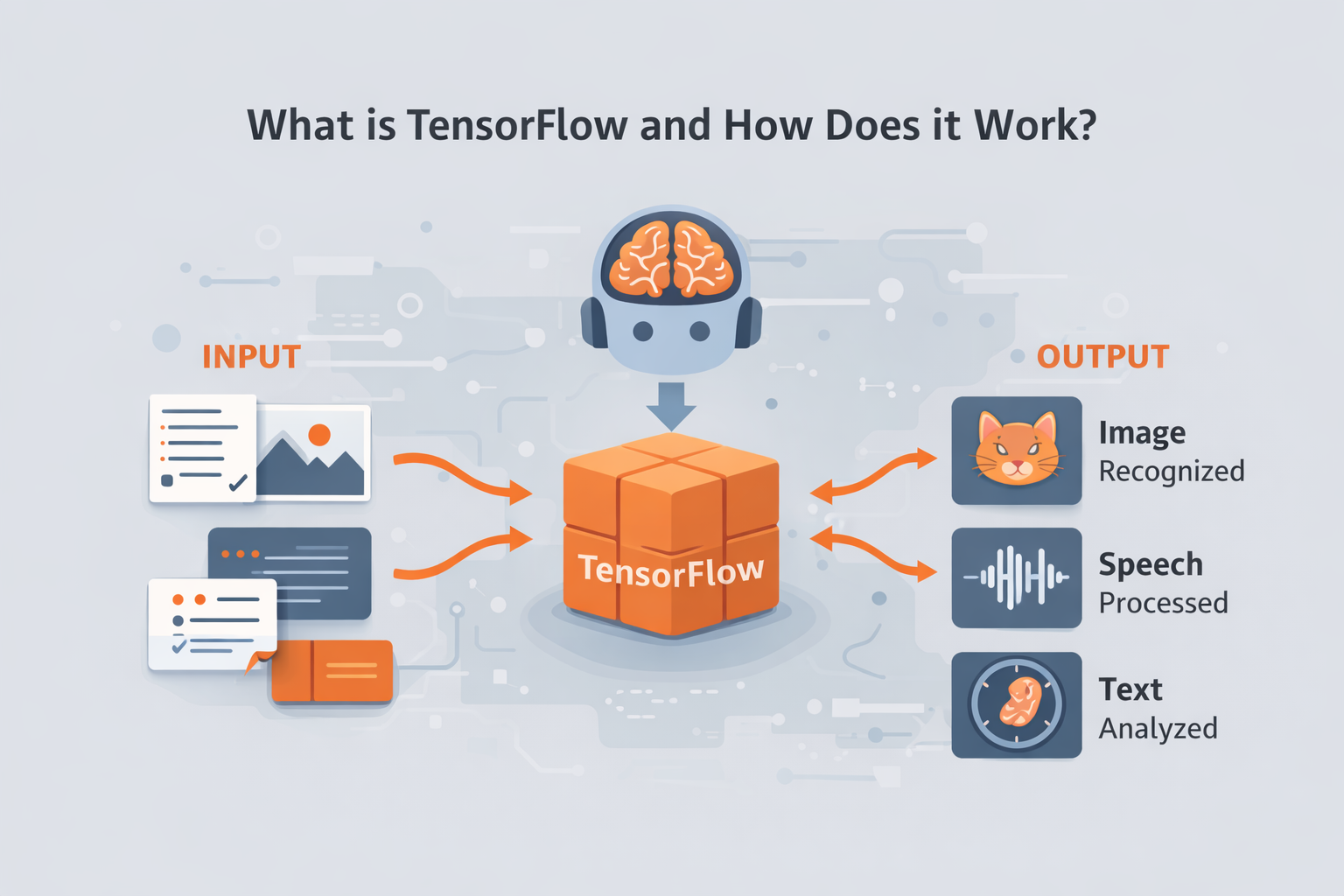
TensorFlow is an open-source machine learning framework developed by Google to help developers build and deploy artificial intelligence models. It’s designed to handle large-scale machine learning projects with ease, from simple predictive models to complex deep learning applications.
In essence, TensorFlow works by creating data flow graphs where the nodes in the graph represent mathematical operations, and the edges represent the data (or tensors) that flow between them. These graphs allow TensorFlow to process and transform data, enabling AI models to learn from it.
For example, when you use Google Photos to search for images, TensorFlow helps categorize your photos by identifying objects, faces, and even locations. As the system processes more data, it gets smarter, learning to recognize more complex features in images and improve its accuracy.
TensorFlow isn't just for Google applications; it’s used across industries for applications like natural language processing (NLP), speech recognition, and autonomous vehicles. Whether you're running a deep neural network or training a simple machine learning model, TensorFlow provides the tools needed for efficient and scalable AI development.
Why Choose TensorFlow?
There are many machine learning frameworks out there, but TensorFlow offers several distinct advantages that make it stand out.
1. Scalability
TensorFlow is designed to scale from small models on a laptop to massive production systems running across hundreds of machines. Whether you're working on a mobile app or training a large-scale AI model, TensorFlow handles it with ease.
2. Flexibility
TensorFlow supports various machine learning models, including deep learning, reinforcement learning, and more. Its flexibility allows it to be used across a wide range of applications, from research to production.
3. Performance
TensorFlow can run on CPUs, GPUs, and even specialized hardware like Tensor Processing Units (TPUs), providing the performance necessary for complex computations and fast model training. This makes it ideal for both small-scale and large-scale projects.
4. Cross-Platform Support
TensorFlow supports multiple platforms, including mobile devices (via TensorFlow Lite), web browsers (with TensorFlow.js), and even edge devices. This makes it easy to deploy your models in any environment.
Real-Life Applications of TensorFlow
TensorFlow is used across many industries to solve complex problems and enhance everyday experiences. Here are a few key applications:
1. Image Recognition and Object Detection
TensorFlow is widely used in image recognition tasks. Google Photos, for example, uses TensorFlow to automatically categorize images and recognize objects, people, and even locations. TensorFlow’s ability to process and understand images makes it indispensable in industries like retail, security, and healthcare.
2. Voice Recognition and Natural Language Processing
Google Assistant and Siri both rely on TensorFlow for voice recognition and NLP. TensorFlow models are trained to understand spoken commands, providing users with accurate responses and actions. Whether it’s dictating a message or asking for the weather, TensorFlow helps voice assistants become smarter over time.
3. Predictive Analytics
TensorFlow is used to predict outcomes based on historical data. For example, it’s used in finance for stock market predictions, in healthcare for patient outcomes, and in retail for customer behavior analysis. By training models on large datasets, TensorFlow enables businesses to make data-driven decisions.
4. Autonomous Vehicles
Self-driving cars use TensorFlow to process real-time data from sensors, cameras, and LiDAR to navigate roads and make driving decisions. TensorFlow’s ability to quickly process large amounts of data helps these vehicles recognize objects, avoid obstacles, and make split-second decisions.
5. Healthcare Diagnostics
TensorFlow is being applied in healthcare to help diagnose diseases by analyzing medical images, detecting anomalies, and predicting health risks. For instance, TensorFlow is used to analyze X-rays, CT scans, and MRIs to detect signs of diseases like cancer or pneumonia.
TensorFlow vs Other Machine Learning Frameworks
While TensorFlow is one of the most popular machine learning frameworks, it’s not the only option. Let’s compare it to other frameworks like PyTorch and Keras:
|
Feature |
TensorFlow |
PyTorch |
|
Ease of Use |
Slightly steeper learning curve |
Easier to start for beginners |
|
Deployment |
Great for large-scale production |
Better for research and prototypes |
|
Performance |
Optimized for speed and scale |
Great for research, but less scalable |
|
Community Support |
Large, enterprise-grade community |
Strong academic and research community |
|
Mobile/Edge Support |
TensorFlow Lite for mobile |
Limited support for mobile |
Which one should you choose?
If you’re working on production-level applications or need to scale, TensorFlow is your best bet. For research and prototyping, PyTorch might be more suitable due to its ease of use and flexibility.
The Future of TensorFlow: What’s Next?
Looking ahead, TensorFlow is evolving to meet the growing demand for AI on edge devices and mobile platforms. With the rise of TinyML, TensorFlow is making it possible to run machine learning models on tiny, resource-constrained devices, from wearables to IoT gadgets.
Additionally, TensorFlow’s focus on simplifying deployment and improving cross-platform compatibility will continue to make it the framework of choice for developers and businesses alike. Whether you’re working on AI-driven apps or large-scale production systems, TensorFlow will remain at the forefront of the machine learning revolution.
Conclusion: Why TensorFlow is Essential for Your AI Projects
TensorFlow is more than just a machine learning framework; it’s the backbone of AI development for businesses, researchers, and developers around the world. From self-driving cars to healthcare diagnostics, TensorFlow is enabling some of the most innovative technologies we use today.
If you’re ready to implement TensorFlow into your projects and drive the next generation of AI innovation, Mediusware can help. Let’s explore how we can bring your AI vision to life with TensorFlow.
Want to take your AI projects to the next level with TensorFlow?
Contact us today and let’s start building smarter solutions for your business.
Frequently Asked Questions
TensorFlow is an open-source machine learning framework developed by Google. It works by using data flow graphs, where nodes represent operations and edges represent data, enabling efficient machine learning model training and deployment. It powers AI applications like image recognition, speech processing, and more.

I work at the point where product decisions, system architecture, and engineering execution meet. At Mediusware, I’m accountable for how technology choices affect reliability, scale, and long-term delivery for our clients.
Featureblogs
Relatedblogs
01
How to Create a Stunning WordPress Website in 2024: Step-by-Step Tutorial02
How Mediusware Empowered Protesters, Strengthened the Economy & Showcased Employee Resilience in the 2024 Movement03
Mastering Error Handling in Rust with Essential Techniques04
Best Practices for Writing Clean Code05
Let's Deep Dive Into Threads with RustAuthorblogs
01
How Digital Agencies Can Deliver Custom Software Without Hiring Developers02
AI in FinTech: Build, Buy, or Integrate? A Founder's Decision Framework03
How to Choose a SaaS MVP Development Company04
How Seed-Stage SaaS Teams Add Engineering Capacity Without Hiring Chaos05
Why Seed-Stage SaaS Startups Struggle to Ship Fast