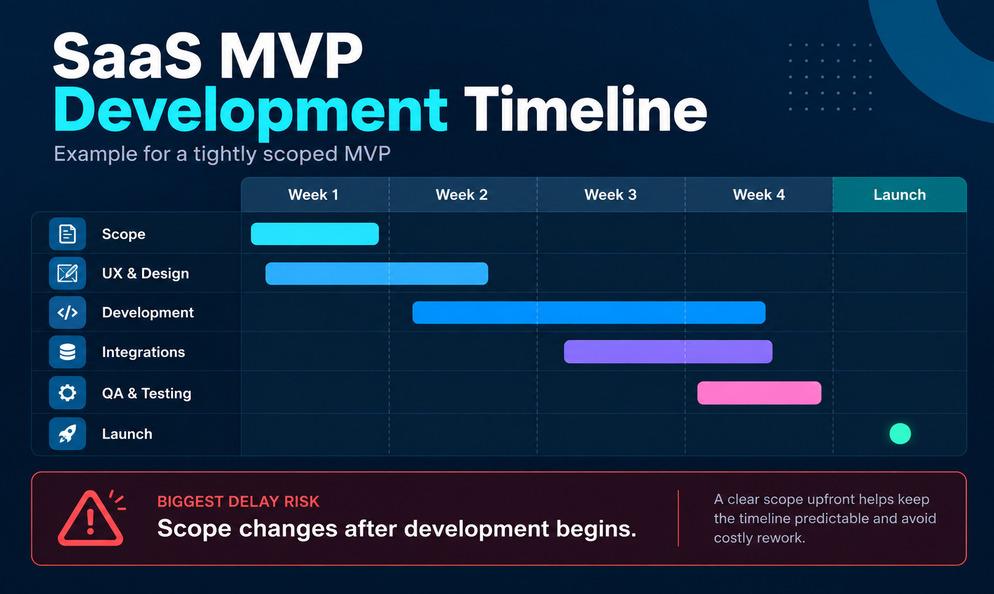
Building an MVP does not mean randomly removing features.
It means being intentional about what stays and what waits.
Here is a simple MVP process founders can follow.
Step 1: Define Your Core Value Proposition
Before building anything, clearly define the problem you are solving.
Ask yourself:
→ Who is the product for?
→ What pain point are they facing?
→ Why does this problem matter?
→ What solution are we offering?
→ What outcome should users get?
For example, “a social media platform” is too broad.
But “a simple platform that helps niche founders build small communities around shared interests” is clearer.
Your MVP needs this clarity.
Without it, your product can quickly become a collection of unrelated features.
Step 2: Build a Minimal Version
Once the core value is clear, identify the essential features only.
Not every idea belongs in the first version.

Here is a simple feature prioritization table:
| Feature Type |
Meaning |
MVP Decision |
| Must-have |
Required to deliver the core value |
Build now |
| Nice-to-have |
Improves experience but not essential |
Add later |
| Future feature |
Useful after validation |
Keep in roadmap |
| Risky feature |
Expensive or unproven |
Validate first |
| Vanity feature |
Looks good but adds little value |
Avoid |
For example, if you are building a basic social media MVP, you may only need:
→ User profiles
→ Friend or follow connections
→ Simple posting
→ News feed
→ Basic notifications
You probably do not need advanced AI recommendations, complex analytics, monetization tools, or multiple content formats in version one.
Those can come later.
The MVP should prove the core behavior first.
Step 3: Launch and Gather Feedback
Once the MVP is ready, get it into the hands of potential users.
You do not need a massive launch.
Start small.
You can launch to:
→ Beta users
→ Your professional network
→ Startup communities
→ LinkedIn audience
→ Niche online groups
→ Early waitlist users
The goal is to observe how people use the product.
- Do they understand it?
- Do they complete the main action?
- Do they return?
- Do they ask for improvements?
- Do they recommend it to others?
This stage helps you move from assumption to evidence.
Step 4: Iterate and Improve
Your MVP is only the beginning.
After launch, use real feedback to improve the product.
Look for repeated patterns.
If one person asks for a feature, it may be personal preference.
If many users ask for the same thing, it may be a product signal.
Pay attention to:
→ User drop-off points
→ Repeated complaints
→ Feature requests
→ Confusing screens
→ Technical issues
→ Payment interest
→ Usage frequency
Iteration is where the product becomes stronger.
The first version helps you learn.
The next versions help you grow.