- Strong development teams support product growth with better structure and ownership.
- Better systems and technical support help teams scale delivery with confidence.
Signs Your Development Team Can’t Keep Up With Product Growth
1 min read
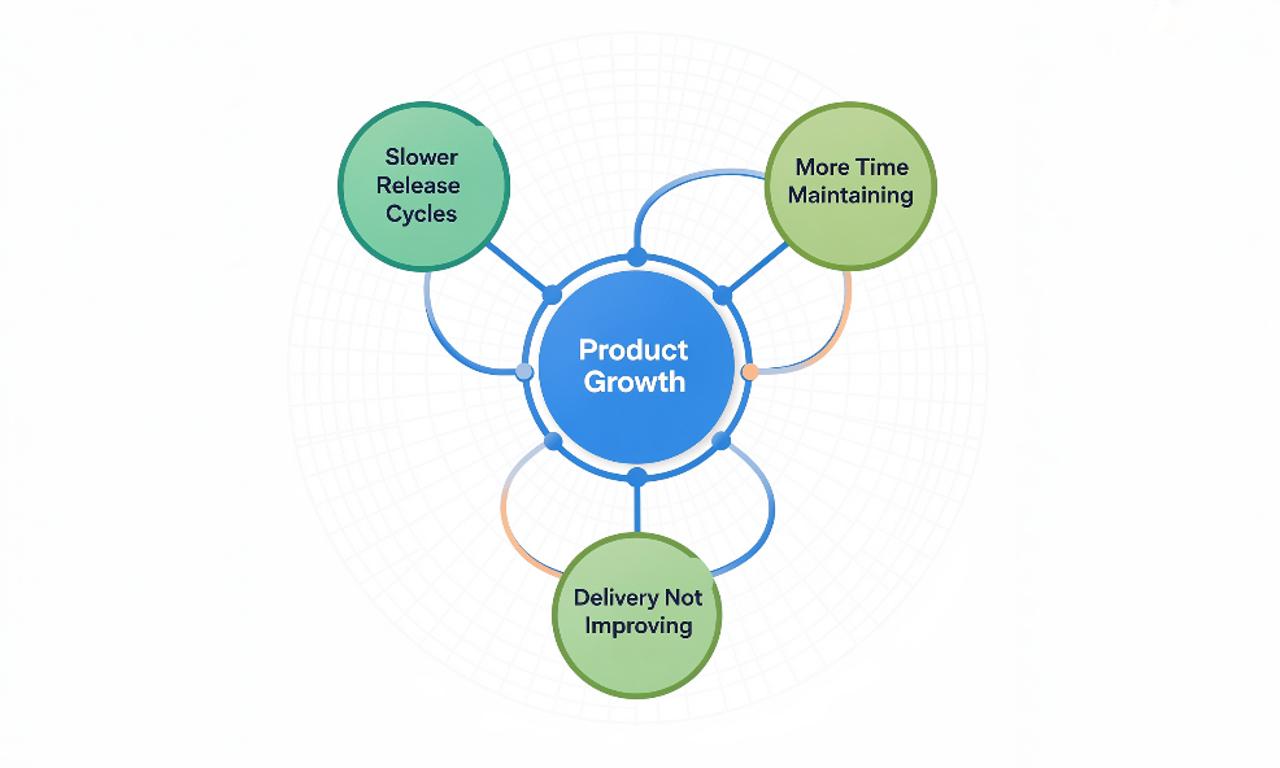
Most products don’t fail because of lack of demand.
They fail because their engineering system breaks under growth.
At first, growth feels exciting.
More users. More features. More traction.
Then something changes.
Releases take longer.
Bugs increase.
Confidence drops.
And suddenly, growth starts feeling like pressure instead of progress.
That’s not random.
That’s a signal your system is hitting its limit.

The Real Problem: It’s Not Talent, It’s System Design
Most teams misdiagnose this.
They think:
We need better developers.
But the reality is different.
As your product grows, complexity multiplies:
- More users → more edge cases
- More features → more dependencies
- More teams → more coordination
According to the Google State of DevOps Report, high-performing teams deploy 208× more frequently than low performers, not because they have better talent, but because they have better systems.
If your system isn’t designed for scale, growth creates friction instead of momentum.
7 Signs Your Development System Is Breaking
1. Release Cycles Are Getting Slower
You’re still shipping.
But every release feels heavier.
- More planning
- More approvals
- More rollback risk
This is a classic scalability failure.
It’s breaking at 20.
This is where teams start exploring dedicated development teams to restore delivery speed without internal chaos.
2. Engineers Are Maintaining More Than Building
Your team spends more time:
- Fixing regressions
- Patching legacy code
- Avoiding risky areas
This is technical debt compounding.
As Martin Fowler (ThoughtWorks) explains:
Technical debt is like financial debt. If you don’t pay it off, it accumulates interest.
The cost isn’t just engineering speed.
It’s business slowdown.
3. You’re Hiring More, But Speed Isn’t Improving
This is where frustration kicks in.
You hire more developers…
But output doesn’t improve.
Sometimes, it gets worse.
Why?
Because complexity grows faster than capacity:
- More communication paths
- More onboarding overhead
- More coordination friction
This is exactly what Fred Brooks warned:
Adding manpower to a late software project makes it later.
4. Product and Engineering Are Losing Alignment
This doesn’t show in dashboards.
It shows in conversations.
- Product wants speed
- Engineering asks for time
- Priorities keep shifting
This is not a planning issue.
It’s a clarity breakdown.
High-performing teams solve this with:
- Clear ownership
- Defined scope
- Stable priorities
Often supported by structured models like staff augmentation to maintain alignment without overloading internal teams.
5. Developer Experience Is Getting Worse
This is the silent killer.
It shows up in small things:
- Slow setup
- Poor documentation
- Broken pipelines
- Too many approvals
Individually manageable.
Collectively destructive.
According to Stripe, developers spend up to 42% of their time on maintenance and inefficiencies, not building new features.
Friction compounds.
And friction kills speed.
6. Your Architecture Is Starting to Push Back
Early systems are built for speed.
Not for scale.
Now you need:
- Scalable infrastructure
- Clear service boundaries
- Observability
- Reliable testing
Without these, simple changes become risky.
This is where modern stacks like Laravel
Or React needs proper architectural planning, not just implementation.
7. Everyone Is Busy, But Progress Feels Slow
This is the clearest signal.
Your team is working hard:
- Sprints are closing
- Tickets are moving
- Meetings are happening
But the business still feels slow.
That gap matters.
Because growth should feel like momentum not resistance.
Why This Happens And Most Teams Get It Wrong
Here’s the pattern we see repeatedly:
Teams treat growth problems as effort problems.
So they:
- Push harder
- Hire faster
- Work longer
But growth doesn’t reward effort.
It rewards systems that handle complexity.
This aligns with the Mediusware writing philosophy:
Build trust by solving real problems, not adding noise.
What Smart Teams Do Differently
They don’t wait for breakdown.
They act early:
- Reduce technical debt before it blocks delivery
- Improve developer experience before it drains productivity
- Fix architecture before scaling makes it expensive
- Strengthen delivery systems before hiring aggressively
And most importantly…
They shift from: How do we work harder?
To: How do we design a system that works better?
The Shift: From Effort to System Design
At some point, every growing product faces a decision:
- Keep pushing harder
- Or redesign how work gets delivered
The teams that scale successfully choose the second.
Because growth doesn’t break products.
Bad systems do.
Turn Growth Into an Advantage Not a Bottleneck
If you’re seeing these signs:
- Slower releases
- Rising technical debt
- Hiring without impact
- Delivery chaos
You don’t need more pressure.
You need a better system.
A Practical Next Step
If your product is growing but delivery isn’t keeping up, step back and ask:
- Where is friction coming from?
- What is slowing execution?
- What part of the system no longer scales?
This is where the right structure, whether through software development services, better architecture, or scalable team models, can unlock speed again.
Final Thought
Growth is supposed to create momentum.
If it’s creating resistance instead…
That’s not a growth problem.
That’s a system problem.
Frequently Asked Questions
Look for practical signs. Slower releases, more bugs, missed roadmap dates, growing technical debt, and overloaded developers usually mean your team is under scaling pressure.

I work at the point where product decisions, system architecture, and engineering execution meet. At Mediusware, I’m accountable for how technology choices affect reliability, scale, and long-term delivery for our clients.
Featureblogs
Relatedblogs
01
Integrating Redux with React: A Comprehensive Guide02
Laravel pagination and filtering with already loaded data as array in memory03
React + Three.js + React Three Fiber: Crafting Interactive 3D views in Web Applications04
Advanced Caching Strategies for Django Applications05
Implementing Roles and Permissions in Laravel Using Guard-LaravelAuthorblogs
01
How Digital Agencies Can Deliver Custom Software Without Hiring Developers02
AI in FinTech: Build, Buy, or Integrate? A Founder's Decision Framework03
How to Choose a SaaS MVP Development Company04
How Seed-Stage SaaS Teams Add Engineering Capacity Without Hiring Chaos05
Why Seed-Stage SaaS Startups Struggle to Ship Fast