-
Explains how software development decisions impact cost, scalability, and long-term product success.
-
Breaks down processes, roles, and development types with real-world business context.
-
Highlights common failure points teams face despite following standard development practices.
-
Shares 2025-ready insights to help businesses build secure, scalable, future-proof software.
Software Development Explained: Process, Roles, and Strategic Decisions That Matter
1 min read
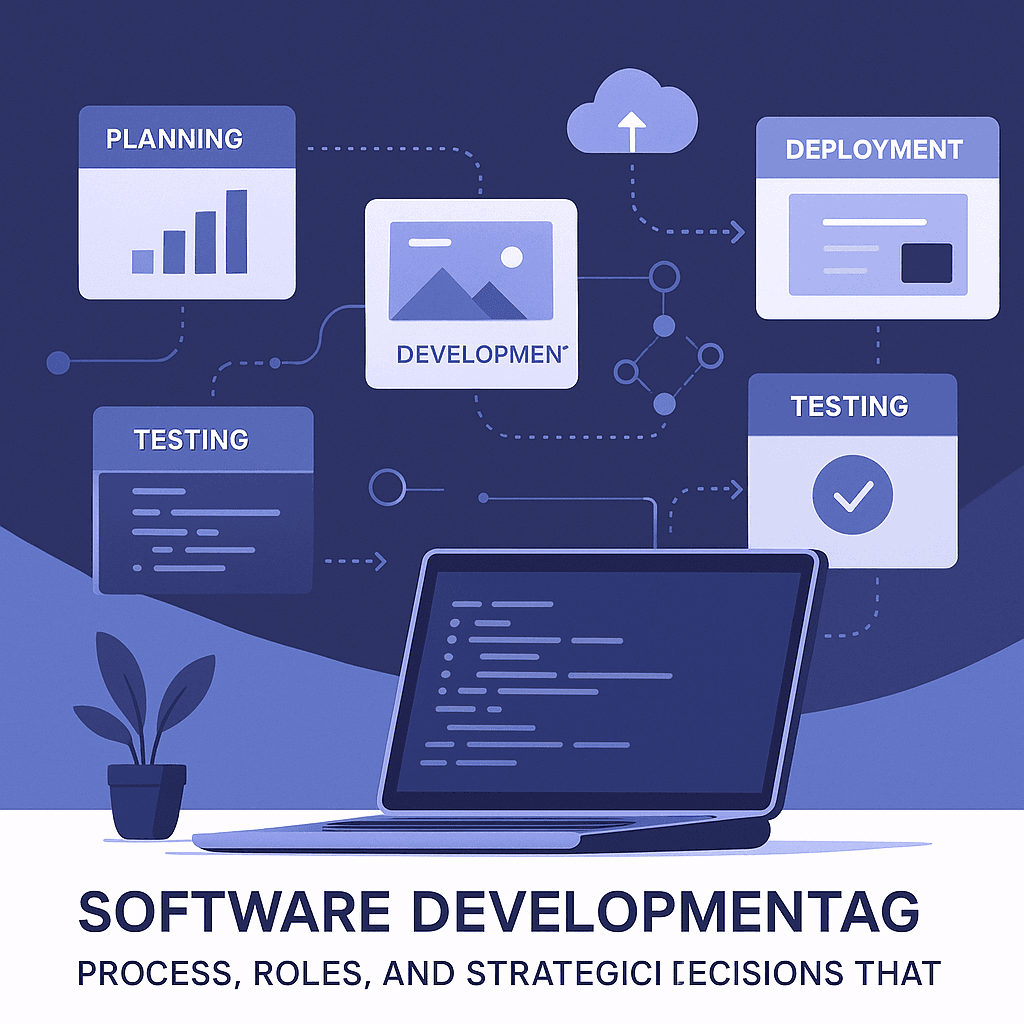
You probably didn’t start your software project to manage bugs, missed deadlines, or endless revisions. Yet here you are, wondering why progress feels slow, costs keep rising, and competitors ship faster.
Here’s the uncomfortable truth.
Most software projects don’t fail because of bad developers. They fail because of poor software development decisions early on.
Maybe you hired too fast.
Maybe you skipped planning to save time.
Maybe you followed a process without understanding why it mattered.
If you are building software in 2025, the question is no longer can it be built.
The real question is, can it scale, stay secure, and deliver long-term value?
Let’s break down how software development actually works, where it often fails, and how to approach it the right way so you do not pay for mistakes twice.
What Software Development Really Means Today
Software development is no longer just about writing code.
It is about turning a business idea into a reliable, scalable digital product.
For example, building a food delivery app is not just coding screens.
It involves handling traffic spikes, payment failures, data security, performance, and constant feature updates.
In simple terms:
- Code is the tool.
- Process is the guardrail.
- Strategy is what protects your investment.
When teams ignore this balance, products launch but struggle to survive.
The Software Development Process Explained with Real Context
Most teams follow the Software Development Life Cycle because it reduces risk.
But following it blindly is where things go wrong.
| The Core Stages and Why They Matter | Column 1 | Column 2 |
| Stage | What It Does | What Happens If You Skip It |
| Planning | Aligns goals, scope, and constraints | Budget overruns, unclear priorities |
| Design | Defines structure and user experience | Rewrites, poor usability |
| Development | Turns plans into working software | Technical debt if rushed |
| Testing | Catches issues before users do | Bugs in production |
| Deployment | Releases safely to users | Downtime, failed launches |
| Maintenance | Keeps software relevant | Security and performance risks |
For example, skipping proper planning might save two weeks today, but it can cost months later when features clash or scaling breaks.
According to McKinsey, fixing defects after release can cost up to 30 times more than fixing them during design and development.
This is why process discipline protects speed in the long run.
Agile vs Waterfall vs Hybrid in Practice
Not every project needs the same approach.
| Model | Best For | Risk |
| Agile | Fast-changing products | Scope creep |
| Waterfall | Fixed requirements | Inflexibility |
| Hybrid | Growing businesses | Requires experience |
For example, a startup launching an MVP benefits from Agile.
A regulated financial system may still rely on Waterfall or Hybrid for compliance.
The mistake is copying a methodology without matching it to your business reality.
Software Development Roles That Actually Drive Results
Hiring developers alone does not guarantee success.
Each role exists to reduce a specific risk.
Key Roles Explained with Examples
- Front-End Developer
Builds what users see and interact with.
Example: Checkout flow speed directly impacts conversion rates. - Back-End Developer
Handles logic, databases, and integrations.
Example: Payment processing reliability during peak traffic. - Full-Stack Developer
Covers both ends for smaller teams.
Example: MVP builds where speed matters more than specialization. - QA Engineer
Protects product quality before users experience issues.
Example: Catching broken login flows before launch. - DevOps Engineer
Ensures smooth deployments and uptime.
Example: Rolling updates without taking the app offline.
Skipping any of these roles often shifts the burden to others, creating burnout and hidden delays.
Types of Software Development and When to Use Each
Understanding types helps you hire and plan correctly.
Common Types Compared
| Type | Best Use Case | Limitation |
| Web Development | Browser-based products | Internet dependency |
| Mobile Development | Native performance | Platform fragmentation |
| Cloud Development | Scalability and flexibility | Requires expertise |
| Desktop Development | Offline tools | Limited reach |
| Database Development | Data-heavy systems | Specialized skillset |
| Security Engineering | Sensitive data systems | Often overlooked |
For example, a healthcare platform should prioritize security engineering early, not after launch.
Why Software Development Projects Fail Even with Good Teams
This is where many blogs stop short.
Common failure points include:
- No clear ownership.
- Poor requirement documentation.
- Overengineering too early.
- Ignoring security until incidents happen.
- Choosing speed over maintainability.
Martin Fowler, software design expert, often emphasizes that technical debt is a business decision, not a technical one.
The real cost shows up months later, when changes become painful and expensive.
Software Development Trends That Matter in 2025
If you are planning today, these shifts cannot be ignored.
- AI-assisted development accelerating delivery.
- Low-code tools supporting faster internal apps.
- Cloud-native architectures becoming default.
- Security baked into development, not added later.
- Distributed teams becoming standard.
Teams that adapt early build faster with fewer resources.
In-House vs Outsourcing vs Staff Augmentation
This decision shapes everything.
| Model | Best For | Trade-Off |
| In-House | Long-term core products | High cost |
| Outsourcing | Fixed scope projects | Less control |
| Staff Augmentation | Scaling fast | Needs coordination |
There is no universal answer.
The right choice depends on control, speed, and budget tolerance.
How to Approach Software Development the Smart Way
Before starting your next project, ask yourself:
- What business problem are we solving?
- How will this scale in one year?
- What happens if requirements change?
- Who owns quality and security?
These questions save more money than any shortcut ever will.
Final Thoughts
Software development is not just a technical function anymore.
It is a long-term business investment.
Teams that treat it strategically build products that grow.
Teams that rush decisions pay for them repeatedly.
If you approach software development with clarity, structure, and the right expertise, it stops being a cost center and becomes a growth engine.
Ready to take the next step? If you are planning what comes next, Mediusware helps you turn development strategy into scalable, production-ready software.

I work at the point where product decisions, system architecture, and engineering execution meet. At Mediusware, I’m accountable for how technology choices affect reliability, scale, and long-term delivery for our clients.
Featureblogs
Relatedblogs
01
How to Create a Stunning WordPress Website in 2024: Step-by-Step Tutorial02
How Mediusware Empowered Protesters, Strengthened the Economy & Showcased Employee Resilience in the 2024 Movement03
Mastering Error Handling in Rust with Essential Techniques04
Best Practices for Writing Clean Code05
Let's Deep Dive Into Threads with RustAuthorblogs
01
How Digital Agencies Can Deliver Custom Software Without Hiring Developers02
AI in FinTech: Build, Buy, or Integrate? A Founder's Decision Framework03
How to Choose a SaaS MVP Development Company04
How Seed-Stage SaaS Teams Add Engineering Capacity Without Hiring Chaos05
Why Seed-Stage SaaS Startups Struggle to Ship Fast