-
Build, Buy, or Hybrid can significantly impact your business's speed, scalability, and control.
-
Each approach has its advantages and trade-offs, so understanding your needs is crucial for long-term success.
Should You Build, Buy, or Go Hybrid for Your AI Project?
1 min read
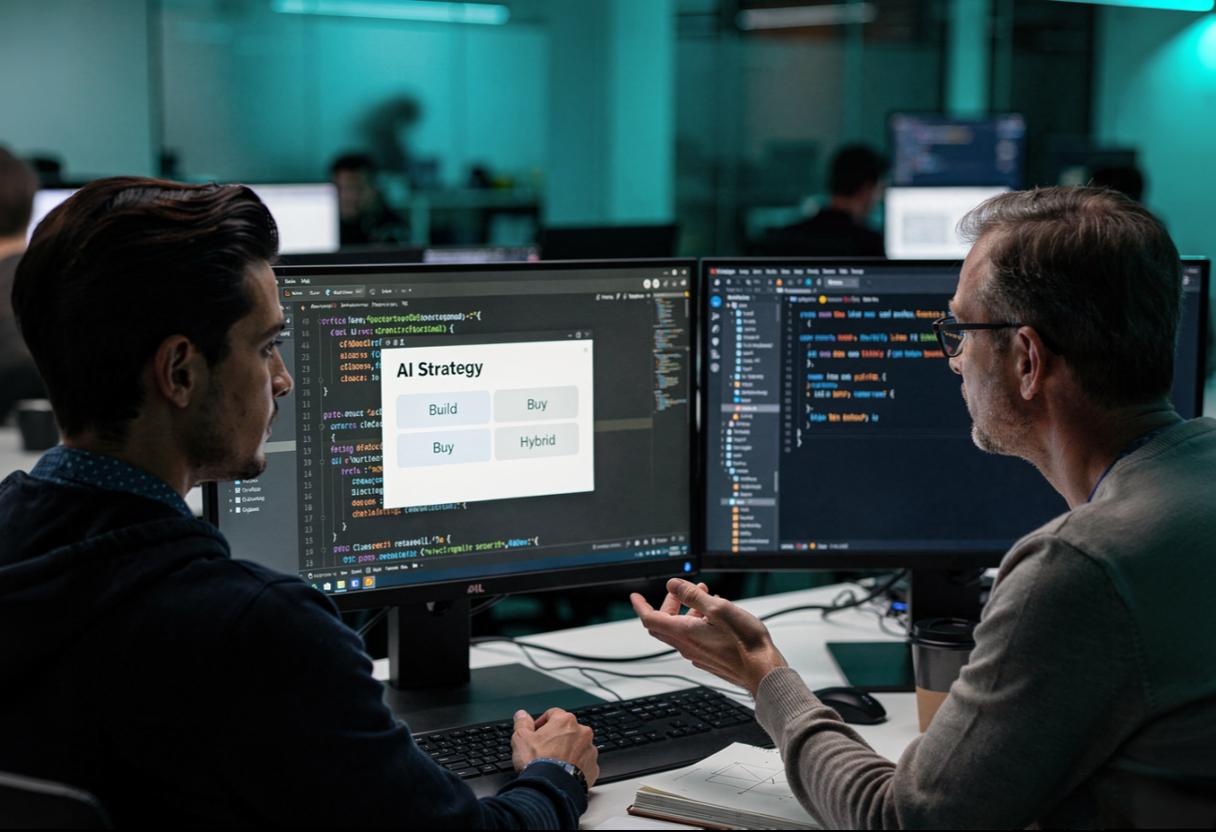
Imagine you've spent weeks building an AI prototype. It’s impressive. Your team’s excited, and your stakeholders love it. But then…
The question comes:
How are we going to scale this?
How do we make sure it’s reliable for thousands of users?
How do we keep it running smoothly for the next few years?
Suddenly, the excitement turns to anxiety. You realize the fun of building the prototype was just the beginning. Now, you’ve got to decide whether to build your AI system from scratch, buy a pre-made solution, or go for a hybrid approach that combines the best of both worlds.
This decision isn’t just a technical one. It’s about choosing the future of your AI system. What's going to work for your business long-term? Let’s break it down and explore your options.
The Build Path: Full Control, but a Lot of Work
Choosing to build your AI system means you have total control. You can customize it exactly the way you want. You’ll have ownership over the data, workflows, and infrastructure. But here’s the truth: it’s a heavy lift. Building from scratch isn’t just about coding; it’s about managing long-term scalability, maintenance, and system updates.
It takes time, resources, and a skilled team that knows how to handle production-level AI systems. For example, in fintech, you might need custom fraud detection algorithms that are tailored to your business model. This level of precision and customization can only be achieved by building from scratch.
However, the challenge is that building your own solution is time-consuming and comes with its own set of risks. If you don’t have a dedicated engineering team experienced in production-level AI systems, this can quickly become overwhelming.
According to an article on Forbes about AI and its business impact-
building AI can require a significant investment in human resources and infrastructure, with little guarantee of success in the initial stages.
Pros of Building:
- Full control over architecture and customization
- Tailored to your business’s exact needs
- Can scale over time as your company grows
Cons of Building:
- Time-consuming, it takes a lot of effort to develop and refine
- Requires skilled engineering resources that may be hard to find
- Your team must continuously manage the system
If you’re ready to put in the work and have the resources, building your own AI system could offer immense value. However, if speed is a critical factor for your business, you might want to consider buying a pre-made solution.
The Buy Path: Quick and Easy, but Limited Flexibility
On the other side, buying a pre-built AI service is the fastest route to deployment. If your goal is to move quickly, buying could be a great option.
You get access to proven AI models and infrastructure with minimal effort from your team.
For instance, you could purchase a pre-built customer support chatbot from a provider like Zendesk or Dialogflow by Google. These solutions are ready to go and integrate easily into your website or app, saving you valuable time.
According to Google Cloud's AI solutions-
Using pre-built models like these allows companies to implement AI without needing a specialized in-house team.
However, and this is a significant caveat, you relinquish a considerable amount of control and customization. When you buy, you’re stuck with the vendor’s system, which may not be as customizable as you need it to be.
If your business grows and you need more tailored features or custom workflows, you might hit a wall.
A perfect example is AI-powered marketing automation tools, like those from HubSpot. They can get you up and running quickly, but if you want to add more complex features tailored to your brand, you’ll likely be limited by the platform’s restrictions.
Pros of Buying:
- Quick setup—Get started immediately
- Low maintenance—The vendor manages the heavy lifting
- Predictable pricing—Subscription models make budgeting easier
Cons of Buying:
- Limited customization—You’ll have to work within the vendor’s limitations
- Vendor dependency—You’re reliant on them for updates and future features
- Scalability issues—If your needs grow, you might find the solution inadequate
Buying is perfect when you’re looking for a fast, reliable solution that gets you up and running. However, if you need more customization or expect to scale in unique ways, you might outgrow this solution quickly, leaving you with a need to reconsider.
The Hybrid Path: The Best of Both Worlds
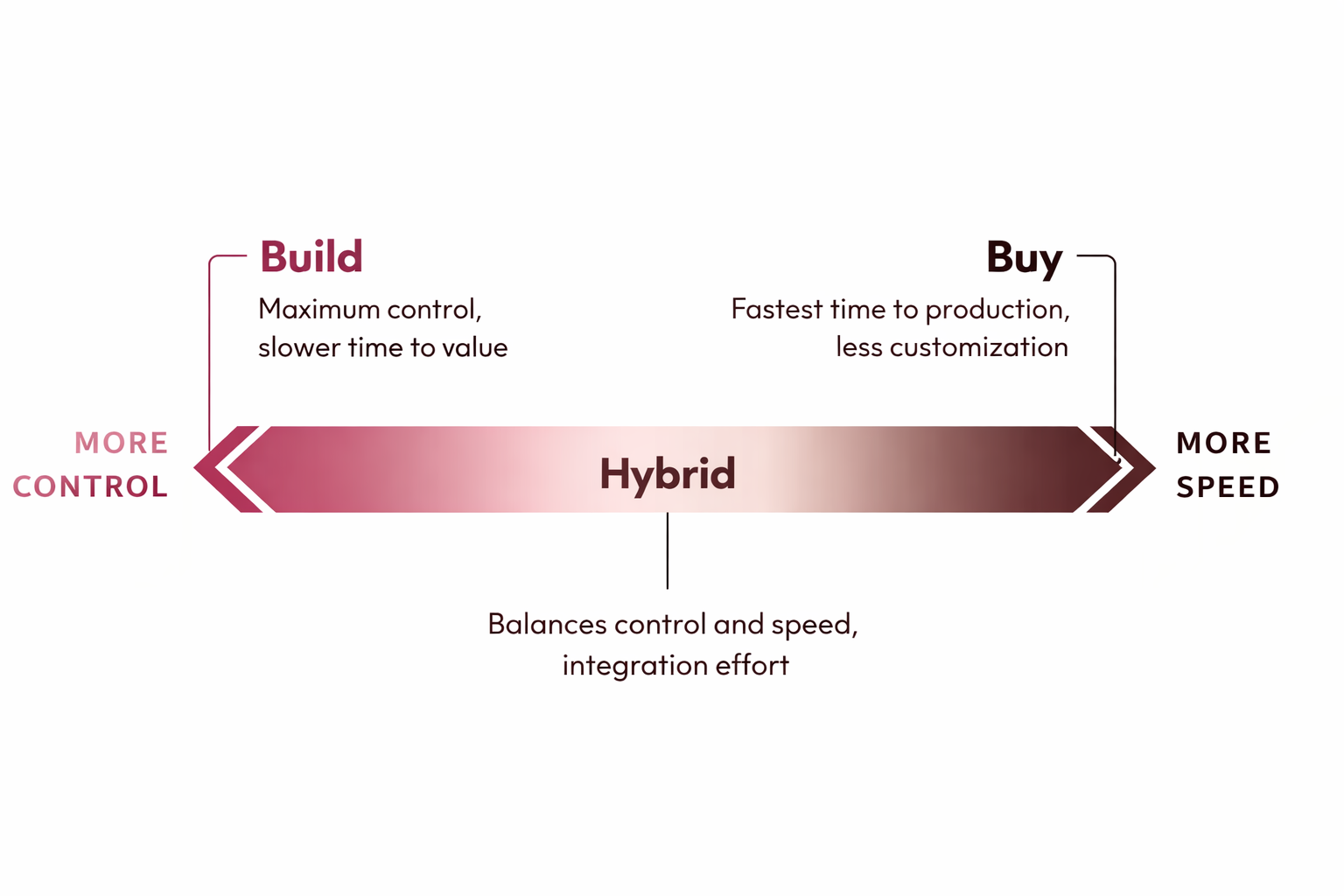
Now, let’s talk about the hybrid path. Hybrid combines the best of both worlds you can buy what you can, and then build the parts that matter most giving you a balance of speed and control.
With hybrid, you could buy AI models for things like text analysis or speech recognition and then build out custom workflows or a recommendation engine that’s unique to your business.
This way, you can move quickly while still retaining control over what really matters to your business.
The hybrid approach works well for businesses that need flexibility you can adjust as your needs change, and still ensure that the most important aspects of your system are customized to your exact needs.
It’s a balance between speed and control, which many fast-growing companies find works well as they scale.
The beauty of hybrid is that it allows for evolution. If your business needs evolve or new opportunities arise, hybrid gives you the flexibility to expand and adapt your AI infrastructure without being locked into a rigid, vendor-specific solution.
Pros of Hybrid:
- Flexibility: Pick and choose which parts to build and which to buy
- Quick to start, but with long-term control where it matters
- Scalable: As your needs grow, the system can adapt
Cons of Hybrid:
- Complex integration: You need clear boundaries between what’s built and what’s bought
- Shared responsibility: Both your team and the vendor are involved
- Potential gaps: If not carefully planned, hybrid systems can become fragile during upgrades
How Do You Choose the Right Path?
Let’s compare the three options in a simple table. Each choice has its trade-offs, so it’s important to weigh what matters most to your company:
| Criterion | Build | Buy | Hybrid |
| Speed to Market | Slow (Takes time to develop) | Fast (Pre-built, ready to use) | Moderate (Quick to start) |
| Cost | High (Upfront development costs) | Low (Subscription-based costs) | Mixed (Initial + ongoing) |
| Customization | High (Tailored to your needs) | Low (Vendor limitations) | Moderate (Customizable features) |
| Control | Full control | Limited control | Shared control |
| Risk | High (More responsibility) | Low (Vendor manages most risks) | Shared risk |
| Scalability | Manual scaling required | Automatic, but limited by vendor | Scalable with flexibility |
Key Takeaway:
Building gives you control, but it takes time.
Buying is fast but lacks customization.
Hybrid gives you flexibility, letting you move quickly and still keep control where it matters.
The Takeaway: What’s the Best Move for Your Business?
At the end of the day, the path you choose depends on your current priorities and long-term vision:
- Build if you need complete control and customization, and you have the time and resources to get it right.
- Buy if you need to get to market quickly with a reliable solution, but don’t need deep customization.
- Hybrid if you want a combination of both speed with the flexibility to adapt as your business grows.
AI is a journey, and the path you choose today might not be the path you stay on forever. You can always pivot as your needs evolve. Whatever you decide, make sure your architecture can scale and adapt with your business.
Frequently Asked Questions
Building an AI system gives you full control but requires more time and resources. Buying an AI solution is fast but offers less customization. Hybrid allows for quick deployment with some customization.

I work at the point where product decisions, system architecture, and engineering execution meet. At Mediusware, I’m accountable for how technology choices affect reliability, scale, and long-term delivery for our clients.
Featureblogs
Relatedblogs
Authorblogs
01
How Digital Agencies Can Deliver Custom Software Without Hiring Developers02
AI in FinTech: Build, Buy, or Integrate? A Founder's Decision Framework03
How to Choose a SaaS MVP Development Company04
How Seed-Stage SaaS Teams Add Engineering Capacity Without Hiring Chaos05
Why Seed-Stage SaaS Startups Struggle to Ship Fast