- Agile helps teams adapt and build the right features through iteration and feedback.
- DevOps ensures those features are delivered, monitored, and scaled reliably in production.
Agile OR DevOps VS. Agile AND DevOps: What’s Best for Your Team?
1 min read

The Pressure to Move Fast, But At What Cost?
Have you ever felt that tension? You sprint through Agile cycles, checking off tasks and feeling the rush of speed. The new feature is ready, the sprint is done, and the team is on to the next big thing.
But once the code hits production, something goes wrong. Bugs appear. Users complain. Something always breaks.
Why does that happen?
Isn’t speed supposed to be the goal?
Why does something that was done in the sprint feel so fragile in the real world?
This is the core problem many teams face when they move too fast with Agile but don’t address deployment reliability. And that’s where DevOps steps in.
But it’s not just about speed versus stability. It’s about understanding how Agile and DevOps work together to make your development process both fast and reliable.
Let’s break this down in a way that speaks to the real problems your team faces, not just theoretical differences.
The Struggle with Agile: Speed Without Stability
The Real Struggle with Agile
Think about your team working in sprints. You build features quickly, keep adapting, and ship often. Everything feels fast and on track. But when it comes time to deploy, there’s always that nervous feeling.
Everything looks good in staging. But once it hits production, bugs pop up. Users start reporting issues. Your team is scrambling to fix things, and the deployment that should feel like a win feels more like a risky move.
This is the challenge with Agile. It’s great at helping you build fast, but it doesn’t promise reliability in production.
Why Agile Alone Isn’t Enough
While Agile gives teams the ability to move fast, it doesn’t ensure safe and stable releases.
When you ship quickly without adequate testing and deployment practices, you face human error, downtime, and unexpected failures.
Agile is great for building fast. But to ensure your team can deliver confidently and reliably, you need DevOps to manage the operational side of deployment.
Why Agile Alone Isn’t Enough
Agile helps you build features, but it doesn’t help you deploy those features safely.
Once the code is live, the pressure shifts. You need stability, but Agile doesn’t really address that.
When you're shipping fast, something always seems to slip through the cracks.
What DevOps Fixes That Agile Doesn’t
The Missing Piece: Operational Reliability
Imagine a tech startup releasing new features every week. Without DevOps, their deployment process is manual.
There's no automation, no real-time monitoring, and no way to ensure smooth deployments.
The team is always working under pressure to ensure the release goes well. But more often than not, something slips through.
Now, with DevOps in place, things change. Automated testing ensures everything is checked before it hits production. The deployment pipeline is fully automated, so no one is manually pushing updates.
Monitoring tools like Prometheus and Grafana track performance in real-time, alerting the team to issues before they become major problems.
With DevOps, your team can focus on building new features without constantly worrying about deployment risks. DevOps, in many ways, aligns with the entire software development life cycle (SDLC).
While Agile helps with fast, iterative development, DevOps ensures that once code is ready, it’s deployed smoothly and consistently.
Agile vs. DevOps: A Side-by-Side Comparison
|
Aspect |
Agile |
DevOps |
|
Focus |
Speed, flexibility, iterative development |
Stability, automation, deployment reliability |
|
Goal |
Build features quickly |
Ensure reliability and smooth operations |
|
Main Audience |
Developers |
Developers + Operations |
|
Tools/Practices |
Scrum, Kanban, iterative cycles |
CI/CD, automated testing, monitoring |
|
Challenges |
Speed at the cost of operational risk |
Complex setup, requires cultural shift |
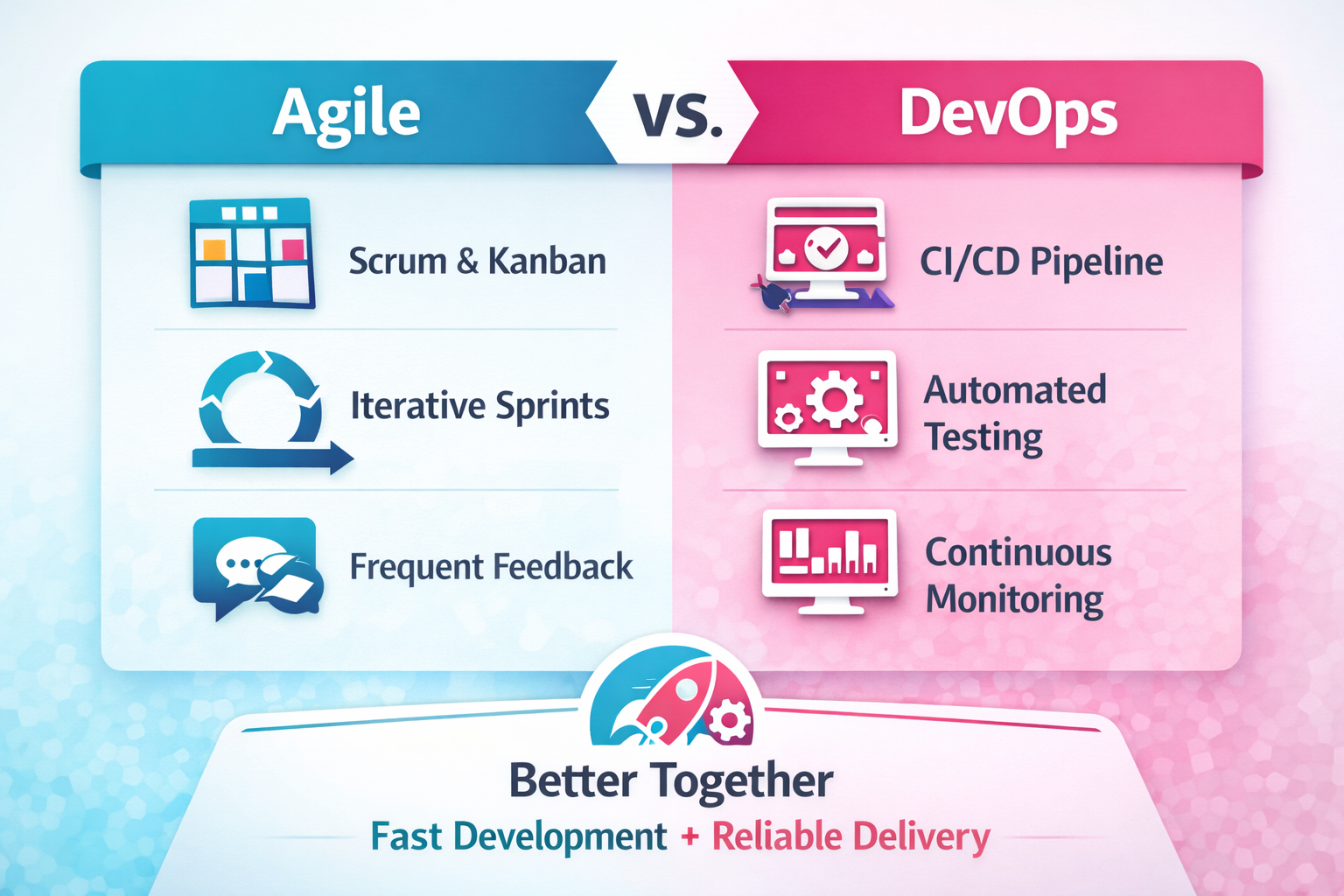
The Power of Combining Agile and DevOps
Using Both Methodologies to Win
You might be wondering, “Can’t we just choose one?” The truth is, Agile and DevOps don’t compete. They complement each other perfectly.
Here’s why:
- Agile drives what you build. It’s all about quickly iterating on ideas, incorporating user feedback, and adapting to changing requirements. Agile helps you build the right features quickly.
- DevOps takes care of how to deliver those features safely and reliably into production. DevOps helps automate processes, reduce manual errors, and ensure that what you’ve built works when it reaches users.
When you combine Agile’s speed with DevOps’ reliability, you get the best of both worlds: fast development and confident delivery.
For Example, The Power of Agile + DevOps Together
Imagine your team is developing a new feature for a SaaS product. With Agile, you build quickly and test based on feedback. But once the feature is ready.
You use DevOps to automate testing, deployment, and monitoring. This ensures that your code makes it into production safely.
Now, instead of worrying about deployment, you can focus on building the next feature. DevOps handles the rest, and your team feels confident that the deployment will go smoothly.
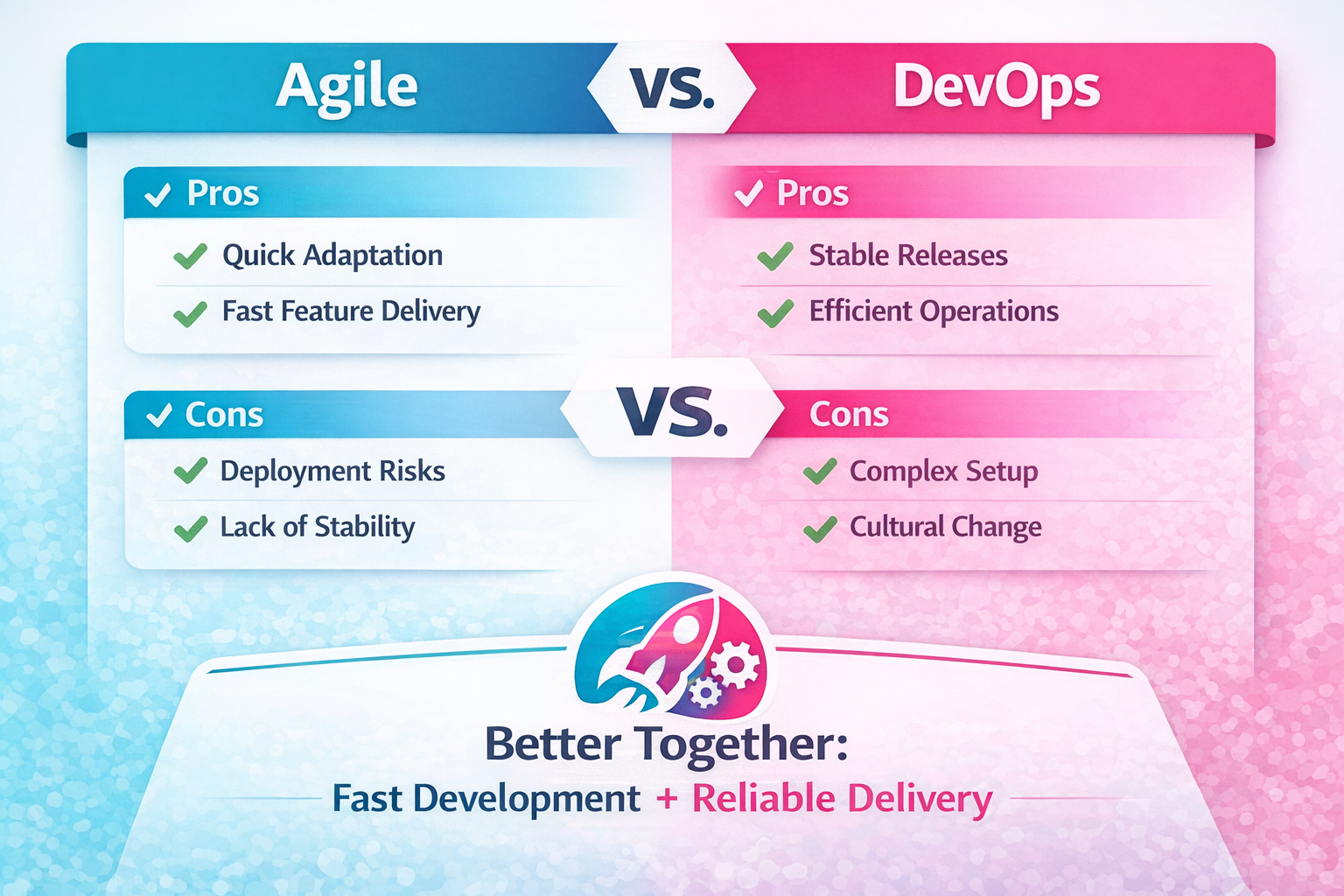
When to Choose Agile, When to Choose DevOps, and When to Use Both
So, when should you choose Agile? When should you choose DevOps? And when should you use both?
Choose Agile if:
- You’re still figuring out your product or market fit.
- Frequent feedback and fast iteration are key to your success.
- You need to stay flexible and build features quickly.
Choose DevOps if:
- You’re releasing frequently and need reliable deployment.
- Downtime directly affects your users or revenue.
- You need to automate processes to reduce errors and streamline workflows.
Use Both if:
- You want the speed of Agile, but also need reliability.
- Your team is scaling, and both agility and stability matter.
- You need to provide continuous delivery without the fear of failure.
Agile and DevOps don’t compete. They complement each other. When used together, your team can move fast, deliver reliably, and scale confidently.
Final Thoughts: Finding the Right Balance
Agile and DevOps aren’t competitors. They solve different problems at different stages.
Agile keeps development flexible and responsive, while DevOps ensures reliable, scalable delivery. Successful teams give Agile ownership over planning and iteration, and DevOps responsibility for delivery and stability.
If your goal is faster learning, start with Agile.
If you need reliable releases, invest in DevOps.
For sustainable growth, use both together.
At Mediusware, we help teams implement DevOps practices to deliver fast while maintaining stability and confidence in production.
The real win isn’t choosing one. It’s combining speed with reliability.
Frequently Asked Questions
No. DevOps is not a subset of Agile. Agile focuses on how teams plan and build software through iterative development. DevOps focuses on how that software is delivered, operated, and maintained in production.

I work with founders and leadership teams when growth moves faster than their systems, teams, or decisions. I’ve led 850+ projects for 750+ clients across 20+ countries, working across 100+ technologies and counting. I care about ownership, clarity, and building things that last beyond the launch.
Featureblogs
Relatedblogs
01
How to Create a Stunning WordPress Website in 2024: Step-by-Step Tutorial02
How Mediusware Empowered Protesters, Strengthened the Economy & Showcased Employee Resilience in the 2024 Movement03
Mastering Error Handling in Rust with Essential Techniques04
Best Practices for Writing Clean Code05
Let's Deep Dive Into Threads with RustAuthorblogs
01
SaaS MVP Development: A Founder’s Guide for 202702
Zero Clicks, Falling Traffic: How to Win Back Revenue03
Ranking on Google in 2026: What Matters in the Age of AI Search04
How to Choose an API Development Company for Your SaaS Product05
Why Software Companies Are Turning to Strategic Partnerships for Faster Growth